
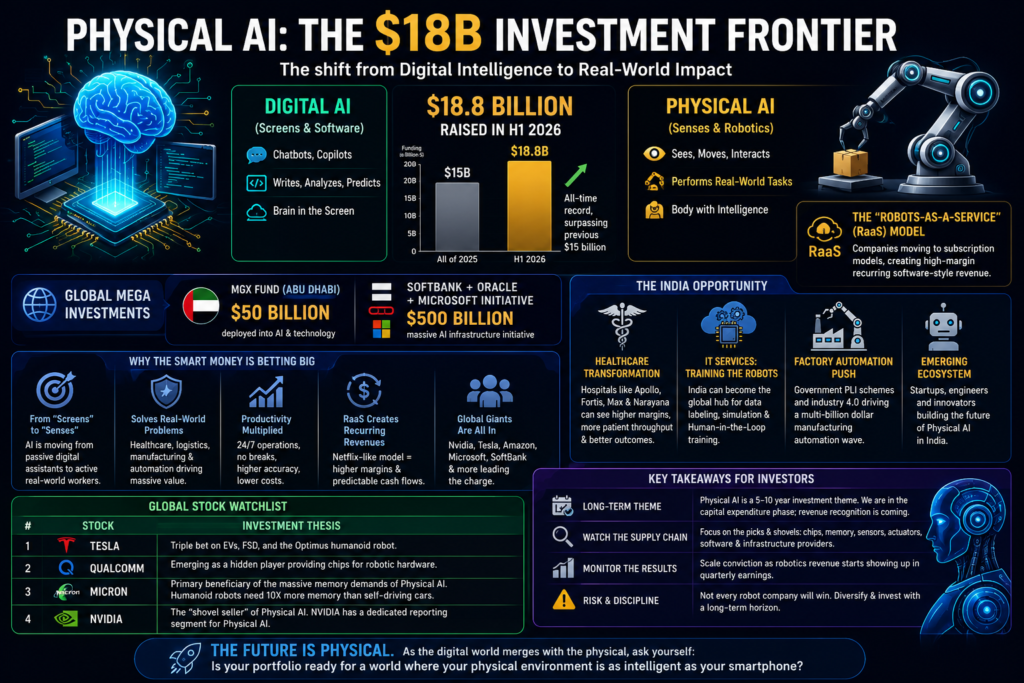
Beyond the Screen: Why Physical AI Could Become the Biggest Investment Opportunity of the Next Decade
Artificial Intelligence has already transformed how we search, write, code, and communicate. Yet, the next wave of innovation is no longer confined to computer screens.
The future of AI is Physical AI—robots that can see, think, move, and interact with the real world.
While many investors continue debating whether the AI boom is a bubble, global technology giants and institutional investors are investing billions into the next generation of intelligent machines.
Tesla is accelerating its humanoid robot ambitions. NVIDIA is building the computing backbone for autonomous machines. Amazon has deployed over a million warehouse robots. Microsoft, SoftBank, and Oracle are backing massive AI infrastructure initiatives.
The message from smart money is becoming increasingly clear:
The next trillion-dollar AI opportunity may not live inside your laptop—it may walk beside you.
What Is Physical AI?
Physical AI combines advanced artificial intelligence with robotics, sensors, computer vision, and autonomous decision-making.
Unlike traditional AI chatbots that generate text or images, Physical AI enables machines to perform real-world tasks.
Examples include:
- Humanoid robots
- Autonomous warehouse robots
- Surgical robots
- Self-driving vehicles
- Factory automation systems
- Agricultural robots
- Delivery robots
- Industrial inspection drones
Instead of simply processing information, Physical AI can physically interact with its environment.
This represents one of the biggest technological shifts since the Industrial Revolution.
Why Investors Are Pouring Billions into Physical AI
Investment activity has accelerated dramatically.
Technology companies, sovereign wealth funds, venture capital firms, and semiconductor manufacturers all see Physical AI as the next major computing platform.
Several trends are driving this investment:
- Labor shortages
- Aging populations
- Rising manufacturing costs
- Supply-chain automation
- Healthcare demand
- Advances in AI models
- Cheaper robotics hardware
- Better computer vision
- Faster AI chips
Unlike previous robotics cycles, today’s AI systems can learn, adapt, and make decisions with minimal human intervention.
The Healthcare Revolution
Healthcare is expected to become one of the largest beneficiaries of Physical AI.
Modern robotic systems already assist surgeons during complex procedures by improving precision and reducing human error.
Potential benefits include:
- Greater surgical accuracy
- Reduced recovery time
- Fewer complications
- Improved hospital efficiency
- Better patient outcomes
Beyond surgery, AI-powered robots may assist in:
- Hospital logistics
- Pharmacy automation
- Elderly care
- Medical imaging
- Rehabilitation
- Remote healthcare
As healthcare systems face increasing pressure from aging populations, intelligent automation is becoming an economic necessity rather than a technological luxury.
Warehouses Are Becoming Autonomous
Logistics is another industry experiencing rapid transformation.
Warehouse robots now perform tasks including:
- Inventory movement
- Package sorting
- Shelf scanning
- Order fulfillment
- Transportation inside warehouses
These systems can operate continuously, reducing operational costs while improving delivery speed and inventory accuracy.
As e-commerce continues expanding globally, warehouse automation is likely to remain one of the fastest-growing applications of Physical AI.
The Rise of Robot-as-a-Service (RaaS)
One of the most important business innovations is the emergence of Robot-as-a-Service (RaaS).
Instead of purchasing expensive robots outright, businesses increasingly subscribe to robotics platforms through recurring payment models.
Similar to cloud computing or software subscriptions, companies pay monthly fees covering:
- Hardware
- Software updates
- AI improvements
- Maintenance
- Remote monitoring
- Technical support
This model lowers adoption costs while creating predictable recurring revenue for robotics companies.
For investors, recurring subscription income often commands higher market valuations than one-time hardware sales.
AI Is Creating a New Industrial Economy
Physical AI extends beyond robots.
Entire industries are emerging around supporting technologies, including:
AI Chips
Robots require powerful processors capable of making decisions in real time.
Semiconductor companies developing AI accelerators may benefit significantly.
Sensors
Robots rely on cameras, lidar, radar, microphones, and touch sensors to understand their surroundings.
Sensor manufacturers are becoming critical parts of the AI supply chain.
Memory
Robots process enormous amounts of visual and sensor data every second.
Demand for high-performance memory continues to rise as AI systems become more sophisticated.
Industrial Software
Robots require operating systems, fleet management software, simulation tools, cybersecurity, and cloud infrastructure.
Software remains a major long-term value creator within the Physical AI ecosystem.
Is Physical AI Another Bubble?
Every transformative technology faces skepticism during its early stages.
The internet experienced a speculative bubble around 2000, yet it eventually reshaped nearly every industry.
Similarly, not every robotics startup will succeed.
However, the broader trend toward intelligent automation appears increasingly supported by long-term structural drivers, including labor shortages, productivity needs, and advances in AI capabilities.
For investors, the challenge is not determining whether Physical AI will matter.
The challenge is identifying which companies will capture the greatest economic value.
Companies Leading the Physical AI Revolution
Several global technology leaders are building the infrastructure powering Physical AI.
Nvidia
Often viewed as the backbone of AI computing, Nvidia supplies advanced processors used in robotics, autonomous systems, and industrial AI applications.
Tesla
Tesla’s ambitions extend beyond electric vehicles into autonomous driving and humanoid robotics, making it one of the most closely watched companies in Physical AI.
Qualcomm
Known for mobile processors, Qualcomm is expanding into edge AI, robotics, and intelligent connected devices.
Micron Technology
High-performance memory is becoming increasingly important as robots process larger amounts of visual and sensor data.
Microsoft
Cloud computing, enterprise AI, digital twins, and industrial software position Microsoft as an important infrastructure provider.
Amazon
Amazon continues investing heavily in warehouse automation, robotics, and AI-powered logistics.
India’s Opportunity in Physical AI
India may become one of the largest beneficiaries of this technological shift.
While the country established itself as the world’s IT outsourcing hub, the next opportunity lies in AI development and robotics support.
Potential growth areas include:
- AI data annotation
- Robotics software
- Simulation platforms
- Digital twins
- Computer vision
- Manufacturing automation
- Healthcare AI
- Industrial AI consulting
- AI model training
Indian IT companies, engineering firms, and healthcare providers could all benefit from the growing adoption of intelligent automation.
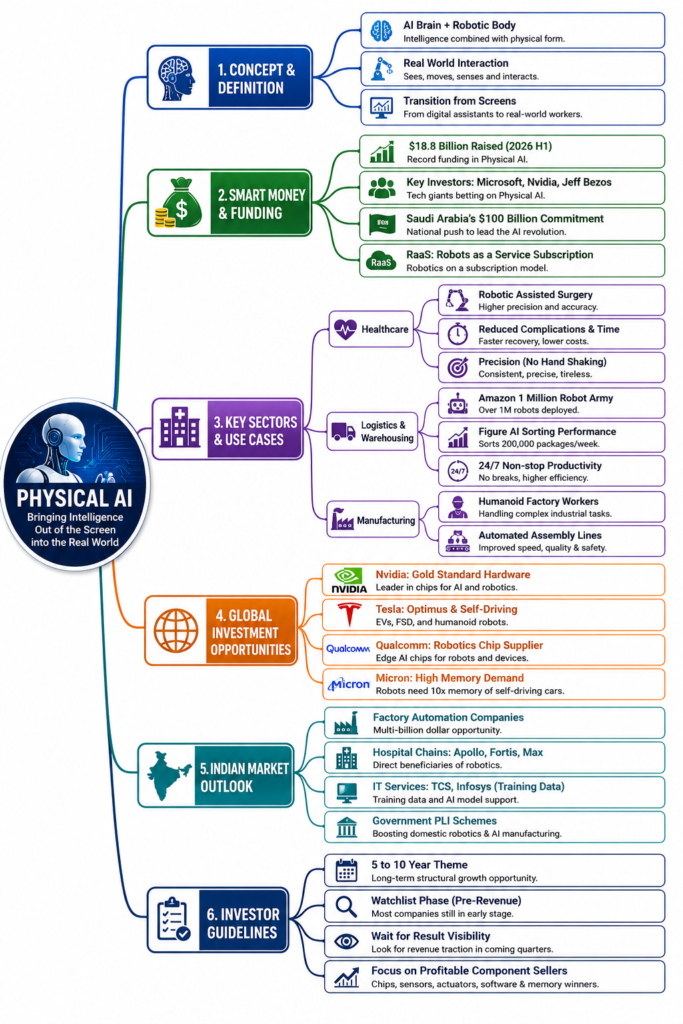
Investment Strategy: Where Should Investors Focus?
Rather than chasing every robotics startup, long-term investors may benefit from focusing on companies supplying the broader ecosystem.
Potential investment themes include:
- AI semiconductor companies
- Memory manufacturers
- Industrial automation firms
- Robotics software providers
- Cloud infrastructure companies
- Sensor manufacturers
- Healthcare technology leaders
- Industrial cybersecurity companies
Infrastructure providers often benefit regardless of which individual robot manufacturer ultimately dominates the market.
Risks Investors Should Consider
Although Physical AI offers enormous potential, investors should remain aware of key risks:
- High development costs
- Slower commercial adoption
- Regulatory uncertainty
- Ethical concerns
- Cybersecurity threats
- Valuation risks
- Global competition
- Supply chain disruptions
As with any emerging technology, careful stock selection and diversification remain essential.
Final Thoughts
Physical AI represents more than the next chapter of artificial intelligence—it represents the convergence of software, robotics, semiconductors, healthcare, manufacturing, and industrial automation.
Whether in hospitals, factories, warehouses, or homes, intelligent machines are expected to become increasingly integrated into everyday life over the coming decade.
For investors, the opportunity extends far beyond robot manufacturers themselves.
The companies building AI chips, memory, cloud infrastructure, sensors, software, and industrial automation platforms may become some of the biggest long-term winners.
The question is no longer whether Physical AI will reshape the global economy.
The real question is whether your investment portfolio is positioned to benefit from it.
Frequently Asked Questions (FAQs)
What is Physical AI?
Physical AI combines artificial intelligence with robotics, enabling machines to interact with the real world through movement, vision, sensors, and autonomous decision-making.
Why is Physical AI attracting so much investment?
Growing labor shortages, advances in AI chips, automation demand, and robotics technology are driving significant investment from technology companies and institutional investors.
Which industries will benefit the most?
Healthcare, manufacturing, logistics, agriculture, automotive, warehousing, defense, and industrial automation are expected to be major beneficiaries.
Which companies are leading the Physical AI revolution?
Major global players include Nvidia, Tesla, Microsoft, Amazon, Qualcomm, and other companies developing AI hardware, robotics platforms, cloud infrastructure, and automation technologies.
Is Physical AI a good long-term investment theme?
Physical AI is considered a long-term structural trend. While risks remain, companies providing essential AI infrastructure, semiconductors, software, and automation technologies may benefit as adoption increases.
High CTR + SEO Titles
- Physical AI Explained: Why Billionaires Are Betting Big on the Next AI Revolution
- The Physical AI Boom: Why Smart Investors Are Buying Robotics Stocks
- Beyond ChatGPT: Why Physical AI Could Create the Next Trillion-Dollar Industry
- Physical AI Investment Guide: The Next Big Opportunity After Generative AI
- NVIDIA, Tesla & Amazon Are Betting on Physical AI—Should Investors Follow?
- The Future of AI Is Physical: Top Stocks and Investment Opportunities for 2026
- Why Physical AI Could Be Bigger Than the Internet Revolution
- From ChatGPT to Humanoid Robots: The Rise of Physical AI Investing
- Physical AI Stocks: 7 Companies Leading the Next Robotics Revolution
- The Next AI Gold Rush: Why Physical AI Is Attracting Billions in Global Investment