
The Reluctant Rally: Why India’s IT & Banking Rally May Be More Fragile Than Investors Think
The Indian stock market has finally found a reason to smile.
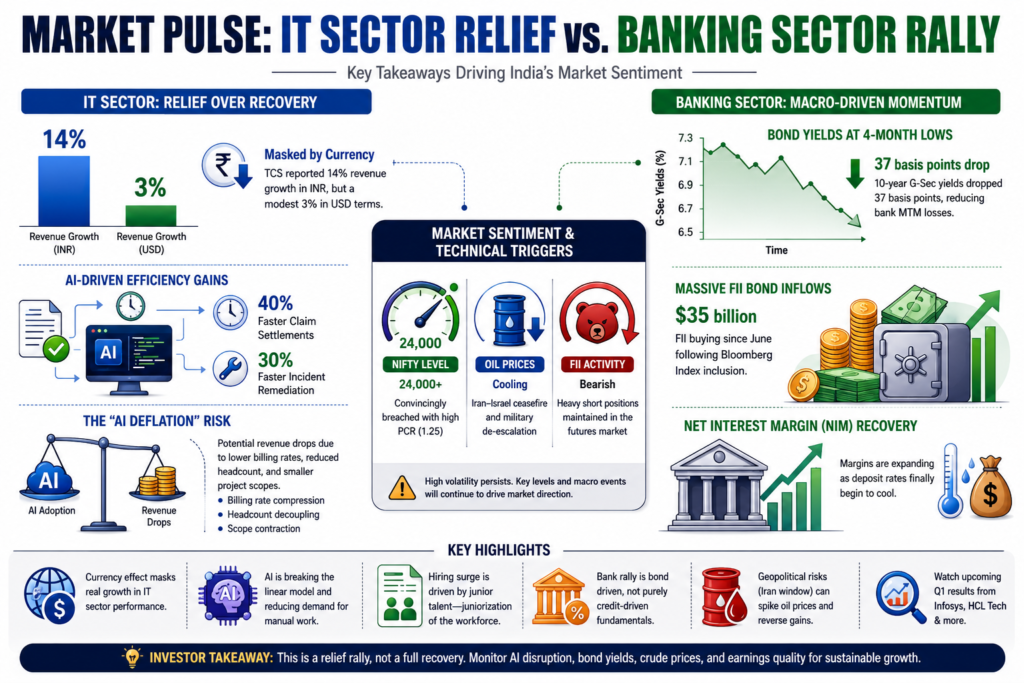
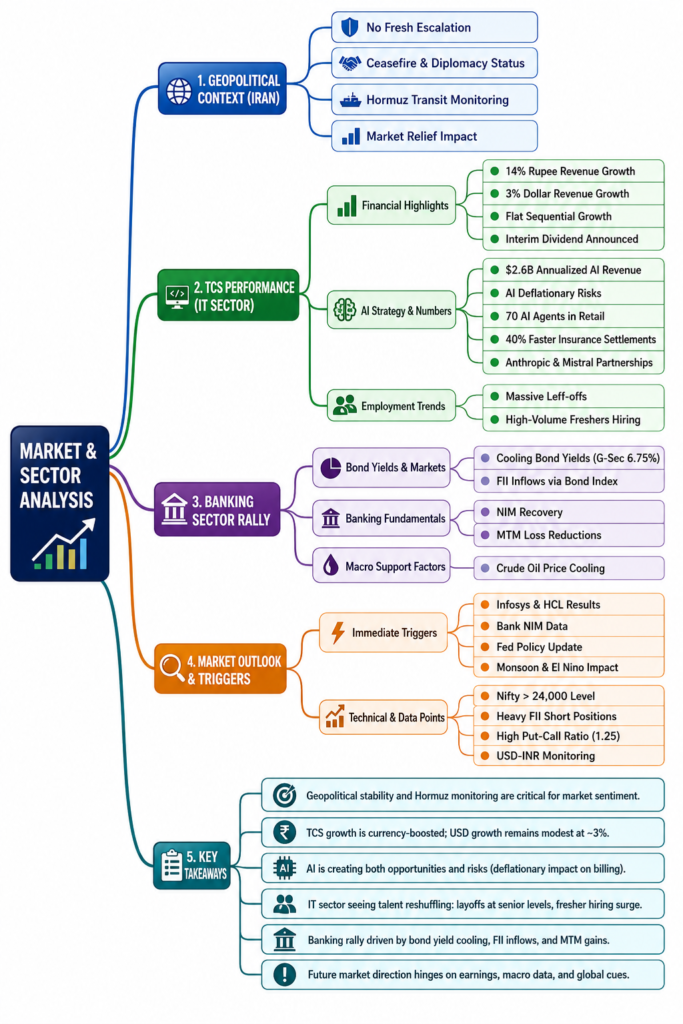
After months of uncertainty surrounding India’s two largest sectors—Information Technology and Banking—recent earnings and macroeconomic developments have triggered a strong relief rally. TCS delivered results that were better than feared, bond yields continued falling, and banking stocks rallied sharply.
But beneath the optimism lies a far more complicated story.
A closer examination of earnings quality, AI disruption, bond-market dynamics, hiring patterns, and geopolitical risks suggests that investors may be celebrating temporary relief rather than sustainable growth.
This is not necessarily the beginning of a new bull market.
It could simply be the calm before another structural shift.
Why the Market Celebrated TCS Results
For nearly eighteen months, India’s IT industry has struggled with slowing global technology spending, delayed client decisions, weaker discretionary budgets, and growing uncertainty around artificial intelligence.
Expectations before the TCS results were extremely low.
Markets feared:
- Revenue slowdown
- Margin pressure
- Weak deal wins
- Lower guidance
- Hiring freezes
Instead, none of these worst-case scenarios materialized.
That alone was enough to trigger a rally.
Markets often move on expectations rather than absolute numbers.
However, relief should not be confused with recovery.
The Currency Effect: Is IT Growth Really Strong?
At first glance, TCS reported healthy revenue growth in Indian Rupee terms.
But international IT companies earn the majority of their revenue in US Dollars.
When revenue is measured in constant currency or Dollar terms, growth appears far more modest.
This distinction matters because currency depreciation can temporarily inflate reported revenue without reflecting stronger business demand.
Investors should therefore evaluate:
- Constant currency growth
- Dollar revenue growth
- New deal pipeline
- Client spending trends
- Operating margins
Rather than relying solely on headline revenue numbers.
AI Is Breaking the Traditional IT Business Model
For decades, India’s IT industry operated using a simple formula:
More engineers = More revenue
Artificial Intelligence is changing that equation.
Instead of hiring larger teams, companies are increasingly using AI-assisted software development, automation platforms, and intelligent workflows to complete projects with fewer employees.
This creates structural pressure across several areas.
1. Lower Billing Hours
AI completes repetitive work much faster than manual coding.
Clients naturally expect lower project costs.
2. Smaller Project Teams
Projects that once required hundreds of engineers may now require significantly fewer professionals supported by AI systems.
3. Productivity vs Revenue
Higher productivity is excellent for efficiency.
However, if clients negotiate lower prices because work finishes faster, revenue growth may slow despite better execution.
This represents one of the biggest long-term challenges facing the global IT outsourcing industry.
AI Agents Could Change the Industry Forever
The technology conversation has evolved beyond AI assistants.
Companies are now investing heavily in AI Agents.
Unlike traditional tools that help employees perform tasks, AI Agents can independently execute entire business processes.
Large IT firms are increasingly partnering with leading AI companies to develop enterprise-grade automation platforms.
Potential applications include:
- Customer support
- Claims processing
- Software testing
- Infrastructure monitoring
- Cybersecurity operations
- Financial reporting
- Workflow automation
While these innovations improve productivity, they also reduce demand for repetitive manual work that historically supported large outsourcing businesses.
The industry’s future may depend less on workforce size and more on intellectual property, AI platforms, consulting, and digital transformation services.
Banking Stocks: Is the Rally Really About Banking?
Banking shares have also performed strongly.
Many investors interpret this as an improvement in loan growth.
However, another important factor deserves attention.
Banks hold large investments in Government Securities.
When bond yields decline, the value of these securities generally increases.
This creates Mark-to-Market (MTM) gains, improving treasury income.
Recent declines in Indian government bond yields have therefore provided a meaningful boost to banking profitability.
This benefit, however, depends on interest-rate movements.
If inflation rises sharply or crude oil prices remain elevated, bond yields could reverse, reducing treasury gains.
Global Bond Flows Have Added More Fuel
India’s inclusion in major global bond indices has attracted significant foreign capital into government bonds.
This has helped:
- Lower yields
- Improve liquidity
- Support banking treasury income
- Strengthen investor confidence
Although positive, these flows are largely macro-driven rather than reflecting stronger banking fundamentals alone.
Why Crude Oil Still Matters
One of the largest risks remains energy prices.
India imports most of its crude oil requirements.
If geopolitical tensions in the Middle East disrupt supply, higher oil prices may lead to:
- Higher inflation
- Rupee weakness
- Rising government borrowing costs
- Higher bond yields
- Pressure on banking valuations
- Lower corporate profitability
This makes geopolitical developments an important variable for investors in financial stocks.
The Hiring Story Isn’t As Bullish As It Appears
Recent headlines highlighted thousands of new hires across the IT sector.
On the surface, this appears encouraging.
However, hiring numbers alone rarely tell the complete story.
Many companies continue restructuring their workforce by:
- Reducing experienced middle-management roles
- Increasing campus hiring
- Hiring fresh graduates
- Optimizing salary costs
- Investing more in AI skills
This trend reflects cost optimization rather than broad-based expansion.
Companies are preparing for a future where AI performs routine work while employees focus on higher-value consulting and innovation.
What Investors Should Watch Next
Instead of reacting to quarterly headlines, investors should monitor broader structural indicators.
Important factors include:
IT Sector
- Constant currency growth
- Large deal wins
- AI revenue contribution
- Client spending outlook
- Employee utilization
- Attrition
- Operating margins
Banking Sector
- Bond yields
- RBI policy
- Credit growth
- Deposit growth
- Treasury income
- Net Interest Margin (NIM)
- Asset quality
Macro Indicators
- Brent crude prices
- US interest rates
- INR/USD exchange rate
- Inflation
- FII flows
- Geopolitical developments
Investment Perspective
Markets often price optimism long before fundamentals fully improve.
The current rally reflects improving sentiment rather than a complete structural recovery.
That does not necessarily mean the rally will fail.
However, investors should distinguish between:
- Temporary macro tailwinds
- Sustainable earnings growth
- Structural competitive advantages
Companies that successfully integrate AI while expanding high-value consulting, cloud services, cybersecurity, digital engineering, and enterprise platforms are likely to emerge stronger.
Those relying solely on traditional labor-arbitrage models may face increasing pressure over the coming years.
Final Thoughts
The recent recovery in India’s IT and banking sectors has undoubtedly improved investor confidence.
Yet beneath the surface, several structural transitions continue reshaping both industries.
Artificial intelligence is redefining the economics of outsourcing.
Bond-market dynamics remain highly sensitive to inflation and global interest rates.
Geopolitical uncertainty continues to influence energy prices and financial markets.
For long-term investors, the biggest opportunity lies not in chasing short-term relief rallies but in identifying businesses capable of adapting to these structural shifts.
Markets reward companies that evolve before disruption becomes obvious.
The next phase of India’s technology and banking story may belong not to the largest employers, but to the fastest innovators.
Frequently Asked Questions (FAQs)
Is India’s IT sector recovering?
The sector has shown signs of stabilization, but investors should focus on constant-currency growth, client spending, AI adoption, and deal wins rather than on headline revenue alone.
Why are banking stocks rising?
Falling bond yields, treasury gains, improved liquidity, and positive investor sentiment have contributed alongside expectations of stable economic growth.
How is AI affecting Indian IT companies?
AI is improving productivity and automating routine work, prompting IT firms to shift toward higher-value services such as consulting, cloud, cybersecurity, and enterprise AI solutions.
Why do crude oil prices matter for banks?
Higher oil prices can increase inflation, raise bond yields, and reduce treasury gains, affecting banking profitability and market valuations.
Should investors chase the current rally?
Rather than following short-term momentum, investors should evaluate earnings quality, business fundamentals, AI strategy, valuation, and long-term competitive advantages before making investment decisions.
High CTR Titles
- The Reluctant Rally: 7 Hidden Risks Behind India’s IT & Banking Boom
- TCS Results Analysis: The Hidden Truth Behind India’s IT Sector Recovery
- India’s IT & Banking Rally Explained: AI, Bond Yields & the Risks Ahead
- TCS Earnings Decoded: Is India’s IT Rally Real or Just Temporary Relief?
- AI, Bond Yields & Banking Stocks: The Real Story Behind India’s Market Rally
- Why India’s IT & Banking Stocks Are Rising—And What Investors Are Missing
- The Hidden Risks Behind TCS Results and India’s Banking Rally
- India’s IT Sector at a Turning Point: AI, Hiring & the Future of Growth
- TCS, AI & Banking Stocks: 5 Structural Changes Every Investor Must Know
- Relief Rally or Bull Trap? The Truth About India’s IT & Banking Stocks