
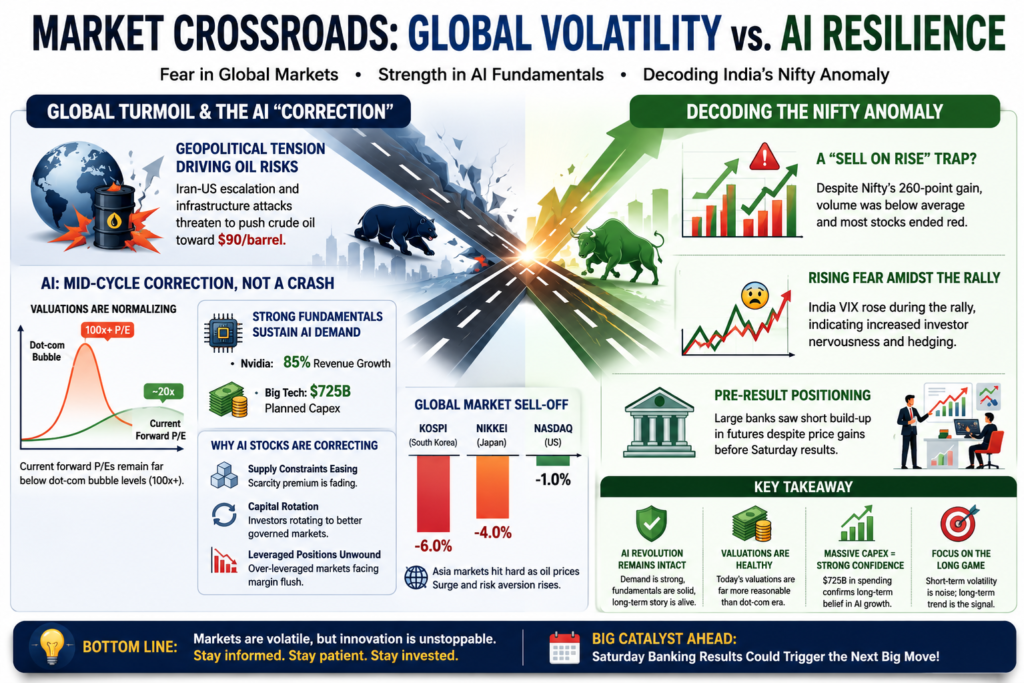
Global financial markets are flashing red.
Japan’s Nikkei plunged nearly 4%, South Korea’s Kospi crashed over 6%, semiconductor stocks suffered double-digit losses, and geopolitical tensions in the Middle East pushed crude oil above $80 per barrel.
Yet, while global markets struggled, India’s Nifty 50 rallied nearly 260 points, leaving investors wondering:
Is this the beginning of another global financial crisis, or simply a healthy correction before the next leg higher?
Looking beyond daily price swings reveals a much clearer story.
1. Rising Oil Prices Are the Biggest Global Risk Right Now
The biggest concern isn’t AI.
It’s oil.
Escalating tensions in the Middle East have increased fears of supply disruptions, pushing Brent crude back above $80.
Unlike previous geopolitical conflicts that focused mainly on shipping routes, recent developments have raised concerns about attacks on critical infrastructure.
Countries like Japan and South Korea, which rely heavily on imported crude oil, are among the most vulnerable.
If oil climbs toward $90 per barrel, inflation could reaccelerate, forcing central banks to remain cautious on interest rates.
For equity markets, expensive oil remains one of the largest macro risks.
2. The AI Sell-Off Looks Like a Mid-Cycle Correction
The recent weakness across semiconductor stocks has created headlines suggesting the AI boom is ending.
The data tells a different story.
Markets appear to be moving from the “AI Hype Phase” into the “AI Earnings Phase.”
Investors are no longer rewarding companies simply for participating in artificial intelligence.
Now they want:
- Revenue growth
- Profitability
- Higher AI monetization
- Better return on investment
This transition often produces sharp corrections even during long-term bull markets.
3. Why Semiconductor Stocks Suddenly Fell
Several factors combined to pressure AI-related stocks.
Supply Constraints Are Easing
As GPU availability improves, investors expect pricing power to normalize.
Markets had previously priced in permanent shortages.
That assumption is now changing.
Capital Rotation
Large institutional investors are reallocating capital across global exchanges as new listing opportunities emerge.
Money is rotating—not disappearing.
Leveraged Positions Are Being Unwound
Retail participation reached elevated levels in several Asian markets.
As prices declined, margin calls accelerated selling, creating a classic short-term liquidation cycle.
This explains why declines became much sharper than underlying fundamentals would normally justify.
4. Massive AI Spending Still Supports the Long-Term Bull Case
Despite recent volatility, one number stands above everything else:
$725 Billion
That is the estimated combined capital expenditure planned by major technology companies over the coming years.
Industry leaders continue investing aggressively in:
- AI infrastructure
- Data centers
- Semiconductor manufacturing
- Cloud computing
- High-performance networking
For example:
- NVIDIA continues reporting exceptional AI-related demand.
- TSMC has increased its capital expenditure plans.
- Microsoft, Amazon, Alphabet, and Meta continue expanding AI infrastructure.
Companies rarely invest hundreds of billions of dollars if long-term demand is weakening.
The investment cycle itself remains intact.
5. This Isn’t Another Dot-Com Bubble
Many investors compare today’s AI rally with the internet bubble of 2000.
The comparison has important limitations.
During the Dot-Com era:
- Many companies generated little or no profit.
- Forward P/E ratios frequently exceeded 100–200x.
- Business models were largely unproven.
Today’s AI leaders generate:
- Strong cash flow
- High margins
- Significant earnings
- Real enterprise demand
Many leading semiconductor companies currently trade at far lower valuation multiples than internet stocks did during the bubble.
That doesn’t eliminate downside risk—but it does suggest today’s environment is fundamentally different.
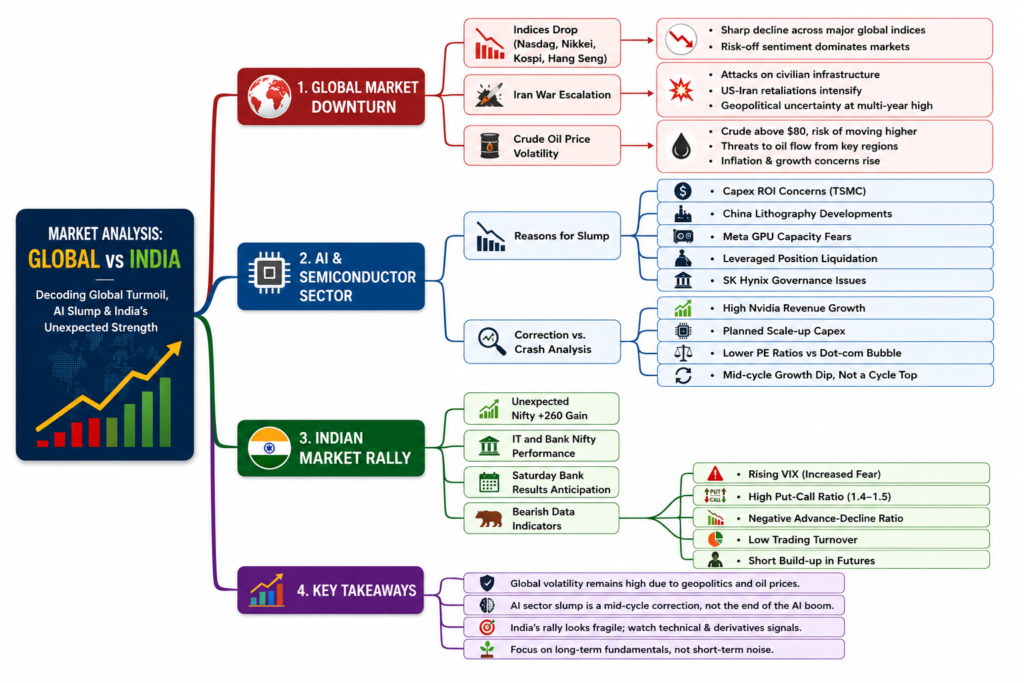
Why India’s Market Is Defying Global Weakness
While global markets declined sharply, Indian equities remained surprisingly resilient.
Several factors may explain this divergence.
Banking Earnings Optimism
Investors are positioning ahead of major quarterly results from India’s largest private banks.
Strong banking numbers could provide short-term support for broader indices.
Domestic Institutional Buying
Consistent domestic inflows continue to cushion Indian markets against global volatility.
Strong Economic Fundamentals
India continues benefiting from:
- Healthy GDP growth
- Infrastructure spending
- Stable banking system
- Long-term consumption growth
These structural factors help explain why Indian markets often outperform during periods of global uncertainty.
Warning Signs Investors Should Still Monitor
Although Nifty remains resilient, several indicators deserve attention.
Rising India VIX
A rising volatility index alongside rising stock prices often signals increasing uncertainty.
Narrow Market Breadth
If only a handful of large stocks are driving the index higher while most stocks decline, market strength becomes less sustainable.
Options Positioning
Elevated Put-Call Ratios may indicate excessive optimism, increasing the probability of short-term volatility.
Investors should watch upcoming earnings and macro developments closely before assuming the next major rally has begun.
What Long-Term Investors Should Do
Periods like these often test investor discipline.
Instead of reacting emotionally to daily headlines, focus on long-term trends:
- Artificial Intelligence adoption continues to accelerate.
- Cloud infrastructure spending remains robust.
- Semiconductor demand is expanding.
- Enterprise AI investment continues growing.
- Digital transformation is still in its early stages.
Short-term corrections are a normal feature of every long-term bull market.
Final Thoughts
The recent market volatility has understandably shaken investor confidence.
Oil prices, geopolitical uncertainty, and semiconductor corrections have combined to create a difficult environment for global equities.
However, the broader AI investment story remains supported by strong earnings, massive capital expenditure, and growing enterprise adoption.
For long-term investors, today’s volatility may represent a period of adjustment rather than the end of the AI revolution.
The key question is no longer whether AI will transform the global economy.
The question is which companies will emerge as the biggest winners over the next decade.
FAQ
Is the AI boom over?
No. The current correction appears to reflect changing investor expectations rather than a collapse in AI demand.
Why are AI stocks falling?
Profit-taking, easing supply shortages, portfolio rotation, and leveraged selling have contributed to the recent decline.
Why is India outperforming global markets?
Strong domestic inflows, resilient economic growth, and optimism around banking earnings have helped support Indian equities.
Is this another Dot-Com bubble?
Current AI leaders generally have stronger earnings, healthier balance sheets, and lower valuation multiples than many companies during the 2000 internet bubble.
Top 10 SEO Titles
- Global Markets Crash, But AI Isn’t Dead: 5 Reasons Smart Investors Should Stay Bullish ⭐⭐⭐⭐⭐
- AI Bloodbath or Buying Opportunity? 5 Shocking Truths Behind the Global Market Selloff
- Why Global Markets Are Crashing While AI’s Long-Term Future Remains Strong
- Global Stock Market Crash Explained: Why AI Stocks Could Make a Massive Comeback
- Oil at $82, Markets Bleed, AI Falls: What’s Really Happening in Global Markets?
- Global Markets in Chaos: Is This the End of the AI Boom or the Best Buying Opportunity?
- NVIDIA, TSMC & AI Stocks Fall: 5 Reasons the AI Revolution Is Far From Over
- Global Markets Are Red, But AI Is Still the Biggest Investment Story of the Decade
- AI Stocks Crash, Oil Surges, Nifty Rallies: 5 Market Signals Every Investor Must Watch
- Global Market Meltdown: Why Smart Money Is Still Betting Big on Artificial Intelligence