
The $1.8 Trillion Space Economy: The Next Jio Moment Has Already Begun
For decades, space exploration was viewed as a prestige project reserved for governments. Today, that narrative has changed forever.
Reusable rockets, artificial intelligence, satellite internet, lunar infrastructure, and private investment are transforming space into one of the world’s fastest-growing industries. Analysts estimate the global space economy could exceed $1.8 trillion over the next decade, making it one of the biggest long-term investment themes after AI.
For investors, this isn’t science fiction anymore.
It is becoming one of the most important structural trends shaping global markets.
The Moment Everything Changed
The biggest revolution wasn’t the Moon landing.
It was learning how to land the rocket.
Traditional rockets were incredibly inefficient. After every launch, the booster was destroyed, making each mission enormously expensive.
Reusable launch systems changed that equation.
Instead of discarding billion-dollar hardware after a single flight, companies can now recover, refurbish, and launch the same rocket multiple times.
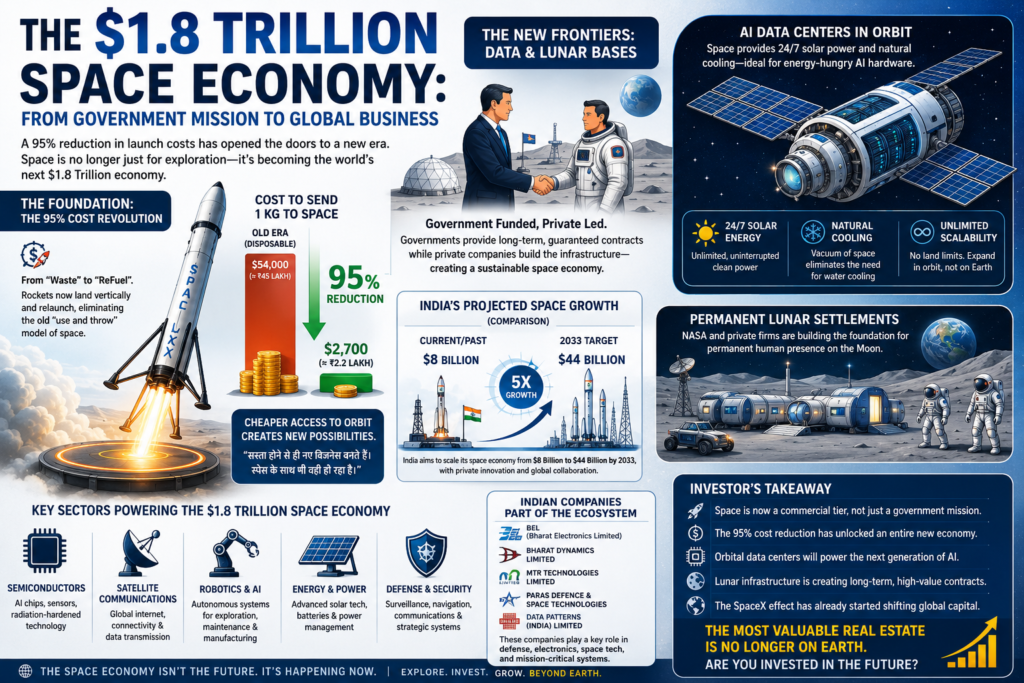
This innovation reduced launch costs by nearly 95%, creating what many investors call the “Jio Moment of Space.”
Just as affordable mobile internet unlocked India’s digital economy, affordable access to orbit is unlocking an entirely new industrial economy beyond Earth.
The End of the Gravity Tax
For over 50 years, launching anything into space came with an enormous “Gravity Tax.”
Cost of Sending 1 Kilogram to Space
| Era | Approximate Cost |
|---|---|
| Disposable Rocket Era | $54,000 |
| Reusable Rocket Era | $2,700 |
Lower transportation costs always create new industries.
Cheap shipping built global trade.
Cheap internet created digital businesses.
Cheap launches are now creating the Space Economy.
Why AI Needs Space
Artificial Intelligence is becoming more powerful every year.
But AI also creates a massive infrastructure challenge.
Modern AI data centers require:
- Huge amounts of electricity
- Massive cooling systems
- Large areas of land
- Billions of liters of water
Orbital computing offers several long-term advantages.
1. Unlimited Solar Power
Satellites receive continuous sunlight without weather interruptions.
2. Natural Cooling
The vacuum of space provides an ideal environment for heat management.
3. Unlimited Expansion
Unlike Earth, space has virtually unlimited room for future computing infrastructure.
Major technology companies are already testing AI hardware for use in orbit, signaling the beginning of a completely new computing era.
Space Is Becoming the Next Industrial Economy
The future space economy extends far beyond rockets.
Several trillion-dollar industries are emerging simultaneously.
Satellite Internet
Global broadband from low-Earth orbit is replacing traditional communication infrastructure in many remote regions.
Earth Observation
Satellites now monitor agriculture, climate, shipping, insurance, mining, and national security.
Space Manufacturing
Zero-gravity manufacturing may enable the production of advanced pharmaceuticals, semiconductors, and specialized materials that are impossible to create on Earth.
Space Tourism
Although still small today, commercial space travel continues to expand as launch costs decline.
Lunar Infrastructure
Governments are increasingly relying on private companies to build transportation, habitats, communication networks, and logistics for long-term lunar missions.
The Moon Is Becoming an Economy
The next phase of space exploration isn’t about planting another flag.
It’s about building permanent infrastructure.
Instead of owning every spacecraft, governments are increasingly awarding long-term commercial contracts to private companies.
This approach resembles the traditional defense industry:
- Governments provide funding.
- Private companies build infrastructure.
- Long-term service contracts generate recurring revenue.
As lunar missions increase, demand will grow for:
- Robotics
- Communication systems
- Power infrastructure
- Construction technology
- Navigation systems
- Autonomous logistics
How the US-China Space Race Benefits Investors
The modern space race is no longer symbolic.
It has become a technological competition involving:
- Artificial Intelligence
- Semiconductors
- Defense
- Satellite communications
- Advanced manufacturing
- National security
Both the United States and China continue investing billions of dollars annually, creating long-term opportunities across multiple industries.
Many companies benefiting from this trend don’t manufacture rockets at all.
Instead, they supply the technology powering the entire ecosystem.
Industries Likely to Benefit Most
Semiconductor Companies
Advanced processors, AI accelerators, sensors, and radiation-resistant chips.
Defense Electronics
Guidance systems, radar, satellite payloads, avionics, and secure communications.
Satellite Communications
Global broadband, navigation, remote connectivity, and next-generation telecommunications.
Robotics
Autonomous systems for orbital servicing, lunar construction, and space exploration.
Renewable Energy
High-efficiency solar panels, batteries, and advanced power management systems.
Indian Companies Benefiting from the Space Ecosystem
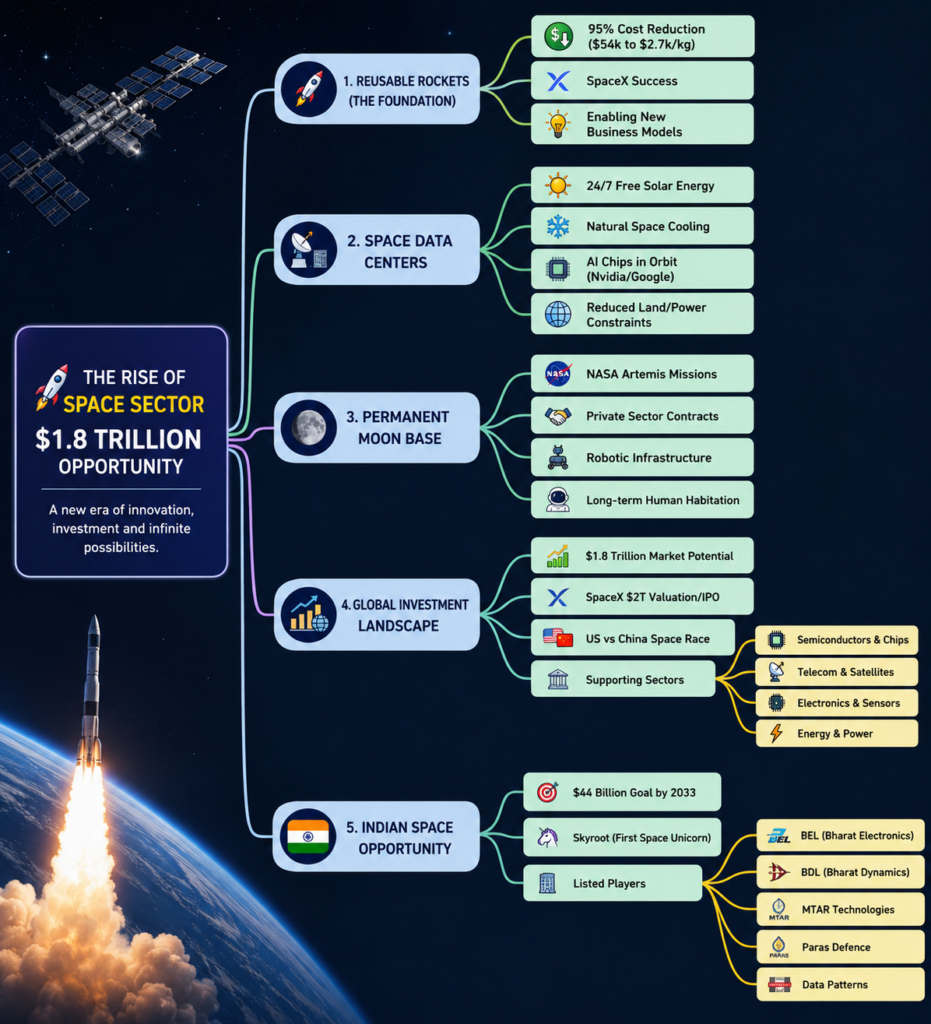
India aims to significantly expand its space economy over the coming decade, creating opportunities for both private and public companies.
Some listed companies with exposure to defense, aerospace, and space-related technologies include:
- BEL (Bharat Electronics)
- Paras Defence
- Data Patterns
- Bharat Dynamics
- MTAR Technologies
These businesses generate revenue from multiple sectors, making them diversified ways to participate in India’s growing aerospace ecosystem.
Risks Every Investor Should Understand
The Space Economy offers enormous long-term potential, but it also carries significant risks.
High Valuations
Many space companies trade at premium valuations despite limited profitability.
Government Dependence
Large portions of industry revenue still come from government contracts.
Technological Risk
Launch failures and project delays remain common.
Capital Intensive Business
Building launch vehicles, satellites, and infrastructure requires enormous investment.
Regulatory Challenges
International treaties and national security regulations continue evolving.
Diversification remains essential.
Investment Strategy
Rather than chasing every exciting rocket company, investors may consider focusing on businesses that supply critical technology.
These include companies involved in:
- AI chips
- Aerospace electronics
- Satellite communications
- Precision manufacturing
- Advanced materials
- Defense systems
Historically, suppliers often generate more stable cash flows than hardware manufacturers.
Final Thoughts
The commercialization of space is no longer a distant dream.
It is becoming one of the defining investment themes of the coming decades.
Lower launch costs, reusable rockets, AI infrastructure, satellite communications, lunar development, and geopolitical competition are collectively creating an entirely new economic frontier.
The biggest fortunes may not come from the rockets themselves, but from the companies providing the technology, software, electronics, semiconductors, and infrastructure powering the entire ecosystem.
As the world enters the age of orbital commerce, one question becomes increasingly important:
Is your portfolio prepared for the Space Economy?
SEO-friendly title options:
- The $1.8 Trillion Space Economy: Why the Next Jio Moment Is Happening in Space
- Space Economy 2026: The $1.8 Trillion Investment Opportunity Every Investor Should Know
- How SpaceX Is Creating a $1.8 Trillion Space Economy and Changing Global Investing
- The Next Trillion-Dollar Boom: Space Economy, AI & Lunar Infrastructure Explained
- From Earth to Orbit: Why the $1.8 Trillion Space Economy Is the Next Big Investment Theme
- SpaceX, AI & the Moon: Inside the $1.8 Trillion Space Economy Revolution
- The Space Economy Explained: Why Smart Investors Are Watching the $1.8 Trillion Opportunity
- Beyond Earth: The $1.8 Trillion Space Economy and the Future of Investing
- The New Space Race: How a $1.8 Trillion Industry Could Transform Global Markets
- The $1.8 Trillion Space Economy: Best Space Stocks and Investment Trends for 2026