
NVIDIA Stock Analysis 2026: Why the World’s Best AI Company Could Be the Biggest Long-Term Investment Opportunity
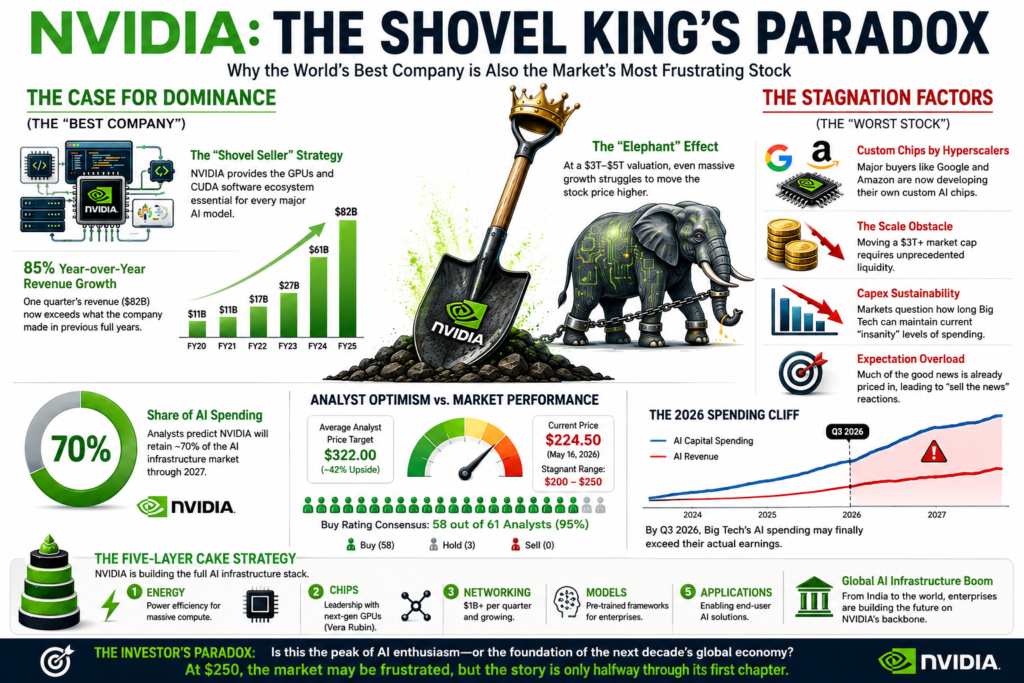
For over two years, NVIDIA has been the undisputed leader of the artificial intelligence revolution. The company powers nearly every major AI breakthrough, dominates the GPU market, and continues to post extraordinary financial results. Yet, despite these achievements, NVIDIA’s stock has spent months trading sideways, leaving investors asking one important question:
Why isn’t the world’s best AI company making new highs every week?
This is the $5 trillion paradox.
NVIDIA is simultaneously one of the strongest businesses ever created and one of the market’s most frustrating stocks. While Wall Street analysts overwhelmingly remain bullish, investors are waiting for proof that the AI boom can continue delivering sustainable returns.
The question isn’t whether NVIDIA is a great company.
The real question is whether today’s valuation already reflects tomorrow’s success.
CUDA: NVIDIA’s Real Competitive Advantage
Most investors believe NVIDIA’s dominance comes from its cutting-edge GPUs.
That is only part of the story.
The company’s greatest competitive advantage is CUDA, its proprietary software ecosystem that has been developed for nearly two decades.
Hardware leadership changes over time.
Software ecosystems rarely do.
Millions of AI developers, researchers, startups, and enterprises have built their applications around CUDA. Moving to another chip isn’t as simple as replacing hardware—it often requires rewriting entire AI workflows, retraining engineers, and redesigning infrastructure.
This creates one of the strongest competitive moats in technology.
As many industry experts say:
Buying another GPU is easy. Leaving CUDA is incredibly difficult.
This software lock-in is why NVIDIA continues to dominate AI infrastructure despite growing competition.
Why NVIDIA Stock Has Stopped Moving
Investors often assume that strong earnings automatically lead to higher stock prices.
In reality, markets price future expectations—not past performance.
Even after reporting revenue growth exceeding 80%, NVIDIA’s share price has struggled to break higher.
Several factors explain this slowdown.
1. The Law of Large Numbers
As companies become larger, maintaining explosive stock returns becomes increasingly difficult.
Moving a trillion-dollar company requires enormous institutional capital.
Growing revenue by billions of dollars is impressive.
Growing market value by another trillion dollars is far harder.
2. AI Spending Concerns
Microsoft, Amazon, Google, and Meta continue investing hundreds of billions into AI infrastructure.
The market is now asking an important question:
When will these investments generate meaningful profits?
If enterprise AI adoption grows slower than expected, infrastructure spending could eventually slow.
3. High Expectations
Investors already expected NVIDIA to dominate AI.
When expectations become extremely high, even excellent earnings may fail to surprise the market.
This creates the classic “buy the rumor, sell the news” effect.
4. Profit-Taking by Institutions
After enormous gains during 2024 and 2025, many institutional investors have begun rebalancing portfolios.
Large funds frequently reduce positions—not because fundamentals weaken—but because portfolio weightings become too concentrated.
Are Hyperscalers Becoming NVIDIA’s Biggest Competitors?
NVIDIA’s largest customers include:
- Microsoft
- Amazon
- Meta
Ironically, these same companies are designing their own AI chips.
Google has TPU.
Amazon has Trainium.
Microsoft continues investing in proprietary silicon.
Does this threaten NVIDIA?
Not immediately.
Custom chips excel at specialized internal workloads.
NVIDIA GPUs remain the industry’s universal AI platform.
| NVIDIA GPUs | Custom AI Chips |
|---|---|
| Universal AI platform | Optimized for internal workloads |
| Massive CUDA ecosystem | Limited ecosystem |
| Broad developer adoption | Company-specific deployment |
| Industry standard | Proprietary infrastructure |
Most enterprises still prefer NVIDIA because they need flexibility across multiple AI applications rather than highly customized hardware.
The 2026 AI Financial Test
Perhaps the biggest long-term risk isn’t competition.
It’s economics.
Research firms increasingly believe 2026 could become the first major stress test for the AI industry.
The concern is simple.
Big Tech companies continue spending hundreds of billions building AI infrastructure.
Eventually, those investments must generate proportionate revenue.
If AI software monetization disappoints, infrastructure spending could slow.
That would directly affect demand for NVIDIA’s GPUs.
The period between 2026 and 2027 may determine whether AI becomes another internet-sized revolution—or experiences its first major investment slowdown.
NVIDIA Is Building Much More Than GPUs
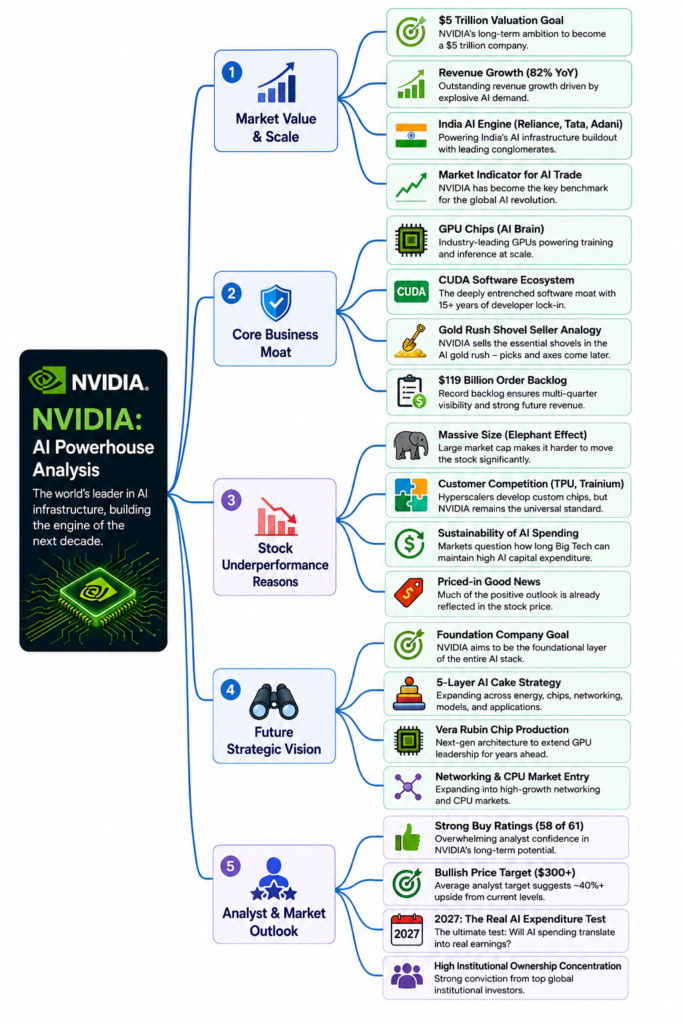
CEO Jensen Huang has repeatedly emphasized that NVIDIA is becoming a full-stack AI infrastructure company.
Rather than selling only chips, NVIDIA is expanding into every layer of AI.
Energy Efficiency
Reducing power consumption for massive AI data centers.
AI Chips
Maintaining technological leadership through future GPU architectures.
Networking
High-speed networking has become a multi-billion-dollar business supporting AI clusters.
AI Models
Providing enterprise AI frameworks and optimized software stacks.
Enterprise Applications
Helping businesses deploy AI solutions faster using NVIDIA’s complete ecosystem.
This diversification reduces dependence on GPU sales alone.
Global AI Growth Extends Beyond Silicon Valley
One overlooked catalyst is international AI infrastructure.
Countries around the world are rapidly building sovereign AI capabilities.
India, the Middle East, Southeast Asia, and Europe are investing heavily in domestic AI infrastructure.
Major Indian conglomerates including Reliance, Tata, and Adani are exploring AI investments requiring world-class compute infrastructure.
This represents a long-term growth opportunity extending far beyond U.S. cloud providers.
Is NVIDIA Stock Overvalued?
Valuation depends on one assumption.
Can AI continue growing at today’s pace?
If AI adoption accelerates across healthcare, manufacturing, finance, robotics, autonomous driving, cybersecurity, and enterprise software, NVIDIA could justify much higher valuations.
If AI spending slows significantly, valuation multiples could compress.
Investors must balance extraordinary business quality against elevated expectations.
Investment Outlook
Bull Case
- AI demand continues accelerating.
- CUDA remains the industry standard.
- Blackwell and future GPU generations drive another upgrade cycle.
- Enterprise AI adoption expands globally.
- Networking and CPU businesses contribute significant new revenue.
Bear Case
- AI infrastructure spending slows.
- Custom silicon gains market share.
- Enterprise AI monetization disappoints.
- Data center capex declines after 2026.
- Valuation multiples compress despite earnings growth.
Final Thoughts
NVIDIA has evolved beyond being a semiconductor company.
It has become the operating system of the AI economy.
The current sideways movement reflects investor caution rather than business weakness.
Markets are waiting for confirmation that today’s AI spending will become tomorrow’s profits.
If that happens, today’s consolidation may eventually look like a long-term accumulation phase.
If it doesn’t, NVIDIA could face its first major cyclical slowdown in years.
For long-term investors, the key question remains unchanged:
Are you witnessing the peak of AI enthusiasm—or the early foundation of a technological revolution that will reshape the global economy over the next decade?
High CTR SEO Titles
- NVIDIA Stock Prediction 2026: Is This AI Giant Ready for a $5 Trillion Valuation?
- Why NVIDIA Stock Is Stuck Despite Record Growth | Complete 2026 Analysis
- NVIDIA Stock: Buy, Hold or Sell? The Ultimate AI Investment Guide (2026)
- The $5 Trillion NVIDIA Paradox: Why the Best AI Company Isn’t Moving Higher
- NVIDIA Stock Forecast 2026: Bull Case, Bear Case & Long-Term Investment Outlook
- NVIDIA vs Google TPU vs Amazon Trainium: Who Will Win the AI Chip War?
- Is NVIDIA Still a Good Investment in 2026? Complete Fundamental Analysis
- Why NVIDIA’s CUDA Ecosystem Makes It Nearly Impossible to Beat
- NVIDIA Stock Could Be the Biggest AI Opportunity of the Decade
- NVIDIA Stock Analysis: Hidden Risks, AI Growth & $5 Trillion Future Explained