
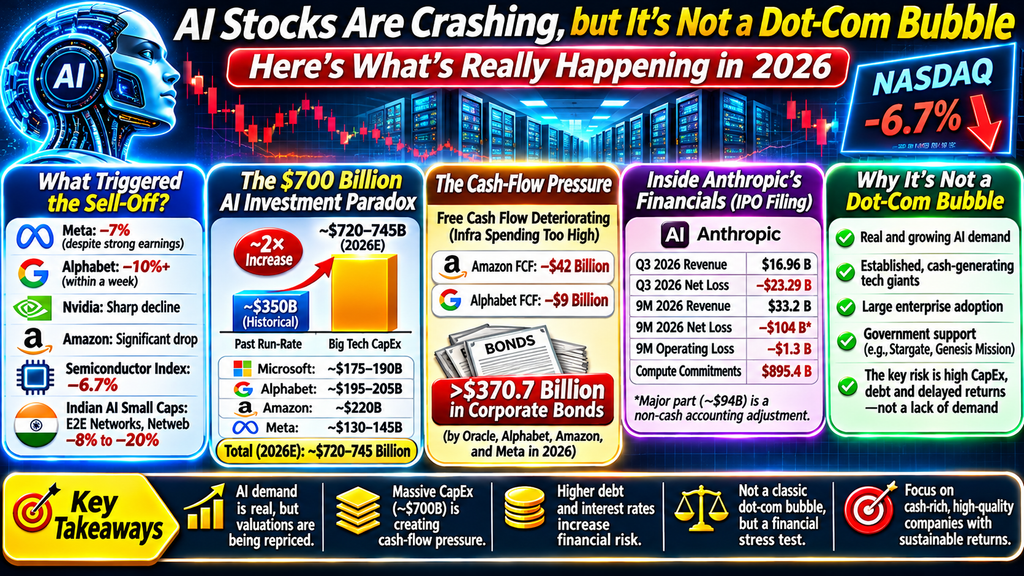
Introduction: The $700 Billion AI Investment Paradox
The artificial intelligence industry is experiencing one of the largest infrastructure investment cycles in modern technology history.
Microsoft, Alphabet, Amazon and Meta are spending enormous amounts on data centres, advanced semiconductors, networking equipment and computing infrastructure. Yet, despite strong AI adoption and expanding cloud businesses, investors have become increasingly concerned about the financial consequences of this spending.
The central paradox is straightforward:
AI demand is growing, but the cost of meeting that demand is growing just as aggressively.
This tension has contributed to sharp volatility in technology stocks, semiconductor companies, and AI-linked businesses.
The market is no longer evaluating artificial intelligence only through revenue growth and technological innovation. Investors are asking harder questions:
- How much cash are AI companies spending?
- Can operating cash flow support future infrastructure commitments?
- How much debt will be required?
- Will AI revenue grow quickly enough to justify the investment?
- Which companies can survive a prolonged period of expensive capital?
According to a September 2026 industry analysis, combined 2026 capital expenditure guidance from four major hyperscalers was estimated at approximately $720–745 billion.
That is an extraordinary amount of capital.
However, the current correction should not automatically be compared with the 2000 dot-com crash. Today’s leading technology companies have substantial operating businesses, established customers and significant cash-generating capabilities.
The bigger concern is a potential financial imbalance between infrastructure spending, borrowing costs and future monetisation.
This article examines five financial realities behind the AI market correction and what they mean for investors.
1. The $700 Billion Cash-Flow Challenge: Why Wall Street Is Becoming Nervous
The first major issue is the enormous increase in AI infrastructure expenditure.
The largest technology companies are competing to build computing capacity before their competitors.
This includes:
- Large-scale AI data centres.
- Advanced GPUs and custom AI chips.
- High-speed networking infrastructure.
- Electricity generation and grid connections.
- Cooling systems.
- Cloud computing capacity.
- Long-term infrastructure leases.
Big Tech’s estimated 2026 capital expenditure
Industry analysis published in September 2026 estimated that the four largest hyperscalers could spend approximately $720–745 billion during 2026.
| Company | Approximate 2026 CapEx guidance | Major investment area |
|---|---|---|
| Amazon | Around $220 billion | AWS, data centres and custom chips |
| Alphabet | Around $195–205 billion | Google Cloud, AI infrastructure and TPUs |
| Microsoft | Around $175–190 billion | Azure and AI computing |
| Meta | Around $130–145 billion | AI infrastructure and data centres |
| Combined | Approximately $720–745 billion | AI and cloud infrastructure |
Figures represent reported estimates and company guidance available in September 2026. Reporting periods and CapEx definitions can differ.
This spending represents a fundamental change in the technology industry’s financial structure.
Historically, leading technology companies often funded expansion through operating cash flow. Today, the scale of infrastructure investment is encouraging greater use of external financing, partnerships, leases and debt.
Why free cash flow matters
Investors frequently focus on revenue and earnings per share. But for infrastructure-heavy companies, free cash flow is equally important.
The basic formula is:
Free Cash Flow = Operating Cash Flow − Capital Expenditure
A company can report strong revenue growth while its free cash flow declines if capital expenditure rises faster than operating cash generation.
Consider a simplified example:
| Financial metric | Company A | Company B |
|---|---|---|
| Annual operating cash flow | $100 billion | $100 billion |
| Capital expenditure | $40 billion | $90 billion |
| Free cash flow | $60 billion | $10 billion |
Both companies generate the same operating cash flow, but Company B has much less financial flexibility after infrastructure investment.
This does not necessarily make Company B a bad investment. If its new infrastructure produces strong returns, today’s expenditure may create tomorrow’s earnings.
The risk appears when the expected returns arrive later than the debt payments and other financial obligations.
The real concern: Capital intensity
Investors should monitor three financial ratios:
- CapEx as a percentage of revenue.
- Free cash flow relative to total debt.
- Operating cash flow relative to interest expense.
If infrastructure spending continues increasing while operating cash flow remains stagnant, the financial risk can rise.
Investor takeaway: AI companies do not need to stop investing. They need to demonstrate that their investments can generate sufficient cash returns over time.
2. Anthropic’s Financial Reality: Revenue Growth Meets Massive Compute Commitments
One of the most important developments in the AI industry is the financial disclosure surrounding Anthropic’s planned public listing.
The company’s November 2, 2026, amended SEC filing provides a detailed view of the economics of building and operating a frontier AI business.
The numbers reveal both extraordinary commercial growth and substantial financial commitments.
Anthropic’s reported financial performance
| Financial metric | Reported figure |
|---|---|
| Q3 2026 revenue | $16.96 billion |
| Q3 2026 net loss | $23.29 billion |
| Nine-month 2026 revenue | $33.2 billion |
| Nine-month 2026 net loss | Approximately $104 billion |
| Nine-month operating loss | Approximately $1.3 billion |
| Nine-month adjusted operating income | Approximately $4.1 billion |
| Total compute and infrastructure commitments | Approximately $895.4 billion |
These figures need careful interpretation.
The reported nine-month net loss of approximately $104 billion includes a very large non-cash accounting adjustment, reported at approximately $94 billion, related to financing arrangements.
Therefore, it would be misleading to interpret the entire net loss as ordinary operating cash expenditure.
The operating loss was approximately $1.3 billion for the nine months, while adjusted operating income was positive.
The $895.4 billion commitment: What does it mean?
This is one of the most important numbers in Anthropic’s filing.
The company disclosed approximately $895.4 billion in aggregate committed spending associated with compute, infrastructure purchases, and lease agreements.
However, this is not an immediate cash bill.
The filing provides a more detailed schedule:
| Commitment category | Amount |
|---|---|
| Total committed spend | $895.4 billion |
| Expected before December 31, 2030 | $447.5 billion |
| Due during the following 12 months after September 30, 2026 | $69.8 billion |
| Remaining commitments | Primarily expected during 2031–2045 |
Anthropic also disclosed approximately $146.6 billion in liquidity as of September 30, 2026, including cash, short-term investments, and available credit.
This matters because infrastructure commitments are spread across multiple years, and the company has substantial liquidity available to meet its financial obligations.
Why the market is still concerned
Anthropic’s filing highlights an important structural issue.
Compute capacity is often contracted well before it becomes available. The company may therefore commit capital today while the revenue associated with that capacity arrives later.
The filing also warns that infrastructure partners may depend on third-party financing. If financing becomes more expensive or unavailable, contracted capacity could be delayed, reduced or repriced.
This creates several risks:
- Higher infrastructure costs.
- Delayed data-centre capacity.
- Pressure on operating margins.
- Dependence on external financing.
- Uncertainty about future AI monetisation.
Investor takeaway: Anthropic’s numbers demonstrate that AI can be a rapidly growing business and still carry significant infrastructure and financing risks. Revenue growth, operating profitability, cash flow and contractual obligations must be evaluated separately.
3. Is This Another Dot-Com Bubble? Understanding the Difference Between 2000 and 2026
The comparison between the AI boom and the dot-com bubble is understandable.
Both periods involved extraordinary enthusiasm for new technology, massive infrastructure investment,t and expectations of future economic transformation.
But there are important differences.
Dot-com crash versus AI infrastructure stress test
| Factor | Dot-com bubble, 2000 | AI investment cycle, 2026 |
|---|---|---|
| Core technology | Internet and fibre-optic networks | Artificial intelligence and advanced computing |
| Market structure | Many speculative internet companies | Established hyperscalers and AI startups |
| Infrastructure | Fibre networks and telecom equipment | Data centres, GPUs and AI computing |
| Financing | Speculative equity and telecom debt | Corporate bonds, leases, partnerships and equity |
| Revenue quality | Many companies had limited monetisation | Major AI businesses already generate substantial revenue |
| Main financial risk | Weak business models and excessive capacity | High CapEx, financing needs and delayed returns |
| Market risk | Valuation collapse and bankruptcies | Repricing, margin pressure and selective financial distress |
During the dot-com crash, the Nasdaq Composite fell approximately 78% from its peak.
Amazon also suffered a drawdown exceeding 90%.
However, the existence of real internet demand did not protect every internet company from financial failure.
The same lesson applies to AI.
Artificial intelligence can become a transformative technology while individual AI companies, infrastructure providers and highly valued stocks still experience severe losses.
Why 2026 is not automatically 2000 again
Today’s major hyperscalers have established cloud businesses, large customer bases and diversified revenue streams.
They are not simply speculative companies promising future products.
At the same time, the scale of current capital expenditure creates new financial risks.
The most important question is not whether AI has real demand.
It is whether the returns generated by AI infrastructure will justify the capital invested in it.
Investor takeaway: AI may be a genuine technological revolution without making every AI-related stock a good investment.
4. The Government’s AI Strategy: Why Washington Supports Infrastructure but Cannot Guarantee Stock Prices
Another major difference between the dot-com period and the current AI cycle is the strategic importance of artificial intelligence to national economic and security policy.
The US government has introduced several initiatives to accelerate AI research, computing infrastructure and domestic technological capability.
Two programmes deserve particular attention.
The Stargate Project
Announced in January 2025, the Stargate Project was introduced as a private-sector initiative intended to invest up to $500 billion over four years in AI infrastructure in the United States.
The initial partners included:
- OpenAI.
- SoftBank.
- Oracle.
- MGX.
Nvidia, Microsoft and Arm were among the initial technology partners.
The project reflects the strategic importance of AI infrastructure and the scale of private investment being planned.
However, Stargate should not be described as a direct $500 billion government bailout or a guaranteed public subsidy.
It is a private-sector investment initiative.
The Genesis Mission
The US government launched the Genesis Mission in November 2025 as a national initiative to accelerate AI-driven scientific discovery.
In July 2026, the White House announced more than $5 billion in federal commitments supporting the programme.
The initiative involves the use of national laboratories, scientific datasets, computing resources and federal research programmes.
Its objectives include:
- AI-assisted scientific research.
- Drug and biological discovery.
- Advanced materials development.
- Energy research.
- National security applications.
- Scientific computing.
Government support does not eliminate investment risk
Public policy can support AI infrastructure development, but it cannot guarantee:
- Corporate profitability.
- Stock-market valuations.
- Debt repayment.
- Future customer demand.
- Successful commercial deployment.
A government may consider AI infrastructure strategically important without protecting every company involved in building it.
The distinction is critical for equity investors.
Investor takeaway: Government support can strengthen the long-term AI ecosystem, but individual companies must still demonstrate sustainable financial performance.
5. The Great AI Separation: Cash-Rich Giants Versus Highly Leveraged Infrastructure Players
The fifth major development is the growing difference between companies that can finance AI expansion comfortably and those that depend heavily on external capital.
Not every AI company has the same balance-sheet strength.
A technology company with substantial operating cash flow can survive a period of higher interest rates more easily than a smaller infrastructure provider relying on expensive borrowing.
Two categories of AI businesses
| Financial characteristic | More resilient businesses | More vulnerable businesses |
|---|---|---|
| Funding | Strong operating cash flow | Heavy dependence on external financing |
| Debt | Manageable leverage | High leverage |
| Customers | Established long-term contracts | Uncertain future demand |
| Infrastructure | Phased investment | Aggressive speculative expansion |
| Liquidity | Large cash reserves | Limited liquidity |
| Interest coverage | Stronger ability to service debt | Higher refinancing risk |
| Main concern | Return on new investment | Debt service and funding availability |
Category 1: More resilient AI infrastructure businesses
Companies with established cloud operations and strong customer relationships may have several advantages:
- Recurring enterprise revenue.
- Existing infrastructure.
- Large customer bases.
- Access to capital markets.
- Diversified business models.
- Stronger operating cash generation.
These advantages do not make their shares immune to market corrections.
Even financially strong companies can experience substantial valuation declines when investors become concerned about future returns on capital.
Category 2: Highly leveraged AI infrastructure providers
Some specialised cloud and data-centre operators are expanding rapidly to meet demand for AI computing.
Their business models can involve:
- Large upfront equipment purchases.
- Long-term infrastructure leases.
- Debt-funded expansion.
- High electricity costs.
- Dependence on a limited number of customers.
- Exposure to refinancing risk.
If interest rates rise or customer demand weakens, these companies may face financial pressure.
Why financing costs matter
Consider a simplified example.
A company borrows $10 billion to build an AI data centre.
| Interest rate | Annual interest expense |
|---|---|
| 5% | $500 million |
| 8% | $800 million |
| 10% | $1 billion |
| 15% | $1.5 billion |
The same amount of debt produces three times as much annual interest expense at 15% compared with 5%.
This illustrates why the cost of capital can determine whether an infrastructure expansion remains financially sustainable.
The actual financing cost of a company will depend on its debt structure, maturity, collateral, credit rating and hedging arrangements.
Where investors may find better opportunities
During a broad technology sell-off, investors should distinguish between companies selling essential infrastructure and companies carrying excessive financial risk.
Potential areas for fundamental research include:
- Advanced semiconductor manufacturers.
- Semiconductor equipment suppliers.
- Memory-chip manufacturers.
- Power-grid equipment companies.
- Data-centre cooling providers.
- Networking and optical infrastructure.
- Established cloud platforms.
These are research categories, not automatic buy recommendations.
Investors should evaluate order books, customer concentration, capital expenditure, margins and valuation before making decisions.
Investor takeaway: The next phase of AI investing may reward financial strength and cash generation more than ambitious expansion announcements.
6. Why Interest Rates Could Decide the Next Phase of the AI Boom
The cost of money is one of the most important variables in evaluating long-duration technology investments.
The US Federal Reserve raised its benchmark federal funds target range by 25 basis points on September 16, 2026, to 3.75%–4.00%.
Meanwhile, US CPI inflation increased 3.7% year over year in September 2026.
These figures demonstrate that the financial environment remains challenging for companies planning large infrastructure investments.
Why higher interest rates matter to AI companies
Higher borrowing costs can affect AI infrastructure through several channels:
- Higher interest expense on new debt.
- More expensive refinancing.
- Lower valuations for long-duration growth companies.
- Higher required returns on data-centre projects.
- Greater pressure on companies with delayed revenue generation.
The valuation connection
A simplified discounted cash-flow framework illustrates the relationship between interest rates and valuations.
The present value of future cash flows is:
[
PV=\frac{FCF}{(1+r)^n}
]
Where:
- (PV) = Present value.
- (FCF) = Future cash flow.
- (r) = Discount rate.
- (n) = Number of years.
When the discount rate rises, the present value of distant future cash flows generally declines.
This is particularly important for companies whose valuations depend heavily on profits expected many years in the future.
Investor takeaway: The AI investment cycle will depend not only on technological progress but also on the availability and cost of capital.
7. What Should Investors Monitor Before Buying AI Stocks?
Investors should avoid treating every decline in an AI stock as a buying opportunity.
A strong technology theme does not eliminate company-specific financial risk.
AI company fundamental checklist
| Metric | Why it matters |
|---|---|
| Revenue growth | Measures commercial demand |
| Operating margin | Shows business profitability |
| Free cash flow | Measures cash remaining after investment |
| Capital expenditure | Shows infrastructure investment requirements |
| Net debt | Indicates balance-sheet leverage |
| Interest coverage | Measures debt-servicing capacity |
| Customer concentration | Reveals dependence on major customers |
| Contractual obligations | Identifies future spending commitments |
| Return on invested capital | Measures investment productivity |
| Valuation | Helps assess whether future growth is already priced in |
Five questions to ask before buying
- Is revenue growth translating into operating cash flow?
- Is capital expenditure growing faster than the company’s ability to generate cash?
- Does the company have enough liquidity to meet future obligations?
- Are customers signing long-term contracts or making temporary purchases?
- Is the stock valuation reasonable relative to its expected earnings growth?
A company can have an excellent technology product and still be a poor investment at an excessive valuation.
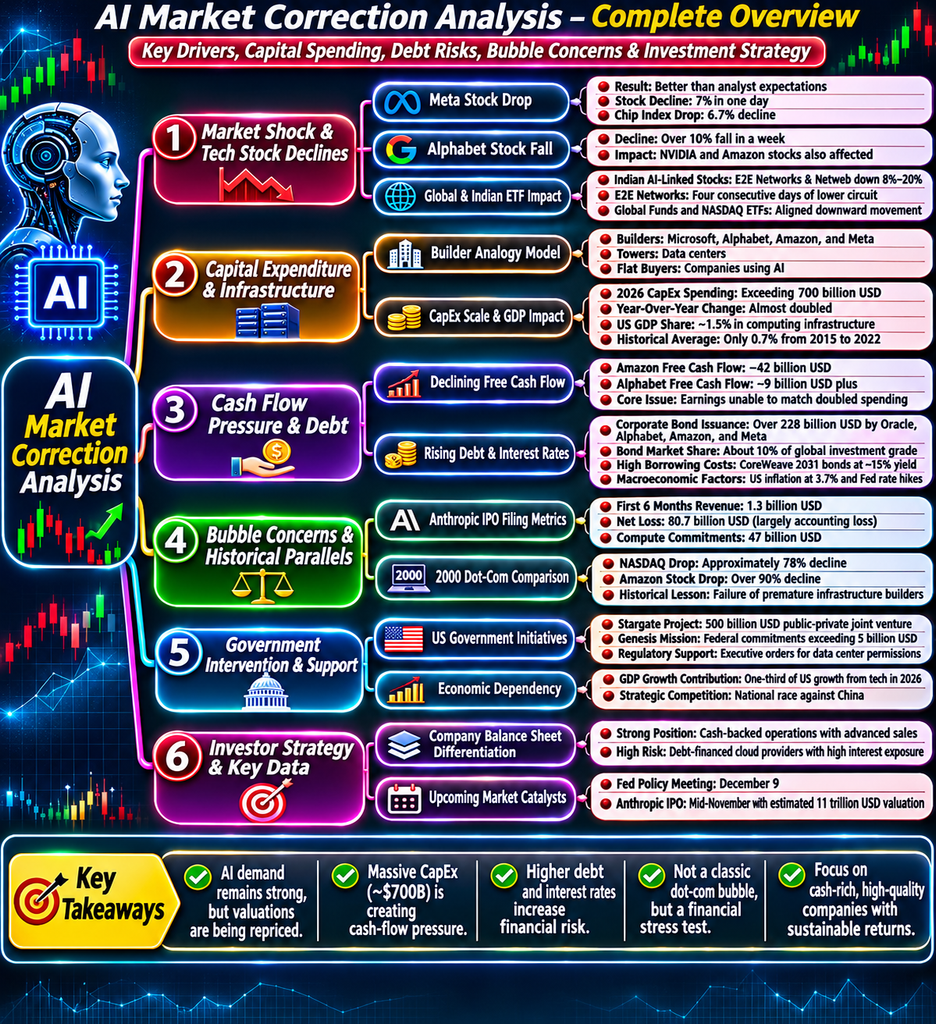
8. Important Events to Watch in November and December 2026
Several upcoming developments could influence the AI investment cycle.
| Event | Expected timing | Why investors should monitor it |
|---|---|---|
| Anthropic IPO process | November 2026 | Tests public-market appetite for frontier AI valuations |
| AI company financial disclosures | November–December 2026 | Provides evidence on revenue, margins and CapEx |
| US inflation releases | Monthly | Influences interest-rate expectations |
| Federal Reserve policy meeting | December 8–9, 2026 | Important for borrowing costs and valuations |
| Data-centre infrastructure announcements | Ongoing | Shows the scale and pace of AI investment |
The Anthropic IPO is particularly important because its financial disclosures provide unusually detailed information about compute commitments and AI economics.
Investors should monitor the final valuation, offering terms, and market demand rather than assuming that an announced IPO will automatically succeed.
Conclusion: AI Is Not Dead, but the Easy Money Phase May Be Over
The current AI stock correction does not necessarily signal the collapse of artificial intelligence.
The technology continues to attract enterprise customers, infrastructure investment and government attention.
However, the financial structure supporting the AI boom is changing.
The largest technology companies are committing hundreds of billions of dollars to data centres and computing capacity. AI startups are entering into enormous infrastructure agreements. Corporate bond markets are financing a growing share of the investment cycle.
At the same time, borrowing costs and inflation remain important constraints.
The market is therefore beginning to separate companies with sustainable cash generation from businesses whose expansion depends heavily on external financing.
Five lessons stand out:
- AI demand can remain strong even when AI stocks fall.
- Capital expenditure must eventually generate cash returns.
- Large infrastructure commitments create long-term financial obligations.
- Government support for AI does not guarantee corporate profitability.
- Balance-sheet strength and valuation will matter more as the market matures.
The 2000 dot-com crash demonstrated that revolutionary technology does not protect investors from excessive valuations and weak financial structures.
The 2026 AI investment cycle may be different, but the underlying lesson remains relevant.
The future of artificial intelligence may be enormous. The future returns of individual AI stocks will depend on how efficiently companies convert that opportunity into sustainable cash flow.
Frequently Asked Questions (FAQs)
1. Are AI stocks crashing in 2026?
Several AI-linked technology and semiconductor stocks have experienced sharp volatility and valuation corrections. The market is increasingly concerned about capital expenditure, financing costs and the time required to monetise AI infrastructure.
2. Is the AI boom another dot-com bubble?
Not necessarily. Today’s leading technology companies have established businesses and significant customer demand. However, individual AI stocks can still be overvalued, and highly leveraged infrastructure providers can face serious financial risks.
3. How much are Big Tech companies spending on AI infrastructure in 2026?
September 2026 industry estimates placed combined 2026 CapEx guidance for Microsoft, Alphabet, Amazon and Meta at approximately $720–745 billion.
4. Why is Anthropic’s $104 billion net loss important?
The figure illustrates the complexity of AI company accounting. A substantial portion of the nine-month loss was a non-cash accounting adjustment. Its operating loss was approximately $1.3 billion, so the net-loss figure should not be interpreted as equivalent to cash burned by operations.
5. What does Anthropic’s $895.4 billion compute commitment mean?
It represents aggregate spending commitments associated with computing infrastructure, purchases,s and leases across multiple years. It is not an immediate payment obligation. Approximately $69.8 billion was due in the 12 months following September 30, 2026.
6. Can the US government prevent an AI market crash?
Government programmes can support AI research and infrastructure development. However, they cannot guarantee the profitability, stock prices, or debt repayment capacity of individual companies.
7. Why are interest rates important for AI stocks?
Higher interest rates increase borrowing costs and can reduce the present value of future cash flows. This can affect companies that require large upfront investments before generating sufficient revenue.
8. Which AI sectors should investors research?
Investors can examine semiconductor manufacturing, equipment suppliers, memory chips, power infrastructure, networking, cooling systems,s and established cloud platforms. Each company still requires independent fundamental and valuation analysis.
Disclaimer
This article is for educational and informational purposes only. It is not investment advice or a recommendation to buy or sell any stock, security, or derivative. Financial figures may be revised, and company CapEx estimates may use different accounting definitions and reporting periods. Adjusted operating income is a non-GAAP measure and should not be confused with statutory operating profit or free cash flow. Investors should review company filings and consult a SEBI-registered investment adviser before making investment decisions.
Top 10 SEO Titles
- AI Stocks Crash 2026: Is It a Dot-Com Bubble or a Debt Crisis?
- AI Bubble 2026: Why Big Tech Is Spending $700 Billion on AI
- AI Stocks Under Pressure: The Hidden Risk Behind Big Tech’s $700 Billion CapEx
- Anthropic IPO 2026: The $895 Billion AI Infrastructure Commitment Explained
- Big Tech Debt Crisis 2026: Why AI Infrastructure Spending Is Worrying Investors
- AI vs Dot-Com Bubble: 5 Critical Differences Investors Must Understand
- Why AI Stocks Are Falling Despite Strong Revenue Growth in 2026
- Microsoft, Amazon, Google and Meta: Is the AI Investment Boom Sustainable?
- AI Infrastructure Crisis: Free Cash Flow, Debt and the Future of Technology Stocks
- AI Stock Market Outlook 2026: Winners, Losers and Investment Risks