
Executive Summary
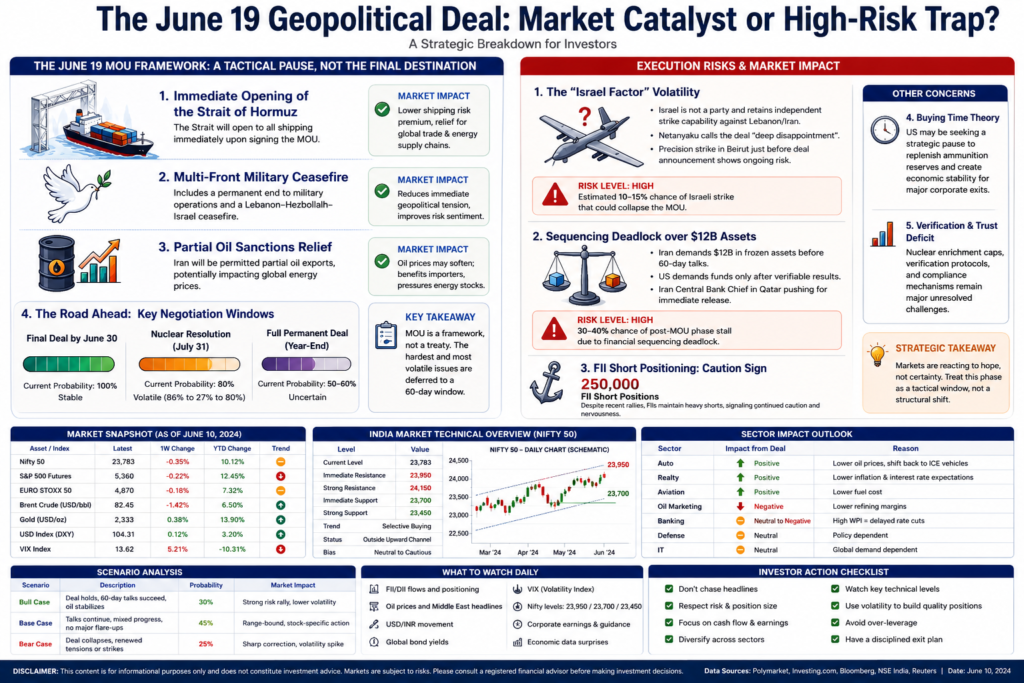
After more than 100 days of geopolitical tensions, markets are once again pricing in optimism as reports suggest a major diplomatic agreement could emerge on June 19.
Equity markets initially welcomed the headlines, but professional investors remain cautious. Market behavior suggests that institutions are waiting for concrete implementation rather than reacting solely to announcements.
The key question is:
Is June 19 the beginning of lasting stability, or merely a temporary pause before another period of uncertainty?
Global Market Snapshot
| Indicator | Current Observation | Market Interpretation |
|---|---|---|
| Global Equity Sentiment | Positive | Risk-On Mood |
| Oil Prices | Volatile | Uncertainty Continues |
| Gold | Elevated | Safe Haven Demand |
| US Futures | Mixed | Cautious Optimism |
| European Markets | Moderate | Waiting for Confirmation |
| Emerging Markets | Sensitive | Dependent on News Flow |
Timeline of Events
| Stage | Status |
|---|---|
| 108-Day Conflict | Completed |
| June 19 MOU Discussion | Expected |
| Next 60-Day Negotiation Window | Critical Phase |
| Nuclear Verification Talks | Pending |
| Long-Term Agreement | Uncertain |
Visual Flow
Conflict
↓
Temporary Understanding
↓
60-Day Negotiation
↓
Verification
↓
Final Agreement (If Successful)
Takeaway 1: MOU is Not the Final Agreement
Many investors confuse an MOU (Memorandum of Understanding) with a permanent treaty.
Difference
| MOU | Final Treaty |
|---|---|
| Framework | Binding Agreement |
| Temporary | Long-Term |
| Negotiation Begins | Negotiation Ends |
| Flexible | Legally Defined |
Investment Implication
Markets may initially celebrate an announcement, but sustainable rallies generally require successful implementation.
Takeaway 2: Geopolitical Complexity
Multiple stakeholders often have different priorities.
Illustrative Framework
| Stakeholder | Primary Focus |
|---|---|
| United States | Security & Verification |
| Iran | Sanctions & Economic Relief |
| Israel | Regional Security |
| Global Energy Markets | Stability |
| Investors | Predictability |
When priorities differ, negotiations can become lengthy and uncertain.
Takeaway 3: Financial Sequencing Matters
Economic agreements frequently depend on sequencing.
Example
Asset Release
↓
Verification
↓
Compliance
↓
Sanction Relief
↓
Long-Term Cooperation
If parties disagree about the order of these steps, negotiations may slow despite positive headlines.
Takeaway 4: Markets Price Expectations, Not Headlines
History shows that markets react to:
- Expectations
- Liquidity
- Institutional positioning
- Earnings outlook
- Macro conditions
rather than headlines alone.
Historical Pattern
| Phase | Market Reaction |
|---|---|
| Rumor | Volatility |
| Announcement | Rally |
| Implementation | Reality Check |
| Execution | Long-Term Trend |
Takeaway 5: Technical Market Signals
Professional investors monitor technical confirmation.
Key Indicators
| Indicator | Importance |
|---|---|
| Market Breadth | High |
| FII/DII Flows | High |
| Volatility Index | Medium |
| Trading Volume | High |
| Sector Rotation | Medium |
| Futures Positioning | High |
A sustainable rally usually features broad participation and strong institutional support.
Sector Impact Analysis
| Sector | Potential Positive Impact |
|---|---|
| Airlines | Lower Fuel Costs |
| Auto | Improved Sentiment |
| Realty | Lower Inflation Expectations |
| Banking | Depends on Interest Rates |
| Energy | Mixed |
| Defense | Policy Dependent |
Bull vs Bear Scenario
| Bull Case | Bear Case |
|---|---|
| Durable Peace | Temporary Pause |
| Stable Oil Prices | Renewed Supply Risk |
| Strong Global Growth | Higher Volatility |
| FII Buying | Continued Risk Aversion |
| Broad Market Rally | Sharp Corrections |
Risk Matrix
| Risk | Severity |
|---|---|
| Geopolitical Risk | 🔴 High |
| Oil Price Shock | 🔴 High |
| Liquidity Risk | 🟠 Medium |
| Policy Uncertainty | 🟠 Medium |
| Valuation Risk | 🟠 Medium |
| Market Sentiment | 🟡 Moderate |
What Smart Investors Watch
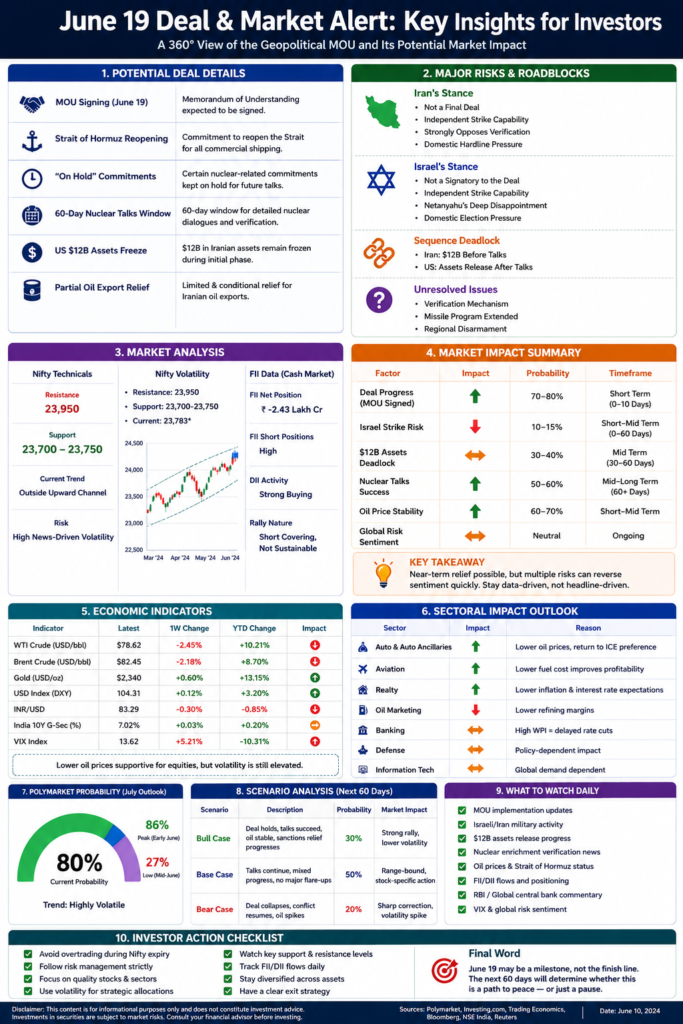
Instead of focusing only on headlines, institutional investors monitor:
✅ FII/DII flows
✅ Oil prices
✅ Currency movement
✅ Volatility Index (VIX)
✅ Corporate earnings
✅ Market breadth
✅ Global bond yields
Scenario Analysis
Scenario 1: Optimistic
- Agreement progresses
- Energy prices stabilize
- Institutional buying increases
Result
Markets may extend gains.
Scenario 2: Neutral
- Talks continue
- Mixed headlines
- Moderate volatility
Result
Range-bound trading.
Scenario 3: Negative
- Negotiations stall
- Geopolitical tensions rise
- Risk assets weaken
Result
Higher volatility and possible correction.
Investor Checklist
Before making investment decisions, ask:
☐ Am I reacting to headlines or data?
☐ Are valuations still reasonable?
☐ Is institutional participation supporting the move?
☐ Can my portfolio withstand volatility?
☐ Am I diversified across sectors and asset classes?
Key Takeaways
- A proposed agreement is an important milestone, but not necessarily the end of negotiations.
- Markets often price expectations well before outcomes become certain.
- Geopolitical developments can influence short-term sentiment, but long-term returns depend on earnings, cash flows, and economic fundamentals.
- Investors should distinguish between temporary optimism and structural improvements in the investment environment.
Final Thought
Successful investing is not about predicting every headline—it is about building a portfolio that can endure uncertainty. Markets reward discipline, diversification, and patience far more consistently than they reward emotional reactions to breaking news.