
Introduction: The $1 Trillion Test That Could Redefine the AI Stock Market
The global artificial intelligence industry is approaching one of its biggest financial milestones.
Anthropic, the company behind the Claude AI platform, has filed updated IPO documents targeting a Nasdaq listing under the ticker symbol ANT.
The proposed offering could value the company at approximately $1 trillion on a basic share-count basis and around $1.4 trillion on a fully diluted basis, depending on the final offering price and share-count assumptions.
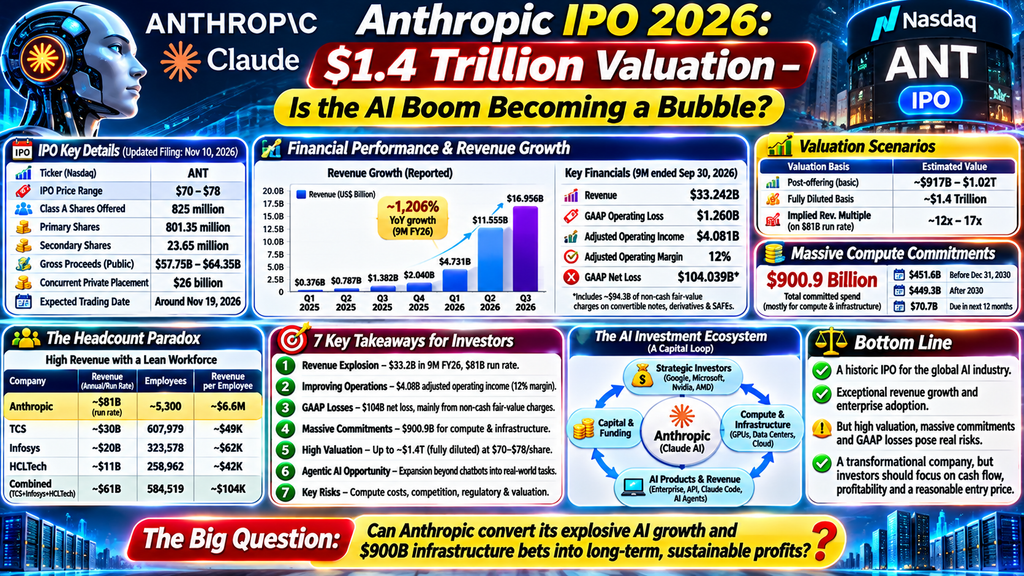
The updated November 10, 2026, filing proposes an IPO price range of $70–$78 per share for 825 million Class A shares. The company could raise approximately $57.75 billion to $64.35 billion through the public offering before underwriting discounts and expenses.
But the numbers create an extraordinary financial paradox.
Anthropic is reporting enormous revenue growth, yet it remains exposed to massive infrastructure commitments, substantial accounting losses and intense competition.
Its disclosed compute and infrastructure-related contractual commitments have reached approximately $900.9 billion.
This raises several questions:
- Is Anthropic’s valuation justified by its revenue growth?
- Can artificial intelligence companies generate enough cash to support their infrastructure spending?
- Are investors buying a sustainable technology business or an expensive AI growth narrative?
- Could Anthropic’s IPO become a turning point for global technology stocks?
This analysis examines seven important financial takeaways from Anthropic’s IPO and what they mean for long-term investors.
1. The Headcount Paradox: How 5,300 Employees Support a Massive AI Business
Traditional IT services companies generally depend on large employee bases to deliver software development, consulting, and technology operations.
Anthropic operates a different business model.
Its revenue is generated through AI models, API access, enterprise subscriptions, and other AI-powered services.
According to its updated SEC filing:
- Employees: Approximately 5,300 as of September 30, 2026.
- Nine-month revenue: $33.242 billion.
- Run-rate revenue: Approximately $81 billion as of October 31, 2026.
- Trailing-twelve-month revenue per employee: More than $6.6 million, as disclosed by the company.
Anthropic versus traditional IT services
| Metric | Anthropic | Traditional IT services |
|---|---|---|
| Main revenue model | AI models, subscriptions and API services | Consulting, outsourcing and software services |
| Workforce requirement | Research, engineering and product-focused | Large delivery and consulting teams |
| Scaling mechanism | Software and compute infrastructure | People, projects and technology |
| Productivity model | Revenue supported by AI platforms | Revenue supported by service delivery |
Why this matters
AI companies may be able to increase revenue without increasing employee headcount at the same rate.
A single AI platform can serve thousands of businesses simultaneously.
However, Anthropic’s business is not infrastructure-free.
Its ability to scale depends on expensive GPUs, data centres, electricity, networking, cloud providers and specialised engineering talent.
The real productivity advantage is therefore a combination of software leverage and infrastructure scale.
A critical comparison warning
Comparing Anthropic’s annualised revenue run rate directly with the annual reported revenue of TCS, Infosys and HCLTech can be misleading.
The business models, revenue recognition, employee structures and reporting periods are different.
A run-rate estimate should not be treated as audited annual revenue.
Investor takeaway: Anthropic demonstrates the potential for software-driven revenue productivity, but its infrastructure costs must be considered alongside its employee efficiency.
2. Revenue Growth: From $4.6 Billion to an $81 Billion Run Rate
Revenue growth is one of the strongest elements of Anthropic’s IPO investment thesis.
The company reported rapid expansion between 2023 and September 2026.
Anthropic’s historical revenue
| Financial period | Revenue |
|---|---|
| FY2023 | $41 million |
| FY2024 | $386 million |
| FY2025 | $4.585 billion |
| Nine months of 2025 | $2.545 billion |
| Nine months of 2026 | $33.242 billion |
Revenue for the first nine months of 2026 increased approximately 1,206% year over year, according to the SEC filing.
Quarterly revenue acceleration
| Quarter | Revenue |
|---|---|
| Q1 2025 | $376 million |
| Q2 2025 | $787 million |
| Q3 2025 | $1.382 billion |
| Q4 2025 | $2.040 billion |
| Q1 2026 | $4.731 billion |
| Q2 2026 | $11.555 billion |
| Q3 2026 | $16.956 billion |
Anthropic Revenue Growth: 2025–2026
| Financial Metric | Reported Data |
|---|---|
| Q3 2026 Revenue Growth YoY | 1,127% |
| 9M 2026 Compute Expenses | $18.81B |
| Compute Expense Growth YoY | 329% |
| Adjusted Operating Income (9M) | $4.08B |
| GAAP Operating Loss (9M) | $1.26B |
| Customers with $100K+ TTM Revenue | 11,900+ |
Anthropic’s revenue increased dramatically, but compute expenses also grew 329% year over year. Revenue growth is impressive; the long-term investment question is whether the company can convert this growth into sustainable operating cash flow.
The $81 billion revenue run rate
Anthropic disclosed that its run-rate revenue reached approximately $81 billion as of October 31, 2026.
This was approximately $10 billion higher than its September 30 run rate.
But investors should understand the difference:
- Actual nine-month revenue: $33.242 billion.
- Latest quarterly revenue: $16.956 billion.
- October 31 run-rate revenue: Approximately $81 billion.
A run rate annualises recent revenue performance. It does not guarantee that the company will generate $81 billion in recognised revenue during the next twelve months.
Why the revenue growth is impressive
The growth reflects increasing adoption of AI tools across:
- Enterprise software development.
- AI-powered coding.
- Business automation.
- API integrations.
- Research and knowledge work.
- Customer-service automation.
- Agentic AI applications.
The important question is whether this growth can continue after the initial wave of enterprise AI adoption.
Anthropic itself warns in its prospectus that historical growth rates are not necessarily indicative of future performance.
Investor takeaway: Revenue growth is exceptional, but future growth should be evaluated using actual customer retention, recurring revenue, pricing power and operating cash flow.
3. The GAAP Accounting Paradox: Huge Losses Despite Improving Operating Performance
One of the most misunderstood parts of Anthropic’s financial statements is the difference between GAAP operating results, net losses,s and adjusted operating income.
The company is reporting improving adjusted operating performance, but its GAAP accounts still show substantial losses.
Nine-month financial performance
| Financial metric | Nine months ended September 30, 2026 |
|---|---|
| Revenue | $33.242 billion |
| GAAP operating loss | $1.260 billion |
| Adjusted operating income | $4.081 billion |
| Adjusted operating margin | 12% |
| GAAP net loss | $104.039 billion |
Why is the net loss so large?
The financial statements show that changes in the fair value of convertible notes, derivative liabilities, ES, and SAFEs contributed approximately $94.324 billion of expense during the first nine months of 2026.
These accounting revaluations significantly affected the reported net loss.
The prospectus explains that the fair value of these financial instruments can change as the company’s valuation and financing assumptions change.
Such changes can create large accounting expenses without representing equivalent cash payments during the period.
Q3 2026: A closer look
| Metric | Q2 2026 | Q3 2026 |
|---|---|---|
| Revenue | $11.555B | $16.956B |
| GAAP operating result | +$974M | -$567M |
| Adjusted operating income | $2.235B | $2.463B |
| Adjusted operating margin | 19% | 15% |
Q3 adjusted operating income increased, but the adjusted margin declined.
The company attributed pressure partly to approximately $5 billion of short-term compute costs, which were more expensive than comparable compute under multi-year arrangements.
It also reported approximately $1.96 billion of non-cash donation-matching charges in Q3.
Should investors ignore GAAP losses?
Absolutely not.
Adjusted operating income is a non-GAAP measure.
It excludes certain expenses, including stock-based compensation, non-cash charitable contributions, and the Bartz settlement.
Investors should examine both reported and adjusted results.
A company can have positive adjusted operating income while still generating substantial GAAP losses and facing large future cash commitments.
Investor takeaway: Anthropic’s core operating performance has improved significantly, but the difference between adjusted profitability and GAAP profitability remains a major issue for investors.
4. The $900.9 Billion Commitment: Is AI Infrastructure Spending Becoming a Financial Risk?
This is arguably the most important risk in Anthropic’s IPO.
The original draft referred to approximately $95.4 billion in infrastructure commitments.
However, the updated November 10 SEC filing reports approximately $900.9 billion in aggregate committed spend as of and after September 30, 2026.
These commitments include purchase agreements and lease arrangements, including leases that have not yet commenced. Substantially all are related to compute and infrastructure.
Breakdown of Anthropic’s commitments
| Commitment period | Amount |
|---|---|
| Total committed spend | $900.9 billion |
| Expected before December 31, 2030 | $451.6 billion |
| Expected after 2030 | Approximately $449.3 billion |
| Due in the next 12 months after September 30, 2026 | $70.7 billion |
These are contractual commitments across multiple future periods, not a single-year cash expenditure or a simple capital-expenditure forecast.
Why does Anthropic need so much compute?
Modern AI systems require enormous computing resources.
The infrastructure supports:
- Training advanced AI models.
- Running inference requests.
- Enterprise AI workloads.
- Claude Code and agentic AI applications.
- Research and model development.
- Data processing and storage.
The company also uses a combination of cloud-provider arrangements and its direct infrastructure strategy.
The infrastructure risk
If customer demand grows more slowly than expected, Anthropic could face a mismatch between contracted infrastructure costs and revenue.
Potential consequences include:
- Lower operating margins.
- Higher financing requirements.
- Greater dependence on cloud partners.
- Increased depreciation and lease costs.
- Lower free cash flow.
- Greater exposure to technology obsolescence.
The long-term commitments may secure valuable compute capacity, but they also reduce financial flexibility.
Investor takeaway: The $900.9 billion figure is not an immediate debt balance. However, it represents an enormous long-term contractual exposure that deserves close attention.
5. The AI Capital Loop: Are Technology Companies Funding Their Own Customers?
Anthropic operates within a connected AI infrastructure ecosystem.
Major technology companies provide funding, cloud access, hardware, and other infrastructure.
Anthropic then uses significant portions of its resources to purchase compute capacity and infrastructure from providers across the ecosystem.
The AI investment ecosystem
How Money Flows Through the AI Ecosystem
Capital & Strategic Investment
Google · Microsoft · Nvidia · AMD
Strategic investors and financing partners
AI Infrastructure
GPUs · Data Centres · Cloud Platforms
High-Bandwidth Memory · Networking · Electricity
Anthropic / Claude AI
AI Model Development · Enterprise Subscriptions
API Revenue · Claude Code · AI Agents
Compute Purchases & Infrastructure Commitments
Cloud Services · GPU Capacity · Long-Term Contracts
Infrastructure Payments · Compute Demand
The AI ecosystem connects strategic investment, infrastructure providers and AI software businesses. Anthropic generates revenue from customers while spending heavily on compute capacity. The key investment question is whether future revenue and cash flow can justify these long-term infrastructure commitments.
Why investors call this a circular financing risk
The concern is that companies investing in AI infrastructure may also provide funding to AI businesses that subsequently spend money on their infrastructure.
This can create an interconnected financial ecosystem.
However, strategic investment and infrastructure purchasing are not automatically evidence of fraudulent or unsustainable circular financing.
Investors must determine whether the underlying customer demand generates sufficient independent economic value.
What could go wrong?
- AI customers may reduce spending.
- Model prices may decline.
- Infrastructure capacity may become excessive.
- Cloud providers may compete aggressively.
- New chips may make existing infrastructure less efficient.
- Financing conditions may tighten.
The important question is not simply how much money enters the AI ecosystem.
It is how much sustainable revenue and cash flow the ecosystem produces.
6. The $1.4 Trillion IPO: What Are Investors Actually Paying For?
Anthropic’s updated IPO filing dated November 10, 2026, provides a price range of $70–$78 per share.
It also specifies 825 million Class A shares, including primary shares issued by the company and a smaller secondary component sold by existing shareholders.
Anthropic IPO details
| IPO parameter | Latest disclosed information |
|---|---|
| IPO price range | $70–$78 |
| Class A shares offered | 825 million |
| Primary shares | 801.35 million |
| Secondary shares | 23.65 million |
| Gross public offering proceeds | $57.75B–$64.35B |
| Concurrent private placement | $26 billion |
| Proposed Nasdaq ticker | ANT |
| Expected trading date | Around November 19, subject to completion |
Basic valuation versus fully diluted valuation
There is an important distinction between the valuation based on basic shares and the fully diluted valuation.
Media reports indicate that the proposed offering could imply approximately:
- $917 billion to $1.02 trillion on the post-offering share count used in one valuation calculation.
- Up to approximately $1.4 trillion on a fully diluted basis.
These figures are valuation estimates based on share-count assumptions, not a valuation officially stated by the SEC prospectus.
Why is the valuation so high?
Investors are valuing Anthropic based on expectations of:
- Continued enterprise AI adoption.
- Claude’s competitive position.
- AI coding and agentic software growth.
- Recurring enterprise revenue.
- Future infrastructure efficiency.
- Long-term AI market expansion.
The valuation is therefore heavily dependent on future performance.
An illustrative valuation sensitivity
Suppose the company eventually achieves $100 billion in annual revenue.
| Illustrative revenue multiple | Implied enterprise value |
|---|---|
| 8x revenue | $800 billion |
| 10x revenue | $1 trillion |
| 12x revenue | $1.2 trillion |
| 14x revenue | $1.4 trillion |
| 16x revenue | $1.6 trillion |
These are hypothetical valuation scenarios, not price targets or analyst forecasts.
A high revenue multiple may be justified for a company with exceptional growth and durable competitive advantages, but investors must also consider profitability, cash flow, dilution, and infrastructure obligations.
Investor takeaway: A $1 trillion valuation requires sustained growth and strong future cash generation. Revenue growth alone is not enough.
7. Agentic AI: The Technology That Could Justify Anthropic’s Valuation
The long-term investment thesis is not limited to conversational AI.
The next stage of artificial intelligence involves agentic systems.
Traditional AI tools respond to individual prompts.
Agentic AI systems can plan and perform multiple tasks using tools, data, and software environments, with varying levels of human supervision.
Example: How an AI investment research agent could work
AI Investment Research Agent: 5-Step Workflow
Define Investment Objectives
Set investment goals, risk appetite, capital allocation, preferred sectors and investment time horizon.
Collect Market and Company Data
Gather financial statements, quarterly results, annual reports, stock prices, market news and institutional activity.
Validate and Score Investment Opportunities
Evaluate business quality, earnings growth, financial strength, valuation, management risks and competitive advantages.
Generate Investment Research Report
Prepare a research report with fair-value estimates, bull and bear scenarios, entry zones, downside risks and portfolio allocation suggestions.
Human Approval and Investment Execution
Review the research, verify data, approve position size, set stop-loss and risk limits. Execute orders only after authorised human approval.
AI can support research, screening and decision-making, but it cannot guarantee investment returns. All financial data must be verified, and final investment decisions should follow appropriate human review and risk controls.
| Step | Data Required | Analysis | Expected Output |
|---|---|---|---|
| 1. Objectives | Capital, horizon, risk profile | Investment planning | Research criteria |
| 2. Data Collection | Results, prices, balance sheets | Data validation | Verified dataset |
| 3. Stock Validation | ROE, ROCE, EPS, debt, valuation | Fundamental and technical scoring | Ranked stock shortlist |
| 4. Research Report | Cash flow, intrinsic value, risks | Valuation and scenario analysis | Investment research report |
| 5. Execution | Entry, quantity, stop-loss, capital | Risk management and approval | Authorised investment decision |
Why this matters for Anthropic
Agentic AI could expand the addressable market beyond chatbots.
Businesses may use AI agents for:
- Software engineering.
- Financial research.
- Customer support.
- Legal-document workflows.
- Enterprise administration.
- Data analysis.
- Business process automation.
Anthropic’s prospectus describes its focus on enterprise customers and the expansion of Claude into practical business workflows.
The risks of agentic AI
The technology also creates risks:
- Incorrect automated decisions.
- Data security failures.
- Unauthorised system access.
- Model reliability problems.
- Regulatory uncertainty.
- Liability for AI-generated actions.
The commercial opportunity is large, but reliable deployment is essential.
8. The Biggest Risks Investors Should Not Ignore
Anthropic’s prospectus identifies several risks that investors must evaluate.
| Risk | Why it matters |
|---|---|
| Compute commitments | Large future contractual obligations |
| Competition | OpenAI, Google and other AI developers |
| AI infrastructure | Dependence on chips, power and data centres |
| Model commoditisation | Falling prices could pressure revenue |
| Customer adoption | Enterprise spending may not meet expectations |
| Regulatory exposure | AI safety, privacy and national-security rules |
| Corporate governance | Unusual multi-class share and trust structure |
| Financial reporting | Large differences between GAAP and adjusted results |
The governance question
Anthropic is structured as a Public Benefit Corporation.
Its updated prospectus also describes a special voting structure.
The founders’ Class F share is designed to carry 50.1% of total voting power on general shareholder matters, while the Long-Term Benefit Trust has separate governance powers over designated directors.
This structure is designed to balance commercial interests with the company’s stated public-benefit purpose.
However, public shareholders should understand that economic ownership and voting control are not necessarily the same thing.
9. AI Infrastructure Spending: A Global Investment Opportunity
Anthropic’s IPO is part of a much larger AI infrastructure investment cycle.
The opportunity extends beyond AI software companies.
The broader ecosystem includes:
- Semiconductor manufacturers.
- Advanced chip designers.
- High-bandwidth memory.
- Data-centre operators.
- Networking equipment.
- Cloud infrastructure.
- Electricity generation.
- Cooling systems.
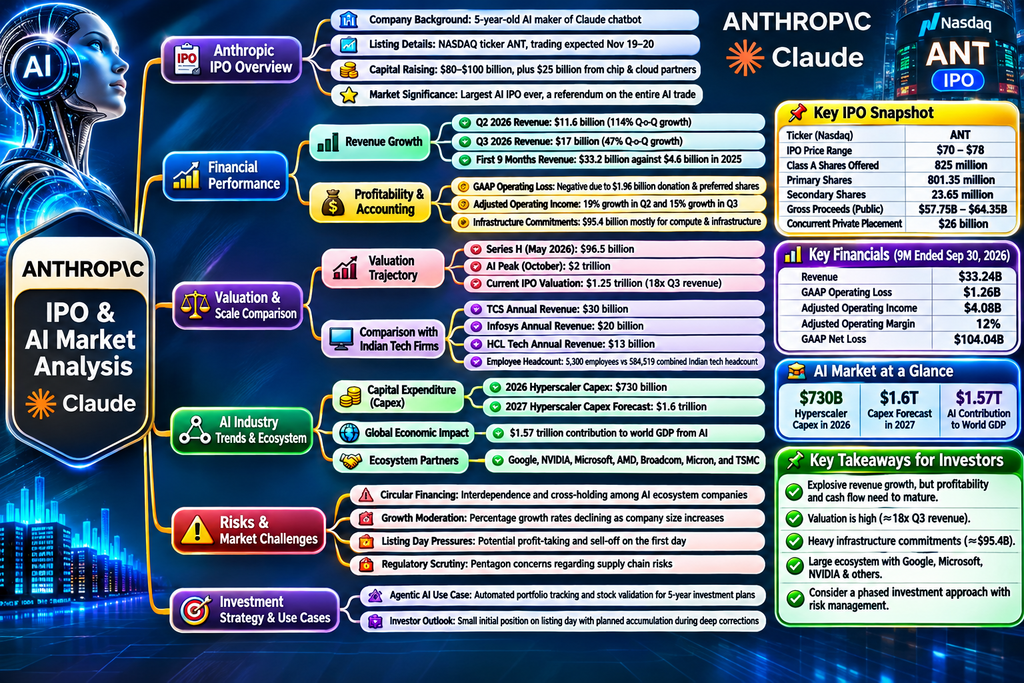
J.P. Morgan Global Research estimated that global AI capital expenditure could reach approximately $900 billion in 2026, with cumulative AI capex projected at $5.5 trillion through 2030.
Potential beneficiaries of the AI investment cycle
| Industry | Growth opportunity | Major risk |
|---|---|---|
| Semiconductor chips | AI accelerator demand | Supply and technology cycles |
| Memory | High-bandwidth memory demand | Pricing volatility |
| Data centres | AI compute infrastructure | Overcapacity |
| Networking | High-speed data movement | Competition |
| Cloud providers | AI service revenue | Heavy capex |
| Energy | Electricity demand | Regulation and capacity |
| AI software | Enterprise automation | Competition and pricing |
Is the AI boom another dot-com bubble?
There are similarities:
- High expectations.
- Rapid valuation expansion.
- Massive infrastructure investment.
- Aggressive competition.
- Strong investor demand.
But there are also differences.
Modern AI companies already generate substantial commercial revenue, and businesses are deploying AI in real workflows.
The critical question is whether the revenue and productivity benefits will eventually justify the capital investment.
Investors should not assume that every AI company will become a long-term winner.
10. Investment Strategy: How Should Investors Approach the Anthropic IPO?
The proposed IPO is extraordinary in size, but that does not mean investors should automatically participate at any price.
Three possible IPO scenarios
| Scenario | What could happen | Investor implication |
|---|---|---|
| Bull case | Strong demand, continued revenue growth and improved operating economics | Valuation premium may persist |
| Base case | Growth remains strong but margins fluctuate | Stock may trade sideways or remain volatile |
| Bear case | Infrastructure commitments rise faster than revenue,e and AI valuations compress | Significant downside risk |
What should investors monitor?
Before considering an investment, examine:
- Final IPO price.
- Final prospectus and fully diluted share count.
- Actual revenue growth.
- Adjusted and GAAP operating performance.
- Operating cash flow.
- Compute commitments and future payments.
- Customer concentration.
- Cloud-provider relationships.
- Share dilution.
- Governance and voting rights.
Should investors buy on listing day?
A large IPO can experience substantial first-day volatility.
The initial market price may reflect enthusiasm rather than a carefully established long-term valuation.
For investors with a multi-year horizon, waiting for the initial trading period to settle may provide a better opportunity to evaluate the market’s valuation.
A 3–5-year investment horizon can be useful for analysing the AI infrastructure transition, but it does not guarantee positive returns.
A sensible approach is to avoid deploying the entire investment amount at once and to size any position according to risk tolerance.
Final Verdict: Anthropic Is a Historic AI Growth Story, but the Valuation Requires Discipline
Anthropic’s proposed IPO represents a major moment for the global AI industry.
The company has reported extraordinary revenue expansion, a rapidly growing enterprise business, ess and improving adjusted operating performance.
However, its financial statements also reveal major risks.
The most important findings are:
- Nine-month 2026 revenue reached $33.242 billion.
- October 31 run-rate revenue reached approximately $81 billion.
- The company reported $4.081 billion of adjusted operating income for nine months.
- GAAP net loss reached $104.039 billion, heavily affected by fair-value accounting movements.
- Aggregate compute and infrastructure-related commitments reached approximately $900.9 billion.
- The proposed IPO price range is $70–$78 per share.
- The fully diluted valuation could reach approximately $1.4 trillion under reported assumptions.
The strongest argument for Anthropic is its potential to become a foundational enterprise AI platform.
The biggest concern is whether future cash generation can support the scale of infrastructure commitments and justify the proposed valuation.
Our conclusion: Anthropic may become one of the most important AI businesses in the world, but an exceptional company is not automatically an exceptional investment at every price.
Investors should focus on actual revenue, cash generation, infrastructure efficiency, competitive positioning and valuation rather than chasing the excitement of a record-breaking IPO.
The $1 trillion question is not whether AI will transform the economy.
It is whether the companies building that future can generate enough sustainable economic value to justify the capital being invested today.
Frequently Asked Questions (FAQs)
1. What is Anthropic’s IPO ticker symbol?
Anthropic has applied to list its Class A common stock on the Nasdaq Global Select Market under the ticker symbol ANT. The listing remains subject to completion of the IPO and SEC effectiveness requirements.
2. What is Anthropic’s expected IPO price?
The November 10, 2026, updated filing gives an indicative IPO price range of $70–$78 per share.
3. What is Anthropic’s expected valuation?
Media estimates indicate a valuation of approximately $917 billion to $1.02 trillion on a basic post-offering share-count basis, potentially reaching around $1.4 trillion on a fully diluted basis.
4. How much revenue does Anthropic generate?
Anthropic reported $33.242 billion in revenue for the nine months ended September 30, 2026. It also disclosed an approximately $81 billion revenue run rate as of October 31, 2026.
5. Why is Anthropic reporting a large net loss?
Its nine-month GAAP net loss was affected substantially by changes in the fair value of convertible notes, derivative liabilities and SAFEs, as well as stock-based compensation and other expenses.
6. Is Anthropic operationally profitable?
It reported $4.081 billion in adjusted operating income for the first nine months of 2026. However, its GAAP operating result was a loss of $1.260 billion. Investors should examine both measures.
7. What are Anthropic’s compute commitments?
The November 10 filing reports approximately $900.9 billion of aggregate committed spend, substantially all related to compute and infrastructure. These commitments cover multiple future periods and are not a single-year cash expenditure.
8. Who are Anthropic’s major strategic technology partners?
Its disclosed relationships include major technology and infrastructure companies such as Google, Microsoft, Nvidia, AMD, Broadcom, Micron and TSMC.
9. Is Anthropic a good long-term investment?
The business has significant growth potential, but its proposed valuation, infrastructure obligations, competition, profitability and governance structure require careful evaluation.
10. Is Anthropic’s IPO a sign of an AI bubble?
Not necessarily. The IPO reflects strong commercial demand for AI, but the valuation and capital commitments create risks if future revenue and cash flow fail to justify current expectations.
Disclaimer
This article is for educational and informational purposes only. It is not a recommendation to buy or sell Anthropic shares or any other securities. The IPO price range and valuation are preliminary and can change before the offering becomes effective. Revenue run rates are not guaranteed future revenue. Adjusted operating income is a non-GAAP measure. Infrastructure commitments are contractual obligations across multiple future periods and should not be interpreted as immediate debt or annual capex. Investors should review the final prospectus, financial statements, ents and risk factors before making investment decisions.
Top 10 SEO Titles
- Anthropic IPO 2026: $1.4 Trillion Valuation – Is the AI Boom Becoming a Bubble?
- Anthropic IPO Analysis: $81 Billion Revenue Run Rate and $900 Billion AI Commitments
- Anthropic Stock (ANT): Revenue, Valuation, Profitability and Investment Risks
- Is Anthropic Worth $1.4 Trillion? Complete Financial Analysis of Claude AI
- Anthropic IPO 2026: 7 Financial Risks Every AI Investor Must Understand
- Claude AI Company Anthropic IPO: Can $81 Billion Revenue Justify Its Valuation?
- Anthropic vs OpenAI: Who Will Dominate the Global AI Market?
- AI Bubble 2026: What Anthropic’s Record IPO Reveals About Technology Stocks
- Anthropic Financial Results 2026: Revenue Growth, GAAP Losses and Compute Spending
- The $1 Trillion AI Test: Anthropic IPO and the Future of Global Technology Stocks