
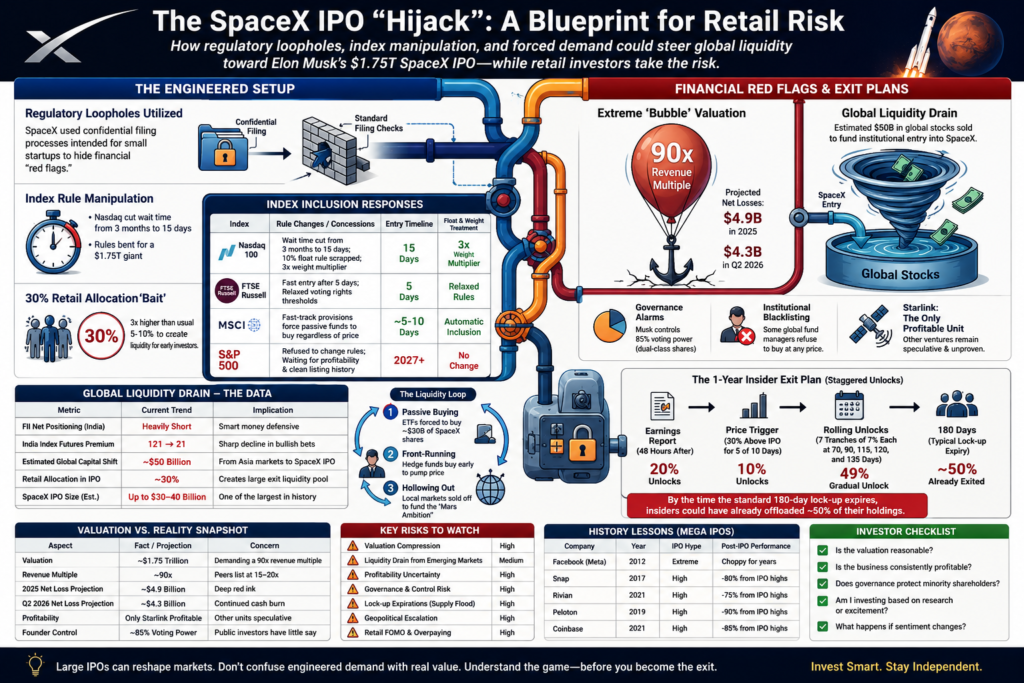
Is Global Liquidity Being Redirected Toward the Biggest IPO of the Decade?
Author’s Note:
This article explores a market hypothesis based on institutional behavior, liquidity flows, and IPO mechanics. Some claims discussed are speculative interpretations rather than verified facts. Investors should rely on official filings and independent research before making decisions.
Executive Summary
Financial markets are entering a period of elevated uncertainty. Rising geopolitical tensions, volatile oil prices, and increasing institutional repositioning have led many analysts to question whether global capital is preparing for one of history’s largest public listings.
If SpaceX eventually launches a massive IPO at a valuation approaching $1.75 trillion, the amount of capital required could reshape liquidity across global markets.
The central question becomes:
Are institutions preparing for a historic opportunity—or creating a liquidity vacuum that retail investors may ultimately finance?
Market Environment
| Indicator | Current Trend | Market Impact |
|---|---|---|
| Global Equity Markets | High Volatility | Risk-Off Sentiment |
| India VIX | Rising | Increased Fear |
| Brent Crude Oil | Rising | Inflation Pressure |
| FII Positioning | Cautious | Potential Selling Pressure |
| Global Liquidity | Tightening | Reduced Risk Appetite |
Why June Could Become a Turning Point
Markets have recently displayed a pattern:
- Opening strongly
- Losing momentum midday
- Closing with significant volatility
This behavior often reflects:
- Institutional repositioning
- Large derivative hedging
- Liquidity adjustments
- Global macro uncertainty
While retail investors focus on price movement, institutions frequently focus on capital allocation.
The Geopolitical Catalyst
Recent tensions in the Middle East have increased uncertainty regarding energy supplies.
Potential consequences include:
| Event | Possible Effect |
|---|---|
| Oil Supply Disruption | Higher Oil Prices |
| Inflation Risk | Delayed Rate Cuts |
| Equity Market Weakness | Capital Rotation |
| Safe Haven Demand | Dollar & Gold Strength |
Higher oil prices generally increase market volatility and reduce investor appetite for risk assets.
The Confidential Filing Debate
Some large companies choose confidential filing mechanisms before going public.
Advantages include:
| Benefit | Explanation |
|---|---|
| Reduced Public Scrutiny | Financial revisions remain private initially |
| Flexible Documentation | Corrections before public release |
| Better Timing | IPO can launch when market conditions improve |
Critics argue that reduced transparency limits public analysis before investment decisions.
The “Force-Buyer” Theory
Passive investing has transformed global markets.
If a massive company enters major indices:
- ETFs
- Index Funds
- Pension Funds
may need to purchase shares automatically.
Simplified Process
Institutional Listing
↓
Index Inclusion
↓
Passive Funds Must Buy
↓
Demand Increases
↓
Price May Rise
↓
Retail Investors Join
↓
Early Investors May Exit
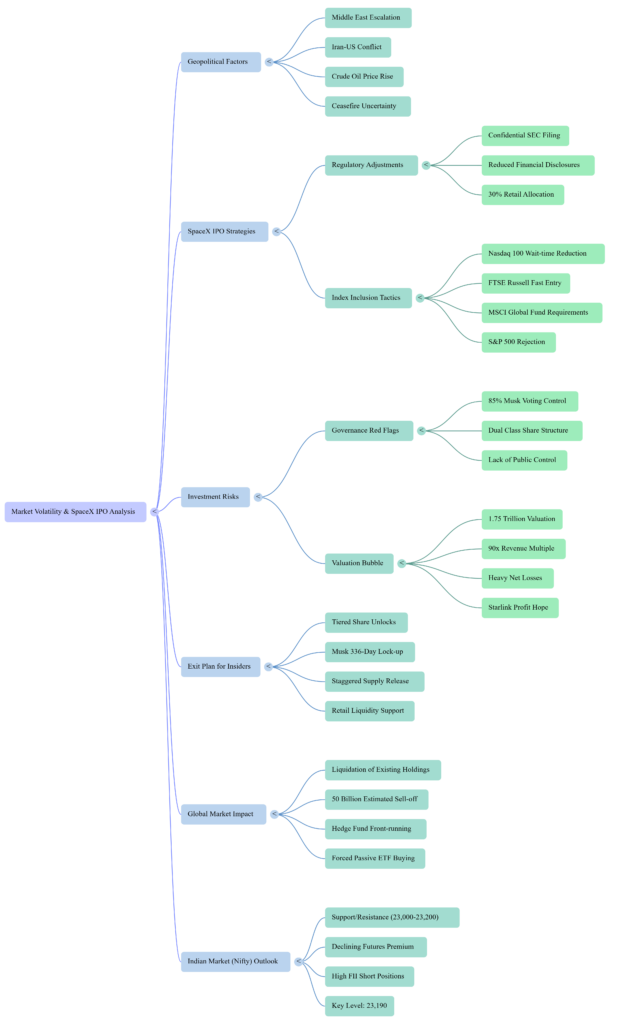
Hypothetical Liquidity Flow
| Source | Destination |
|---|---|
| India | Global IPO Allocation |
| Japan | Global IPO Allocation |
| Korea | Global IPO Allocation |
| Europe | Global IPO Allocation |
| US Funds | SpaceX Shares |
This process could temporarily reduce liquidity available for other equities.
Valuation Analysis
Suppose valuation reaches:
$1.75 Trillion
| Metric | Example |
|---|---|
| Revenue Multiple | Very High |
| Market Expectations | Extremely Optimistic |
| Future Growth Needed | Massive |
| Execution Risk | High |
Markets would effectively be pricing decades of future expansion.
Governance Considerations
Large founder-controlled companies often use dual-class share structures.
Potential concerns:
| Issue | Impact |
|---|---|
| Founder Voting Control | Limited shareholder influence |
| Governance Risk | Higher |
| Minority Rights | Reduced |
| Decision Concentration | Increased |
Institutional vs Retail Timeline
Phase 1
Institutional positioning
↓
Phase 2
IPO excitement
↓
Phase 3
Retail participation
↓
Phase 4
Lock-up expirations
↓
Phase 5
Potential increased supply
↓
Phase 6
Price discovery
Possible Winners
| Sector | Potential Benefit |
|---|---|
| Aerospace | High |
| Satellite Internet | High |
| Defense Technology | Medium |
| AI Infrastructure | Medium |
| Space Manufacturing | Long-Term |
Possible Risks
| Risk | Severity |
|---|---|
| Valuation Compression | High |
| Liquidity Drain | Medium |
| Profitability Concerns | Medium |
| Global Risk-Off Environment | High |
| Retail FOMO | High |
Lessons from Previous Mega IPOs
History shows that many highly anticipated IPOs experience:
- Initial excitement
- Strong media coverage
- Elevated valuations
- Volatile post-listing performance
Long-term returns ultimately depend on fundamentals rather than hype.
Investor Checklist
Before investing, ask:
✅ Is the valuation reasonable?
✅ Is the business consistently profitable?
✅ Does governance protect minority shareholders?
✅ Am I investing based on research or excitement?
✅ What happens if sentiment changes?
Final Thoughts
Whether or not a SpaceX IPO reaches a valuation near $1.75 trillion, one principle remains constant:
Liquidity drives markets in the short term, while fundamentals drive markets in the long term.
Large IPOs can attract enormous capital and temporarily reshape global investment flows, but investors should distinguish between compelling narratives and verifiable financial data.
The smartest investors focus not only on what everyone is buying—but also on who may ultimately be selling.