
Introduction: The Market Paradox Behind Nifty’s Rally
Global financial markets are experiencing a complicated phase. While technology stocks, commodities, and other asset classes face uncertainty, India’s benchmark Nifty 50 has demonstrated considerable resilience.
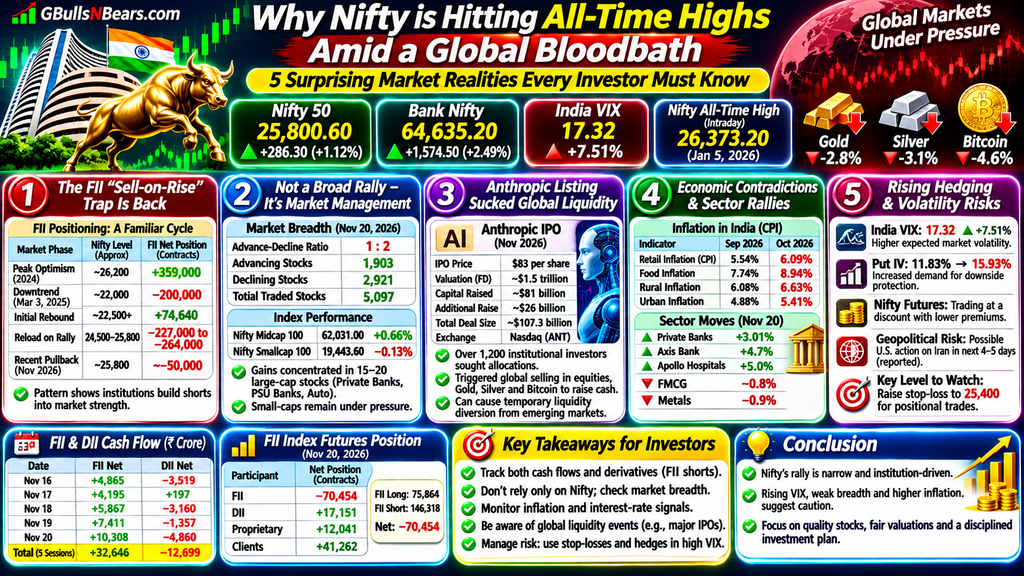
On November 20, 2026, the Nifty closed at 25,800.60, gaining 286.30 points or 1.12% in a single session. Bank Nifty performed even better, advancing 2.49% to 64,635.20.
However, the rally comes with an important qualification: the Nifty is approaching its previous record, not making a fresh all-time high. Its reported intraday record stands at 26,373.20, recorded on January 5, 2026.
More importantly, the broader market and derivatives data reveal a more complicated picture. India VIX increased, small-cap stocks struggled, and foreign investors remained net short in index futures despite buying equities in the cash market.
This creates an important question: Is India’s stock market entering a sustainable bullish phase, or is the latest rally hiding risks beneath the surface?
Here are five important realities investors should understand.
Takeaway 1: The FII Double Game – Buying Stocks While Maintaining Futures Shorts
One of the most interesting developments in the current market is the difference between foreign institutional investors’ cash-market activity and their derivatives positioning.
On November 20, FIIs were significant net buyers in the cash market. However, their index futures positions remained net short.
Latest FII and DII activity
| Date | FII net cash (₹ crore) | DII net cash (₹ crore) |
|---|---|---|
| November 16 | +4,865 | -3,519 |
| November 17 | +4,195 | +197 |
| November 18 | +5,867 | -3,160 |
| November 19 | +7,411 | -1,357 |
| November 20 | +10,308 | -4,860 |
| Five-session total | +32,646 | -12,699 |
Source: Reported NSE cash-market flow data. Figures are provisional.
The figures show that foreign investors were strong buyers over these five sessions, while domestic institutions were net sellers overall.
But cash buying does not automatically mean that FIIs have become completely bullish.
What does the derivatives market reveal?
As of November 20, participant-wise index futures data showed:
| Participant | Net index futures position |
|---|---|
| FII | -70,454 contracts |
| DII | +17,151 contracts |
| Proprietary traders | +12,041 contracts |
| Clients | +41,262 contracts |
FIIs held 75,864 long contracts against 146,318 short contracts.
This means their index futures position remained net short by 70,454 contracts.
Why does this matter?
Institutional investors can buy individual shares in the cash market while simultaneously using index futures or options to hedge their overall portfolios.
Therefore, the combination of cash buying and futures shorts should not automatically be interpreted as market manipulation or a guaranteed sell-on-rise strategy. It may represent hedging, relative-value trades or different investment mandates.
Investor takeaway: Track cash flows and derivatives positioning together. Neither indicator should be interpreted independently.
Takeaway 2: Nifty Is Rising, but the Broader Market Is Not Equally Strong
A rising benchmark index does not necessarily mean that every part of the market is participating.
The November 20 market session demonstrated this divergence.
Indian market performance – November 20, 2026
| Index / Indicator | Closing level | Daily change |
|---|---|---|
| Nifty 50 | 25,800.60 | +1.12% |
| Bank Nifty | 64,635.20 | +2.49% |
| Nifty Midcap 100 | 62,031.00 | +0.66% |
| Nifty Smallcap 100 | 19,443.60 | -0.13% |
| India VIX | 17.32 | +7.51% |
The strongest sector was Private Banks, which gained approximately 3.01%. Media was among the weakest, declining 1.68%.
Market breadth also remained concerning. One reported market-wide snapshot showed 1,903 advancing stocks against 2,921 declining stocks across 5,097 traded counters.
That is a significant divergence from the headline index’s positive performance.
Why does this happen?
The Nifty is a market-capitalisation-weighted index. Large companies have greater influence on its movement than smaller companies.
Consequently, a strong rally in a relatively small number of heavyweight companies can lift the Nifty even when a substantial number of listed stocks decline.
This creates three different market experiences:
- Large-cap investors may see their portfolios recover.
- Mid-cap investors may experience relatively limited gains.
- Small-cap investors may continue to face selling pressure.
Investor takeaway: Never judge the health of the entire stock market using the Nifty’s closing level alone. Monitor advance-decline data, sector participation and equal-weighted market performance.
Takeaway 3: The Anthropic IPO Is a Major Liquidity Event, but Its Market Impact Needs Context
Artificial intelligence has become one of the most important investment themes in global financial markets.
The public offering of Anthropic, the company behind Claude AI, is another major milestone in this story.
According to its November 2026 offering documents and subsequent reporting:
| IPO metric | Reported figure |
|---|---|
| IPO price | $83 per share |
| IPO valuation | Approximately $1.5 trillion |
| Capital raised | Approximately $81 billion |
| Trading symbol | ANT |
| Exchange | Nasdaq |
| Additional private placement | Approximately $26 billion |
The offering has attracted enormous investor attention and represents one of the largest public-market transactions in history.
However, there is an important distinction between a large IPO and a global liquidity crisis.
An IPO can attract capital that might otherwise have been allocated to existing equities, bonds or other investments. But there is no verified evidence that the Anthropic offering alone caused simultaneous selling in gold, silver, Bitcoin and global technology stocks.
What should investors monitor?
There are three important areas:
- AI valuations: Are investors paying sustainable prices for future AI revenue?
- Infrastructure spending: Can AI companies generate sufficient returns on enormous computing commitments?
- Capital allocation: Will investors continue allocating money to established technology companies or shift toward new public offerings?
The broader AI industry is likely to remain an important driver of global investment sentiment.
For Indian investors, the impact may emerge through foreign portfolio flows, technology-sector valuations and changes in global risk appetite.
Investor takeaway: Treat the Anthropic IPO as an important global market catalyst, not as the proven single cause of every asset-class decline.
Takeaway 4: Inflation Is Back on the Radar – Why the RBI and Global Investors Must Pay Attention
Another important risk comes from inflation.
India’s latest official October 2026 Consumer Price Index release, published on November 12, showed that retail inflation increased to 6.09%.
Food inflation was even higher at 8.94%.
India’s October 2026 inflation snapshot
| Indicator | September 2026 | October 2026 |
|---|---|---|
| Retail CPI inflation | 5.54% | 6.09% |
| Food inflation | 7.74% | 8.94% |
| Rural CPI inflation | 6.08% | 6.63% |
| Urban CPI inflation | 4.88% | 5.41% |
Source: Ministry of Statistics and Programme Implementation, November 12, 2026.
The increase in retail inflation is significant because the RBI operates under an inflation-targeting framework with a 4% target and a tolerance band of 2% to 6%.
October’s 6.09% reading was marginally above the upper tolerance limit.
Why should equity investors care?
Higher inflation can influence:
- RBI monetary policy decisions.
- Government bond yields.
- Corporate borrowing costs.
- Consumer spending and discretionary demand.
- Banking-sector credit growth.
- Equity valuation multiples.
However, one inflation reading does not guarantee an immediate rate hike.
Investors should monitor subsequent CPI releases, core inflation, food prices, crude oil and RBI communication before assuming that monetary tightening is inevitable.
Which sectors could be sensitive?
| Sector | Potential inflation impact |
|---|---|
| Banking | Higher funding costs and possible credit-quality pressure |
| Realty | Borrowing affordability and housing demand |
| Auto | Vehicle financing costs and consumer demand |
| FMCG | Input costs and consumer purchasing power |
| Metals | Global demand, energy costs and commodity prices |
Investor takeaway: A strong stock-market rally cannot permanently ignore inflation, interest rates and earnings fundamentals.
Takeaway 5: India VIX Is Rising – The Market Is Signalling Caution
Perhaps the most important warning signal in the latest market data is the increase in India VIX.
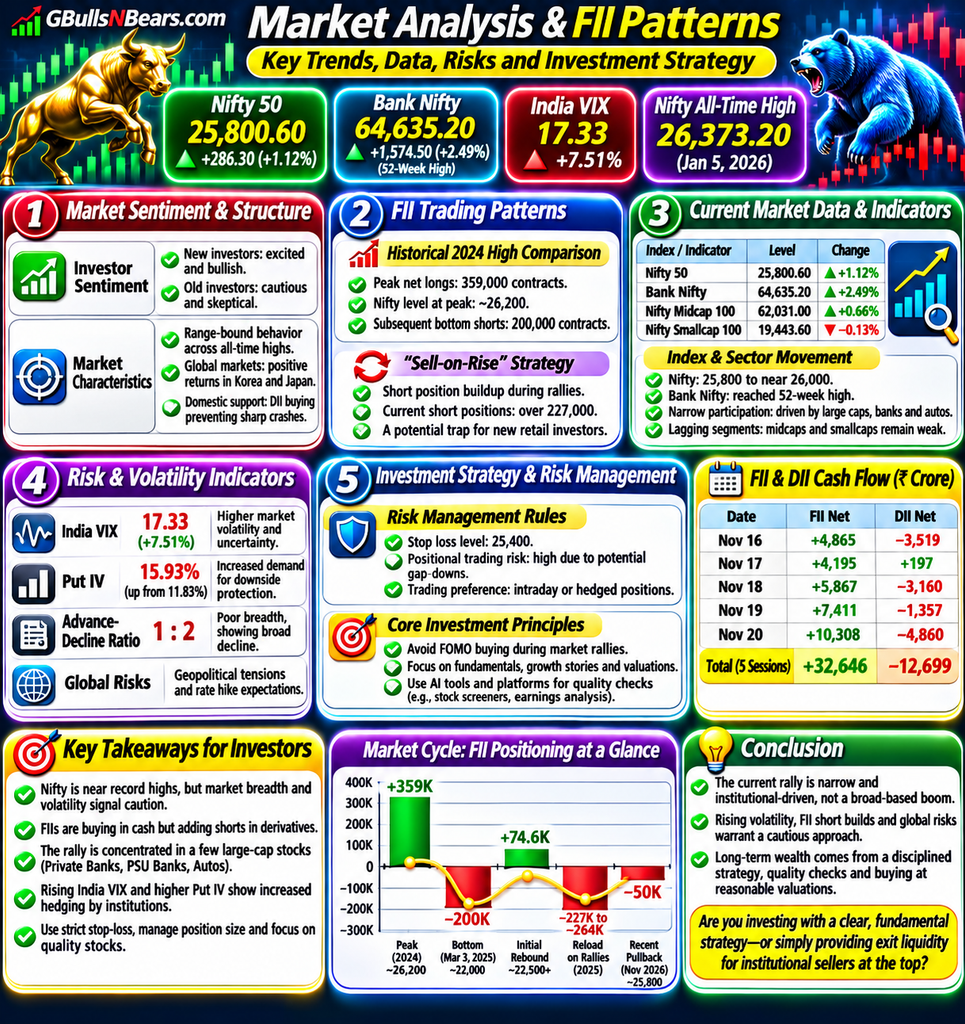
On November 20, Nifty gained 1.12%, but India VIX increased by 7.51% to 17.32.
This divergence deserves attention.
India VIX measures the market’s expected near-term volatility, derived from Nifty options prices. It is not a direct prediction of whether the market will rise or fall.
A rising VIX during a rising market can indicate that traders are paying more for protection against potential volatility.
What does the latest VIX reading suggest?
| Indicator | November 20 reading |
|---|---|
| India VIX | 17.32 |
| Daily increase | 7.51% |
| Nifty daily return | +1.12% |
| Market interpretation | Higher expected volatility |
A VIX reading of 17.32 does not automatically signal an impending crash. However, it indicates that investors should not assume that the market is entering a low-risk environment.
A practical Nifty trading framework
The Nifty’s previous record high of 26,373.20 remains an important reference point.
For short-term traders, the following framework can help:
| Market condition | Possible interpretation |
|---|---|
| Sustained move above 26,000 | Positive momentum, subject to breadth confirmation |
| Move toward 26,373 | Test of previous record territory |
| Rejection near resistance with weak breadth | Potential profit-booking risk |
| Breakdown below recent swing support | Reassess bullish positions |
| VIX continuing to rise | Reduce excessive leverage and review hedges |
These are scenario-based guidelines, not confirmed support or resistance levels. Traders should calculate precise levels from current price charts before placing orders.
Conclusion: Is Nifty’s Rally Strong Enough to Sustain?
The latest Nifty rally demonstrates that India’s equity market can remain resilient even when global markets are experiencing uncertainty.
But the underlying evidence suggests that investors should remain selective.
Five developments deserve attention:
- FIIs are buying in the cash market while maintaining net short index futures positions.
- Nifty’s gains are not being matched equally across the broader market.
- The Anthropic IPO represents a major global capital-market event, but its direct impact on other asset classes should not be overstated.
- India’s October inflation reading has moved above the RBI’s 6% upper tolerance limit.
- India VIX has increased even as the Nifty rallied.
The combination of these signals does not prove that a market crash is approaching. It does, however, suggest that a rising index should not be confused with an absence of risk.
What Should Long-Term Investors Do?
Long-term investors should concentrate on business fundamentals rather than daily index movements.
- Prefer companies with sustainable earnings growth.
- Check valuations before adding fresh positions.
- Maintain diversification across sectors.
- Avoid excessive leverage.
- Keep sufficient liquidity for market corrections.
- Use systematic investments rather than deploying all capital at one market level.
For short-term traders, position sizing and risk management become especially important when volatility increases.
The biggest lesson is simple: a strong Nifty does not mean every stock is safe, and rising volatility does not automatically mean the bull market is over.
The real opportunity lies in identifying quality businesses, understanding valuations and managing risk before the next major market move.
Frequently Asked Questions (FAQs)
1. Why is Nifty rising despite weak global markets?
Domestic buying, selective foreign institutional inflows, sector rotation and gains in heavyweight companies can support the Nifty even when global markets remain under pressure.
2. Are FIIs bullish on the Indian stock market?
On November 20, 2026, FIIs were net buyers of approximately ₹10,308 crore in the cash market. However, they remained net short by 70,454 contracts in index futures. This combination suggests that cash buying and derivatives hedging can coexist.
3. What does India VIX at 17.32 mean?
It indicates higher expected near-term market volatility compared with lower VIX readings. It does not independently predict a market crash or a particular direction.
4. Is Nifty at an all-time high?
No. Nifty closed at 25,800.60 on November 20, 2026. Its reported intraday record is 26,373.20, recorded on January 5, 2026.
5. How does inflation affect the Indian stock market?
Higher inflation can increase borrowing costs, affect consumer demand, influence RBI policy, and reduce the valuation investors are willing to pay for future corporate earnings.
6. Should investors sell stocks when India VIX rises?
Not automatically. Investors should review their portfolio risk, stock valuations, business fundamentals and investment horizon rather than making decisions using VIX alone.
Disclaimer: This article is for educational and informational purposes only. Market data and institutional positions are time-specific and may be revised. The analysis does not constitute investment advice or a recommendation to buy or sell any security. Derivatives trading involves substantial risk.
Top 10 SEO Titles
- Nifty Near All-Time Highs 2026: 5 Hidden Risks Every Investor Must Watch
- Nifty 50 Analysis: Why FIIs Are Buying Stocks but Still Holding Short Positions
- Indian Stock Market Outlook 2026: Is the Nifty Rally Hiding a Bigger Risk?
- FII vs DII Data November 2026: What Institutional Investors Are Signalling
- Nifty at 25,800: Is This a Genuine Bull Market or a Sell-on-Rise Trap?
- India VIX at 17.32: 5 Warning Signals Behind the Nifty Rally
- Nifty All-Time High Rally: The Truth About Market Breadth and FII Positioning
- Indian Stock Market Crash Warning? 5 Signals Smart Investors Should Track
- Anthropic IPO, Inflation and FII Flows: What Could Move the Indian Stock Market?
- Nifty 50 Forecast 2026: FII Shorts, Rising VIX and Key Market Levels