
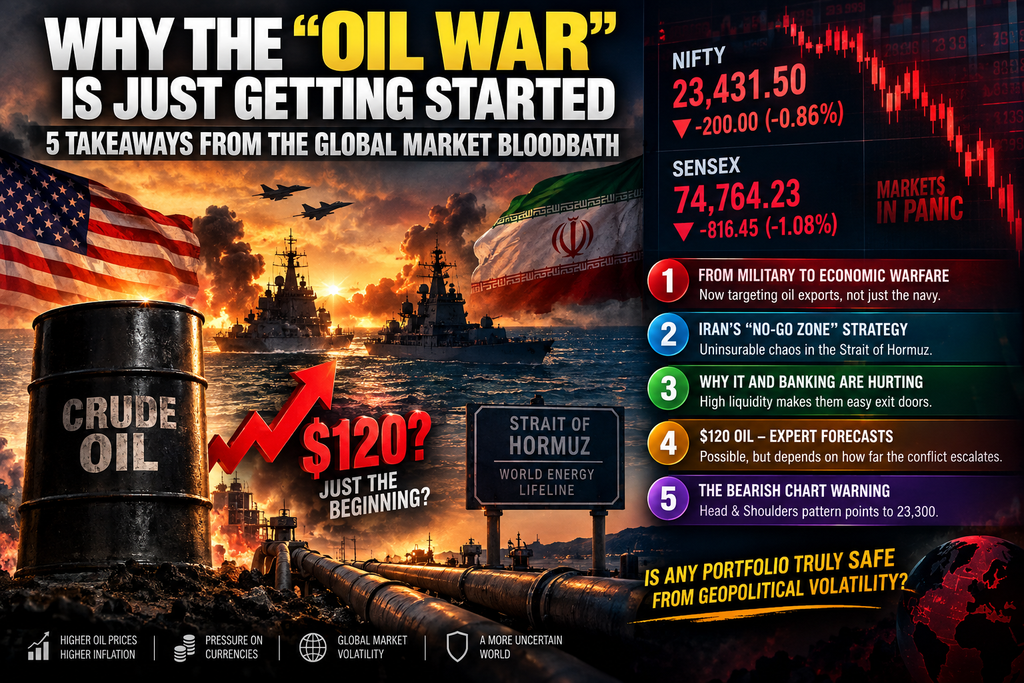
Global financial markets are once again facing a major geopolitical shock as the US-Iran conflict, Strait of Hormuz disruptions and rising crude oil prices combine to create a dangerous environment for investors.
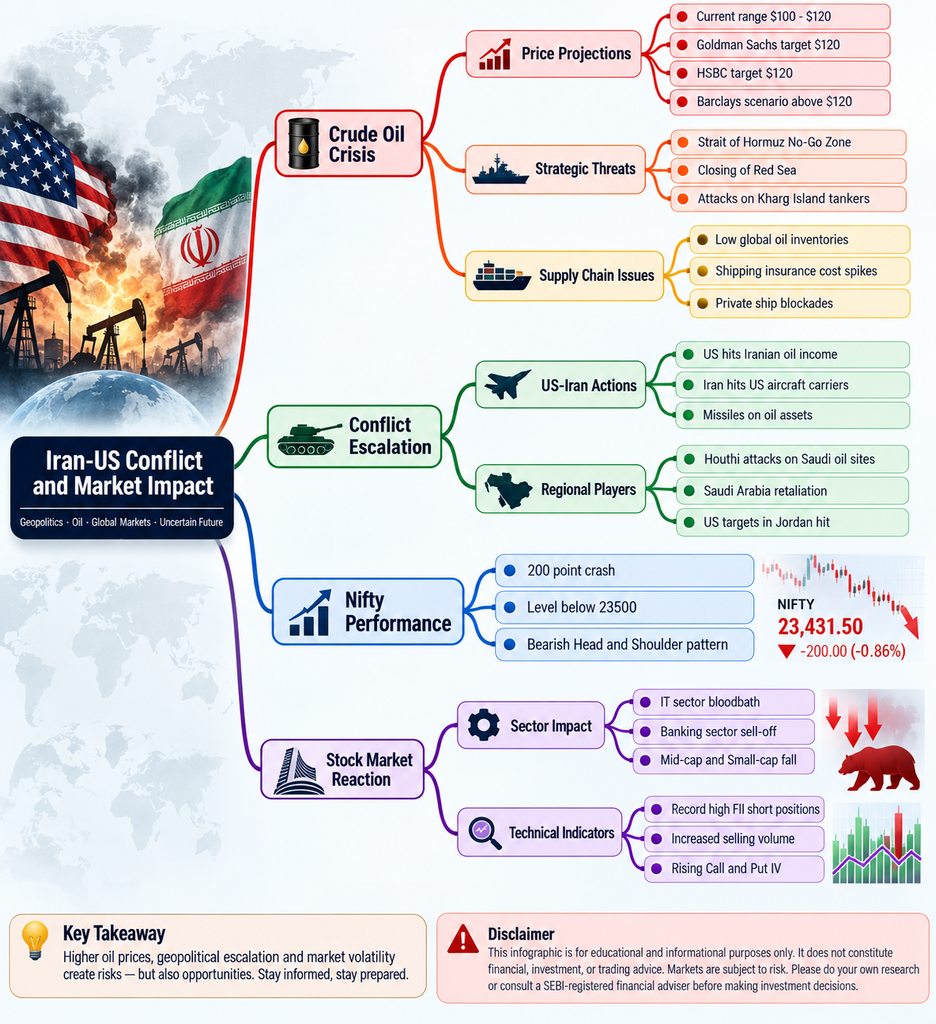
On September 9, 2026, the Nifty 50 fell 0.86% to 23,431.50, while the Sensex declined 1.08% to 74,764.23. Both indices touched their lowest levels since June 11. The sell-off came as Brent crude moved above $100 per barrel, increasing concerns about inflation, interest rates, corporate earnings and India’s oil import bill.
The pressure is particularly significant because the Strait of Hormuz is one of the world’s most important energy chokepoints. Current disruptions have reportedly reduced oil traffic through the strait dramatically, while attacks on shipping are adding a substantial geopolitical risk premium to crude.
The big question is no longer simply whether oil can reach $100.
The bigger question is whether prolonged disruption can push Brent toward $120—or even higher.
Here are five key takeaways investors should watch.
1. The Conflict Is Moving From Military Targets to Economic Warfare
The latest escalation indicates that the conflict is increasingly affecting the economic infrastructure behind the war.
The United States has destroyed Iranian oil tankers following attacks involving Iranian forces, while Iran has threatened or carried out attacks against vessels operating around the Strait of Hormuz. Iran has also claimed attacks on multiple vessels in the region.
This is an important change.
Military assets can be replaced or repositioned. But when oil exports, shipping routes, insurance and energy infrastructure become targets, the consequences spread far beyond the battlefield.
The economic objective becomes clear:
Attack the flow of money, energy and trade—and the entire global economy feels the impact.
The risk is particularly serious for Iran because the country’s oil-export infrastructure is closely connected to the Gulf shipping system.
For global markets, however, the bigger danger is the possibility of a prolonged disruption rather than a single attack.
2. Strait of Hormuz Has Become the Global Oil Chokepoint
The Strait of Hormuz is at the centre of the current oil crisis.
Approximately one-fifth of global oil and LNG supply normally passes through the waterway, according to Goldman Sachs.
Current disruptions have reportedly reduced oil flows through the strait from around 8 million barrels per day to roughly 1 million barrels per day, dramatically tightening the effective availability of Gulf crude.
This is where the insurance problem becomes extremely important.
Iran does not necessarily need to physically stop every tanker.
If shipping companies begin facing:
- Extremely high insurance premiums
- Security restrictions
- Delayed voyages
- Higher freight costs
- Greater risk of vessel damage
- Difficulty obtaining financing
then the economic effect can resemble a partial blockade.
The real danger: “Uninsurable” shipping
Oil markets are not dependent only on the physical availability of crude.
They also depend on the ability to transport, insure, and finance that crude.
That means even if oil remains physically available in the Middle East, the market can experience a supply shock if shipping becomes too risky.
3. Why Indian Stocks—Especially IT and Banking—Are Under Pressure
India is particularly vulnerable to an oil shock because higher crude prices can quickly affect the country’s import bill, inflation, currency,y and interest-rate expectations.
The September 9 market sell-off demonstrates this vulnerability.
September 9, 2026 market snapshot
| Indicator | Latest move |
|---|---|
| Nifty 50 | 23,431.50 |
| Nifty daily change | -0.86% |
| Sensex | 74,764.23 |
| Sensex daily change | -1.08% |
| Brent crude | Above $100/barrel |
| Nifty IT | -3.2% |
| Small-cap index | -0.5% |
| Mid-cap index | -0.5% |
IT stocks were among the biggest losers, with the sector falling around 3.2% during Wednesday’s session.
This does not necessarily mean that the fundamentals of Indian IT companies suddenly deteriorated.
In a geopolitical sell-off, investors often liquidate the most liquid positions first.
That creates an uncomfortable paradox:
High-quality, highly liquid sectors can become selling targets precisely because institutional investors can exit them quickly.
Banking stocks can also suffer because prolonged oil inflation can create concerns about:
- Higher inflation
- Higher bond yields
- Delayed monetary easing
- Rupee depreciation
- Slower economic growth
- Higher corporate financing costs
In other words, oil becomes a macro problem rather than merely an energy-sector problem.
4. Can Brent Crude Really Reach $120?
This is the biggest question confronting the market.
The answer is:
Yes, $120 is possible—but it is not currently the base case.
Goldman Sachs has warned that Brent could rise toward $120 per barrel if attacks on Middle Eastern shipping intensify and oil flows remain severely disrupted.
Goldman’s current framework is more nuanced than the headline “$120 oil” suggests.
Its latest estimates include:
- December 2026 Brent forecast: around $85
- 2027 average forecast: around $80
- Escalation scenario: Brent potentially above $120
- A more severe and prolonged Gulf supply disruption could create substantially higher prices.
HSBC has also raised its oil outlook and described a potential “disrupted new normal” in which the Strait of Hormuz is neither completely open nor completely closed. HSBC’s Q4 Brent forecast is around $95, while its 2027 forecast was raised to about $85.
Oil-price scenarios
| Scenario | Possible Brent range | Market implication |
|---|---|---|
| Rapid de-escalation | $80–$90 | Relief rally in equities |
| Persistent disruption | $95–$105 | Inflation pressure remains |
| Severe shipping disruption | $110–$120+ | Major global risk-off event |
| Full regional supply shock | $120+ | Potential global inflation shock |
The critical point is that $120 is an escalation scenario, not an inevitability.
If shipping normalizes, additional non-Middle Eastern supply and weaker demand could push prices substantially lower.
5. The Nifty Technical Picture Is Turning Dangerous
The fundamental oil shock is being reinforced by technical weakness.
The Nifty has now fallen to 23,431.50, its lowest level since June 11, according to Wednesday’s market data.
The previously important 23,500 psychological level has been decisively breached.
That changes the short-term technical structure.
Key Nifty levels to watch
23,500:
Immediate psychological resistance. A sustained move back above this level would be the first sign that selling pressure is easing.
23,300:
Important downside zone. A decisive break could increase bearish momentum.
23,000:
Major psychological support and the next major level bears could target if geopolitical pressure continues.
22,800–22,700:
Potential deeper support zone if oil remains above $100 and global risk sentiment deteriorates further.
The market is also becoming increasingly vulnerable to short covering.
That creates an unusual setup:
Bearish fundamental picture + oversold technical conditions
The fundamental backdrop remains negative:
- Oil above $100
- Hormuz disruption
- Geopolitical escalation
- Foreign investor selling
- Inflation concerns
- Rupee pressure
- Global risk aversion
But if there is suddenly a ceasefire announcement, successful diplomatic negotiation, or evidence that oil shipments are returning to normal, heavily shorted positions could unwind extremely quickly.
That could create a sharp short-covering rally even without a major improvement in the underlying economic picture.
The Hidden Risk: Oil Can Become an Inflation Shock
The most important second-order effect of the current crisis may not be the oil price itself.
It is what central banks do because of oil.
Higher crude prices can feed into:
Oil → Transportation costs → Production costs → Consumer prices → Inflation expectations → Interest rates → Equity valuations
For India, the transmission mechanism can also include:
Higher crude → Larger import bill → Rupee pressure → Imported inflation
That is why a prolonged oil shock could be significantly more damaging than a temporary spike.
If Brent briefly touches $110 and then falls back toward $85, markets can absorb the shock.
But if crude remains above $100 for several months, the consequences become much more serious.
What Investors Should Watch Now
The next few sessions are likely to revolve around five variables.
1. Strait of Hormuz traffic
This is arguably the most important indicator.
If shipping activity begins returning toward normal levels, the oil risk premium could fall rapidly.
2. Brent crude
The key levels are now psychologically important:
$100 → $105 → $110 → $120
A sustained move above $100 is significantly different from an intraday spike.
3. Nifty 23,500
The market needs to reclaim 23,500 and then establish support above it.
Failure to do so keeps the bearish structure intact.
4. Rupee
A prolonged oil rally combined with foreign outflows could put additional pressure on the Indian rupee.
5. FII positioning
If foreign investors continue reducing Indian equity exposure, highly liquid sectors such as financials and IT can remain under pressure even when company-specific fundamentals are unchanged.
Final Takeaway: The Real Oil War Is About Duration
The biggest mistake investors can make right now is focusing only on the headline oil price.
The real variable is duration.
If the conflict is resolved quickly, Brent can fall sharply as the geopolitical risk premium disappears.
But if the Strait of Hormuz remains impaired for weeks or months, the global economy faces a very different environment.
A prolonged disruption could mean:
$100+ oil → higher inflation → higher yields → weaker currencies → lower equity valuations.
And that is why the current market sell-off deserves attention.
The Nifty’s fall below 23,500 is not merely a technical event. It is occurring at the same time that Brent has crossed $100 and geopolitical risk around one of the world’s most important energy corridors is increasing.
At the same time, investors should not assume that $120 oil is guaranteed. Goldman Sachs itself treats $120 as an escalation scenario, while its central forecasts remain considerably lower.
The next major market catalyst could therefore be the exact opposite of today’s fear:
Any credible ceasefire, reopening of Hormuz or normalization of shipping could trigger a powerful relief rally.
Until that happens, however, the combination of oil above $100, geopolitical escalation and a Nifty below 23,500 keeps the risk-reward equation firmly tilted toward caution.
Disclaimer
This article is intended strictly for educational and informational purposes only and should not be considered financial, investment, trading, legal, tax, or professional advice. The views, market analysis, price levels, forecasts, scenarios, and opinions expressed in this article are based on publicly available information and are subject to change without notice.
Financial markets, crude oil prices, geopolitical developments, currencies, and individual securities can be highly volatile and unpredictable. References to possible oil prices, Nifty levels, market targets, support/resistance levels, or potential scenarios are not guaranteed predictions or recommendations to buy, sell, or hold any security or financial instrument.
Past market performance does not guarantee future results. Investors should conduct their own research and consider their financial objectives, risk tolerance, and investment horizon before making any investment or trading decision. Where appropriate, investors should consult a SEBI-registered investment adviser or other qualified financial professional.
The publisher/author accepts no responsibility for any financial loss, direct or indirect, arising from reliance on the information presented in this article. Any trading or investment decision made based on this content is entirely at the reader’s own risk.
Important: Geopolitical events, oil prices, market conditions, and government policies can change rapidly. Readers should independently verify the latest information before acting on any market-related information.
Alternative SEO Titles
- Oil Price Crisis 2026: Why $120 Crude Could Trigger a Global Market Shock
- Nifty Crash Today: Strait of Hormuz, $100 Oil and the Risk of $120 Crude
- US-Iran Conflict: Why Rising Oil Prices Are Hitting Nifty and Indian Stocks
- Brent Crude Above $100: What $120 Oil Means for Nifty, Rupee and Inflation
- Strait of Hormuz Crisis: 5 Things Investors Must Know About $120 Oil
- Nifty Below 23,500: Is the Oil War Creating a Bigger Stock Market Crash?
- Oil War 2026 Explained: Hormuz Crisis, $120 Brent and the Indian Market
- Why Oil Above $100 Is Dangerous for Nifty, Banks and IT Stocks
- Goldman Sachs $120 Oil Warning: What It Means for Global Markets
- Oil Shock 2026: Will the Strait of Hormuz Crisis Push Brent to $120?