
Introduction: The Political Shock That Changed Global Market Sentiment
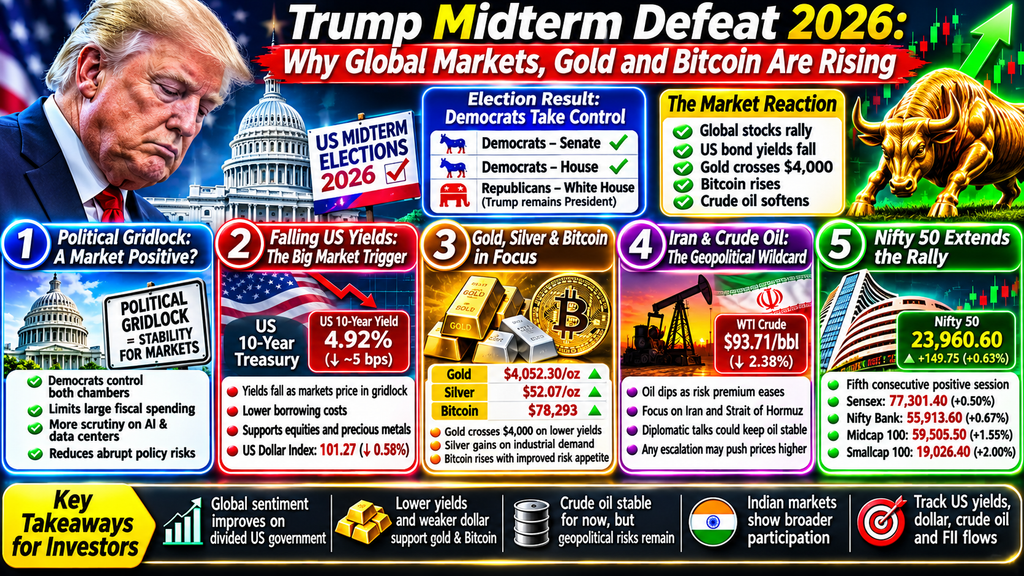
The November 2026 US midterm elections have delivered a major political setback to President Donald Trump. Democrats secured control of both the Senate and the House of Representatives, creating a divided political environment in Washington for the remainder of Trump’s presidency.
Initially, financial markets reacted nervously.
Asian equities came under pressure as investors assessed the possibility of tougher AI regulations, changes in government spending priorities and uncertainty surrounding future US economic policies.
However, the market reaction subsequently changed.
US equities recovered, Treasury yields moved lower, the US dollar weakened, and gold climbed above the psychologically important $4,000-per-ounce level. Silver and Bitcoin also advanced, while crude oil prices declined.
Indian equities extended their winning streak, with the Nifty 50 closing at 23,960.60 on November 4, 2026.
This unusual combination of political uncertainty and improving financial-market sentiment raises an important question:
Why are investors responding positively to a major political defeat for the US President, and what does this mean for global markets, commodities and Indian investors?
The answer involves five important developments: political gridlock, falling bond yields, geopolitical uncertainty, institutional positioning and the changing relationship between global markets and the US dollar.
1. Political Gridlock: Why Wall Street May Welcome a Divided Government
The Democratic victory changes the political balance in Washington.
With Democrats controlling both chambers of Congress and Republicans retaining the presidency, passing major legislation could become more difficult.
This situation is commonly known as political gridlock.
Although political gridlock can slow government decision-making, financial markets sometimes welcome it because it can reduce the probability of sudden legislative changes.
Why investors may prefer balanced political power
A divided government can create several potential market implications:
- Major spending proposals may face stronger congressional scrutiny.
- New tax legislation could become more difficult to pass.
- Technology and AI companies may face increased regulatory debate.
- Large fiscal expansion plans may encounter legislative resistance.
- Trade and tariff policies may remain uncertain because the executive branch retains important powers.
For investors, the central issue is policy predictability.
Markets generally prefer a stable regulatory environment because businesses can make investment decisions with greater confidence.
Why AI stocks could face additional pressure
One of the major concerns following the Democratic victory is the possibility of stronger scrutiny of artificial intelligence infrastructure.
The AI industry requires enormous capital investment in:
- Data centres.
- Advanced semiconductors.
- Electricity infrastructure.
- Cooling systems.
- Cloud computing facilities.
- High-performance networking equipment.
If policymakers introduce stricter rules around AI infrastructure, government support or data-centre expansion, some companies could face higher compliance costs or slower project approvals.
However, increased regulation does not automatically mean that AI investment will collapse.
Demand for computing capacity, enterprise automation and cloud infrastructure remains an important long-term factor.
Investor takeaway: Political gridlock can reduce some policy risks, but investors should distinguish between regulatory uncertainty and an actual deterioration in corporate earnings.
2. Falling US Treasury Yields: The Biggest Macro Signal Behind the Rally
The bond market is one of the most important indicators to monitor after a major political event.
Following the election results, investors moved towards US government bonds, pushing Treasury prices higher and yields lower.
On November 4, the US 10-year Treasury yield was around 4.92% in the morning market snapshot, approximately five basis points lower than the previous reference level reported by Reuters.
This movement matters because Treasury yields influence borrowing costs and asset valuations across the global financial system.
Why falling bond yields matter
When bond prices rise, yields generally decline.
Lower Treasury yields can support financial markets through several channels:
- Lower discount rates can improve the valuation of future corporate earnings.
- Government bonds become relatively less attractive to some investors when yields decline.
- A weaker US dollar can improve the relative appeal of emerging-market assets.
- Lower yields can support precious metals by reducing the opportunity cost of holding non-yielding assets.
- Global borrowing conditions may become more favourable if the decline is sustained.
However, falling yields do not always indicate an improving economy.
Yields can decline because investors expect lower inflation, weaker economic growth, monetary easing or greater demand for safe-haven assets.
The reason behind the movement is therefore just as important as the movement itself.
US Treasury and dollar snapshot
| Indicator | November 4, 2026 snapshot |
|---|---|
| US 10-year Treasury yield | Approximately 4.92% |
| US Dollar Index | 101.27 |
| Dollar Index change | -0.58% |
| Gold | $4,052.30/oz |
| WTI crude oil | $93.71/barrel |
| Bitcoin | $78,293 |
These are indicative market quotes from the November 4 morning US-market snapshot, not guaranteed closing prices.
Why the US dollar matters to India
A weaker US dollar can support emerging-market currencies and improve foreign investor appetite for selected markets.
For India, the relationship between the dollar, crude oil and foreign investment is particularly important.
A weaker dollar may provide some relief to the rupee, but higher crude oil prices or other domestic and international factors can offset that benefit.
Investor takeaway: Monitor the US 10-year yield and Dollar Index together. Their direction can influence gold, emerging-market equities, currencies and global capital flows.
3. Gold Above $4,000, Silver and Bitcoin: Why Alternative Assets Are Rising
One of the most interesting developments following the US election has been the simultaneous strength in precious metals and selected digital assets.
Gold crossed $4,000 per ounce, while silver and Bitcoin also advanced.
This suggests that investors are reassessing currency exposure, interest-rate expectations and geopolitical risk.
Gold: A new psychological milestone
Gold reached approximately $4,052 per ounce in the November 4 morning market snapshot.
Several factors may support gold prices:
- Lower US Treasury yields.
- A weaker US dollar.
- Geopolitical uncertainty.
- Central-bank demand.
- Portfolio diversification.
- Expectations about future monetary policy.
Gold does not pay interest or dividends. Therefore, declining bond yields can improve its relative attractiveness.
However, gold prices can also experience sharp corrections if the dollar strengthens or real yields rise.
Silver: More than a precious metal
Silver has two important demand sources.
Investment demand: Investors use silver as a precious-metal allocation.
Industrial demand: Silver is used in solar panels, electronics, electrical equipment and several industrial applications.
This means silver can respond to both monetary conditions and expectations for industrial activity.
A stronger global manufacturing outlook may support industrial demand, while a weaker economic outlook can create pressure.
Bitcoin: The digital asset response
Bitcoin also advanced to approximately $78,293 in the November 4 morning snapshot.
Its price movement may reflect improving risk appetite, changing liquidity expectations and investor positioning.
However, Bitcoin is not equivalent to gold.
Gold has a long history as a reserve and investment asset, whereas Bitcoin remains a highly volatile digital asset exposed to regulatory, technological and liquidity risks.
Asset performance snapshot
| Asset | November 4 snapshot | Market interpretation |
|---|---|---|
| Gold | $4,052.30 | Strong safe-haven and monetary demand |
| Silver | $52.07 | Precious-metal and industrial demand |
| Bitcoin | $78,293 | Improving risk appetite |
| WTI crude | $93.71 | Lower energy-price pressure |
Investor takeaway: Gold, silver and Bitcoin may all rise during a period of changing monetary expectations, but their underlying risks and investment characteristics are very different.
4. Iran, the Strait of Hormuz and the Geopolitical Risk Premium
The US political transition is taking place against a complicated geopolitical background.
The relationship between Washington and Tehran remains important for global energy markets.
One of the most strategically significant locations is the Strait of Hormuz.
The Strait connects the Persian Gulf with international shipping routes and is a critical passage for global oil and gas transportation.
Any serious disruption could increase energy prices and create uncertainty for importing countries.
Why crude oil reacted to the political developments
Crude oil prices moved lower following the election-related market developments.
In the November 4 morning snapshot, WTI crude was approximately $93.71 per barrel, down around 2.38%.
This decline can reflect changing expectations about geopolitical risk, future sanctions, and the possibility of diplomatic engagement.
However, investors should not assume that the election automatically guarantees a diplomatic settlement with Iran.
Oil prices also depend on:
- OPEC+ production decisions.
- US crude production.
- Global inventories.
- Chinese and Indian demand.
- Shipping and insurance costs.
- Sanctions.
- Actual developments around the Strait of Hormuz.
Two possible geopolitical scenarios
| Scenario | Possible development | Potential market impact |
|---|---|---|
| Diplomatic de-escalation | Negotiations progress and shipping risks ease | Lower oil risk premium, improved sentiment |
| Military escalation | Conflict or shipping disruption intensifies | Higher crude prices, inflation concerns and volatility |
A third possibility is an extended period of uncertainty in which diplomatic discussions continue without a lasting agreement.
That scenario could keep crude oil volatile without producing a decisive market direction.
Why India is particularly exposed
India imports a large proportion of its crude oil requirements.
A sustained increase in crude prices can affect:
- Inflation.
- The current account deficit.
- The rupee.
- Aviation and transportation costs.
- Oil marketing companies.
- Paint, chemicals and industrial manufacturers.
Therefore, Indian investors should not ignore developments in the Middle East even when domestic equities are rising.
Investor takeaway: Watch Brent crude, shipping developments and the rupee. These indicators can reveal whether geopolitical uncertainty is becoming an economic problem for India.
5. The Nifty 24,000 Rally: Why Some Investors Still Feel Left Behind
While global markets were reacting to the US election, Indian equities extended their recovery.
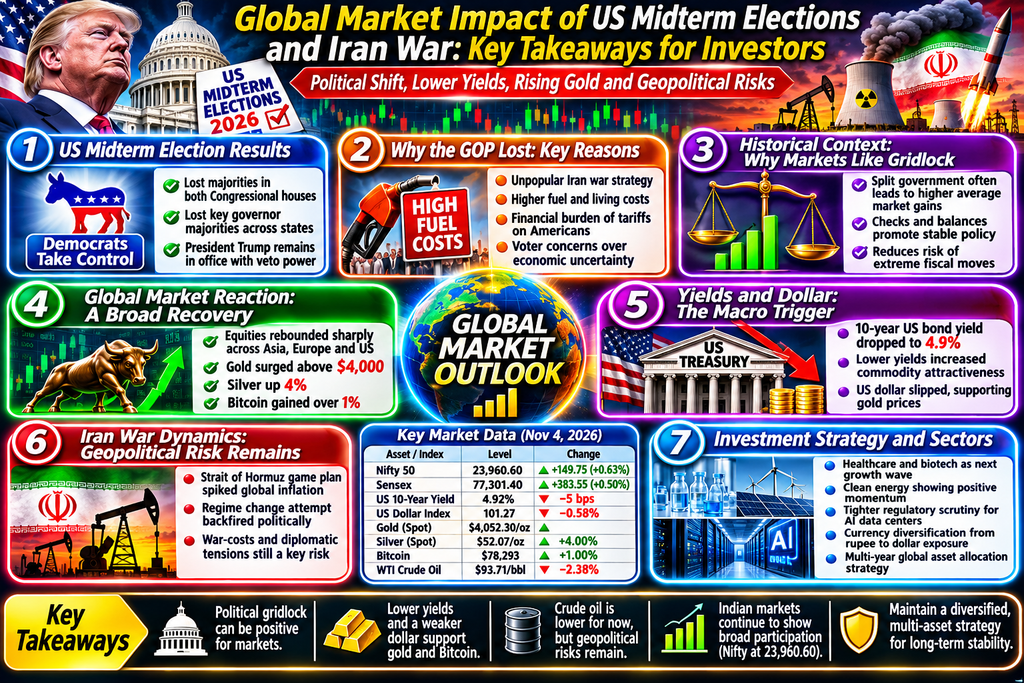
The Nifty 50 closed at 23,960.60 on November 4, gaining 149.75 points or 0.63%.
The Sensex finished at 77,301.40, up 383.55 points or 0.50%.
The Indian market also recorded its fifth consecutive positive session.
Indian stock market data: November 4, 2026
| Index | Closing level | Daily change |
|---|---|---|
| Nifty 50 | 23,960.60 | +0.63% |
| Sensex | 77,301.40 | +0.50% |
| Nifty Bank | 55,913.60 | +0.67% |
| Nifty Midcap 100 | 59,505.50 | +1.55% |
| Nifty Smallcap 100 | 19,026.40 | +2.00% |
Market breadth improved
An important development was the improvement in broader market participation.
On November 4:
- 36 Nifty 50 stocks advanced.
- 14 Nifty 50 stocks declined.
- Approximately 2,948 shares advanced across the reported BSE market breadth.
- Approximately 1,260 shares declined.
This is an important difference from a rally driven entirely by a handful of heavyweight stocks.
Mid-cap and small-cap indices also outperformed the Nifty 50 during the session.
Therefore, the November 4 data suggests that buying participation was broader than the narrow-rally theory in the original market commentary might imply.
Why retail portfolios can still underperform
Even when benchmark indices rise, individual portfolios may fail to recover.
There are several possible reasons:
- A portfolio may contain small-cap stocks that have not participated in the rally.
- Some sectors may remain under pressure.
- Stocks purchased at higher valuations may need stronger earnings growth.
- A few heavyweight index constituents can influence benchmark performance disproportionately.
- Investors may hold stocks with weak technical structures or deteriorating fundamentals.
A rising index does not guarantee that every investor will make money.
Investor takeaway: Compare your portfolio with the relevant sector and market benchmark. Do not judge portfolio performance only by looking at the Nifty’s closing level.
6. FII Positioning: Short Covering or Fresh Institutional Buying?
Institutional positioning is another important factor behind the recent rally.
The original market thesis suggests that part of the recovery may have been driven by FII short covering rather than fresh long accumulation.
This is a reasonable possibility to investigate, but the claim that more than 32,000 short contracts were closed in a single session should be supported by the corresponding exchange participant-wise data before being presented as a confirmed figure.
Why short covering can create sharp rallies
Suppose an institutional trader holds a large short position in Nifty futures.
If the market suddenly rises, the trader may face mark-to-market losses.
To reduce risk, the trader may buy back futures contracts.
When several large participants cover short positions simultaneously, the resulting buying pressure can accelerate the rally.
This is known as a short-covering rally.
Short covering versus fresh long accumulation
| Indicator | Short covering | Fresh long accumulation |
|---|---|---|
| Price | Rising | Rising |
| Short positions | Declining | May decline or remain stable |
| Long positions | May not increase significantly | Increasing |
| Open interest | Often declines | Often increases |
| Market interpretation | Potentially temporary momentum | Potentially stronger bullish conviction |
These are general interpretations, not universal rules. Open interest must be analysed alongside price changes, participant positions and contract-level activity.
What investors should monitor
- FII long and short index futures.
- Changes in total open interest.
- Nifty futures premium or discount.
- Options implied volatility.
- Put-call ratio.
- Cash-market FII/DII activity.
- Market breadth.
A short-covering rally can continue longer than expected. It should not automatically be treated as an opportunity to sell.
7. Global Market Snapshot: November 4, 2026
The election results triggered a notable repricing across several financial assets.
| Market indicator | November 4 snapshot |
|---|---|
| S&P 500 | 7,568.92 |
| Dow Jones | 51,786.72 |
| Nasdaq Composite | 25,372.01 |
| US 10-year Treasury yield | 4.92% |
| US Dollar Index | 101.27 |
| Gold | $4,052.30 |
| WTI crude oil | $93.71 |
| Bitcoin | $78,293 |
US equity and asset prices above are from the November 4 morning market snapshot. Intraday prices can change substantially.
The important observation is that global markets did not move in a single direction throughout the session.
Asian markets initially experienced risk aversion. US equities subsequently recovered as investors reassessed the political outcome and its implications.
This is why investors should avoid drawing long-term conclusions from the first reaction to an election result.
8. What Should Indian Investors Do Now?
The combination of falling Treasury yields, gold strength, changing oil prices and improving Indian equity breadth creates opportunities, but it also demands discipline.
For long-term investors
- Focus on company earnings and cash-flow generation.
- Avoid buying stocks only because the Nifty is rising.
- Diversify across sectors and asset classes.
- Monitor the rupee and international commodity prices.
- Avoid excessive concentration in highly valued stocks.
For swing traders
- Wait for price confirmation before entering a trade.
- Use sector strength to identify better-performing stocks.
- Track volume and delivery data.
- Monitor Nifty futures positioning and India VIX.
- Define stop-losses before entering positions.
For options traders
- Monitor implied volatility before buying options.
- Understand time decay and changes in option Greeks.
- Avoid assuming that a bullish index automatically means profitable call buying.
- Use defined-risk strategies where appropriate.
- Avoid excessive leverage during major geopolitical events.
Five indicators to watch
| Indicator | Why it matters |
|---|---|
| US 10-year Treasury yield | Global interest-rate expectations |
| US Dollar Index | Dollar strength and emerging-market flows |
| Brent crude oil | Inflation and India’s import bill |
| India VIX | Expected Indian equity volatility |
| FII derivatives positioning | Institutional hedging and directional exposure |
Conclusion: The Political Shock Is Over, but the Market Story Is Not
The 2026 US midterm elections have changed the political balance in Washington and triggered a major reassessment across global financial markets.
The immediate reaction included lower Treasury yields, a weaker dollar, gold above $4,000, and renewed strength in selected equity markets.
India also benefited from improving global sentiment, with the Nifty 50 closing at 23,960.60 on November 4.
But investors should not confuse a positive short-term reaction with a permanent improvement in global economic conditions.
Three major uncertainties remain:
- Whether political gridlock will create a more predictable US policy environment or increase regulatory uncertainty.
- Whether falling Treasury yields and a weaker dollar can sustain support for global assets.
- Whether geopolitical developments involving Iran and the Strait of Hormuz will lead to diplomatic progress or renewed energy-market volatility.
For Indian investors, the most important lesson is simple:
Do not trade political headlines alone. Follow the movement of bonds, currencies, commodities, institutional flows and corporate earnings.
The global rally may continue, but the next major market direction will depend on whether improving sentiment is supported by sustainable economic and financial fundamentals.
Frequently Asked Questions (FAQs)
1. Why did global markets react positively to Trump’s midterm defeat?
Democrats secured control of both chambers of Congress, increasing the possibility of political gridlock. Some investors viewed this as a potential constraint on abrupt policy changes and fiscal expansion. Markets also reacted to falling Treasury yields and a weaker US dollar.
2. Why did gold cross $4,000 per ounce?
Gold benefited from lower Treasury yields, a weaker dollar and demand for portfolio diversification amid political and geopolitical uncertainty.
3. How does the US election affect the Indian stock market?
US political developments can influence global liquidity, the dollar, Treasury yields, foreign institutional flows and risk appetite. These factors can affect Indian equities and the rupee.
4. Why are US Treasury yields important for Indian investors?
US Treasury yields influence global borrowing costs and investment returns. Changes in yields can affect capital flows, emerging-market currencies, gold and equity valuations.
5. Can falling crude oil prices benefit India?
Yes. Lower crude prices can reduce India’s import bill and ease inflationary pressure. They can also support industries with significant energy and transportation expenses.
6. Is Bitcoin a safe-haven asset like gold?
No. Bitcoin is a volatile digital asset with different risk characteristics from gold. Although both can rise during periods of changing monetary expectations, they should not be treated as equivalent investments.
7. Will the Nifty 50 cross 24,000?
The Nifty closed at 23,960.60 on November 4, 2026. A sustained move above 24,000 would require continued buying and market confirmation. No price target is guaranteed.
8. Should investors buy gold after it crosses $4,000?
Not simply because it has crossed a psychological price level. Investors should consider valuation, portfolio allocation, volatility, investment horizon,n and the risks of buying after a sharp rally.
Disclaimer
This article is for educational and informational purposes only. It is not investment advice or a recommendation to buy or sell stocks, commodities, cryptocurrencies, es or derivatives. Market prices are time-sensitive and may change. Political developments and geopolitical scenarios are uncertain. Investors should conduct independent research and consult a SEBI-registered investment adviser before making financial decisions.
Top 10 SEO Titles
- Trump Midterm Defeat 2026: Why Global Markets, Gold and Bitcoin Are Rising
- US Midterm Elections 2026: How Trump’s Defeat Is Impacting Global Markets
- Global Stock Market Rally 2026: Gold, Bitcoin and Nifty Surge After US Elections
- Trump Election Setback: Why Gold Crossed $4,000 and Treasury Yields Fell
- US Midterm Election Impact on India: What Nifty Investors Should Know
- Gold Above $4,000: How US Politics and Falling Bond Yields Are Driving Prices
- Trump vs Democrats 2026: What the Election Means for Wall Street and Investors
- Nifty 50 Market Outlook 2026: US Election, Crude Oil and FII Investment Trends
- US Treasury Yields Fall: Why Gold, Silver and Bitcoin Are Gaining
- Global Market Analysis 2026: Trump, Iran Tensions and the Future of Investments