
The 150-Point Nifty Mystery: 5 Hidden Signals Behind India’s Latest Market Rally
The Indian stock market has just delivered one of its most unusual trading sessions in recent memory.
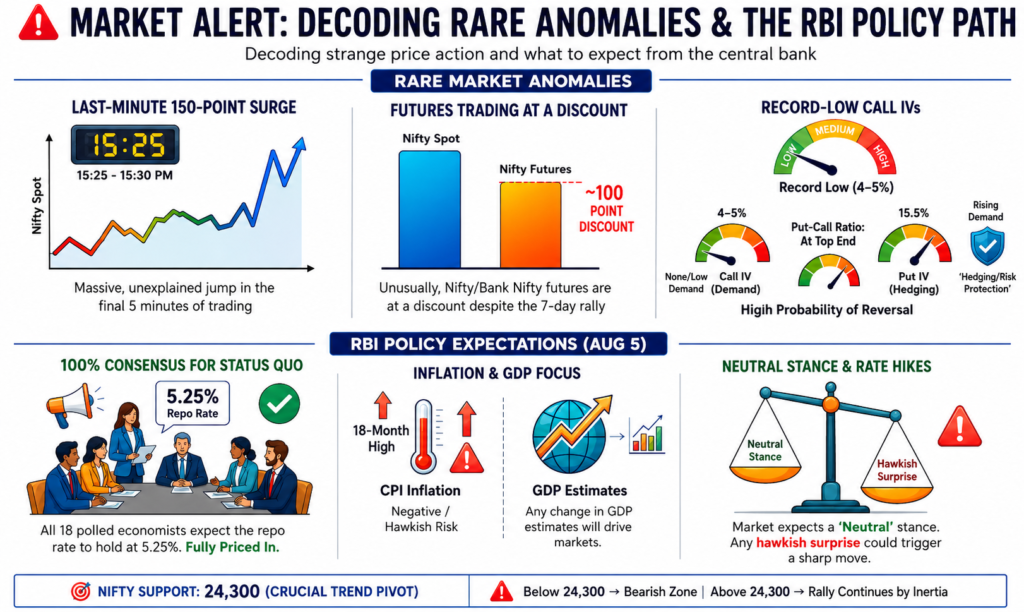
During the last five minutes of trading, both the Nifty 50 and Bank Nifty suddenly surged nearly 150 points, creating an impressive green close that looked bullish on the surface.
But beneath that spectacular finish lies a very different story.
Professional traders don’t judge a rally simply by price. They study futures premiums, options positioning, institutional participation, implied volatility, and open interest.
When those internal indicators disagree with price, caution becomes more important than optimism.
Let’s examine the five hidden signals suggesting this rally may not be as strong as it appears.
1. The 150-Point Closing Auction Surprise
The most surprising event was the massive jump during the final minutes of trading.
Normally, genuine breakouts are supported by:
- Heavy institutional buying
- Rising trading volume
- Strong futures participation
Instead, this rally occurred on relatively average market volume.
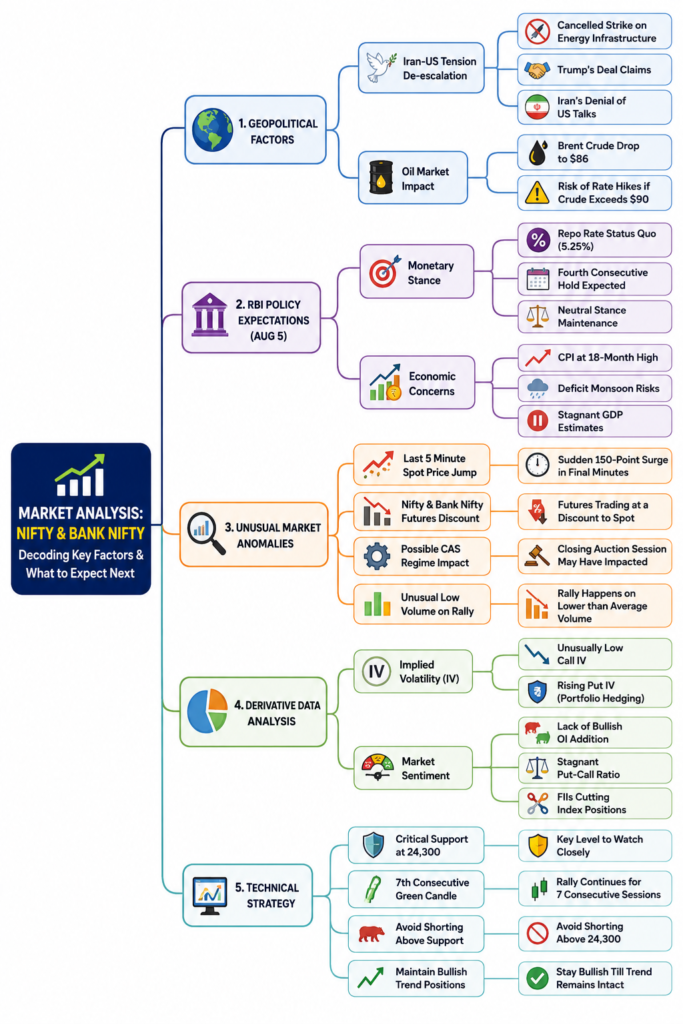
One possible explanation is the impact of the Closing Auction Session (CAS), which can significantly influence the spot index near market close.
Interestingly, the same magnitude of buying wasn’t reflected in Nifty futures, creating an unusual divergence between spot and derivatives.
This suggests that the final rally may have been more mechanical than fundamentally driven.
2. The Geopolitical Trigger May Be More Narrative Than Reality
Global markets initially reacted positively after reports suggesting diplomatic progress regarding Iran.
However, conflicting statements from Tehran quickly cast doubt on those reports.
Rather than celebrating a confirmed peace agreement, markets may simply have priced out the worst-case geopolitical scenario.
Meanwhile:
- Brent crude eased toward the $86–88 range.
- Middle East tensions remain unresolved.
- Energy supply risks haven’t disappeared.
Markets often rally on reduced uncertainty, but that doesn’t necessarily mean the underlying risk has vanished.
3. Why Are Nifty Futures Trading Below Spot?
One of the biggest warning signs comes from the derivatives market.
In a healthy bull market, futures generally trade at a premium to spot prices because investors expect higher future prices.
Currently, however, Nifty futures are trading at a noticeable discount.
This unusual situation indicates:
- Weak institutional conviction
- Reduced willingness to carry long positions
- Possible rollover activity rather than fresh buying
When price reaches new highs, but futures refuse to confirm the move, professional traders usually become cautious.
4. Options Market Sends a Completely Different Message
The options market reveals another interesting divergence.
Call Option Activity
Call implied volatility remains relatively subdued.
This suggests traders are not aggressively chasing higher prices despite the rally.
Put Option Activity
Put implied volatility has increased noticeably.
Higher Put IV often indicates growing demand for downside protection.
Instead of expecting unlimited upside, many sophisticated participants appear more interested in buying insurance against a potential correction.
The options market is signaling caution rather than euphoria.
5. The Missing Fuel: Where Is the Open Interest?
Perhaps the biggest concern is the lack of meaningful Open Interest expansion.
A sustainable bull market usually requires:
- Fresh capital inflows
- Rising futures open interest
- Strong institutional participation
Instead, recent gains appear to have occurred without significant new positioning.
This raises the possibility that traders are merely rotating existing positions instead of initiating fresh bullish bets.
Without new participation, rallies can lose momentum quickly.
RBI Policy: Why the Market May Already Be Fully Priced
Ahead of the RBI policy meeting, expectations remain heavily tilted toward a status quo on interest rates.
Several factors support a cautious central bank:
- Sticky inflation
- Food price risks
- Monsoon uncertainty
- Global geopolitical tensions
If the policy outcome matches expectations, market reaction could remain limited because much of it is already priced in.
However, any unexpectedly hawkish commentary could increase market volatility.
Technical Levels to Watch
From a technical perspective:
Immediate Support
- 24,300 remains an important support zone.
If Support Holds
- The rally could continue with reduced momentum.
If Support Breaks
- Weak futures positioning and limited Open Interest support could accelerate downside pressure.
Risk management becomes increasingly important near key technical levels.
Final Thoughts
The recent seven-day rally has certainly improved market sentiment.
However, several internal indicators continue to raise questions:
- Closing Auction-driven price action
- Futures trading below spot
- Rising Put IV
- Weak Call participation
- Limited Open Interest expansion
None of these indicators guarantee an immediate market correction.
But together they suggest that the rally may be more fragile than headline index gains imply.
Smart investors often focus not only on where prices are moving—but also on who is participating, how positions are being built, and whether institutional conviction matches the price action.
As always, markets reward disciplined risk management more consistently than emotional chasing.
Frequently Asked Questions (FAQs)
Why did Nifty jump 150 points in the last five minutes?
One possible explanation is the Closing Auction Session (CAS), which can significantly affect the final spot index calculation. However, other market dynamics may also contribute, and no single factor fully explains such moves.
What does it mean when Nifty futures trade below the spot index?
A futures discount (backwardation) can reflect cautious sentiment, hedging demand, or technical positioning. It is not, by itself, proof that the market will decline.
Why is Open Interest important?
Rising Open Interest alongside rising prices generally suggests fresh participation. If prices rise without meaningful OI growth, the move may have weaker underlying support.
Does rising Put Implied Volatility always predict a crash?
No. Higher Put IV often indicates increased demand for downside protection, but it does not guarantee that a market correction will occur.
Should investors be worried about this rally?
Rather than reacting to a single indicator, investors should consider the broader picture—including price action, derivatives data, macroeconomic developments, and their own risk tolerance.
Disclaimer: This article is for educational and informational purposes only and should not be considered investment advice. Financial markets involve risk, and readers should conduct their own research or consult a qualified financial advisor before making investment decisions.
High-CTR SEO titles
- The 150-Point Nifty Mystery: 5 Hidden Signals Behind the Recent Market Rally
- Nifty’s 150-Point Jump Explained: 5 Reasons Smart Money Isn’t Celebrating
- Nifty Rally Analysis 2026: Why This 150-Point Surge Could Be a Bull Trap
- Why Nifty Jumped 150 Points in 5 Minutes: The Truth Behind the Rally
- Nifty Futures at Discount? 5 Warning Signs Every Investor Should Know
- The Hidden Truth Behind Nifty’s 150-Point Rally: Is a Correction Coming?
- Nifty’s 7-Day Rally Decoded: 5 Red Flags Investors Shouldn’t Ignore
- 150-Point Nifty Rally: Futures, IV & Open Interest Reveal the Real Story
- Is the Nifty Rally Fake? 5 Counter-Intuitive Truths Behind the Market Surge
- Nifty’s Biggest Mystery: Why Smart Money Is Hedging While Markets Rise