
The 3:30 PM Shock: How India’s New Closing Auction System (CAS) Is Rewriting Market Closing Prices
Introduction
The Indian stock market has entered a completely new era.
If you’ve recently seen the Nifty 50 suddenly jump or fall 150–200 points exactly at 3:30 PM, you’re not imagining things. Many traders watched profitable positions disappear within seconds as the official closing price differed sharply from the market seen at 3:15 PM.
This isn’t a technical glitch.
It’s the result of NSE’s new Closing Auction System (CAS)—a structural change that fundamentally alters how closing prices are determined.
For retail traders, understanding this mechanism is no longer optional.
What Happened During the Recent 3:30 PM Shock?
Over the last few trading sessions, Nifty witnessed unusually large moves during the closing auction.
While prices appeared relatively stable until 3:15 PM, the official closing price was determined later through a separate auction process, producing dramatic last-minute adjustments.
Many traders experienced:
- Unexpected MTM changes
- Futures-Spot price mismatch
- Closing price far away from the visible 3:15 market
- Sudden changes in option premiums
This phenomenon has now become popularly known as the “3:30 PM Shock.”
What is the Closing Auction System (CAS)?
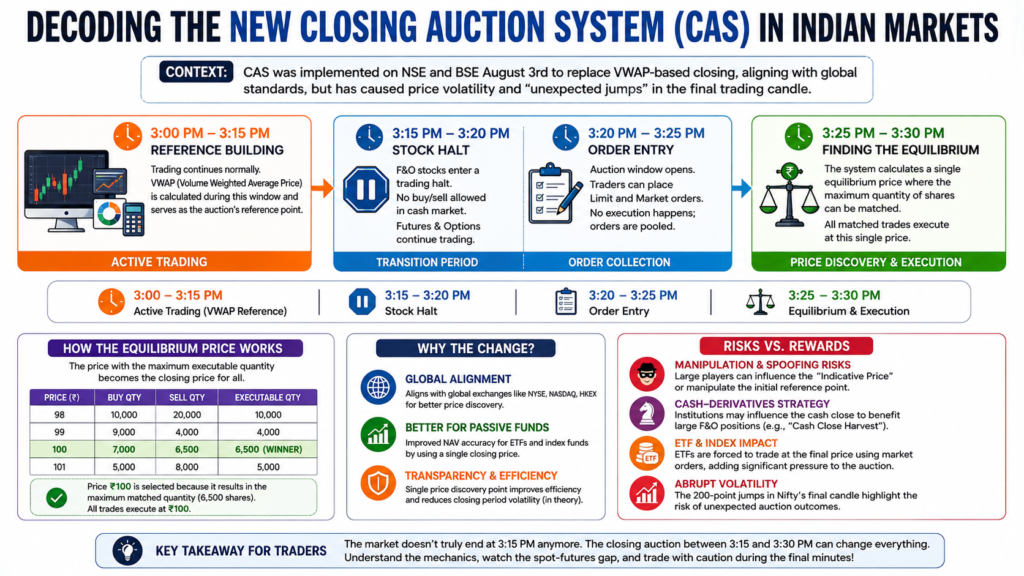
The Closing Auction System (CAS) is a market mechanism where the final closing price is determined through an auction instead of simply averaging trades over the last 30 minutes.
Instead of using continuous market trades, the exchange collects buy and sell orders and calculates one Equilibrium Price where maximum shares can be matched.
This single price becomes the official closing price.
How the New Closing Auction Timeline Works
3:00 PM – 3:15 PM
Reference Price Window
Normal trading continues.
During this period, the exchange calculates the VWAP (Volume Weighted Average Price), which becomes the reference price for the auction.
3:15 PM – 3:20 PM
Continuous Trading Stops
For eligible F&O stocks:
- Cash market trading stops
- Futures & Options continue trading
- Spot market remains frozen
This creates a temporary disconnect between the cash and derivatives markets.
3:20 PM – 3:25 PM
Auction Order Collection
Participants submit:
- Market Orders
- Limit Orders
No trades happen during this period.
Orders simply accumulate inside the auction book.
3:25 PM – 3:30 PM
Price Discovery
The exchange calculates one single equilibrium price where the maximum quantity of buyers and sellers can transact.
Every matched trade executes at this identical price.
How the Equilibrium Price Works
Imagine BT Bank trading near ₹100.
| Price | Buy Qty | Sell Qty | Matched Qty |
|---|---|---|---|
| ₹98 | 10,000 | 20,000 | 10,000 |
| ₹99 | 9,000 | 4,000 | 4,000 |
| ₹100 | 7,000 | 6,500 | 6,500 |
The exchange chooses the price that satisfies its auction algorithm, maximizing executable quantity under its matching rules. All matched trades execute at the single auction price, which may differ from the last traded price seen before the auction.
This is why the final candle can suddenly appear disconnected from the market at 3:15 PM.
Why the Spot-Futures Gap Is Growing
One major consequence of CAS is the growing disconnect between:
- Cash Market
- Futures Market
Between 3:15 PM and 3:30 PM:
- Spot market stops trading.
- Futures continue reacting to news, hedging activity, and expectations.
Without live cash-market price discovery, derivatives can temporarily diverge until the closing auction determines the official cash closing price.
The ±3% Reference Price Rule
To prevent extreme price movements, auction orders generally must remain within a permitted band around the reference price.
This reference price is based on the earlier VWAP calculation.
Although the band limits extreme prices, market participants closely watch the reference level because it defines the allowable auction range.
Can the Closing Auction Be Manipulated?
Like any auction-based market, concerns exist regarding possible abusive practices.
Common concerns discussed globally include:
1. Indicative Price Influence
Large visible orders can temporarily affect the indicative auction price before the final match.
Modern exchanges monitor such activity closely and enforce surveillance against manipulative behavior.
2. Cash vs Derivatives Strategy
Large institutional participants may have incentives to influence the cash-market close because many derivatives, index products, and benchmarked portfolios reference official closing prices.
However, exchanges and regulators actively monitor unusual trading patterns, and proving market manipulation requires evidence beyond large trades alone.
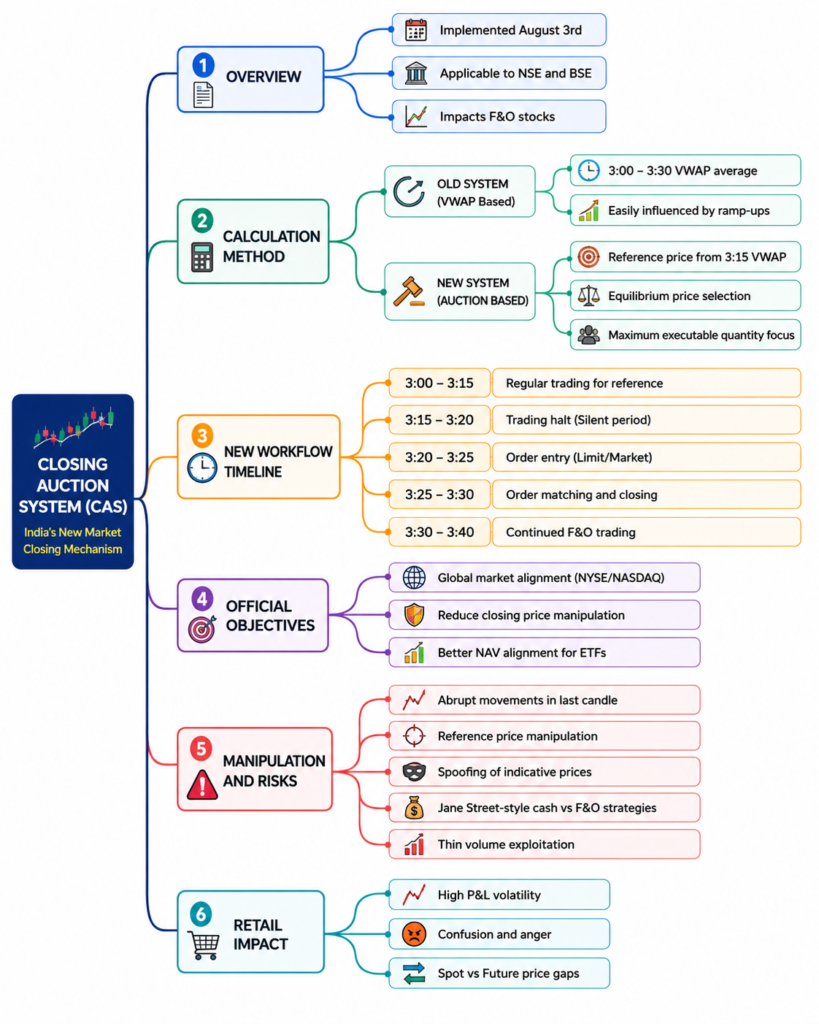
Why ETFs Add More Pressure
Exchange Traded Funds (ETFs) usually attempt to match the official closing value of their benchmark index.
During rebalancing or end-of-day execution:
- Large buy orders
- Large sell orders
- Passive fund flows
can increase auction participation and deepen liquidity. At the same time, these sizeable flows can contribute to larger auction volumes and noticeable price adjustments on some days.
How Retail Traders Should Adapt
The new system requires a different mindset.
Avoid Blind Market Orders
During the auction window, market orders can execute at prices that differ from expectations.
Understand Auction Timing
Know when continuous trading ends and when the closing auction begins.
Watch Spot and Futures Together
A widening Spot-Futures gap can indicate increased auction uncertainty.
Reduce Last-Minute Speculation
Avoid making emotional decisions based solely on the final few minutes of trading.
Learn Auction Mechanics
Understanding the closing auction process is now as important as understanding support, resistance, or option Greeks.
Is CAS Better Than the Old VWAP Method?
The previous VWAP-based closing mechanism smoothed prices by averaging trades over time.
The new auction system instead concentrates liquidity into a single price-discovery event.
Supporters argue this approach improves price discovery and aligns India with many major global exchanges.
Critics argue it can produce sharper end-of-day price movements and requires traders to adapt to a different market structure.
Its long-term effectiveness will depend on liquidity, surveillance, and how market participants adjust over time.
Final Thoughts
The Closing Auction System (CAS) represents one of the biggest structural changes to India’s equity markets in recent years.
The dramatic 3:30 PM moves are not random—they are a consequence of how the official closing price is now discovered.
For retail investors, the key lesson is simple:
The market no longer truly ends at 3:15 PM.
Understanding the closing auction has become essential for anyone trading stocks, futures, options, ETFs, or index-based strategies.
FAQ
What is the Closing Auction System (CAS)?
CAS is an exchange mechanism that determines the official closing price using an auction rather than continuous trading.
Why is Nifty moving sharply at 3:30 PM?
The official closing price is now determined through the auction process, which can differ from the last traded price before the auction.
Does CAS affect Futures and Options?
Yes. The cash market and derivatives can temporarily diverge because futures continue trading while the cash market enters the auction process.
Should retail traders avoid market orders during the auction?
Using limit orders and understanding auction timing can help reduce execution uncertainty during the closing auction.
high-CTR SEO title
- 3:30 PM Market Shock Explained: How the New Closing Auction System (CAS) Changed Nifty Forever
- Why Nifty Jumped 200 Points at 3:30 PM? The Truth Behind NSE’s Closing Auction System
- Closing Auction System (CAS): The Real Reason Behind Nifty’s 3:30 PM Surprise
- NSE’s New Closing Auction System Explained: Why the Last 5 Minutes Are So Volatile
- The 3:30 PM Kaand: How India’s New Closing Auction System Is Impacting Retail Traders
- Nifty’s Final Candle Mystery: Understanding the New Closing Auction System (CAS)
- Closing Auction System Explained: Why Nifty’s Closing Price No Longer Matches 3:15 PM
- NSE Closing Auction System (CAS): Everything Every Trader Must Know in 2026
- Why the Nifty Closing Price Suddenly Changes at 3:30 PM – CAS Explained
- Nifty’s 3:30 PM Shock: How the New Closing Auction System Is Rewriting India’s Stock Market