
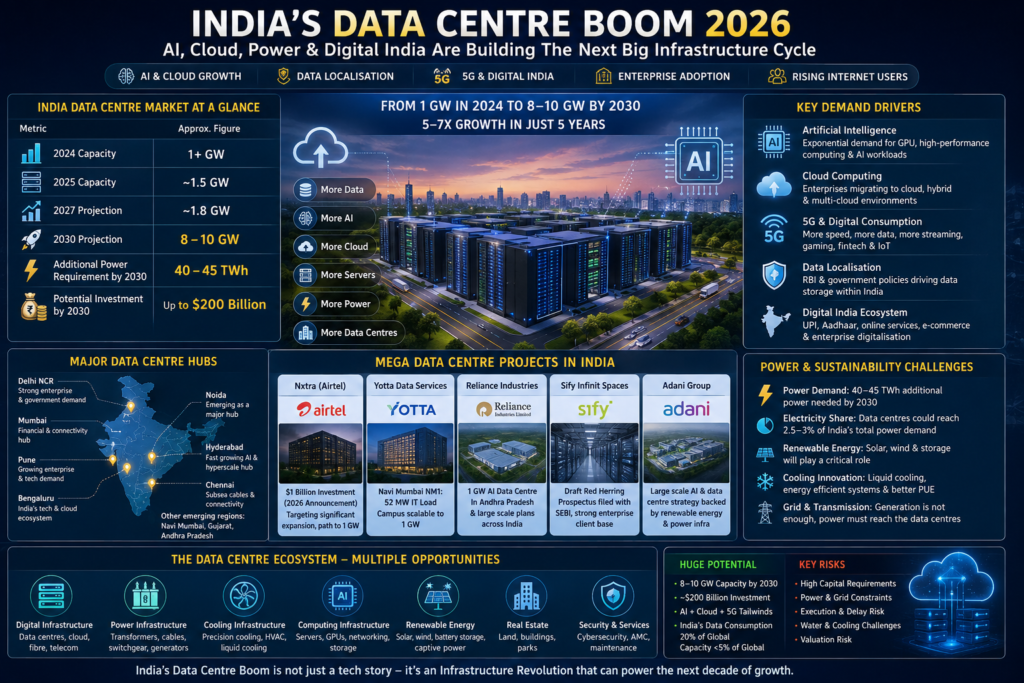
India’s Data Centre Boom Is Becoming a New Infrastructure Story
India’s next major infrastructure opportunity may not be roads, ports or traditional real estate—it could be data centres.
The combination of Artificial Intelligence (AI), cloud computing, 5G, digital payments, data localisation and increasing internet consumption is creating enormous demand for computing infrastructure.
The opportunity is particularly interesting because India consumes roughly 20% of global data but currently hosts less than 5% of the world’s data-centre capacity, according to Deloitte.
That gap is the central investment thesis.
India is essentially saying:
More data + more AI + more cloud = more servers + more power + more cooling + more connectivity + more data centres.
And this could create a much larger ecosystem than just data-centre operators.
1. India’s Data Centre Capacity Is Entering a New Phase
India crossed the 1 GW data-centre capacity milestone in 2024. JLL projected the market could reach around 1.8 GW by 2027, representing a 77% increase from its 2024 level.
More recent CBRE data shows the operational stock reached approximately 1,530 MW by September 2025, with around 260 MW of new supply added during the first nine months of 2025.
But the most interesting number is the long-term projection.
India Data Centre Growth
| Metric | Approx. Figure |
|---|---|
| 2024 capacity | 1+ GW |
| 2025 capacity | ~1.5 GW |
| 2027 projection | ~1.8 GW |
| 2030 projection | 8–10 GW |
| Additional power requirement by 2030 | 40–45 TWh |
| Potential investment by 2030 | Up to ~$200 billion |
Deloitte estimates India’s data-centre capacity could rise from about 1.5 GW in 2025 to 8–10 GW by 2030.
That would represent roughly a 5–7x expansion in only five years.
2. Why Is India Suddenly Building So Many Data Centres?
The answer is not just one thing.
There are at least five major demand drivers.
1. Artificial Intelligence
Generative AI requires enormous computing power.
Training and operating AI models requires:
- GPUs
- high-density servers
- advanced networking
- high-speed storage
- sophisticated cooling
- reliable electricity
AI workloads are therefore creating demand for a new generation of AI-ready data centres.
2. Cloud Computing
Businesses are moving workloads from physical servers to:
- AWS
- Microsoft Azure
- Google Cloud
- private cloud
- hybrid cloud
More cloud adoption means more physical infrastructure somewhere behind the screen.
3. 5G and Digital Consumption
Faster networks increase data usage.
Video streaming, gaming, fintech, digital payments, social media, IoT and enterprise applications are all generating additional data.
4. Data Localisation
India increasingly wants sensitive data to be stored and processed within the country.
For example, the RBI’s 2018 payment-data rule requires payment-system operators to store the entire payment-system data in systems located in India, subject to the treatment of the foreign leg specified by the RBI.
This creates structural demand for domestic infrastructure.
5. Digital India
India has built a massive digital ecosystem around:
- UPI
- Aadhaar
- online banking
- e-commerce
- government digital services
- cloud platforms
- smartphones
- enterprise software
The physical infrastructure underneath this digital economy has to expand.
3. India’s Biggest Advantage: The Data Consumption Gap
This is perhaps the most important point for investors.
India accounts for approximately 20% of global data consumption, while having less than 5% of global data-centre capacity.
This mismatch suggests India has substantial room to increase its digital infrastructure.
In simple terms:
India generates and consumes huge amounts of data—but much of the physical infrastructure needed to process that data is still being built.
That creates an infrastructure opportunity similar to the telecom expansion of earlier decades—but with a much heavier requirement for electricity, land, fibre and cooling.
4. Mega Data Centre Projects Are Getting Bigger
The scale of projects is changing dramatically.
Earlier, data centres were commonly discussed in terms of tens of megawatts.
Now, the conversation has moved towards hundreds of megawatts and even gigawatts.
Major developments across India include:
- Navi Mumbai: Yotta’s NM1 is a large Tier IV facility with a 52 MW IT load and a campus designed to scale toward 1 GW.
- Jamnagar: Reliance has been developing a major AI infrastructure ecosystem, with reports around gigawatt-scale capacity.
- Andhra Pradesh: Reliance announced plans for a 1 GW AI data centre in the state.
- Nxtra/Airtel: Airtel’s data-centre business is targeting significant expansion; in March 2026, Airtel announced a $1 billion investment involving Nxtra, with Nxtra valued at around $3.1 billion post-transaction.
- Adani Group: The group has announced a large-scale long-term plan for renewable-powered hyperscale AI data centres.
The industry is therefore moving from data-centre buildings to AI infrastructure campuses.
5. The Real Opportunity May Be Bigger Than Data Centre Operators
This is where the investment story becomes more interesting.
A data centre needs much more than servers.
Think of a data centre as an ecosystem:
Land → Building → Electricity → Transformers → Switchgear → Cables → Cooling → Servers → GPUs → Networking → Fibre → Security → Backup Power → Renewable Energy
Therefore, a data-centre boom can potentially benefit multiple industries.
Potential beneficiary categories
Digital infrastructure
- Data-centre operators
- Cloud infrastructure
- Fibre networks
- Telecom companies
Electrical infrastructure
- Transformers
- Switchgear
- Cables
- Power equipment
- Backup generators
Cooling
- Precision cooling
- HVAC
- Liquid cooling
- Thermal management
Computing
- Servers
- GPUs
- Networking
- AI hardware
Energy
- Solar
- Wind
- Battery storage
- Transmission
- Power generation
This means investors should not look only at companies that own data centres.
The larger opportunity could be the companies supplying the infrastructure around them.
6. India’s Data Centre Investment Landscape
Several major groups are entering or expanding their presence.
Bharti Airtel / Nxtra
Nxtra is becoming an increasingly important part of Airtel’s digital infrastructure strategy.
In March 2026, Airtel announced a $1 billion investment in Nxtra led by Alpha Wave Global, Carlyle and Anchorage Capital, while Airtel remained the controlling shareholder.
A recent company update also indicates a long-term ambition to expand data-centre capacity substantially toward 1 GW.
Yotta Data Services
Yotta has built large facilities in Navi Mumbai and Greater Noida.
Its Navi Mumbai NM1 facility currently has a 52 MW IT load and is part of a campus designed to scale up to 1 GW.
The company’s infrastructure is also being positioned for AI workloads and high-density GPU computing.
Sify Infinit Spaces
Sify’s data-centre business is another important domestic player.
Sify Infinit Spaces filed a Draft Red Herring Prospectus with SEBI in 2025, indicating its intention to access the public markets.
Reliance Industries
Reliance is targeting AI infrastructure at enormous scale.
In addition to its Jamnagar plans, Reliance announced a 1 GW AI data-centre project in Andhra Pradesh in 2025.
Adani Group
Adani is also building a major AI/data-centre strategy around the combination of:
Renewable Energy + Power Infrastructure + Data Centres + AI
That combination could become strategically important because electricity availability may become one of the biggest constraints on AI infrastructure.
7. Power Could Become India’s Biggest Data Centre Problem
This is the most important risk investors should understand.
A data centre cannot operate without 24×7 reliable electricity.
And AI data centres are much more power-intensive than traditional facilities.
Deloitte estimates India could require 40–45 TWh of incremental electricity by 2030 to support AI-driven data-centre growth.
The sector’s electricity consumption could rise from around 10–15 TWh in 2024 to 40–45 TWh by 2030, according to Deloitte’s India analysis.
This means India’s data-centre story is simultaneously an:
AI story + Power story + Renewable Energy story + Transmission story.
8. Why Renewable Energy Will Become Critical
Large data centres require reliable electricity, but hyperscalers and technology companies are also under pressure to reduce emissions.
This creates demand for:
- Solar power
- Wind power
- Battery storage
- Open-access renewable power
- Captive generation
- Energy-efficient cooling
- Better Power Usage Effectiveness (PUE)
Deloitte estimates that data centres could reach 2.5–3% of India’s electricity demand by 2030 under its growth scenarios.
Therefore, India’s data-centre boom could indirectly accelerate investment in renewable power and grid infrastructure.
9. Cooling Is Another Hidden Opportunity
A common mistake is to think:
Data Centre = Servers
Actually:
Data Centre = Servers + Power + Cooling + Networking + Security + Land + Connectivity
Cooling is particularly important.
As AI GPU density rises, conventional air cooling becomes less efficient for some high-density applications.
This is increasing interest in:
- liquid cooling
- direct-to-chip cooling
- immersion cooling
- advanced chillers
- thermal management
Deloitte notes that computing/server systems and cooling are among the largest components of data-centre electricity consumption.
So the data-centre boom could also create a substantial cooling-equipment opportunity.
10. India’s Data Centre Hubs
India’s data-centre market is not evenly distributed.
The major established and emerging locations include:
Mumbai
A major connectivity and financial-services hub.
Chennai
Important for subsea cables and southern India connectivity.
Delhi-NCR
Strong enterprise, government and northern India demand.
Bengaluru
India’s major technology and cloud ecosystem.
Hyderabad
Rapidly becoming an important AI and hyperscale location.
Pune
Growing enterprise and technology demand.
Other locations such as Navi Mumbai, Noida, Gujarat and Andhra Pradesh are also becoming increasingly important as developers search for land, power and connectivity.
11. Data Centre Stocks: Where Should Investors Look?
Investors should avoid thinking about this theme as simply:
“Which company owns a data centre?”
A better approach is to divide the opportunity into layers.
Layer 1 — Data Centre Operators
Companies directly developing or operating data centres.
Layer 2 — Digital Infrastructure
Telecom, fibre, connectivity and cloud infrastructure.
Layer 3 — Power Infrastructure
Transformers, cables, switchgear, generators and transmission.
Layer 4 — Cooling Infrastructure
Air conditioning, precision cooling and liquid-cooling technologies.
Layer 5 — Computing Infrastructure
Servers, networking equipment and AI/GPU infrastructure.
Layer 6 — Renewable Energy
Solar, wind, storage and captive power.
This creates a Data Centre Value Chain rather than a single-stock theme.
12. The Biggest Risks
The story is powerful, but investors should not blindly assume that every company associated with AI or data centres will generate strong returns.
1. Huge Capital Requirements
Data centres require billions of dollars of investment at scale.
Deloitte estimates construction costs excluding IT hardware at approximately $5.5–8 million per MW for new capacity.
2. Electricity Constraints
If sufficient power cannot be secured, planned data-centre capacity may be delayed.
3. Grid & Transmission Bottlenecks
Generation alone is not enough.
Power has to reach the data centre reliably.
4. Water & Cooling
Large facilities can face water availability and environmental constraints.
5. Execution Risk
A company announcing 1 GW of planned capacity does not mean 1 GW is already operational.
Investors must distinguish:
Announced → Under Construction → Commissioned → Operational → Revenue Generating
6. Valuation Risk
A strong industry can still produce poor stock returns if investors pay an excessive valuation.
This is especially important for companies whose share prices rise mainly on future data-centre expectations rather than current earnings.
13. The Bigger Picture: India Could Become an AI Infrastructure Hub
The opportunity extends beyond India’s domestic requirements.
India has several strategic advantages:
- Large digital population
- Huge data consumption
- Growing AI adoption
- Skilled technology workforce
- Large renewable-energy potential
- Expanding telecom infrastructure
- Strong domestic digital ecosystem
- Strategic location between major markets
Deloitte estimates India could attract up to $200 billion in data-centre investment by 2030 under its growth scenario.
That makes this much bigger than a technology story.
It is an infrastructure cycle.
14. The Investment Thesis in One Diagram
India’s Data Centre Flywheel
AI Growth
↓
More Computing Demand
↓
More Data Centres
↓
More Electricity Demand
↓
More Renewable Energy & Grid Investment
↓
More Transformers / Cables / Cooling / Power Equipment
↓
More Digital Infrastructure
↓
More AI & Cloud Adoption
↓
Even More Data Centre Demand
This is why the sector could create multiple investment opportunities across the economy.
15. Final Verdict: India’s Next Digital Infrastructure Cycle?
India’s data-centre industry is moving from an emerging niche into a strategic infrastructure sector.
The most important numbers tell the story:
- ~1.5 GW capacity around 2025
- 8–10 GW potential capacity by 2030
- 40–45 TWh incremental power requirement
- $200 billion potential investment opportunity
- India consumes roughly 20% of global data while hosting <5% of global data centres.
But the real opportunity is not simply “buy data-centre stocks.”
The smarter way to analyse the theme is to track the entire ecosystem:
Data Centres → AI → Power → Renewable Energy → Grid → Cooling → Cables → Transformers → Fibre → Servers → Real Estate
The winners may ultimately be the companies that can convert this enormous infrastructure spending into sustainable revenue, cash flow and return on capital.
For investors, therefore, the key question isn’t:
“Which company is talking the most about AI?”
It is:
“Which company has the land, power, technology, customers, balance sheet and execution capability to turn India’s data-centre boom into actual earnings?”
That is where the real investment research begins.
Disclaimer: This article is for educational and research purposes only and is not a buy/sell recommendation. Data-centre projects, capacity targets and investment plans can change; investors should verify company filings, valuations, debt, cash flow and execution before making investment decisions.