

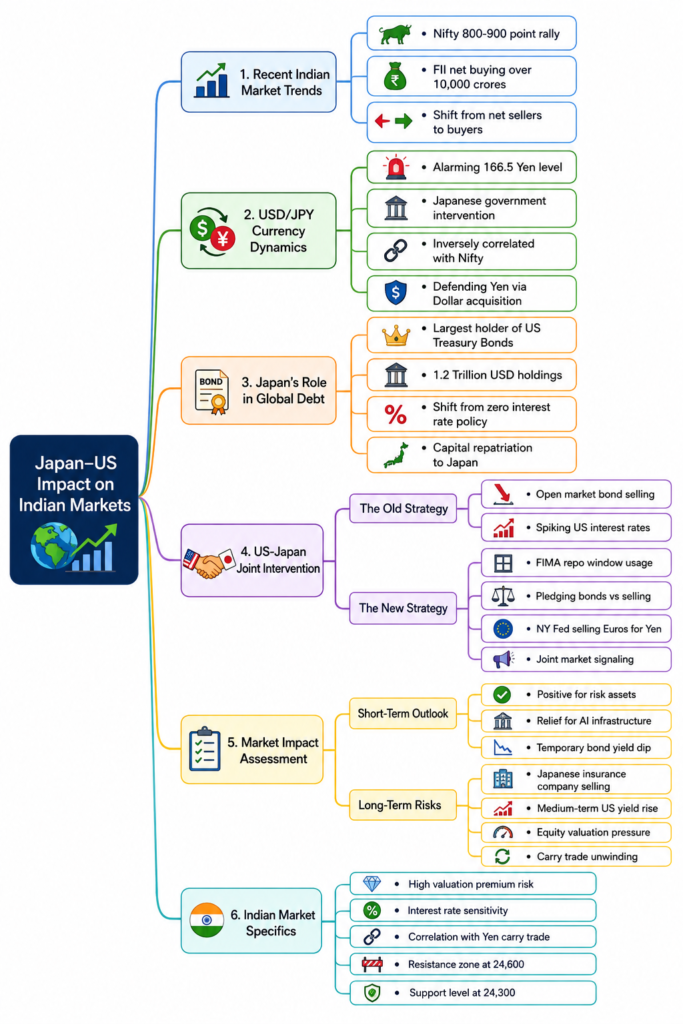
During the final week of July 2024, India’s stock market delivered one of its most surprising rallies of the year. The Nifty jumped nearly 800–900 points, while Foreign Institutional Investors (FIIs), who had been consistent sellers, suddenly became aggressive buyers.
Within just a few trading sessions, FIIs invested more than ₹10,000 crore, leaving many analysts searching for domestic explanations such as earnings, GDP growth, or sectoral strength.
But the real story was unfolding thousands of kilometers away.
The rally wasn’t primarily driven by India’s economy—it was supported by a global liquidity operation involving the United States, Japan, the Federal Reserve, and the Bank of Japan.
To understand why FIIs suddenly returned to India, investors need to monitor USD/JPY and US Treasury yields, not just the Nifty chart.
Why USD/JPY Matters More Than Most Indian Investors Realize
Most Indian investors focus on:
- Corporate earnings
- RBI policy
- Inflation
- Budget announcements
However, FIIs manage global portfolios worth trillions of dollars.
Before investing in India, they evaluate:
- US bond yields
- Dollar strength
- Japanese Yen
- Global liquidity
- Currency funding costs
Among all these indicators, the USD/JPY exchange rate has become one of the most influential.
When the Japanese Yen weakens sharply, global investors reduce risk exposure, often pulling money out of expensive equity markets like India.
Japan’s Hidden Problem
Japan owns approximately $1.2 trillion worth of US Treasury securities.
This makes Japan the largest foreign holder of US government debt.
Whenever Japan wants to strengthen its currency, it requires large amounts of US dollars.
Historically, it obtained those dollars by selling US Treasury bonds.
This approach creates a serious problem.
Selling billions of dollars of Treasuries pushes bond prices lower and drives US Treasury yields higher.
Higher US yields increase borrowing costs across the global financial system.
Technology companies, AI stocks, and high-growth markets generally perform poorly in such an environment.
The United States wanted to avoid exactly this outcome.
The “Pawn Shop Strategy”
Instead of selling Treasury bonds, Japan adopted a smarter approach.
Using the Federal Reserve’s FIMA Repo Facility, Japan temporarily pledged its Treasury holdings as collateral in exchange for US dollars.
Think of it like visiting a pawn shop.
Instead of permanently selling your gold, you temporarily pledge it, receive cash, and later reclaim it.
Japan effectively did the same with US government bonds.
Advantages include:
- No panic selling
- Stable Treasury prices
- Controlled bond yields
- Immediate dollar liquidity
- Better Yen defense
This strategy prevented unnecessary stress in global bond markets.
The Hidden Currency Intervention
Toward the end of July 2024, another important development occurred.
The US Treasury and Japan coordinated efforts to stabilize the Yen.
Rather than flooding markets with Treasury sales, authorities reportedly used alternative currency operations while reinforcing market confidence through official communication.
The message to currency traders was simple:
Do not aggressively bet against the Japanese Yen.
The impact was immediate.
The Yen recovered sharply, reducing fears surrounding excessive currency volatility.
How the Yen Carry Trade Moves the Nifty
The Yen Carry Trade is one of the world’s largest funding strategies.
Its mechanics are straightforward:
- Borrow Japanese Yen at extremely low interest rates.
- Convert the money into US dollars.
- Invest in higher-return assets.
These assets include:
- Indian equities
- US technology stocks
- Emerging markets
- Global growth sectors
India has long attracted these flows because of its:
- Strong economic growth
- Premium market valuations
- High corporate profitability
- Long-term structural story
However, premium valuations also make India more sensitive to global liquidity changes.
When the Yen weakens excessively or becomes unstable, investors unwind these positions.
That means selling Indian equities.
When the Yen stabilizes, these same investors often return.
This explains why FII buying resumed so quickly.
Why FIIs Suddenly Bought Indian Stocks
The intervention created three important conditions:
1. Stable US Treasury Market
No major Treasury liquidation meant bond yields remained relatively controlled.
2. Stronger Yen
Currency volatility declined, reducing pressure on carry trades.
3. Improved Global Risk Appetite
Global investors became comfortable increasing exposure to emerging markets once again.
India, being one of the largest and most liquid emerging markets, became a natural destination for these funds.
The Hidden Risk Nobody Is Talking About
The current stability may not last.
While the Bank of Japan has access to the Fed’s liquidity facilities, private Japanese insurance companies do not.
These insurers manage enormous portfolios.
If rising Japanese interest rates encourage them to repatriate capital, they may begin selling US Treasury holdings.
That would likely:
- Push Treasury yields higher
- Strengthen risk aversion
- Weaken the Yen again
- Trigger FII selling in emerging markets
Several economists have estimated that such selling could noticeably increase US Treasury yields.
If this scenario unfolds, India’s equity market could once again face liquidity pressure.
Why India Is Especially Vulnerable
India currently trades at valuation premiums compared with many other emerging markets.
At the same time:
- Government borrowing remains elevated.
- Domestic bond yields have limited room to decline.
- Market valuations depend heavily on foreign liquidity.
This combination makes India particularly sensitive to changes in global capital flows.
When liquidity is abundant, India benefits significantly.
When liquidity tightens, FIIs often reduce exposure quickly.
Technical Analysis: 24,600 Remains the Key Resistance
From a market structure perspective, the Nifty is approaching an important decision zone.
Resistance: 24,600
- Strong supply area
- Previous failed breakout
- Likely profit-booking zone
Support: 24,300
- Immediate demand area
- Short-term trend support
Unless supported by stronger earnings or sustained global liquidity, the index may remain range-bound between these levels.
A decisive breakout would likely require fresh institutional participation.
What Should Investors Monitor?
Instead of focusing only on daily Nifty movements, investors should track:
- USD/JPY exchange rate
- US 10-Year Treasury Yield
- FII Daily Flows
- DII Buying
- Dollar Index (DXY)
- RBI Liquidity
- Bank of Japan policy
- Federal Reserve policy
- Japanese bond market
- Global carry trade activity
These indicators often provide earlier signals than price alone.
Final Thoughts
The July 2024 rally demonstrated how interconnected global financial markets have become.
What appeared to be a domestic equity rally was heavily influenced by international liquidity dynamics, currency stabilization efforts, and institutional capital flows.
The coordinated actions by the United States and Japan helped calm markets and restored confidence among global investors.
However, the underlying structural challenges remain unresolved.
If the Japanese Yen weakens again or US Treasury yields rise sharply because of renewed private-sector selling, FIIs could quickly reverse course.
For long-term investors, the lesson is clear:
The future direction of the Indian stock market will depend not only on earnings and economic growth but also on the health of the global liquidity system.
In today’s interconnected world, watching USD/JPY and US Treasury yields may be just as important as watching the Nifty itself.
SEO FAQs
Q1. Why did the Nifty rally nearly 800 points in July 2024?
The rally coincided with improving global liquidity, stronger FII inflows, stabilization in the Japanese Yen, and reduced stress in the US Treasury market.
Q2. What is the Yen Carry Trade?
It is a strategy where investors borrow low-interest Japanese Yen and invest in higher-return assets such as Indian equities and US technology stocks.
Q3. Why does USD/JPY affect Indian markets?
Changes in USD/JPY influence global carry trades. A stable Yen encourages investment in emerging markets like India, while a weak or volatile Yen can trigger capital outflows.
Q4. Why are US Treasury yields important for Indian investors?
Higher US Treasury yields make safer US assets more attractive, often reducing foreign investment in emerging markets.
Q5. What indicators should investors monitor besides the Nifty?
Key indicators include USD/JPY, US 10-Year Treasury Yield, FII flows, DXY, RBI liquidity, and Bank of Japan policy decisions.
Yeh article ke liye high-CTR SEO title ideas hain:
- The 800-Point Secret: How the US-Japan Shadow Pact Triggered India’s Market Rally
- Why FIIs Suddenly Bought Indian Stocks: The Hidden US-Japan Deal Explained
- The Hidden Reason Behind Nifty’s 800-Point Rally Nobody Is Talking About
- How the Yen Carry Trade Fueled India’s 800-Point Stock Market Rally
- US-Japan Currency Intervention: The Real Reason Behind Nifty’s Big Rally
- The Global Secret Behind India’s Stock Market Boom: US, Japan & FIIs
- Nifty’s 800-Point Rally Explained: The USD/JPY Connection Every Investor Must Know
- The Shadow Pact That Moved India’s Stock Market: Inside the US-Japan Strategy
- Why USD/JPY Matters More Than Nifty: The Hidden Driver of FII Money
- The FII Buying Mystery Solved: How Japan’s Yen Rescue Lifted Indian Markets
- The Global Liquidity Game: Why Nifty Jumped 800 Points Overnight
- Beyond Earnings: The Real Story Behind India’s 800-Point Market Rally
- How the US and Japan Quietly Changed the Direction of India’s Stock Market
- The Yen Carry Trade Explained: Why India’s Stock Market Depends on Japan
- Nifty’s Biggest Secret: How Global Currency Wars Drove India’s Market Higher