
India’s retail-investor story looks almost unstoppable.
Every month, investors continue to pour billions of rupees into mutual funds through SIPs. Mutual-fund assets have exploded over the past decade, while domestic investors have become one of the most important stabilising forces in the Indian equity market.
Yet the Nifty 50 is struggling.
On September 8, 2026, Nifty closed at 23,635.10, down 0.61%, while the index has fallen about 2.2% over the previous seven sessions. At the same time, Brent crude was approaching $100 a barrel, adding another layer of pressure to Indian equities.
This creates the obvious question:
If Indian investors are putting so much money into the market every month, why isn’t the Nifty going up?
The answer is more complicated than “FIIs are selling.”
The Indian market is experiencing a collision between:
- strong SIP inflows,
- domestic institutional buying,
- massive IPO issuance,
- OFS and block deals,
- QIPs,
- excess banking liquidity,
- high crude prices,
- expensive valuations in parts of the market,
- and global risk coming from US interest rates.
The result is a fascinating structural paradox:
India doesn’t necessarily have a shortage of money. It has a shortage of unrestricted marginal buying power.
1. The SIP Machine Is Bigger Than Ever
Let’s start with the strongest part of India’s market story.
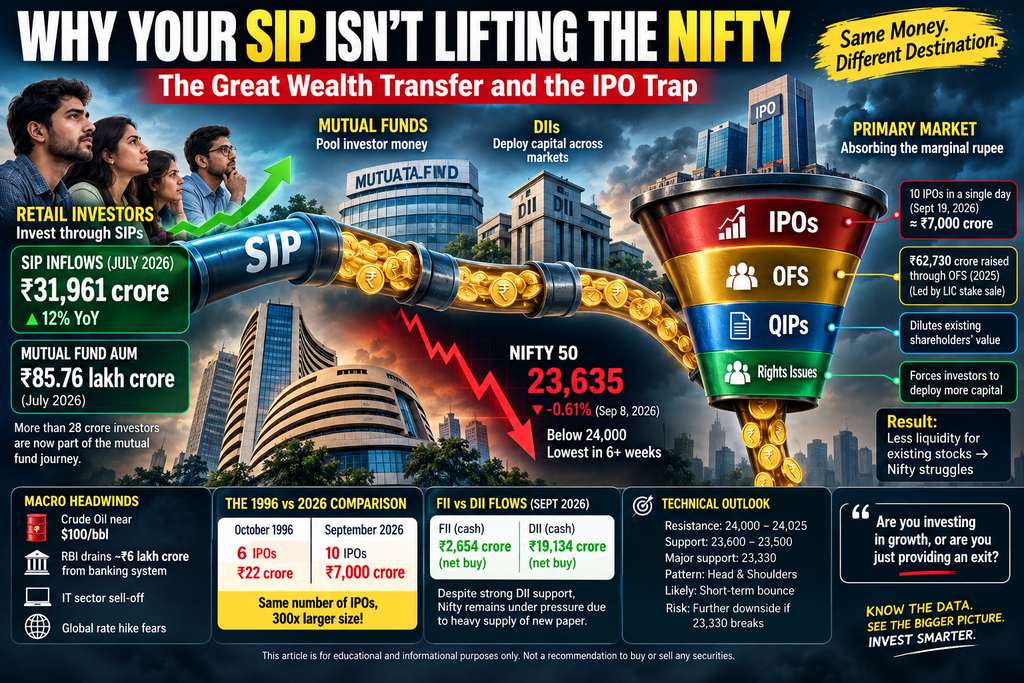
According to AMFI, SIP contributions reached:
₹31,961 crore in July 2026
That represented roughly 12% year-on-year growth, according to industry data.
The scale of India’s mutual-fund industry is even more impressive.
As of July 31, 2026:
Mutual Fund AUM: ₹85.76 lakh crore
The industry had approximately 28.09 crore folios, while equity, hybrid, and solution-oriented schemes accounted for around 21.40 crore folios.
This is a structural transformation.
A decade ago, foreign institutional investors were far more dominant in determining marginal equity demand.
Today:
SIP → Mutual Funds → DIIs → Indian Equities
has become a powerful domestic capital pipeline.
But there is one important misconception.
SIP money does not automatically buy Nifty 50.
A SIP investor may ultimately be exposed to:
- large-cap stocks,
- mid-caps,
- small-caps,
- debt,
- hybrid funds,
- international assets,
- ETFs,
- sector funds,
- or cash.
Therefore:
₹31,961 crore in SIP inflows ≠ ₹31,961 crore in buying Nifty stocks.
That distinction is crucial.
2. The Real Mystery: Why Doesn’t ₹32,000 Crore of SIP Money Push Stocks Higher?
Because the stock market isn’t a closed system.
Every month, new capital enters.
But at the same time, existing shareholders are selling.
That creates a continuous battle between:
New demand
and
New supply.
Think of the market as a giant auction.
If buyers bring ₹1,000 crore worth of shares to the market but sellers bring ₹ 1,200 crore, prices don’t necessarily rise.
The same thing can happen even if the buyers are extremely strong.
This is where the primary market becomes important.
3. The IPO Machine Is Absorbing the Marginal Rupee
India’s IPO market has entered another extremely busy phase.
Reuters reported that six IPOs are scheduled to open on September 9, 2026, seeking as much as ₹4,511 crore collectively.
And that’s not an isolated day.
Reports indicate that 11 mainboard IPOs were scheduled across the week beginning September 7, targeting roughly ₹7,055 crore in aggregate.
Another report put the broader primary-market activity at more than ₹7,280 crore across 16 IPOs, including SME issues, during the week.
This creates an unusual situation.
Investors have a limited pool of capital.
They can choose between:
Existing listed stocks
or
New IPOs
or
OFS
or
QIPs
or
Debt
or
Cash
When several large IPOs arrive simultaneously, the market’s marginal capital has more places to go.
4. The 2026 IPO Boom Is Already Huge
The scale is bigger than the weekly numbers suggest.
By late August 2026, India had seen approximately:
165 IPOs
raising around:
$8.61 billion
according to Reuters.
That makes India one of the world’s busiest IPO markets by number of offerings.
September is expected to be another extremely active month, with potential offerings including the highly anticipated NSE IPO.
The NSE issue could be around:
₹30,000 crore
and would potentially become India’s largest IPO by fundraising size.
This matters because an issue of that size isn’t just another IPO.
It becomes a major capital-allocation event.
5. But There Is an Important Correction: IPOs Don’t “Destroy” Liquidity
This is where the popular narrative needs some nuance.
It is incorrect to say:
“IPO money leaves the stock market and disappears.”
It doesn’t.
In a fresh issue, investors give money to the company.
The company receives that capital and can eventually use it for:
- expansion,
- debt repayment,
- acquisitions,
- working capital,
- capital expenditure,
- or other corporate purposes.
That money can eventually return to the economy and financial markets.
An OFS, however, is different.
In an OFS, existing shareholders sell shares.
The money primarily goes to the selling shareholders rather than to the company.
That distinction is extremely important.
Fresh IPO
Investor → Company
OFS
Investor → Existing shareholder
Therefore, the more accurate argument isn’t:
“IPOs destroy liquidity.”
It is:
“Large primary-market issuance can absorb the marginal capital that might otherwise bid up existing listed stocks, especially when issuance is concentrated in a short period.”
That is a much stronger economic argument.
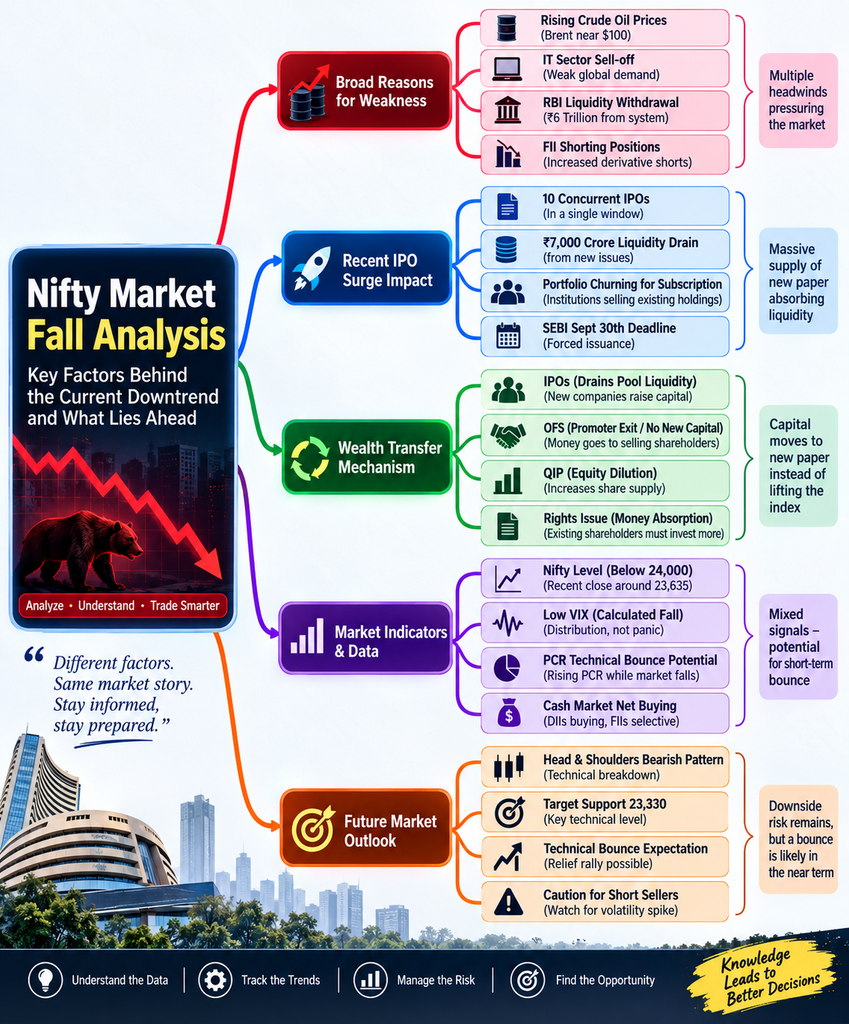
6. The Four Channels Competing for Your Money
Indian investors are currently dealing with four major equity-fundraising channels.
1. IPOs
New companies enter the public market.
Capital flows from investors toward new listings.
2. OFS — Offer for Sale
Existing shareholders sell their holdings.
This can include:
- promoters,
- governments,
- private-equity investors,
- institutional shareholders.
The company generally doesn’t receive the sale proceeds.
3. QIPs
Listed companies issue new shares to qualified institutional investors.
This raises fresh capital for the company but also increases the number of shares outstanding.
That can create earnings-per-share dilution, depending on how the capital is deployed and the returns generated.
4. Rights Issues
Existing shareholders are offered the opportunity to buy additional shares.
This requires existing investors to deploy additional capital if they want to maintain their proportional ownership.
7. The Numbers Show the Supply Is Real
Indian equity fundraising has become enormous.
According to data reported from Prime Database, equity fundraising through IPOs, QIPs, OFSs and related transactions crossed ₹1 lakh crore between April and early July 2026, more than double the comparable period a year earlier.
Government OFS transactions alone raised around:
₹18,700 crore
through six transactions involving companies including Central Bank of India, Coal India, NHPC, NLC India, GIC and IRFC.
Bulk and block deals added another:
₹55,000+ crore
during the same period.
So the market is not merely receiving SIP money.
It is simultaneously processing a huge amount of new and secondary supply.
8. This Is the Real “Marginal Rupee” Problem
Imagine:
SIP + DII demand
₹100
But simultaneously:
IPO + OFS + QIP + block-deal supply
₹95
The net effect on the secondary market may be very small.
Now imagine:
Demand
₹100
Supply
₹130
The market can fall even though ₹100 of new money has arrived.
This is why:
High SIP inflows do not guarantee a rising Nifty.
What matters is the balance between incremental demand and incremental supply.
9. The RBI Is Adding Another Layer to the Puzzle
There is also a major liquidity story happening inside India’s banking system.
The RBI attracted enormous foreign-currency inflows through its special mobilisation measures.
The FCNR(B) component alone attracted around:
$127.23 billion
while total special foreign-currency mobilisation reached approximately:
$136.38 billion
by August 31.
The result?
An enormous rupee-liquidity surplus.
By September 3, banking-system surplus liquidity had reached approximately:
₹10.3 lakh crore
according to reports citing RBI data.
And the latest reports put the surplus even higher at around:
₹11.16 lakh crore
on September 6.
This is the exact opposite of a conventional liquidity shortage.
10. The RBI Is Absorbing Billions—Not Tightening the Economy
The RBI has been using Variable Rate Reverse Repo (VRRR) operations to temporarily absorb excess funds.
On September 4, two VRRR auctions absorbed approximately:
₹6.02 lakh crore
against a combined notified amount of ₹8.5 lakh crore.
That means the headline:
“RBI drains ₹6 lakh crore”
needs to be interpreted correctly.
This is not the same thing as saying:
“RBI has permanently removed ₹6 lakh crore from India’s economy.”
VRRR is primarily a liquidity-management operation.
Banks park funds with the RBI temporarily.
The central bank is trying to keep overnight rates and monetary transmission under control while preventing the enormous liquidity surplus from creating additional inflation or asset-price distortions.
11. So Is RBI Tightening or Easing?
This is the fascinating part.
The RBI can simultaneously:
Support growth
through an accommodative policy rate,
while
Absorbing excess liquidity
through VRRR.
The result is a monetary-policy environment that cannot be understood simply by looking at the repo rate.
Investors should watch:
- Repo rate
- Call rate
- VRRR absorption
- CRR
- system liquidity
- USD/INR
- bond yields
together.
12. The Crude Oil Problem Makes Everything Worse
And now comes the external shock.
Brent crude is approaching:
$100 per barrel
On September 8, Brent was around $98.4-$98.5, after rising sharply amid escalating Middle East tensions.
For India, this matters enormously.
Higher oil means:
Import bill ↑
↓
Inflation risk ↑
↓
Current-account pressure ↑
↓
Rupee pressure ↑
↓
RBI flexibility ↓
↓
Equity valuation pressure ↑
The rupee fell to around ₹94.82 per dollar on September 8, its sharpest daily decline in more than a month, as crude moved toward $100.
13. The FII Story Is More Complicated Than “Foreigners Are Selling”
Another important correction.
It would be wrong to say that FIIs are simply abandoning India.
In August 2026, foreign investors actually bought approximately:
$3.1 billion
of Indian equities—their strongest monthly inflow in nearly two years.
And July-August combined FII investment was around:
₹49,830 crore
according to market data.
Yet the Nifty is still struggling.
Why?
Because cash-market flows are only one part of the market.
Investors also need to look at:
- derivatives,
- sector allocation,
- large-cap positioning,
- currency hedging,
- bond flows,
- valuation,
- and primary-market supply.
14. Domestic Investors Are Actually Providing a Huge Cushion
The DII story is even stronger.
Through September 7, domestic institutional investors had been net buyers of roughly:
₹19,134 crore
in the September cash market, while FIIs were net buyers of around:
₹2,654 crore
at that point.
On September 8 itself, provisional data showed:
FII: approximately −₹123 crore
DII: approximately +₹1,350 crore.
So the market is not collapsing because domestic investors have disappeared.
Quite the opposite.
DIIs are absorbing substantial supply.
The problem is that they are absorbing supply in a market where the supply itself is unusually large.
15. The “Great Wealth Transfer” Is Better Described as Capital Recycling
This is where the article’s original thesis becomes especially interesting.
Imagine the following cycle:
Retail investor
↓
SIP
↓
Mutual fund
↓
DII
↓
IPO / OFS
↓
Company / Promoter / PE investor
The money has not disappeared.
It has been reallocated.
In an OFS:
Retail/DII capital → selling shareholder
In a fresh IPO:
Retail/DII capital → company
The key issue is whether those new allocations ultimately generate enough earnings growth to justify the valuations at which the securities were sold.
That’s the real investment question.
16. The IPO Trap Is Not That IPOs Are Bad
Investors should not conclude:
“IPO = bad.”
That’s too simplistic.
Some IPOs become outstanding long-term investments.
Others don’t.
The real danger is valuation and timing.
When many companies come to market simultaneously, investors may begin chasing:
- new stories,
- hot sectors,
- listing gains,
- IPO momentum,
- and short-term excitement.
Meanwhile, established companies may become relatively neglected.
That can create an unusual market structure:
Primary market = exciting
Secondary market = boring
But the boring stocks may actually offer better long-term valuations.
17. The NSE IPO Could Become the Biggest Test
The potential NSE IPO is particularly interesting.
Reports suggest a possible issue size around:
₹30,000 crore
which could make it India’s largest-ever IPO.
Because NSE is central to India’s financial-market infrastructure, the issue could attract enormous institutional attention.
But it also raises a bigger question:
How much capital can India’s market absorb without forcing investors to sell existing positions?
That is the real liquidity test.
18. Why Nifty Can Fall Even When DII Buying Is Strong
Consider a simplified example.
Suppose DIIs receive:
₹30,000 crore
from SIPs and other inflows.
But simultaneously:
IPOs absorb ₹15,000 crore
OFS absorbs ₹8,000 crore
QIPs absorb ₹5,000 crore
Now only:
₹2,000 crore
remains as potential net demand for the secondary market.
This is obviously a simplified model—not an accounting identity—but it demonstrates the mechanism.
The marginal rupee matters more than the headline SIP number.
19. The Mid-Cap and Small-Cap “Illusion”
There is another important misconception.
If mid-cap and small-cap indices rise, it doesn’t necessarily mean every stock in those segments is performing well.
Index returns are weighted.
A relatively small number of large constituents can disproportionately influence the index.
However, I would not call this automatically “manufactured performance” or “index churning.”
Index rebalancing can change the composition, but that doesn’t mean the index is deliberately hiding losses.
A better measure of market health is:
Market breadth.
Watch:
- Advance/decline ratio
- percentage of stocks above 50-DMA
- percentage above 200-DMA
- equal-weight index performance
- new highs vs new lows
- median stock performance
These metrics tell you whether the rally is broad or concentrated.
20. The Nifty Is Now Fighting Two Different Battles
The first battle is macro.
Macro pressure:
Crude ↑
US yields ↑
Rupee ↓
Global risk ↑
The second battle is structural.
Supply pressure:
IPO ↑
OFS ↑
QIP ↑
Block deals ↑
This creates a particularly difficult environment.
Even if SIP flows remain strong, the secondary market can struggle to generate a sustained re-rating.
21. Nifty’s Technical Picture
The latest close is important.
Nifty: 23,635.10
on September 8.
The index has now moved decisively below the psychologically important 24,000 level.
A practical technical framework is:
Resistance
24,000–24,025
Reclaiming this zone would improve short-term sentiment.
Immediate support
23,600–23,500
This is the first area bulls need to defend.
Major support
23,330
A decisive break would increase downside risk.
Psychological support
23,000
This becomes the major medium-term psychological level.
These are technical reference zones, not guaranteed targets.
22. What Should SIP Investors Actually Do?
This is where the headline becomes misleading.
If you are investing through a long-term SIP, the fact that Nifty is temporarily struggling doesn’t automatically mean your SIP is failing.
A SIP’s purpose is to buy through different market cycles.
The real questions are:
What are you buying?
At what valuation?
What is the fund’s allocation?
How concentrated is the portfolio?
Are earnings growing?
Are you paying too much for the growth?
The problem isn’t:
“My SIP isn’t lifting Nifty.”
The better question is:
“Is my SIP accumulating assets whose future earnings justify today’s valuations?”
23. The New Investor Dashboard
If you’re trying to understand whether this structural pressure is getting better or worse, watch these 10 indicators:
| Indicator | Why it matters |
|---|---|
| SIP inflows | Domestic recurring demand |
| DII net buying | Domestic institutional support |
| FII cash flows | Foreign demand/supply |
| IPO fundraising | Primary-market capital absorption |
| OFS activity | Existing-holder supply |
| QIP activity | New-share supply/dilution |
| RBI system liquidity | Monetary transmission |
| Brent crude | Inflation/import shock |
| USD/INR | Currency pressure |
| Nifty breadth | Actual market participation |
This dashboard is much more useful than simply looking at monthly SIP numbers.
24. The Three Scenarios Ahead
🟢 Bullish Scenario
If:
Crude falls below $90
US yields decline
Rupee stabilises
IPO supply slows
then DII/SIP money could have much greater impact on secondary-market valuations.
That could create a meaningful Nifty recovery.
🟡 Neutral Scenario
If:
Brent remains $95-$100
IPO issuance remains high
SIP flows stay strong
FIIs remain selective
then the market could remain range-bound.
In this scenario, stock selection becomes much more important than simply buying the index.
🔴 Bearish Scenario
If:
Brent >$100
US yields remain elevated.
Rupee weakens
IPO/OFS supply remains high
then even strong DII buying may not be enough to produce a broad market rally.
Nifty could continue struggling around the 23,600–23,000 zone.
Conclusion: Your SIP Isn’t Broken—The Market’s Supply-Demand Equation Has Changed
The biggest misconception in today’s Indian market is:
“If SIP inflows are at record levels, Nifty must go up.”
Not necessarily.
SIP is a source of demand.
But the market also has a supply side.
And in 2026, that supply side has become unusually powerful.
India has:
- ₹31,961 crore monthly SIP contributions in July,
- ₹85.76 lakh crore mutual-fund AUM,
- a huge domestic institutional investor base,
- 165 IPOs raising $8.61 billion by late August,
- more than ₹1 lakh crore of equity fundraising since April through IPOs, QIPs and OFS-related activity,
- and a record-scale IPO pipeline in September.
At the same time, the RBI is dealing with a completely different liquidity problem: banking-system surplus liquidity has reached around ₹10–11 lakh crore, forcing aggressive VRRR absorption.
And outside India, Brent crude is approaching $100, while the rupee has fallen toward ₹95 per dollar.
So the real story isn’t:
“SIP money isn’t working.”
The real story is:
“India’s capital market is absorbing an extraordinary amount of new and existing share supply at the same time that global macro conditions are becoming more hostile.”
That changes the investment game.
The investor who simply watches the Nifty may miss the story.
The smarter investor watches:
SIP flows → DII flows → IPO supply → OFS → QIPs → liquidity → crude → rupee → earnings → valuation.
Because when the marginal rupee becomes scarce, the index can remain sideways even while billions continue flowing into the financial system.
And that leads to the real question:
Are your monthly investments buying genuine future earnings growth—or are they simply providing liquidity for someone else’s exit?
That is the question investors should be asking in India’s 2026 IPO boom.
Disclaimer
This article is for educational and informational purposes only and should not be considered financial, investment, trading, tax, or legal advice. The market data, statistics, projections, technical levels, and opinions presented in this article are based on publicly available information and may change without notice.
The discussion of SIP inflows, Nifty 50, IPOs, OFS, QIPs, RBI liquidity, FII/DII flows, crude oil, USD/INR, mutual funds, and market valuations is intended to explain market dynamics and should not be interpreted as a recommendation to buy, sell, or hold any stock, index, mutual fund, ETF, derivative, commodity, cryptocurrency, or other financial instrument.
IPO and capital-market activity involves significant risks. Past performance does not guarantee future results. Technical support/resistance levels and market scenarios mentioned in this article are illustrative and are not guaranteed targets or predictions.
Readers should conduct their own research and consider their financial objectives, risk tolerance, and investment horizon before making any investment decision. Where appropriate, consult a SEBI-registered investment adviser or other qualified financial professional.
The author and publisher assume no responsibility for any financial loss, damage, or investment decision resulting from the use of the information, analysis, data, or opinions contained in this article.
SEO title top 10:
- Why SIP Is Not Lifting Nifty: The IPO Boom and India’s Great Wealth Transfer
- SIP vs IPO: Why Nifty Is Struggling Despite Record Domestic Investment
- Why Nifty Is Falling Despite Strong SIP Inflows: The IPO Liquidity Trap Explained
- The IPO Trap: Why SIP Money Isn’t Lifting the Nifty in 2026
- ₹32,000 Crore SIPs vs ₹4.67 Lakh Crore IPO Pipeline: What’s Happening to Nifty?
- India’s Great Wealth Transfer: How IPOs, OFS and SIPs Are Reshaping the Stock Market
- Why SIP Investors Aren’t Seeing Nifty Rise: The Hidden Capital Supply Problem
- Nifty vs IPO Boom: Why Domestic Liquidity Is Not Driving the Index Higher
- IPO Rush 2026: Is Your SIP Funding New Stocks Instead of Lifting Nifty?
- SIP, IPOs, FII & DII Flows: The Hidden Reason Nifty Is Stuck in 2026