
The $99 Crude Trap: Why Markets Are Ignoring a Geopolitical Powderkeg—and What It Means for the NSE IPO
1. Introduction: The Market Paradox
Global financial markets are facing a difficult combination of geopolitical uncertainty, volatile crude oil prices, and major capital-market activity in India.
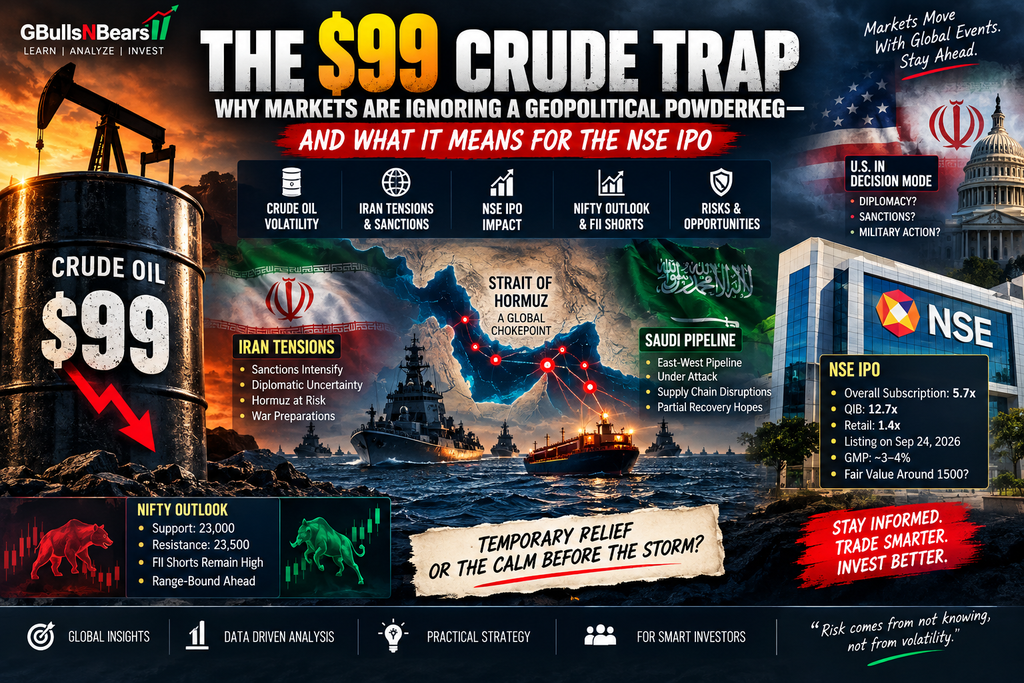
Brent crude recently moved below the $100-per-barrel mark as traders responded to reports of Saudi Arabia’s East-West pipeline recovery and possible diplomatic progress involving Iran and the United States. On September 22, Brent was reported around $99.34, while WTI traded near $94.80.
At first glance, lower crude prices appear positive for oil-importing economies such as India. However, the decline does not eliminate the underlying risks. The market is balancing two opposing possibilities:
- Supply recovery: Pipeline operations resume and shipping disruptions ease.
- Geopolitical escalation: Negotiations fail, infrastructure remains vulnerable, and supply routes face further disruption.
This is why the current crude-price movement should not be interpreted as proof that the energy crisis has ended.
Falling oil prices can reduce immediate inflation pressure, but they do not automatically eliminate geopolitical or supply-chain risks.
For Indian investors, the situation is particularly relevant because the National Stock Exchange (NSE) IPO is scheduled to list on the BSE on September 24, 2026, after attracting substantial institutional demand.
2. Crude Oil Below $100: Relief or Temporary Repricing?
What caused the recent decline?
Several developments contributed to the fall in crude prices:
- Reports of Saudi Arabia restarting or testing its East-West pipeline.
- Expectations of a possible improvement in Middle East supply flows.
- Diplomatic discussions involving Iran and the United States.
- A reduction in the immediate supply-disruption premium.
- Market participants reassessing the probability of prolonged disruption.
The East-West pipeline has a reported design capacity of approximately 7 million barrels per day, although the actual volume restored and the speed of a complete recovery remain important uncertainties.
The National reported that Brent fell to approximately $99.25 per barrel amid expectations of improved supply and partial pipeline restoration.
Why lower prices do not guarantee lower risk
Oil prices reflect expectations about future supply and demand. A price decline may occur even while physical risks remain elevated if traders expect:
- A diplomatic agreement
- Improved export availability
- Alternative shipping arrangements
- A faster infrastructure recovery
- Lower future demand
However, if these expectations fail to materialize, crude prices could rise again.
Important distinction
The statement that the fall in crude is entirely “speculative” cannot be established without detailed market-positioning data and physical supply statistics. The more balanced interpretation is:
The decline reflects a combination of expected supply recovery, diplomatic optimism and changing risk premiums, while important geopolitical uncertainties remain.
3. Strait of Hormuz: The Market’s Major Supply-Chain Risk
The Strait of Hormuz remains a critical energy transit route. Disruptions can increase transportation costs, delay shipments,s and create uncertainty for refiners and importing countries.
Reports have indicated that navigation through the strait has been affected by regional conflict, while Iran has signaled conditions under which the waterway could reopen.
Potential consequences of prolonged disruption
| Risk | Possible market impact |
|---|---|
| Shipping delays | Longer delivery times |
| Higher insurance premiums | Increased transportation costs |
| Limited tanker availability | Higher freight rates |
| Supply uncertainty | Increased crude-price volatility |
| Regional export disruption | Pressure on refiners and importers |
Saudi Arabia’s energy ministry attributed higher shipping costs to regional conflict and disruption to navigation around the Strait of Hormuz, according to a Reuters report.
What Indian investors should monitor
- Brent and WTI price differentials
- Tanker freight rates
- Indian crude import costs
- USD/INR movement
- Refinery margins
- Government fuel-pricing decisions
- Strategic petroleum reserve policy
The longer a disruption continues, the greater the possibility that transportation costs and supply shortages affect inflation and corporate earnings.
4. Saudi Arabia’s East-West Pipeline: Why Restoration Matters
Saudi Arabia’s East-West pipeline provides a route for moving crude toward the Red Sea, helping the country reduce dependence on shipments through the Strait of Hormuz.
The pipeline was damaged in attacks and subsequently became a major focus of the oil market. Reports later indicated that Saudi Arabia was testing or restarting the pipeline at reduced capacity.
Why the market reacted positively
Pipeline recovery could:
- Improve export flexibility
- Reduce dependence on vulnerable maritime routes
- Support the availability of crude for international buyers
- Reduce the immediate supply-risk premium
- Improve sentiment in energy-importing economies
However, pipeline capacity does not equal immediate export availability. Some crude may be redirected toward domestic refineries, and the actual volume reaching international markets depends on operational conditions and logistics.
Scenario analysis
| Scenario | Potential oil-market impact |
|---|---|
| Full and sustained restoration | Supply concerns may ease |
| Partial restoration | Limited relief, continued uncertainty |
| New infrastructure damage | Renewed upward price pressure |
| Hormuz reopening and supply recovery | Risk premium may decline further |
The restoration process is therefore more important than a single headline announcing that the pipeline has restarted.
5. Iran Sanctions and the “Economic Outcast” Claim
The original analysis refers to an alleged August 24 announcement called “Operation Economic Outcast” and attributes specific measures to the US Treasury Secretary.
These claims should be treated cautiously unless supported by an official US Treasury release, a presidential order or reliable reporting. The available sources reviewed for this article do not independently establish the exact programme name or all the measures listed in the original draft.
What can be analysed more reliably?
Iran-related sanctions can potentially affect:
- Oil exports
- Shipping and insurance
- Financial transactions
- Aviation and logistics
- Regional trade
- Chinese and other third-party entities involved in sanctioned activity
The impact of any sanctions package depends on its legal scope, enforcement, exemptions and the response of other countries.
Diplomacy versus sanctions
Diplomatic talks and economic pressure can exist simultaneously. Negotiations do not necessarily mean that sanctions have been withdrawn, and sanctions do not automatically mean that diplomacy has failed.
Investors should verify:
- Whether a measure has been officially announced.
- Which entities and industries are covered.
- Whether exemptions are available.
- Whether enforcement has begun.
- Whether the measure affects actual physical oil flows.
Avoid treating unverified policy labels or social-media descriptions as confirmed government policy.
6. NSE IPO: What the Subscription Data Actually Shows
The NSE IPO attracted substantial interest during its September 2026 offering.
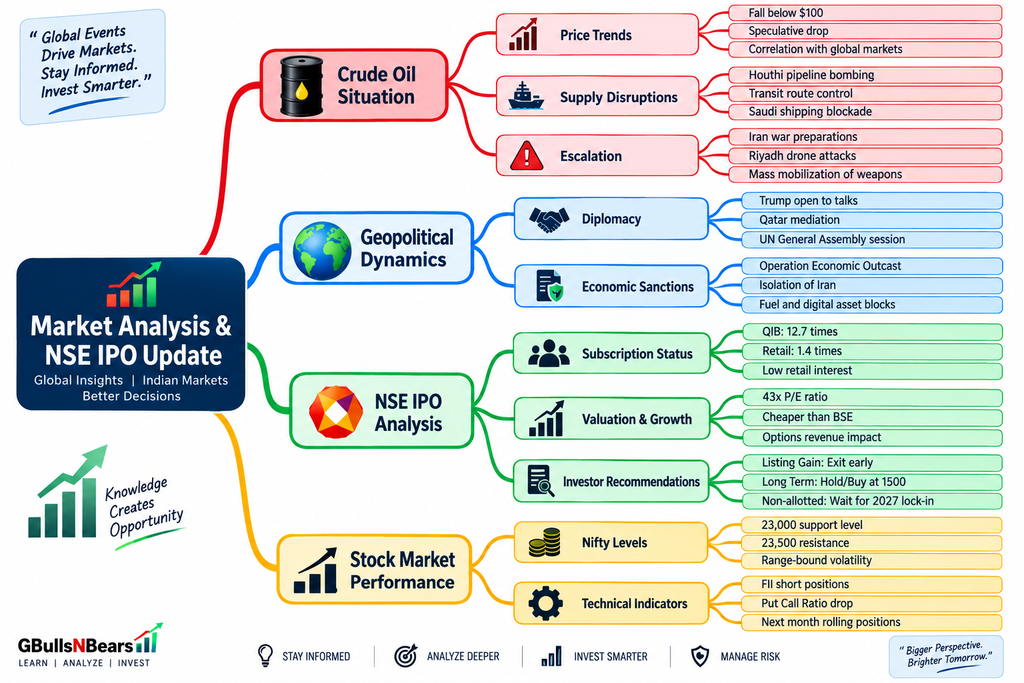
According to Financial Express, the issue closed with an overall subscription of approximately 5.7 times. The reported category-wise figures were:
| Category | Subscription |
|---|---|
| Qualified Institutional Buyers (QIB) | 12.68x |
| Non-Institutional Investors (NII) | 6.55x |
| Retail Investors | 1.39x |
| Employees | 2.40x |
| Overall | 5.71x |
The issue received bids for approximately 505.81 million shares against around 88.64 million shares on offer.
Does 1.39x retail subscription prove retail exhaustion?
Not necessarily.
A relatively lower retail subscription compared with QIB demand may indicate differences in:
- Capital availability
- Investor risk tolerance
- Valuation expectations
- Minimum lot size
- Institutional allocation preferences
- Demand for other IPOs
- Market conditions
It does not by itself prove that retail investors have lost confidence in the Indian equity market.
The NSE IPO’s institutional demand was considerably stronger than its retail demand, but subscription data alone cannot establish whether institutional investors expect a sustained post-listing rally.
7. NSE Valuation: What Investors Should Examine
The NSE IPO had a reported price band of ₹1,700–₹1,785 per share, with an issue size of approximately ₹22,561.57 crore. The IPO was structured as an offer for sale, meaning existing shareholders were selling shares rather than the company raising fresh primary capital through a new issue.
Important valuation factors
Investors should evaluate the following before making a decision:
- Price-to-earnings ratio: Compare NSE with its historical earnings and relevant peers.
- Options revenue concentration: Assess the contribution of derivatives and options-related activity.
- Regulatory changes: Review the impact of SEBI measures on derivatives participation and exchange revenues.
- Cash generation: Examine operating cash flow and capital requirements.
- Competitive position: Compare NSE with BSE and other market infrastructure providers.
- Growth outlook: Consider cash equities, derivatives, data products, technology and other businesses.
- Shareholder selling: Understand the effect of an offer-for-sale structure on the ownership profile.
Options revenue and regulatory risk
The original draft states that 60% of NSE’s revenue comes from options trading and that its valuation is approximately 43x PE compared with 53–54x for BSE. These precise figures should be verified against the final IPO documents and the relevant financial reporting period before publication.
The broader issue is valid for analysis: if regulatory changes reduce derivatives activity, exchanges with high derivatives-related revenue exposure may face earnings pressure.
However, regulatory measures can also encourage market diversification, improve investor protection and alter the competitive landscape in ways that are not immediately reflected in short-term trading volumes.
8. NSE Listing Strategy: Listing Gains Versus Long-Term Valuation
The NSE is scheduled to list on the BSE on September 24, 2026.
Investors considering the listing should separate two different strategies.
A. Listing-gain approach
Listing-gain investors generally focus on:
- Issue price
- Grey market premium
- Subscription momentum
- Broader market sentiment
- Expected opening price
- Liquidity and volatility
Grey market premium is an unofficial indicator. It does not guarantee the listing price or future returns. PL Capital reported a GMP of ₹70 on September 21, corresponding to an indicative premium of approximately 3.92% over the upper price band.
GMP should not be treated as a reliable prediction of listing performance.
B. Long-term investment approach
Long-term investors should assess:
- Sustainable earnings growth
- Valuation relative to earnings
- Regulatory exposure
- Competitive advantages
- Future trading activity
- Cash flow quality
- Corporate governance
- Potential changes in shareholder ownership
A specific entry price such as ₹1,500 should be presented as an individual valuation scenario, not as an objectively established fair value. A proper valuation estimate requires verified financial statements, earnings assumptions and a suitable valuation methodology.
A practical valuation framework
| Factor | Question |
|---|---|
| Earnings | Are profits sustainable? |
| Valuation | What growth is already priced in? |
| Regulation | Could policy affect revenue? |
| Competition | Can BSE or other platforms gain share? |
| Risk | What could reduce earnings or valuation? |
| Margin of safety | Is the purchase price justified by conservative assumptions? |
9. Lock-In Expiry: Why the Date Must Be Verified
The original article refers to a mid-2027 lock-in expiry and predicts a potential supply glut within six months.
This claim requires confirmation from the final offer documents and applicable lock-in provisions. The exact date may vary by shareholder category, acquisition history and regulatory rules.
Even when a lock-in expires, it does not automatically mean that all shareholders will sell their holdings. Investors should distinguish between:
- Shares becoming eligible for sale
- Actual shareholder selling
- The size of the eligible shareholding
- Market liquidity
- Investor demand at that time
What could happen after lock-in expiry?
Potential outcomes include:
- Additional free-float shares becoming available
- Increased trading liquidity
- Temporary selling pressure
- No material selling if shareholders retain their positions
- Price volatility depending on demand and valuation
A lock-in expiry should therefore be treated as a potential supply event, not a guaranteed collapse or discount opportunity.
10. Nifty 50 and FII Short Positions: What the Data Can and Cannot Prove
The original analysis identifies 23,000 as support and 23,500 as resistance, while suggesting that foreign investors are positioned for a breakdown.
These levels may be used as a technical framework, but they require current chart and derivatives data for validation. A stated short position does not automatically prove that FIIs “know something” or that a market decline is imminent.
Why FII futures positioning matters
FII index futures positions can represent different purposes:
- Directional trading
- Portfolio hedging
- Arbitrage
- Relative-value strategies
- Options-related risk management
Therefore, high short positions do not necessarily equal a direct bearish prediction.
Technical levels to monitor
| Level | Interpretation |
|---|---|
| 23,000 | Proposed psychological support |
| 23,150 | Short-term reference level in the original framework |
| 23,500 | Proposed resistance |
| Below support | Requires confirmation through volume and market breadth |
| Above resistance | Requires confirmation through sustained participation |
These levels are not independently verified in this article and should be updated using the latest Nifty chart before publication or trading.
Stronger confirmation signals
Investors can combine price levels with:
- Market breadth
- Trading volume
- India VIX
- FII index futures data
- Put-call ratio
- Open interest changes
- USD/INR movement
- Sector participation
A single technical level is rarely sufficient to establish a market trend.
11. How $99 Crude Could Affect the Indian Stock Market
India is a major crude oil importer, so energy prices can influence inflation, the rupee, corporate costs and investor sentiment.
Possible effects if crude rises again
Negative pressure
- Higher import expenditure
- Increased transportation costs
- Pressure on the rupee
- Higher input costs for energy-intensive companies
- Potential inflation concerns
- Reduced consumer purchasing power
Potential beneficiaries
Some energy producers and selected upstream companies may benefit from higher realised oil prices. However, the outcome depends on government policies, production costs, taxation, hedging and company-specific factors.
Sectors to monitor
| Sector | Potential sensitivity |
|---|---|
| Aviation | Jet-fuel costs |
| Paints | Petrochemical input prices |
| Tyres | Synthetic rubber and raw materials |
| Logistics | Diesel and freight expenses |
| Chemicals | Feedstock and energy costs |
| Consumer goods | Transportation and packaging |
| Oil producers | Higher realised crude prices |
| Refiners | Crack spreads and crude sourcing |
The effect of crude oil on the Nifty 50 will depend on the balance between beneficiaries and vulnerable sectors, as well as the duration of the price movement.
12. Three Scenarios for the Market
Scenario 1: Supply recovery and diplomatic progress
If Saudi pipeline operations improve and diplomatic negotiations reduce shipping risks:
- Crude prices may remain below recent highs.
- Inflation concerns may ease.
- Importing economies may benefit.
- Risk sentiment could improve.
Reports have already linked pipeline recovery and diplomatic expectations with the recent decline in crude prices.
Scenario 2: Prolonged uncertainty
If the pipeline recovery is partial and Hormuz-related risks remain:
- Oil may remain volatile.
- Freight costs may stay elevated.
- Indian markets may trade in a wider range.
- Sector performance may diverge.
Scenario 3: Renewed supply disruption
If additional infrastructure attacks occur or shipping restrictions worsen:
- Crude could rise sharply.
- Inflation expectations may increase.
- Emerging-market currencies could face pressure.
- Equity-market volatility could intensify.
None of these scenarios is certain. Investors should track actual supply developments rather than rely solely on geopolitical headlines.
13. Key Market Triggers to Watch
1. Strait of Hormuz shipping conditions
Monitor whether vessel traffic improves or restrictions continue.
2. Saudi East-West pipeline restoration
Track actual operating capacity and export volumes rather than only announcements.
3. NSE listing and price discovery
Watch the listing price, trading volume, valuation and post-listing volatility.
4. Nifty market breadth
Monitor whether gains are supported by multiple sectors or a narrow group of stocks.
5. FII and DII flows
Evaluate cash-market flows alongside derivatives positioning and hedging activity.
Conclusion: The $99 Crude Price Is Not the Whole Story
The decline in crude oil prices below $100 per barrel offers some relief to oil-importing economies, but it does not eliminate the geopolitical risks surrounding the Strait of Hormuz, regional infrastructure and global shipping.
Saudi Arabia’s pipeline restoration efforts and diplomatic developments have contributed to improved supply expectations. Nevertheless, the market remains sensitive to renewed disruption, incomplete recovery and further escalation.
The NSE IPO adds another important dimension to the Indian market. The issue attracted an overall subscription of approximately 5.7 times, with stronger institutional participation than retail participation. However, subscription data, GMP and FII short positions should not be interpreted as guaranteed indicators of future price direction.
The central takeaway
Investors should not judge the market only by the crude oil price or a single day of index movement.
A more comprehensive approach considers:
- Physical oil supply and transportation
- Diplomatic and sanctions developments
- NSE valuation and earnings potential
- FII and DII activity
- Market breadth and technical confirmation
- Individual portfolio risk
The $99 crude price may represent temporary relief, a change in expectations, or the beginning of a more stable supply environment. The evidence will depend on whether infrastructure recovery and diplomatic progress translate into sustained improvements in physical energy flows.
Frequently Asked Questions
1. Why did crude oil fall below $100?
Reports linked the decline to expectations of improved Middle East supply, Saudi East-West pipeline recovery and potential diplomatic progress involving Iran and the United States.
2. Is the fall in crude oil a sign that geopolitical risks are over?
No. Lower prices may reflect changing expectations, but shipping restrictions, infrastructure risks and diplomatic uncertainty can continue to influence the market.
3. What was the final NSE IPO subscription?
The NSE IPO reportedly closed with approximately 5.71x overall subscription, QIB subscription of 12.68x and retail subscription of 1.39x.
4. When is the NSE IPO scheduled to list?
The NSE IPO is scheduled to list on the BSE on September 24, 2026.
5. Does a high FII short position guarantee a Nifty fall?
No. FII positions can include hedging, arbitrage and other strategies. Positioning should be evaluated alongside price action, open interest, volume and market breadth.
6. Is NSE IPO GMP a guaranteed listing-profit indicator?
No. GMP is an unofficial market indicator and does not guarantee the actual listing price or future returns.
Disclaimer
This article is intended for educational and informational purposes only and does not constitute financial, investment, trading, legal,l or geopolitical advice. Market prices, geopolitical events, IPO data, ta and regulatory policies can change rapidly. Some scenarios discussed are conditional and uncertain. Readers should verify current information using official documents and reliable sources, conduct independent research, and consider their risk tolerance before making investment decisions.
🔥 Top 10 SEO Titles for Your Article
1. $99 Crude Oil Trap: Iran Tensions, NSE IPO and the Risk to Indian Markets
2. Crude Oil Below $100: Why Geopolitical Risks Could Shake the Indian Stock Market
3. $99 Oil Price Explained: Strait of Hormuz Crisis, Iran Sanctions and NSE IPO Impact
4. NSE IPO 2026: How Crude Oil Prices and Middle East Tensions Could Impact Investors
5. Crude Oil Market Outlook 2026: The Hidden Risks Behind the $99 Price Drop
6. Why Is Crude Oil Falling Below $100? Iran Conflict, Saudi Pipeline and Market Risks
7. Indian Stock Market Warning: $99 Crude Oil, FII Shorts and NSE IPO Volatility
8. The $99 Crude Trap: Global Energy Risks and Their Impact on Nifty 50
9. NSE IPO Listing 2026: Valuation, GMP, Crude Oil Risks and Investor Strategy
10. Oil Price Crash or Temporary Relief? Iran Tensions, Hormuz Risks and Indian Markets