

Introduction: The Market’s Sudden U-Turn and the Jio IPO Effect
India’s stock market can experience a sharp change in sentiment even when its longer-term outlook appears constructive. Banking-sector earnings, foreign investment flows, global interest rates and large public offerings can all influence short-term price movements.
In October 2026, the upcoming listing of Jio Platforms has become a major focus for Indian equity investors. The offering has attracted unprecedented institutional interest, while investors are also assessing the financial performance of private and public sector banks and the impact of international developments on Reliance Industries.
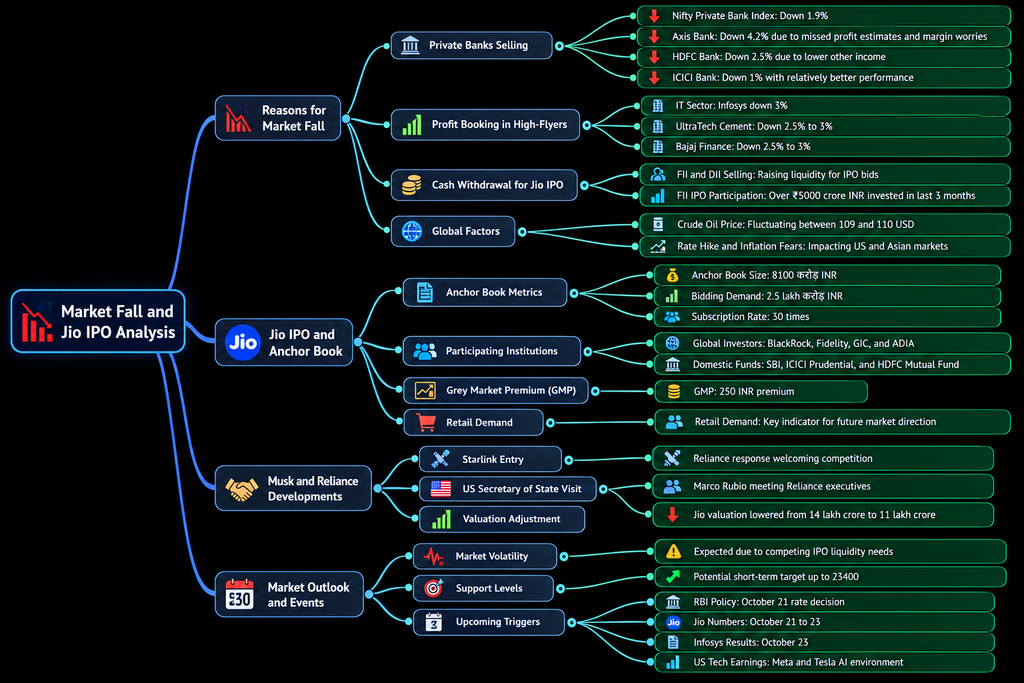
The scale of Jio’s IPO is significant. According to Reuters, the company attracted more than $25 billion in bids for its anchor-investor allocation alone, representing demand of more than 30 times the amount available. The offering is expected to raise approximately ₹30,213 crore.
However, strong demand for a major IPO does not automatically explain every movement in the secondary market. Investors need to distinguish between confirmed capital commitments, actual trading flows, corporate earnings and speculation about institutional strategies.
Here are five important takeaways from the Jio IPO, banking-sector divergence and the risks shaping India’s equity markets.
Takeaway 1: The Jio IPO Liquidity Question — Can a Mega-Offering Affect Blue-Chip Stocks?
A large IPO can influence the broader market because investors have a limited pool of capital to allocate across different opportunities. When a major company launches an offering, institutional and retail investors may reconsider existing positions to make room for the new investment.
This process is often described as liquidity rotation. However, the existence of a large IPO does not establish that institutions are selling specific stocks to finance it.
Jio’s anchor book: The numbers behind the headlines
Jio Platforms’ IPO has attracted substantial institutional demand ahead of its public subscription period.
| IPO metric | Reported details |
|---|---|
| Total IPO size | Approximately ₹30,213 crore |
| Anchor allocation | Approximately ₹8,110 crore |
| Anchor-book bids | More than ₹2.5 lakh crore |
| Reported anchor demand | More than 30 times the allocation |
| Price band | ₹1,065–₹1,119 per share |
| Public subscription period | October 21–23, 2026 |
| Proposed issue | 27 crore fresh equity shares |
The anchor allocation was approximately 26.8% of the overall IPO size. This is a substantial amount, but it is not equivalent to the entire IPO being funded by new secondary-market purchases.
How IPO-related liquidity rotation works
Several mechanisms can influence the market around a large offering:
- Portfolio rebalancing: Investors may sell existing holdings to maintain their preferred allocation across stocks.
- Cash management: Institutional investors may hold additional cash before participating in an offering.
- IPO allocation decisions: Investors may reduce exposure elsewhere if they want to participate in a new issue.
- Profit booking: Traders may sell stocks that have already risen sharply, independently of the IPO.
- Market sentiment: A highly publicised offering may temporarily draw attention away from other investment opportunities.
These are possible mechanisms, not proof that a specific institution sold Infosys, UltraTech Cement or Bajaj Finance to finance Jio subscriptions.
Does strong anchor demand guarantee a successful listing?
No. Anchor demand is an indicator of institutional interest, but it must be interpreted carefully.
A high bid-to-allocation ratio means investors sought substantially more shares than were available in that allocation. It does not mean every bid resulted in an investment, nor does it guarantee that the shares will trade above the IPO price after listing.
Investors should separately monitor the public subscription figures, final allotment, valuation, company fundamentals and post-listing trading activity.
Key takeaway: The Jio IPO is large enough to influence investor attention and portfolio decisions. But attributing a broad market decline entirely to IPO-related liquidity withdrawal requires evidence from actual trading and fund-flow data.
Takeaway 2: The Great Banking Divergence — Private Banks Versus PSU Banks
One of the most useful ways to understand the Indian stock market is to look beyond the Nifty 50 and examine sector-level performance.
Banking stocks can move in different directions because public and private lenders have different deposit bases, loan portfolios, operating costs, funding structures and earnings drivers.
A private-bank sell-off alongside a PSU-bank rally can therefore reflect company-specific earnings developments, valuation differences or sector rotation rather than a single market-wide cause.
Why private banks may come under pressure
Private banks are sensitive to several important financial indicators.
Net interest margin (NIM): NIM measures the difference between interest earned on assets and interest paid on funding, relative to the relevant earning-asset base. A decline can pressure profitability if it is not offset by loan growth or lower operating costs.
Cost of deposits: Banks compete for deposits to fund lending. If deposit costs rise faster than loan yields, profitability may weaken.
Credit costs: Higher defaults or provisions can reduce net profit.
Loan-to-deposit ratio: A high ratio can indicate that lending is growing faster than the deposit base, potentially increasing funding pressure.
Other income: Treasury gains, fees and other non-interest income can influence quarterly earnings. Weakness in this category can affect profit even when core lending operations remain relatively stable.
For example, if a bank reports margin compression alongside elevated funding costs, investors may reduce their earnings expectations. The stock can fall even when the bank remains profitable.
Why PSU banks can outperform
Public sector banks may rally when investors see improving asset quality, stronger credit growth, better recoveries or lower credit costs.
Other potential catalysts include:
- Improved profitability and operating efficiency
- Stronger capital adequacy
- Better-than-expected quarterly results
- Attractive valuations relative to private-sector peers
- Expectations of continued credit demand
However, a rally in PSU banks does not prove that the entire market is free from macroeconomic risk. Government-owned lenders can also be affected by slower economic growth, higher funding costs and deterioration in asset quality.
Banking-sector indicators investors should compare
| Indicator | Why it matters |
|---|---|
| Net interest margin | Measures the profitability of core lending |
| Deposit growth | Indicates funding capacity |
| Loan growth | Shows expansion in lending activity |
| Gross and net NPA ratios | Help assess asset quality |
| Credit costs | Show the impact of loan defaults and provisions |
| Cost-to-income ratio | Measures operating efficiency |
| Capital adequacy | Indicates the bank’s capacity to absorb losses |
The daily percentage changes cited in the original draft—such as a 4.2% decline in Axis Bank or a 6% rise in Union Bank—should be matched to a specific trading date and verified against official market data before publication.
Key takeaway: Private-bank weakness and PSU-bank strength can coexist. The right interpretation comes from earnings quality, asset quality, valuations and funding conditions, rather than assuming that one day’s sector rotation reveals the entire market’s direction.
Takeaway 3: The Starlink Twist — Why Satellite Competition Matters for Jio’s Valuation
Jio Platforms’ business is closely associated with India’s digital economy, including mobile connectivity, broadband, enterprise services, and technology infrastructure. The arrival of new competitors in satellite connectivity creates another factor investors should consider.
Starlink, the satellite internet business associated with Elon Musk, represents a potential alternative for customers who need connectivity in areas where traditional terrestrial networks are less practical.
The competitive implications are important, but they should not be exaggerated.
Satellite internet versus traditional telecom
Satellite and terrestrial networks serve overlapping but different needs.
| Business factor | Traditional telecom and broadband | Satellite connectivity |
|---|---|---|
| Infrastructure | Mobile towers, fibre and local network equipment | Satellites, ground stations and user terminals |
| Potential strength | Dense coverage and established customer relationships | Connectivity in remote or difficult-to-reach areas |
| Cost considerations | Spectrum, network investment and ongoing operations | Satellite deployment, terminals and service delivery |
| Competition | Telecom operators and broadband providers | Satellite providers and other connectivity solutions |
Satellite services could create competitive pressure in selected customer segments. At the same time, they can expand connectivity in underserved areas and support enterprise applications.
The actual effect on Jio’s earnings will depend on regulatory approvals, pricing, customer adoption, service quality and the size of the addressable market.
Why the valuation debate matters
Jio’s public offering has attracted attention because of its scale and its position within Reliance Industries’ digital business.
The Financial Times reported that the IPO targeted a valuation of approximately $107 billion, compared with earlier expectations of around $150 billion. This suggests a lower target valuation than some earlier expectations, but it does not independently establish that three successive valuation cuts were made or that satellite competition alone caused the change.
A valuation must ultimately be assessed against the company’s revenue, profitability, cash flow, capital expenditure, debt and future growth opportunities.
The Marco Rubio visit and Reliance’s strategic role
US Secretary of State Marco Rubio’s October 2026 visit to India has also brought attention to Reliance’s energy operations and the wider relationship between Indian companies and international energy security.
Reporting indicates that the visit included engagement involving Reliance’s Jamnagar refinery and discussions around processing heavy crude. This is a distinct energy-sector development, rather than direct evidence of a change in Jio’s IPO valuation.
Investors should keep these issues separate: Reliance’s energy business, Jio’s telecommunications operations and the satellite internet market have different financial drivers, even though they sit within a wider strategic and corporate context.
Key takeaway: Competition from satellite providers is a relevant long-term consideration for Jio, but it should be evaluated alongside the company’s core telecom economics, customer growth and ability to monetise its digital services.
Takeaway 4: Managed Hype Versus Retail Reality — Understanding the 30x Anchor Demand
The headline figure surrounding Jio’s anchor book is extraordinary: more than ₹2.5 lakh crore in reported bids for an allocation of approximately ₹8,110 crore.
Reuters reported that global institutions, including BlackRock and Fidelity, were among the investors seeking exposure. The offering also attracted participation from domestic institutions and sovereign wealth funds.
Such demand suggests that major investors see sufficient potential to participate at the offered price. But it does not eliminate valuation risk.
Anchor investors and retail investors have different objectives
Anchor investors are institutional investors who receive allocations before the public issue opens, subject to the applicable IPO rules. Their participation can provide useful information about institutional interest, but their objectives may differ from those of individual investors.
Retail investors, meanwhile, need to assess whether the issue price offers a reasonable entry point relative to the company’s expected future performance.
A popular IPO can still disappoint if its valuation already incorporates optimistic assumptions.
The Paytm lesson: Strong demand is not the same as attractive returns
Paytm’s 2021 IPO is a useful historical example of why investors should separate subscription demand from subsequent share-price performance.
The company attracted substantial investor interest before listing, but its shares subsequently came under significant pressure as investors reassessed its valuation, profitability outlook and business risks.
The lesson is not that Jio will repeat Paytm’s performance. The two companies have different business models, market positions and financial characteristics.
The lesson is that IPO demand measures interest at a particular price, while long-term investment returns depend on the price paid and the company’s future financial performance.
Five questions to ask before subscribing
- Is the IPO valuation reasonable relative to revenue, earnings and cash flow?
- How much future growth is already reflected in the issue price?
- What are the company’s capital expenditure and debt requirements?
- Are competitive advantages sustainable?
- Would the investment still make sense if the share price declined after listing?
Investors should also distinguish between the grey market premium (GMP), official subscription data and actual stock-exchange prices. GMP is an unofficial market indicator, not a guaranteed listing premium.
Key takeaway: Strong anchor-book demand is a positive signal of institutional interest, but it is not a substitute for valuation analysis or an assurance of listing gains.
Takeaway 5: India VIX, Crude Oil and Nifty — The Risks Behind Intraday Volatility
Indian equities are influenced by both domestic developments and international financial conditions. Even when company earnings remain healthy, higher volatility can increase the risk of sudden price swings.
India VIX is one indicator that traders use to assess expected near-term volatility in the Nifty 50 options market.
A rise in India VIX generally indicates that options prices reflect greater expected volatility. It does not indicate the direction of the next market move, and it does not guarantee a crash.
Why crude oil matters
India imports a large share of its crude oil requirements, making energy prices an important macroeconomic variable.
Higher crude prices can increase transport and production costs, add to inflationary pressure,e and affect the rupee through the import bill. These effects can influence corporate margins and investor expectations.
However, the impact differs by sector. Airlines, logistics companies, paints and some chemical businesses may face cost pressure, while other businesses may benefit from particular changes in commodity prices.
How global interest rates affect Indian equities
Higher US Treasury yields can make dollar-denominated assets more attractive to some international investors. They can also raise the discount rates used to value future corporate earnings.
The resulting impact on India depends on several variables, including domestic growth, earnings, currency movements, capital flows and monetary policy.
Investors should therefore avoid attributing every market decline to a single factor such as an IPO, crude oil or the Federal Reserve.
Nifty technical levels: Use them as reference points, not guarantees
The original analysis identifies 23,080 as a key support reference and 23,400 as a potential upside level.
These levels require fresh confirmation against the relevant trading session, current price action and chart structure. They should not be presented as guaranteed stop-loss triggers or as proof that a rebound will occur before the IPO listing.
| Market indicator | What investors should monitor |
|---|---|
| India VIX | Whether implied volatility is rising or falling |
| Brent crude | The direction and persistence of oil-price changes |
| USD/INR | Currency pressure and foreign-exchange volatility |
| FII flows | Whether foreign selling is accelerating or moderating |
| Nifty market breadth | Whether gains or losses are broad-based |
| Bank earnings | Margin trends, credit costs and deposit growth |
| IPO subscription | Demand across retail, non-institutional and institutional categories |
A disciplined investor should define risk limits before entering a trade rather than changing the plan after a sudden market move.
Key takeaway: Volatility is a risk indicator, not a directional forecast. Investors should combine market breadth, earnings, macroeconomic developments and position sizing instead of relying on one technical level.
What Should Investors Watch Next?
The Jio IPO provides an important near-term event, but investors should continue to evaluate the wider market.
Jio IPO subscription and listing
The issue’s subscription period is scheduled for October 21–23, 2026, with the proposed listing date of October 28. Investors should monitor final subscription figures, allotment details and official exchange disclosures.
Private-bank earnings
Quarterly results from private lenders can provide insight into deposit competition, net interest margins, credit costs and loan growth. These indicators are more informative than a single day’s share-price movement.
PSU-bank performance
Investors should determine whether strength in public sector banks is supported by sustained earnings and improving asset quality or by short-term sector rotation.
Global energy and interest rates
Crude prices, US Treasury yields and global risk appetite can influence Indian equities through inflation, currency and capital-flow channels.
Institutional fund flows
FII and DII data can help investors understand market demand, but the figures need to be interpreted alongside primary-market activity and actual secondary-market transactions.
Conclusion: Is the Market Reversal a Warning or a Buying Opportunity?
The Jio IPO has generated extraordinary institutional interest and has become a major focus for Indian investors. At the same time, the banking sector illustrates why stock-market performance cannot be explained by a single headline.
Private banks may face pressure from margins and funding costs while PSU banks benefit from earnings momentum or more attractive valuations. Satellite internet competition adds another variable to Jio’s long-term outlook, while crude oil, global interest rates and volatility remain relevant macroeconomic risks.
The most important distinction is between confirmed data and market interpretation.
A large anchor book does not prove that institutions are liquidating blue-chip holdings to finance an IPO. A rally in PSU banks does not establish that macroeconomic risks have disappeared. Strong institutional demand does not guarantee listing gains, and a rise in India VIX does not predict the direction of the next market move.
Investors should focus on valuation, earnings quality, risk management and verified disclosures rather than relying on a single day’s trading narrative.
What is your strategy for the Jio IPO? Are you considering subscribing based on the company’s long-term digital growth prospects, or would you prefer to wait for post-listing price discovery? Share your view in the comments.
Frequently Asked Questions (FAQs)
1. Why is the Jio IPO attracting so much attention?
Jio Platforms operates across telecom, broadband and digital services, and its IPO is one of India’s largest planned public offerings. Its scale and growth prospects have attracted substantial institutional interest.
2. Does 30x anchor-book demand guarantee listing gains?
No. The reported demand reflects bids for the anchor allocation. It does not guarantee retail subscription levels, a positive listing, ng or long-term share-price performance.
3. Can a large IPO cause the stock market to fall?
A large IPO can influence portfolio allocation and investor liquidity, but a market decline cannot be attributed to the offering without evidence of actual fund flows and trading activity.
4. Why do private banks and PSU banks sometimes move in opposite directions?
They can have different earnings trends, funding costs, asset-quality conditions, valuations and investor expectations. Sector divergence does not necessarily indicate a broader market crash.
5. How does India VIX affect traders?
India VIX measures expected near-term volatility derived from Nifty options. A higher reading generally reflects greater expected volatility, but it does not predict whether the market will rise or fall.
6. Should investors subscribe to the Jio IPO?
The decision depends on an investor’s financial goals, risk tolerance, valuation assessment, and investment horizon. Review the official offer documents and consider seeking independent financial advice before investing.
Disclaimer
This article is for educational and informational purposes only. It does not constitute investment advice or a recommendation to subscribe to the Jio IPO, buy or sell banking stocks, or trade the Nifty 50. IPO details, market prices, and economic conditions may change. Verify all current figures using official exchange filings and company disclosures before making investment decisions.
10 SEO titles
- Jio IPO 2026: 5 Surprising Market Trends Every Investor Should Know
- Jio IPO Shakeup: Why Nifty Fell and Banking Stocks Moved in Opposite Directions
- Jio IPO 2026 Analysis: Record Anchor Demand, Valuation Risks and Market Impact
- Jio Platforms IPO 2026: 7 Key Facts Investors Must Understand
- Indian Stock Market Today: Jio IPO, Nifty 50 and Banking Sector Analysis
- Jio IPO vs Banking Stocks: 5 Major Factors Driving India’s Stock Market
- Jio IPO 2026: ₹30,213 Crore Issue, Valuation Concerns and Investor Risks
- Why Private Banks Fell While PSU Banks Rallied: Jio IPO Market Analysis
- Jio IPO News 2026: Anchor Investor Demand, Listing Expectations and Key Risks
- Nifty 50 Market Reversal: How the Jio IPO Could Influence Investor Sentiment