

Introduction: Why Is the Indian Stock Market Defying Global Volatility?
Global financial markets have experienced significant turbulence in October 2026, driven by concerns over artificial intelligence valuations, rising borrowing costs, geopolitical tensions and uncertainty surrounding global economic growth. Yet India’s stock market has demonstrated resilience at several points during the sell-off.
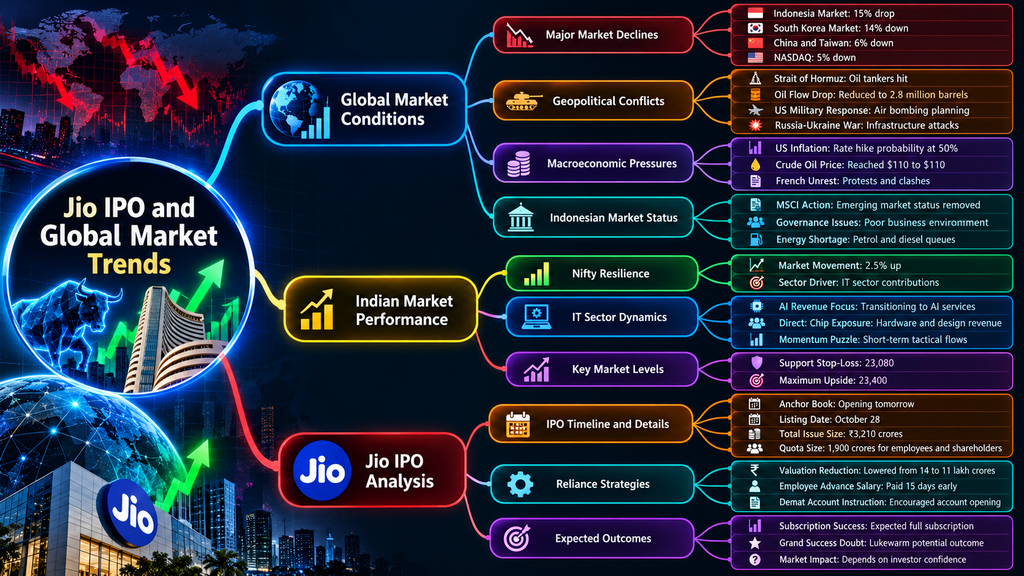
On October 21, the Nifty 50 rose approximately 0.57% to 23,019.2, while the Sensex gained around 0.7% to 74,370.91. Information technology stocks led the advance, and Reliance Industries also moved higher as Jio Platforms’ much-anticipated initial public offering opened for subscription. At the same time, India’s small-cap and mid-cap indices declined, highlighting the uneven nature of the recovery.
This divergence raises an important question: Does the Nifty rally indicate genuine economic strength, or is domestic liquidity temporarily cushioning the Indian market against global risks?
The answer is more complicated than a simple bullish or bearish forecast. Domestic investment flows, company-specific earnings and IPO-related activity can support Indian equities even when international markets are unstable. However, expensive crude oil, foreign investor withdrawals and tighter global financial conditions can quickly change the outlook.
Here are five important market developments investors should understand before making their next investment decision.
1. Indian IT Stocks Are Benefiting From an AI Rotation—but the Long-Term Picture Is More Complicated
One of the most counterintuitive developments in October 2026 has been the recovery in Indian IT stocks during a period of international technology-sector uncertainty.
Some investors view weakness in global AI and semiconductor stocks as an opportunity for Indian IT services companies. The argument is that investors may rotate from expensive AI hardware and infrastructure businesses toward established technology service providers.
There is some logic behind this argument, but it is not a guaranteed investment trend.
Why Indian IT stocks are attracting attention
Indian IT companies operate across several segments, including:
- Enterprise software implementation and consulting
- Cloud migration and infrastructure management
- AI integration and automation
- Cybersecurity and data management
- Semiconductor engineering and embedded systems
These businesses do not necessarily have the same financial characteristics as semiconductor manufacturers or AI infrastructure companies. Their earnings depend on client spending, contract execution, margins, and the ability to convert technology demand into revenue.
Recent earnings also demonstrate that AI is already becoming a measurable business opportunity.
Tata Consultancy Services reported annualised AI services revenue of $3.1 billion in Q2 FY2027, representing more than 10% of its overall revenue. The company also reported quarterly total contract value of $9.6 billion and an operating margin of 24%.
These figures suggest that AI is not merely a future promise for every Indian IT provider. Some companies are already generating meaningful revenue from AI-related services.
However, revenue growth alone does not guarantee higher profits or attractive stock valuations.
The hidden risks behind the IT rally
First, global enterprise spending remains critical. If inflation, higher interest rates or weaker economic growth force businesses to reduce technology budgets, Indian IT companies could face delayed projects and slower contract conversion.
Second, AI creates both opportunities and competitive pressure. Automation can help service providers improve productivity, but it may also reduce the time and labour required for traditional coding, testing and maintenance services. The eventual impact on revenue and margins will depend on pricing models and the services customers purchase.
Third, semiconductor exposure differs across companies. Engineering-focused businesses such as L&T Technology Services, Tata Elxsi and KPIT Technologies have different revenue drivers from large general-purpose IT service providers. A semiconductor slowdown may affect some engineering businesses more directly.
Finally, investors should not assume that domestic mutual fund activity alone explains the rally. Establishing that claim would require stock-level fund-flow data and evidence of actual portfolio reallocations.
What should investors monitor?
| Indicator | Why it matters |
|---|---|
| AI-related revenue growth | Measures commercial adoption |
| New deal wins and contract value | Indicates future business demand |
| Operating margins | Shows whether growth is profitable |
| Client technology budgets | Signals demand sustainability |
| Valuation versus earnings growth | Helps assess downside risk |
Key takeaway: Indian IT stocks may benefit from a change in investor preferences, but sustainable performance ultimately depends on earnings, deal conversion and valuations—not just weakness in overseas AI shares.
2. The Strait of Hormuz: Why Crude Oil Could Become India’s Biggest Macro Risk
Crude oil is one of the most important variables for the Indian economy because India depends heavily on imported petroleum.
According to data compiled from India’s Petroleum Planning and Analysis Cell, crude oil import dependence reached approximately 88.7% in FY2025–26, up from 88.3% in FY2024–25.
That dependence makes India vulnerable to international supply disruptions, freight costs and sudden increases in oil prices.
Why the Strait of Hormuz matters
The Strait of Hormuz is a strategic maritime passage connecting the Persian Gulf with the Gulf of Oman and the wider Indian Ocean. Historically, approximately one-fifth of global oil and petroleum trade has passed through this route.
Any sustained disruption can affect more than the availability of crude. It can also increase shipping costs, insurance premiums, delivery times and the cost of supplying refineries.
Reuters reported on October 20 that tanker shipping costs had surged amid regional security risks. Some shipping costs from the United States to Asia had reached approximately $40 per barrel, illustrating how logistics expenses can compound energy-market stress.
Oil prices have also remained volatile amid geopolitical tensions. Reuters reported Brent crude near $110 per barrel in recent trading, with market concerns involving shipping routes and threats to regional energy infrastructure.
These conditions make energy prices an important variable for India’s market outlook.
How higher crude prices affect India
A sustained rise in crude prices can affect the Indian economy through several channels:
- Inflation: Higher fuel and transport costs can push up the prices of goods and services.
- Rupee pressure: A larger import bill can increase demand for foreign currency.
- Corporate margins: Airlines, paints, chemicals, logistics and other fuel-sensitive businesses may face higher costs.
- Interest-rate expectations: Persistent inflation can make monetary easing more difficult.
- Consumer spending: Higher household energy expenses may leave less money for discretionary purchases.
The impact is not uniform. Oil producers and certain refining or trading businesses may benefit from particular price movements, while fuel-intensive businesses may face pressure. Government policies, refinery margins, inventories and the extent of price pass-through also matter.
Three crude oil scenarios investors should consider
| Scenario | Possible market implications |
|---|---|
| Crude prices stabilise | Inflation and currency pressures may ease |
| Crude stays near $100–$110 | Import costs and corporate margins remain under pressure |
| Supply disruptions intensify | Risk of higher inflation, weaker sentiment and greater rupee volatility |
These are scenario-based illustrations, not guaranteed price forecasts.
Key takeaway: India’s domestic growth story can remain attractive, but an extended energy shock could weaken earnings expectations and reduce the support provided by domestic liquidity.
3. Indonesia’s Stock Market Crash Is a Warning About Governance and Foreign Investor Confidence
Indonesia’s October market turmoil provides another important lesson for emerging-market investors: financial-market confidence can deteriorate rapidly when concerns about transparency and market accessibility intensify.
On October 16, 2026, Indonesia’s Jakarta Composite Index plunged approximately 11.4% in its worst one-day decline since January 1998. The fall followed MSCI’s warning that it could reclassify Indonesia from emerging-market status to standalone-market status.
The potential consequences extend beyond daily share-price movements.
Why the MSCI warning mattered
Global investment funds use indices such as those maintained by MSCI to benchmark portfolios and determine asset allocations. If a country is removed from an index or reclassified, funds that track that benchmark may need to adjust their holdings.
Reuters reported that a potential change in Indonesia’s classification could put as much as $19 billion in investment flows at risk, including both passive and active investor allocations. This was an estimate of potential exposure, not a confirmed amount of money already withdrawn.
The episode illustrates how concerns about transparency, ownership structures, market accessibility and regulatory credibility can influence investment decisions.
Does this mean India faces the same risk?
No. Indonesia’s circumstances should not be directly equated with India’s.
India has its own regulatory structure, investor base, market depth and corporate fundamentals. A sell-off in one emerging market does not automatically imply that another will suffer a similar decline.
Nevertheless, the broader lesson applies to all emerging economies: foreign investor confidence is influenced by governance standards, regulatory predictability, liquidity and the ability to enter or exit investments efficiently.
For Indian investors, the relevant questions include:
- Are corporate disclosures clear and consistent?
- Are minority shareholder interests protected?
- Is market liquidity sufficient during periods of stress?
- Are foreign investors reducing exposure because of domestic concerns or global portfolio adjustments?
Key takeaway: India’s market resilience should be judged by its own fundamentals. Indonesia’s crisis is a reminder that governance and investor confidence matter, not proof that India is headed for a similar crash.
4. Jio IPO 2026: A Landmark Offering, but Is the Valuation Attractive?
Jio Platforms’ IPO is one of the most significant corporate events affecting Indian markets in October 2026.
The issue opened for public subscription on October 21 and is scheduled to close on October 23, with listing expected on October 28, according to published offering details. The reported price band is ₹1,065–₹1,119 per share. At the upper end of the band, the offering is expected to raise approximately ₹30,213 crore, implying a valuation of around ₹10.3 lakh crore.
The valuation debate is central to the investment decision.
Why Jio’s valuation matters
Jio is not simply a traditional telecom operator. Its investment case includes several business opportunities:
- Mobile connectivity and 5G adoption
- Home broadband and fixed-wireless services
- Enterprise connectivity and cloud services
- Digital applications and platforms
- AI-related services and infrastructure
The company’s long-term prospects depend on its ability to monetise its large user base, improve average revenue per user (ARPU), control capital expenditure and grow higher-value digital businesses.
Jio has also attracted significant institutional attention. Reuters reported on October 21 that anchor demand had exceeded 30 times the available anchor allocation, while noting that oil-price risks remained a concern for the rupee.
Strong anchor demand is an important signal of institutional interest. However, it is not proof that the IPO is undervalued, that retail investors will receive listing gains or that the stock will perform well over the long term.
Has Jio’s valuation been reduced?
Earlier reporting indicated that Jio had considered a valuation of approximately ₹11 lakh crore, while the final reported IPO valuation was around ₹10.3 lakh crore. These figures suggest that the offering is being priced below some earlier expectations. They do not, by themselves, establish that the company cut its valuation three separate times or that the pricing decision was caused by institutional anxiety.
A lower valuation can improve the entry price for investors, but the relevant question is whether the valuation adequately reflects future earnings, capital requirements and business risks.
Jio IPO: The main factors to evaluate
| Factor | What investors should examine |
|---|---|
| IPO valuation | Is the price reasonable relative to projected earnings and cash flows? |
| ARPU growth | Can Jio generate more revenue per subscriber? |
| Capital expenditure | How much investment is required for network and digital expansion? |
| Competition | Can Jio defend pricing and market share? |
| Debt and cash flow | Can growth be funded without creating excessive financial pressure? |
| Listing performance | Does post-listing demand support the IPO valuation? |
The claim that early employee salary payments were designed to manufacture artificial subscription multiples should not be treated as fact without credible, independent evidence.
Key takeaway: Jio’s IPO could be an important long-term investment opportunity, but a prominent brand and strong subscription demand do not replace valuation analysis. Investors should read the official offer documents and assess the business on its financial merits.
5. The Federal Reserve, Treasury Yields and Nifty’s Critical Market Levels
The final factor connecting global volatility with Indian equities is the cost of capital.
When US interest rates and Treasury yields rise, investors may demand higher returns from riskier assets. This can place pressure on equity valuations, corporate borrowing costs and capital flows to emerging markets.
However, investors should distinguish between market fears and the most likely policy outcome.
A Reuters survey conducted from October 16–20 found that 94 of 100 economists expected the US Federal Reserve to hold rates at 3.75%–4.00% at its October 27–28 meeting. The survey also indicated that economists generally expected further tightening in December.
This suggests that the risk of tighter monetary policy remains relevant, but an October rate hike should not be presented as a confirmed event or an established consensus.
Why the Fed matters for Indian markets
A more restrictive US monetary outlook can affect Indian equities through several channels:
Foreign investment flows: Higher US yields can make dollar-denominated assets more attractive relative to emerging-market investments.
Currency movements: Foreign capital withdrawals and a stronger dollar can put pressure on the rupee, although the direction also depends on domestic policy and other capital flows.
Corporate valuations: Higher discount rates reduce the present value of future earnings, particularly for companies whose valuations depend heavily on long-term growth.
Borrowing costs: Businesses with substantial financing needs may face more expensive capital.
Investor sentiment: Uncertainty around the Fed can increase volatility even before an actual policy change takes place.
Jio’s listing and the Fed meeting: An important coincidence
Jio’s expected October 28 listing falls on the same date as the conclusion of the Fed’s October policy meeting. This creates a potentially important calendar overlap, but the two events are not necessarily linked.
The Jio listing will depend on the company’s offering, demand, market conditions and investor expectations. The Fed’s decision will depend on economic data, inflation and policymakers’ assessment of financial conditions.
If global risk appetite deteriorates around the same time, the combination could amplify market volatility. If the Fed holds rates and investors respond positively to corporate earnings, the impact could be more limited.
Nifty 50: How to interpret 23,400 and 23,080
The original technical framework identifies 23,400 as a potential resistance level and 23,080 as a critical support level.
These levels should be treated as conditional technical reference points, not guaranteed ceilings, floors or automatic liquidation triggers.
The Nifty closed near 23,019.2 on October 21, below both of these reference levels. That means traders should reassess the levels against the latest price action, chart structure, trading volume and market breadth rather than assuming that the original setup remains valid.
| Technical reference | Possible interpretation |
|---|---|
| 23,400 | Potential resistance if the index recovers toward this level |
| 23,080 | Previously identified support; needs fresh confirmation |
| Below support | Could increase bearish pressure if accompanied by weak breadth and selling volume |
| Sustained recovery | Could improve sentiment if supported by broader participation |
Technical levels are most useful when combined with risk management. A break below support does not guarantee a crash, just as a move above resistance does not guarantee a sustained rally.
Key takeaway: The Fed’s policy outlook, Jio’s listing and Nifty’s technical structure are three separate factors that may interact. Investors should avoid treating their calendar coincidence as a certain market forecast.
What Is Really Supporting the Nifty Rally?
The most useful way to understand the rally is to separate domestic support from external risks.
| Market factor | Potential positive effect | Potential negative effect |
|---|---|---|
| Domestic investment flows | Can absorb some foreign selling | May not fully offset sustained outflows |
| Indian IT earnings | Can support index-heavy stocks | Global technology spending may weaken |
| Jio IPO | Creates a major corporate-market catalyst | Valuation or listing disappointment may affect sentiment |
| Crude oil | Stable prices can support inflation expectations | Sustained high prices can pressure the rupee and margins |
| US monetary policy | A policy pause may reduce immediate uncertainty | Renewed tightening can pressure valuations |
| Corporate governance | Strong disclosures support confidence | Deteriorating standards can trigger investor withdrawals |
The rally does not automatically prove that Indian markets have permanently decoupled from global markets. It may reflect a combination of local demand, sector-specific earnings, portfolio rebalancing and temporary changes in investor sentiment.
Similarly, foreign selling does not guarantee that the market will fall immediately. Domestic investors, corporate earnings and valuation changes can all influence the outcome.
Three Possible Scenarios for Indian Investors
Scenario 1: The recovery strengthens
This scenario becomes more plausible if IT earnings remain resilient, crude oil stabilises, foreign investor selling moderates and market participation broadens beyond a small number of large-cap stocks.
In that environment, the Nifty could build a more durable recovery. Investors should still compare stock valuations with expected earnings growth.
Scenario 2: The market moves sideways
If domestic buying offsets foreign selling but oil prices and global rates remain elevated, Indian equities could experience choppy, range-bound trading.
Stock selection, position sizing and avoiding excessive leverage would be particularly important in this environment.
Scenario 3: Global risks overwhelm domestic support
A prolonged oil-supply disruption, weaker global technology spending, renewed monetary tightening or a sharp deterioration in investor confidence could put pressure on Indian equities.
In this scenario, small-cap and mid-cap stocks with weak liquidity or stretched valuations could be especially vulnerable, although actual performance would vary by company.
These scenarios are analytical frameworks, not predictions with guaranteed outcomes.
What Should Investors Do Now?
Rather than trying to predict the exact day of a market crash, investors can focus on a disciplined decision-making process.
- Review portfolio concentration. Check whether too much capital is exposed to a single sector, theme or stock.
- Track earnings quality. Distinguish real revenue and cash-flow growth from expectations that depend on distant future profits.
- Monitor crude oil and the rupee. Both can influence inflation expectations, corporate margins and foreign capital flows.
- Evaluate IPOs independently. Read the official prospectus, review valuation assumptions and understand the risk of post-listing volatility.
- Use predefined risk limits. Avoid increasing leverage simply because the market has recovered for several sessions.
- Separate short-term trading from long-term investing. Technical levels can guide a trading plan, while long-term holdings require analysis of business fundamentals and valuation.
No single indicator can reliably forecast a market crash. A combination of valuation, earnings, liquidity, macroeconomic conditions and investor behaviour provides a more useful framework.
Conclusion: Is Nifty’s Rally Sustainable or Just a Temporary Buffer?
India’s stock market has several sources of domestic support, including local investment flows, corporate earnings and the development of large businesses such as Jio Platforms. Recent strength in IT shares also shows that investors can identify opportunities even during periods of global technology-sector stress.
But resilience should not be confused with immunity.
India’s dependence on imported crude oil creates an important vulnerability. Foreign investor flows can change quickly, global interest rates influence asset valuations, and a company-specific catalyst such as the Jio IPO cannot eliminate broader economic risks.
The decisive question is not whether the Nifty can rise while overseas markets fall. It clearly can. The more important question is whether that rally is supported by broad market participation, sustainable earnings growth and reasonable valuations.
For investors, the most sensible approach is to remain evidence-driven: monitor the oil market, track earnings and fund flows, assess IPO valuations carefully, and avoid making major decisions based on a single day’s price movement.
What is your view? Is the Nifty rally a sign of India’s underlying strength, or could global macroeconomic risks trigger another correction? Are you considering the Jio IPO, or would you prefer to wait for post-listing price discovery? Share your perspective in the comments.
Frequently Asked Questions (FAQs)
1. Why is the Nifty rising while global markets are volatile?
Domestic investment flows, company-specific earnings, and sector rotation can support the Nifty even when global markets are weak. The strength of the rally depends on whether participation and earnings growth broaden.
2. Is the Indian IT sector benefiting from the AI stock correction?
Some investors view the correction as an opportunity to rotate into Indian IT services companies. However, the long-term outcome depends on enterprise technology spending, AI monetisation, margins and valuations.
3. Why is crude oil important for the Indian stock market?
India imports most of its crude oil requirements. Higher prices can increase inflationary pressure, raise import costs, weaken the rupee and reduce profit margins in fuel-sensitive sectors.
4. What is important about the Jio IPO in October 2026?
The offering is a major corporate event because it provides investors with a direct opportunity to assess Jio Platforms’ valuation and growth prospects. Strong demand does not guarantee listing gains or long-term returns.
5. Will the Federal Reserve raise interest rates in October 2026?
A Reuters survey published on October 20 found that most surveyed economists expected the Fed to hold rates at its October 27–28 meeting. Future decisions remain dependent on incoming economic data and policymakers’ assessments.
6. Is a Nifty crash inevitable in 2026?
No. Global volatility and macroeconomic risks can increase the probability of sharp corrections, but they do not establish that a crash will occur. Investors should evaluate multiple indicators and maintain appropriate risk controls.
Disclaimer
This article is for educational and informational purposes only. It is not investment advice, a recommendation to subscribe to an IPO, or a recommendation to buy or sell any security. Market prices, IPO details, economic conditions,s and monetary-policy expectations can change rapidly. Readers should verify the latest official disclosures and consult a qualified financial adviser before making investment decisions.
Best SEO title for your article
Nifty Rally 2026: Why Is the Indian Stock Market Rising Amid Global Crashes?
Indian Stock Market Outlook 2026: 5 Hidden Risks Behind the Nifty Rally
Jio IPO 2026: Valuation, Listing Date and What Investors Should Know
Global Markets Crash, but Nifty Rises: 5 Surprising Reasons Explained
Nifty 50 Prediction 2026: Jio IPO, Crude Oil and Fed Rate Risks
Jio IPO and Stock Market Crash 2026: What Indian Investors Need to Know
Crude Oil at $110? How the Hormuz Crisis Could Impact the Indian Stock Market
Indian IT Stocks Rally 2026: Is the AI Boom Hiding Major Risks?
FII Selling vs Domestic Buying: Can the Nifty Rally Sustain in 2026?
Nifty Rally or Market Trap? Jio IPO, Global Sell-Off and 5 Warning Signs