

Introduction: Why Is the Indian Stock Market Struggling Despite Record SIP Inflows?
India’s stock market is facing a major contradiction. Millions of investors continue investing through Systematic Investment Plans (SIPs), domestic mutual funds are attracting substantial inflows, and long-term participation in equities remains strong. Yet the benchmark Nifty 50 has struggled amid foreign investor selling, expensive crude oil, currency pressure and global uncertainty.
The central question is simple: If domestic investors keep buying, why isn’t the stock market delivering a sustained rally?
The answer lies in the interaction between domestic liquidity, foreign portfolio investment, corporate earnings, taxation, currency movements and global asset allocation.
September 2026 provides a striking example. According to Reuters, Indian equity mutual funds attracted ₹38,307 crore in net inflows, while monthly SIP contributions reached a record ₹32,490 crore. At the same time, foreign portfolio investors withdrew approximately $3.75 billion from Indian equities, and the Nifty 50 declined 6.1% during September. The index was also down approximately 14.4% year-to-date at the time of the report.
These figures reveal five important trends investors should understand before making their next investment decision.
1. The Economic Paradox: Strong Domestic Participation, but Persistent Market Pressure
India’s domestic investment ecosystem has become an important source of support for its equity markets. Monthly SIP contributions provide a recurring flow of money into mutual funds, while domestic institutional investors (DIIs) can help absorb selling pressure from foreign investors.
However, domestic buying does not guarantee that share prices will rise.
Key Indian market indicators
| Indicator | Latest reported figure |
|---|---|
| September SIP contributions | ₹32,490 crore |
| September equity mutual fund net inflows | ₹38,307 crore |
| September foreign equity outflows | Approximately $3.75 billion |
| Nifty 50 performance in September | -6.1% |
| Nifty 50 year-to-date performance | Approximately -14.4% |
Source: Reuters’ October 12, 2026 report on Indian mutual fund flows. Figures reflect the period covered by that report, not live market data.
The figures demonstrate that substantial domestic inflows can coexist with falling equity prices.
Why? Because markets respond to the balance between buyers and sellers, the prices at which they transact, corporate earnings expectations, valuations, and investor risk appetite. SIP contributions are not automatically directed towards the same stocks that foreign investors are selling, and mutual funds may also hold cash or allocate money across different securities.
Are SIP investors providing exit liquidity to foreign investors?
This is a popular interpretation of the current market environment, but it needs careful qualification.
When foreign investors sell shares and domestic institutions buy them, domestic demand can help absorb the supply. In that limited sense, domestic capital provides liquidity to the market.
However, it would be misleading to conclude that SIP investors are necessarily being exploited or that their money is directly financing every foreign investor’s exit. SIP contributions flow into mutual fund schemes, which invest according to their mandates. Domestic investors can also benefit from accumulating quality assets during periods of weakness.
The genuine risk is different: if domestic inflows slow while foreign selling accelerates, the market may lose an important source of demand.
2. The LTCG–STT Debate: Could Tax Relief Bring Foreign Investors Back?
India’s taxation of equity investments has become an important topic of discussion as investors assess the relative attractiveness of Indian equities.
On October 13, 2026, Finance Minister Nirmala Sitharaman said the government was open to hearing stakeholder views on long-term capital gains (LTCG) tax and securities transaction tax (STT). She did not promise that either tax would be removed or reduced.
What are LTCG and STT?
- LTCG tax: A tax on eligible long-term capital gains from investments.
- STT: A transaction tax charged on specified securities-market transactions.
- FPI flows: Investments by foreign portfolio investors in listed securities and other permitted financial assets.
For eligible listed equity shares and equity-oriented mutual funds, the general LTCG framework introduced in the July 2024 tax changes applies a 12.5% rate to qualifying gains exceeding ₹1.25 lakh in a financial year, subject to the applicable conditions. Investors should verify the current rules for their specific transactions.
The STT framework also matters to active traders. According to reporting on the 2026 Budget, STT rates on equity derivatives were revised upwards, affecting the transaction costs of futures and options trading.
Would removing LTCG tax reverse foreign selling?
Not necessarily.
Foreign investors assess several factors when deciding where to allocate capital:
- Currency risk: Rupee depreciation can reduce returns when foreign-currency investors convert their investments back into dollars.
- Relative valuations: Investors compare Indian shares with opportunities in the United States and other markets.
- Earnings growth: Stronger expected earnings can attract capital even when valuations are high; disappointing earnings can do the opposite.
- Interest rates and bond yields: Higher US Treasury yields can make dollar-denominated assets more attractive.
- Policy predictability: Clear and stable rules can improve investor confidence, but tax changes alone cannot eliminate broader risks.
India’s foreign exchange market has also faced pressure. Reuters reported on October 15 that the Reserve Bank of India had used an estimated $75–80 billion through spot dollar sales and dollar-rupee swaps since June 8, according to bankers and market estimates. Foreign exchange reserves stood at $734.6 billion as of October 2, after declining approximately $51 billion from their early-September peak.
This highlights the importance of currency stability and external financing conditions.
Investor takeaway: A possible LTCG or STT review could affect market sentiment and trading costs, but no tax change should be assumed until an official announcement is made. A sustained market recovery would also require supportive earnings, valuations and capital flows.
3. The Retail Liquidity Trap: Record SIPs, but a Warning Signal in Stoppages
One of the most important developments in India’s investment landscape is the continued growth of systematic investing.
According to data reported by the Association of Mutual Funds in India (AMFI), September 2026 SIP contributions reached ₹32,490 crore, a new monthly record. The SIP stoppage ratio declined to 78.53% from 81.05% in August, while new registrations fell from 66.40 lakh to 63.26 lakh.
SIP data: August versus September 2026
| Metric | August 2026 | September 2026 |
|---|---|---|
| SIP contributions | ₹32,297 crore | ₹32,490 crore |
| New SIP registrations | 66.40 lakh | 63.26 lakh |
| SIPs discontinued or completed | 53.82 lakh | 49.68 lakh |
| SIP stoppage ratio | 81.05% | 78.53% |
Source: AMFI-based figures reported by Moneycontrol and The Economic Times.
What does a 78.53% SIP stoppage ratio actually mean?
This figure is easy to misunderstand.
The ratio compares SIPs discontinued or completed during a month with new SIP registrations during that month. It does not mean that 78.53% of all SIP investors have abandoned investing.
In September, 63.26 lakh new SIPs were registered, compared with 49.68 lakh SIPs discontinued or completed. The ratio fell for the fifth consecutive month, although new registrations were lower than in August.
This distinction matters because a high stoppage ratio can indicate friction in the investment system, but it does not independently establish that retail investors are running out of money or that a market crash is imminent.
Three signals worth watching
- Monthly contributions: Are investors continuing to invest through market volatility?
- New registrations: Is fresh participation expanding or slowing?
- Discontinuations: Are more investors stopping plans, and are those plans cancelled or simply reaching their scheduled end?
For long-term investors, a market correction does not automatically justify cancelling a suitable SIP. Investment decisions should depend on financial goals, time horizon, emergency savings and risk tolerance—not just short-term index movements.
4. Crude Oil Near $112: The Geopolitical Risk India Cannot Ignore
Crude oil is one of the most important external variables for the Indian economy because India imports a large share of its oil requirements.
On October 21, 2026, Reuters reported that Brent crude rose by $1.59, or 1.5%, to $110.38 per barrel amid concerns about Middle East supply disruptions and falling US crude inventories. Prices had recently approached $112 per barrel as geopolitical tensions intensified.
Why expensive oil matters for India
1. Inflation risk
Higher crude prices can increase fuel, transport and production costs. If these increases spread across the economy, they may complicate the inflation outlook.
2. Pressure on the trade balance
A higher oil import bill can widen India’s merchandise trade deficit unless offset by stronger exports or lower imports elsewhere.
India’s merchandise trade deficit widened to $30.21 billion in September 2026, from $26.86 billion in August, according to Reuters. Imports rose to $74.61 billion, while exports reached $44.40 billion.
3. Currency pressure
If the demand for dollars to pay for imports increases, the rupee can come under pressure, although exchange rates are influenced by many other factors as well.
4. Corporate margin pressure
Airlines, logistics companies, paint manufacturers and other oil-sensitive businesses may face higher costs. The actual impact depends on pricing power, hedging and the ability to pass costs to customers.
5. Interest-rate uncertainty
A sustained oil shock can complicate monetary policy by increasing inflation risks even when economic growth is slowing.
What should investors monitor?
- Brent crude’s sustained price trend, rather than a single intraday spike.
- Developments affecting shipping through the Strait of Hormuz.
- The rupee-dollar exchange rate.
- India’s inflation and trade data.
- RBI policy statements and inflation forecasts.
A move toward $112 per barrel is a risk signal, not a guaranteed prediction of an Indian stock market crash. Oil prices can reverse quickly if supply risks ease or diplomatic developments reduce the market’s risk premium.
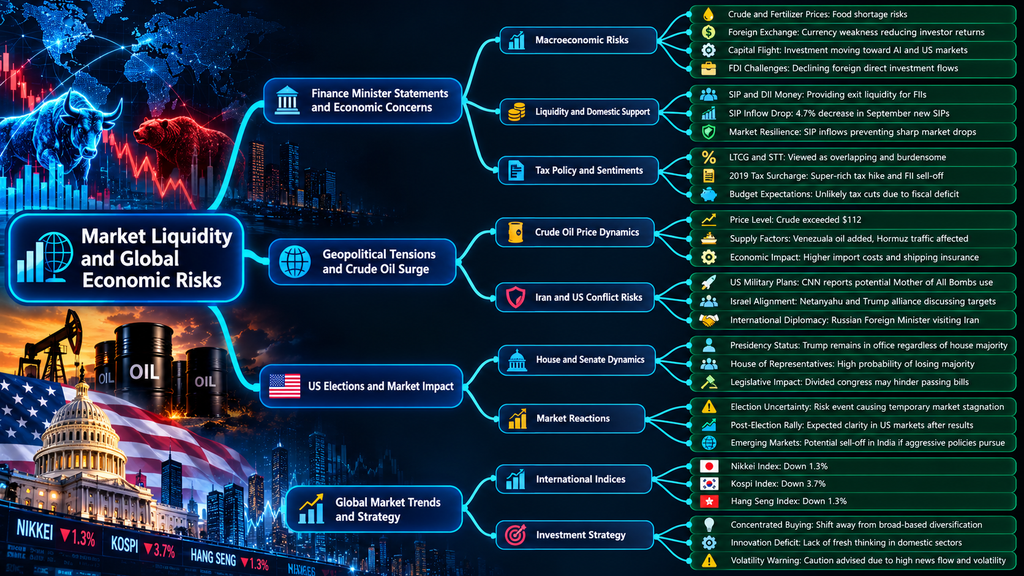
5. The US Midterm Elections: Why Political Uncertainty Can Affect Indian Equities
Global markets also respond to US politics because American fiscal policy, trade policy, interest rates and the dollar influence international capital flows.
The 2026 US midterm elections are scheduled for November 3. Reuters reported on October 20 that Republicans held narrow majorities in both chambers of Congress and that the election outcome would determine whether the administration continued to face fewer legislative constraints.
How could the result affect emerging markets?
The relationship is not straightforward. A change in congressional control could affect expectations around taxation, government spending, trade measures and fiscal policy. Those expectations may influence bond yields, the dollar and investor risk appetite.
However, a prediction that one specific electoral result will automatically cause a rally or crash in Indian equities would be too strong.
Investors should instead track the economic channels through which US politics could affect India:
- US Treasury yields: Higher yields can draw capital towards dollar assets.
- The US dollar: A stronger dollar can create pressure on emerging-market currencies.
- Trade policy: Tariffs and restrictions can affect export-oriented businesses.
- Energy policy and geopolitical risk: These can influence crude prices and global inflation.
- Technology investment: Changes in US policy and capital spending can affect global technology-sector valuations.
Election forecasts and prediction-market probabilities can change rapidly. They should be treated as estimates, not certainties.
Bonus Analysis: Why Strong Domestic Flows Cannot Replace Strong Corporate Earnings
A major lesson from the recent market environment is that liquidity and fundamentals are different things.
Domestic mutual fund inflows can provide demand for shares, but long-term valuations ultimately depend on expected earnings, cash flows, capital allocation and the price investors are willing to pay.
A company can rise during a weak market if earnings exceed expectations. Equally, a company can fall despite positive news if its valuation already assumes exceptional growth.
Investors should therefore examine:
- Revenue and profit growth over several quarters.
- Operating margins and cash-flow conversion.
- Debt levels and interest costs.
- Valuation relative to earnings growth and peers.
- Promoter pledging, governance and capital allocation.
- Sector-specific exposure to crude oil, currency movements and interest rates.
Avoid treating every decline as a buying opportunity. A falling stock can be undervalued, fairly valued or still expensive—the answer depends on its fundamentals.
Three Market Scenarios Investors Should Prepare For
The following scenarios are analytical frameworks, not price targets or forecasts.
| Scenario | What could drive it | What investors should watch |
|---|---|---|
| Bullish recovery | Lower crude prices, easing foreign selling and improving earnings | FPI flows, earnings upgrades, market breadth |
| Sideways and volatile | Persistent foreign selling offset by domestic buying | SIP trends, valuations, index leadership |
| Bearish pressure | Sustained oil shock, weaker rupee and earnings downgrades | Inflation, bond yields, trade deficit, corporate results |
The key is to update the outlook as new evidence emerges instead of committing to a single market prediction.
Conclusion: The Next Indian Market Rally Needs More Than Liquidity
India’s market paradox is real: domestic investors continue to support equity funds even as foreign investors withdraw capital and benchmark indices experience pressure.
September’s ₹32,490 crore SIP contribution record shows the strength of systematic investing, while the $3.75 billion foreign equity outflow highlights the scale of competing forces.
At the same time, crude oil near $110–112 per barrel, currency pressures and uncertainty over global monetary and trade policy create risks that domestic liquidity cannot eliminate on its own.
The LTCG–STT debate may influence sentiment, but tax relief alone cannot guarantee foreign buying. Similarly, a high SIP stoppage ratio is worth monitoring, but it should not be misrepresented as proof that most retail investors have quit.
For investors, the most sensible approach is to maintain diversification, review valuations, preserve an appropriate emergency fund and match investment choices to their time horizon. Avoid leveraged positions based solely on headlines or speculative predictions.
The most important question is not whether domestic money can support the market today, but whether earnings growth, valuations and global conditions can sustain that support over time.
Frequently Asked Questions (FAQs)
1. Why is the Indian stock market weak despite record SIP inflows?
Domestic SIP inflows provide support, but share prices are also influenced by foreign investor selling, earnings expectations, valuations, currency movements, crude oil prices and global risk appetite.
2. What was India’s SIP contribution in September 2026?
Monthly SIP contributions reached a record ₹32,490 crore in September 2026, according to AMFI-based figures reported by Moneycontrol and The Economic Times.
3. Does a 78.53% SIP stoppage ratio mean most investors have quit?
No. The ratio compares SIPs discontinued or completed during a month with new registrations in that month. It is not the percentage of all SIP investors who have stopped investing.
4. Will removing LTCG tax bring foreign investors back?
Not necessarily. Tax changes can affect after-tax returns and sentiment, but foreign investors also consider currency risk, earnings growth, valuations, bond yields and global opportunities. The Finance Minister’s October 13 remarks did not confirm a tax rollback.
5. Why is crude oil near $112 a concern for India?
Higher oil prices can increase import costs, inflation, and pressure on the rupee, while hurting margins in oil-sensitive sectors. The overall effect depends on how long prices remain elevated and how businesses and policymakers respond.
6. Is a market crash inevitable?
No. The indicators discussed here show risks and uncertainty, not certainty of a crash. Investors should assess new data, portfolio diversification, valuations, and their own financial goals.
Disclaimer
This article is for educational and informational purposes only. It is not investment, legal,l or tax advice and does not constitute a recommendation to buy or sell any security. Market conditions and economic data can change rapidly. Verify figures with official sources before making financial decisions. Investments in securities markets are subject to market risks.
Top 10 SEO titles:
- Indian Stock Market 2026: 5 Hidden Risks Behind the Market Paradox
- Why Is the Indian Stock Market Falling Despite Record SIP Inflows?
- LTCG Tax, Crude Oil at $112 and FII Selling: 5 Market Risks in 2026
- Indian Stock Market Analysis 2026: SIP Inflows vs Foreign Investor Selling
- Nifty 50 Outlook: How Crude Oil Prices and FII Outflows Affect India
- SIP Investment Risks 2026: Can Domestic Investors Support the Stock Market?
- LTCG Tax Removal in India: Will It Bring Foreign Investors Back?
- FII Selling in India: Why Record Mutual Fund Inflows May Not Lift the Market
- Crude Oil at $112: Impact on the Indian Economy and Stock Market
- Indian Stock Market Crash Risk 2026: 5 Signals Every Investor Should Watch