
Introduction: A 150% Rally – Is Ather Energy Becoming India’s EV Success Story?
Welcome to Prism Dissection, where we investigate stocks experiencing unusual price movements and separate genuine business growth from market momentum.
Today’s subject is Ather Energy.
Ather Energy has emerged as one of India’s most closely watched electric two-wheeler companies. Its stock has delivered extraordinary returns in 2026, supported by strong revenue growth, improving operating margins, expanding customer demand, and its first quarterly net profit.
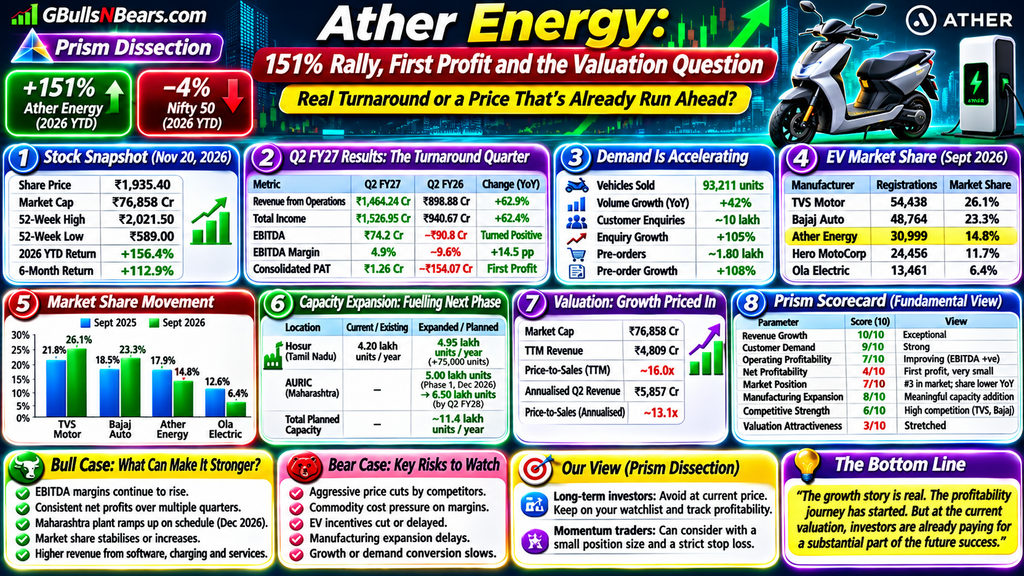
As of November 20, 2026, Ather Energy closed at approximately ₹1,935.40. Its year-to-date return was around 156.4%, while the Nifty 50 was down approximately 1.3% over the same period.
That is a remarkable difference in performance.
But there is a catch.
The company has reported only ₹1.26 crore in consolidated net profit for Q2 FY27, despite generating more than ₹1,464 crore in quarterly revenue.
The market is therefore pricing in much more than the latest quarter’s earnings. Investors are effectively betting on Ather becoming a substantially larger and consistently profitable EV manufacturer.
Let’s examine whether the business fundamentals justify the excitement.
1. Why Is Ather Energy Stock Rising So Rapidly?
Ather’s rally is supported by several genuine business developments.
The company has moved beyond being a premium electric scooter manufacturer and is attempting to build a broader EV ecosystem involving vehicles, batteries, software, charging infrastructure, and after-sales services.
Three developments are particularly important.
First: Revenue growth. Ather’s quarterly revenue from operations increased approximately 63% year-on-year.
Second: Improving profitability. The company reported its second consecutive EBITDA-positive quarter and its first positive consolidated PAT quarter.
Third: Strong customer demand. Enquiries increased, pre-orders more than doubled, and existing manufacturing facilities approached high utilisation.
Ather Energy’s latest stock-market performance
| Indicator | Latest reported figure |
|---|---|
| Share price (November 20, 2026) | ₹1,935.40 |
| Market capitalisation | Approximately ₹76,858 crore |
| 52-week high | ₹2,021.50 |
| 52-week low | Approximately ₹589 |
| 2026 YTD return | +156.4% |
| Six-month return | +112.9% |
The stock’s performance demonstrates how aggressively investors have reassessed Ather’s growth potential.
However, a rising share price does not automatically mean that the company’s intrinsic value has increased at the same rate.
2. Q2 FY27 Results: Revenue Growth Is Real, but Profitability Is Still at an Early Stage
Ather’s September 2026 quarterly results were the central fundamental catalyst behind the rally.
Q2 FY27 financial performance
| Financial metric | Q2 FY27 | Q2 FY26 |
|---|---|---|
| Revenue from operations | ₹1,464.24 crore | ₹898.88 crore |
| Revenue growth | +62.9% | — |
| EBITDA (company-reported) | ₹74.2 crore | Negative ₹90.8 crore |
| EBITDA margin | 4.9% | -9.6% |
| Consolidated PAT | ₹1.26 crore | Loss of ₹154.07 crore |
| Total income | ₹1,526.95 crore | ₹940.67 crore |
The most important development is the improvement in EBITDA margin from negative 9.6% to positive 4.9%.
This indicates that Ather is generating better operating economics as its production volumes increase.
However, investors must understand the difference between EBITDA profitability and net profitability.
The first-profit milestone
Ather reported consolidated PAT of approximately ₹1.26 crore in Q2 FY27.
That is a meaningful milestone, but the profit margin remains extremely thin.
Against quarterly revenue of ₹1,464 crore, the consolidated net profit margin was approximately 0.09%.
In other words, the company earned less than ₹1 in net profit for every ₹100 of revenue.
The half-year numbers provide another important perspective.
| H1 FY27 metric | Reported figure |
|---|---|
| Revenue from operations | ₹2,681.16 crore |
| Consolidated net loss | Approximately ₹49.83 crore |
| H1 FY26 net loss | ₹332.30 crore |
The half-year loss has narrowed considerably, but Ather has not yet demonstrated sustained half-year profitability.
Prism interpretation: The operating turnaround is more convincing than the net-profit milestone alone. Investors should monitor whether EBITDA margins continue improving and whether operating cash flow becomes consistently positive.
3. Demand Explosion: Ather’s Customer Pipeline Is Growing
One of the strongest elements of Ather’s investment story is demand.
The company’s Q2 FY27 operating performance included:
| Business indicator | Q2 FY27 |
|---|---|
| Vehicles sold | 93,211 units |
| Year-on-year volume growth | 42% |
| Customer enquiries | Approximately 10 lakh |
| Enquiry growth | 109% |
| Pre-orders | Approximately 1.80 lakh |
| Pre-order growth | 108% |
| Production growth | Approximately 45% |
The numbers indicate that customer interest is increasing faster than the company previously experienced.
However, enquiries and pre-orders should not be treated as completed sales.
The important question is how many of these potential customers eventually convert into delivered and registered vehicles.
Investors should monitor:
- Monthly vehicle registrations.
- Order cancellations.
- Delivery waiting periods.
- Customer acquisition costs.
- Repeat purchases and referrals.
- Average selling prices.
A strong order pipeline creates an opportunity, but execution determines whether that opportunity becomes revenue and profit.
4. Ather vs TVS vs Bajaj vs Ola: Who Is Winning India’s EV Market?
The Indian electric two-wheeler market is becoming increasingly competitive.
Ather is growing, but established automobile manufacturers are expanding their EV businesses rapidly.
September 2026 electric two-wheeler market share
| Manufacturer | Registrations | EV market share |
|---|---|---|
| TVS Motor | 54,438 | 26.1% |
| Bajaj Auto | 48,764 | 23.3% |
| Ather Energy | 30,999 | 14.8% |
| Hero MotoCorp | 24,456 | 11.7% |
| Ola Electric | 13,461 | 6.4% |
Source: September 2026 Vahan registration data.
Ather ranked third in the electric two-wheeler market.
Its registrations increased approximately 58% year-on-year, which is a strong performance.
But there is an important warning.
Market-share movement tells a different story
| Manufacturer | September 2025 share | September 2026 share |
|---|---|---|
| TVS Motor | 21.8% | 26.1% |
| Bajaj Auto | 18.5% | 23.3% |
| Ather Energy | 17.9% | 14.8% |
| Ola Electric | 12.6% | 6.4% |
Ather’s registrations grew, but its market share declined by approximately 3.1 percentage points.
This happened because the overall EV market expanded rapidly and competitors grew faster.
TVS and Bajaj have significant advantages:
- Established dealer networks.
- Manufacturing scale.
- Strong brand recognition.
- Existing customer relationships.
- Large service and distribution networks.
Ola’s declining share may create opportunities for competitors, including Ather, but the available registration data does not prove that Ola’s lost customers have directly migrated to Ather.
Prism interpretation: Ather is a strong growth challenger, but it has not yet established market leadership. Its ability to defend and expand market share will be a critical long-term indicator.
5. Manufacturing Expansion: Can Ather Deliver the Growth It Is Promising?
Ather’s manufacturing capacity is another important part of the investment thesis.
The company has announced capacity expansion across two major facilities.
Capacity expansion plans
| Manufacturing location | Existing / planned capacity | Expansion |
|---|---|---|
| Hosur, Tamil Nadu | 4.20 lakh units annually | 4.95 lakh units |
| AURIC, Maharashtra | Phase 1: 5 lakh units | 6.50 lakh units by Q2 FY28 |
| Combined planned capacity | — | Approximately 11.4 lakh units annually |
At Hosur, the company plans to add 75,000 units of annual capacity, with completion targeted for December 2026.
The Maharashtra facility at Chhatrapati Sambhajinagar is being developed in phases, with commercial production targeted to begin from December 2026.
The company has indicated investments of up to ₹58 crore at Hosur and ₹64 crore at AURIC for the planned capacity enhancements.
Why does this matter?
Manufacturing expansion can provide three important benefits:
- Higher production volumes.
- Better utilisation of fixed manufacturing costs.
- Improved ability to fulfil customer demand.
But capacity expansion also introduces risks.
If demand slows or production ramps up more slowly than expected, the company may face underutilised facilities, higher depreciation and additional working-capital requirements.
The important metric is not installed capacity alone.
Investors should monitor actual production, utilisation, deliveries and cash conversion.
6. Valuation: Is Ather Energy Becoming Too Expensive?
This is where the investment story becomes more challenging.
Ather’s business is growing rapidly, but the share price has already moved substantially ahead of its current profitability.
As of November 20, 2026:
- Share price: approximately ₹1,935.
- Market capitalisation: approximately ₹76,858 crore.
- Trailing twelve-month revenue: approximately ₹4,809 crore.
Using these figures:
Price-to-Sales ratio
Market Capitalisation ÷ Trailing 12-Month Revenue
₹76,858 crore ÷ ₹4,809 crore = approximately 16 times.
On an annualised Q2 revenue basis:
₹76,858 crore ÷ (₹1,464 crore × 4) = approximately 13.1 times.
These are two different valuation methods. The trailing revenue measure includes the previous four reported quarters, while annualised Q2 assumes the September-quarter revenue continues for four quarters.
Neither is a guaranteed measure of fair value.
Why is this valuation demanding?
A company trading at approximately 16 times trailing sales must eventually deliver substantial earnings growth to justify its market capitalisation.
Investors are paying for:
- Future revenue expansion.
- Higher manufacturing utilisation.
- Sustained positive EBITDA.
- Improving net profit margins.
- Stronger market share.
- Long-term EV ecosystem growth.
The problem is that these expectations are already reflected to a considerable extent in the share price.
Traditional P/E analysis is also less useful at this stage because the company’s quarterly profit is extremely small and trailing earnings remain negative.
Prism interpretation: Ather may become a successful EV manufacturer, but a successful company is not necessarily an attractive investment at every valuation.
7. Prism Dissection: Our Fundamental Scorecard
Here is a qualitative assessment of Ather’s investment profile.
| Parameter | Score / Assessment | Reason |
|---|---|---|
| Revenue growth | 10/10 | Strong quarterly revenue expansion |
| Customer demand | 9/10 | Enquiries and pre-orders rising rapidly |
| Operating profitability | 7/10 | EBITDA positive, but margins need improvement |
| Net profitability | 4/10 | First profit is very small |
| Market position | 7/10 | Third in EV registrations, but share has declined YoY |
| Manufacturing expansion | 8/10 | Significant planned capacity additions |
| Competitive strength | 6/10 | Strong competition from TVS and Bajaj |
| Valuation attractiveness | 3/10 | High sales multiple and limited current earnings |
These scores are analytical opinions, not audited financial ratings or a guaranteed investment-return forecast.
The distinction is important: Ather’s growth score is much stronger than its current valuation score.
8. Bull Case vs Bear Case: What Could Happen Next?
Bullish scenario
Ather’s long-term investment case becomes stronger if:
- EBITDA margins continue improving.
- Quarterly net profits become consistent.
- The Maharashtra facility starts commercial production on schedule.
- Production capacity translates into higher deliveries.
- Market share stabilises or increases.
- Software, accessories, charging and service revenue expand.
The company has an opportunity to develop a broader EV ecosystem rather than depending entirely on scooter sales.
Bearish scenario
The investment thesis weakens if:
- Competitors initiate aggressive price cuts.
- Commodity costs reduce gross margins.
- EV incentives or government policies become less favourable.
- Manufacturing expansion is delayed.
- Customer enquiries fail to convert into deliveries.
- Market share continues declining.
- Cash burn and working-capital requirements increase.
The most important risk is that investors may have priced in several years of successful execution before the company has established a consistent profitability record.
9. What Investors Should Track Over the Next Four Quarters
For a company at Ather’s stage, monitoring a few important metrics is more useful than simply watching the share price.
| Metric | What investors should look for |
|---|---|
| Revenue growth | Sustainable year-on-year expansion |
| EBITDA margin | Consistent improvement |
| Net profit | Multiple consecutive profitable quarters |
| Gross margin | Protection against commodity-cost pressure |
| Vehicle registrations | Growth faster than the overall market |
| EV market share | Stabilisation or improvement |
| Capacity utilisation | Efficient use of new factories |
| Operating cash flow | Movement towards sustainable positive cash generation |
| Non-vehicle revenue | Growth in software, charging and services |
Ather’s next four quarterly results should provide a much clearer picture of whether its first profitable quarter represents a structural turnaround or an early milestone.
10. Final Prism Verdict: Watchlist, Not Blind Buying
Ather Energy has several characteristics of a potentially successful long-term EV business.
Revenue growth is strong, customer interest is increasing, EBITDA has turned positive, and the company has ambitious manufacturing expansion plans.
However, three major concerns remain:
- The first consolidated quarterly profit was only ₹1.26 crore.
- Market share declined year-on-year despite higher registrations.
- The stock trades at a demanding valuation relative to its current revenue and earnings.
Our investment view
Long-term value investors: Avoid chasing the rally. Wait for stronger evidence of sustainable profitability and a more reasonable valuation.
Growth investors: Keep Ather on the watchlist and track its revenue, EBITDA margins, market share and cash flows.
Momentum traders: The stock may continue attracting trading interest, but position sizing and stop-loss discipline are essential after such a substantial rally.
The final question
Ather Energy has demonstrated that its business can grow quickly. The next challenge is proving that this growth can produce durable profits and attractive returns on invested capital.
The growth story is real. The profitability journey has started. But at the current valuation, investors are already paying for a substantial part of the future success.
Frequently Asked Questions
1. Why is Ather Energy share price rising in 2026?
The rally has been supported by strong revenue growth, positive EBITDA, its first consolidated quarterly profit, increasing customer demand, and manufacturing expansion plans.
2. Is Ather Energy profitable?
Ather reported consolidated net profit of approximately ₹1.26 crore in Q2 FY27. However, its H1 FY27 consolidated result remained a net loss of approximately ₹49.83 crore.
3. What is Ather Energy’s market share?
Ather had approximately 14.8% of India’s electric two-wheeler registrations in September 2026, ranking third behind TVS Motor and Bajaj Auto.
4. Is Ather Energy overvalued?
At its November 20, 2026 market capitalisation of approximately ₹76,858 crore and trailing revenue of approximately ₹4,809 crore, its price-to-sales ratio was around 16 times. This is a demanding valuation and requires substantial future earnings growth.
5. Who are Ather Energy’s main competitors?
Its major competitors include TVS Motor, Bajaj Auto, Ola Electric and Hero MotoCorp.
6. What should investors monitor before investing?
Focus on revenue growth, EBITDA margins, net profit, market share, manufacturing utilisation, operating cash flow and valuation.
Disclaimer: This article is for educational purposes only and is not investment advice. Ather Energy is a high-growth, high-volatility stock. Investors should independently evaluate financial statements, valuations, risk tolerance and investment objectives before making investment decisions.