
Introduction: The Weekend Headlines Tell Only Half the Story
Weekend headlines are often designed to capture attention, not reveal the complete investment picture. Record banking profits, resilient corporate earnings, and optimistic commentary can easily create the impression that the Indian stock market is entering another bullish phase.
However, experienced investors know that headline numbers rarely tell the entire story.
As markets prepare for the new trading week, investors face an unusual combination of powerful domestic and global forces. While India’s largest private banks have delivered strong quarterly earnings, geopolitical tensions in the Middle East, rising crude oil prices, and the possibility of fresh sanctions targeting buyers of Russian oil are creating new uncertainties.
The market’s biggest challenge isn’t whether profits have grown.
The real question is whether those profits are sustainable.
Let’s examine the five major triggers every investor should monitor before making fresh investment decisions.
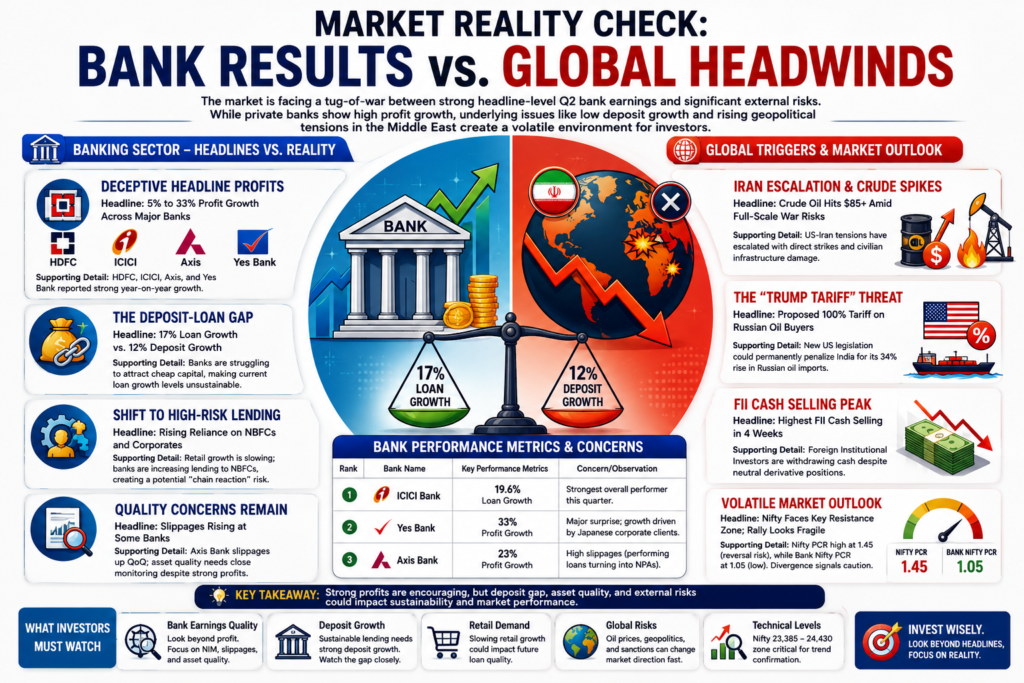
1. Banking Profits Look Strong — But Are They High Quality?
At first glance, India’s banking sector appears exceptionally healthy.
Several private banks reported impressive profit growth during the latest quarter.
- ICICI Bank posted strong double-digit earnings growth.
- Axis Bank delivered another solid quarter.
- Yes Bank surprised investors with one of its strongest earnings performances in years.
These numbers have naturally generated optimism across the banking sector.
But professional investors rarely stop at headline profit figures.
Instead, they examine the quality of earnings.
A bank can report higher profits due to:
- Lower provisioning
- Treasury gains
- One-time income
- Accounting adjustments
- Tax benefits
These factors may temporarily boost profits without reflecting genuine business strength.
The real indicators include:
- Net Interest Margin (NIM)
- Credit Growth
- CASA Ratio
- Gross and Net NPA
- Slippages
- Provision Coverage
- Return on Assets (ROA)
For example, Yes Bank’s improving profitability is partly supported by its ongoing transformation after strategic investment from Japanese banking interests. While this is encouraging, investors should wait to see whether the improvement remains consistent across multiple quarters.
Similarly, Axis Bank reported healthy earnings, but rising loan slippages indicate that asset quality deserves closer attention.
Headline profits create excitement. Quality earnings create long-term wealth.
2. India’s Retail Economy Is Showing Signs of Fatigue
One of the most important developments currently receiving limited attention is the slowing of retail credit demand.
Consumer spending has started losing momentum.
Several indicators suggest pressure on middle-class finances:
- Slower personal loan growth
- Weak discretionary spending
- Soft credit card spending
- Rising household leverage
- Higher EMIs after interest rate hikes
Retail lending has traditionally been among the most profitable segments for Indian banks.
When retail demand slows, banks naturally shift toward:
- Corporate lending
- Infrastructure financing
- Lending to NBFCs
While this helps maintain loan growth, it also changes the overall risk profile of bank balance sheets.
Investors should carefully monitor whether retail weakness becomes a broader economic trend.
3. NBFC Exposure Could Become the Next Risk
One emerging concern is increasing dependence on NBFC lending.
The current chain works like this:
Banks provide funding to NBFCs.
NBFCs lend to consumers and smaller businesses.
If end borrowers struggle to repay loans, stress gradually moves back through the financial system.
Although India’s banking system is significantly stronger than during previous financial crises, excessive dependence on leveraged lending can still create pockets of risk.
Investors should monitor:
- NBFC asset quality
- Collection efficiency
- Delinquency trends
- Consumer loan performance
- Credit costs
Strong loan growth alone is not enough.
The sustainability of that growth matters even more.
4. Deposit Growth Is Not Keeping Pace With Loan Growth
One structural issue continues to worry banking analysts.
Loan growth has remained stronger than deposit growth.
Banks cannot continue expanding lending indefinitely without attracting fresh deposits.
Deposits remain the cheapest and most stable source of funding.
When deposit growth slows:
- Funding costs rise.
- Net Interest Margins come under pressure.
- Competition for deposits increases.
- Profitability becomes harder to maintain.
Interestingly, some of India’s largest banks appear to recognize this challenge.
Instead of aggressively chasing loan growth, institutions such as HDFC Bank and Kotak Mahindra Bank have focused on strengthening their deposit franchises.
Although this cautious strategy may disappoint investors seeking rapid earnings growth, it may ultimately prove more sustainable over the long term.
Sometimes the market rewards excitement.
Long-term investing rewards discipline.
5. Global Risks Could Easily Overshadow Strong Earnings
Domestic earnings are only one side of the equation.
Global developments remain equally important.
Rising Middle East Tensions
The conflict involving Iran and regional military activity continues to elevate geopolitical uncertainty.
Any escalation could impact:
- Global energy supplies
- Shipping routes
- Investor sentiment
- Foreign institutional investment (FII) flows
Crude Oil Prices Matter More Than Many Investors Realize
India imports nearly 85% of its crude oil requirements.
Higher oil prices can trigger:
- Higher inflation
- Rising transportation costs
- Pressure on government finances
- Weakening corporate margins
- Slower consumer demand
For many sectors, crude oil remains one of the most influential macroeconomic variables.
Russia Oil Sanctions Remain a Key Risk
Global discussions around additional sanctions targeting Russian oil buyers continue to attract market attention.
India has significantly increased purchases of discounted Russian crude over the past two years.
Any major policy changes affecting this trade could influence:
- Energy costs
- Trade balances
- Currency stability
- Inflation expectations
- Foreign investment flows
While policymakers continue monitoring developments closely, investors should remain aware that geopolitical events can rapidly alter market sentiment.
Technical Outlook: Nifty Faces Important Resistance
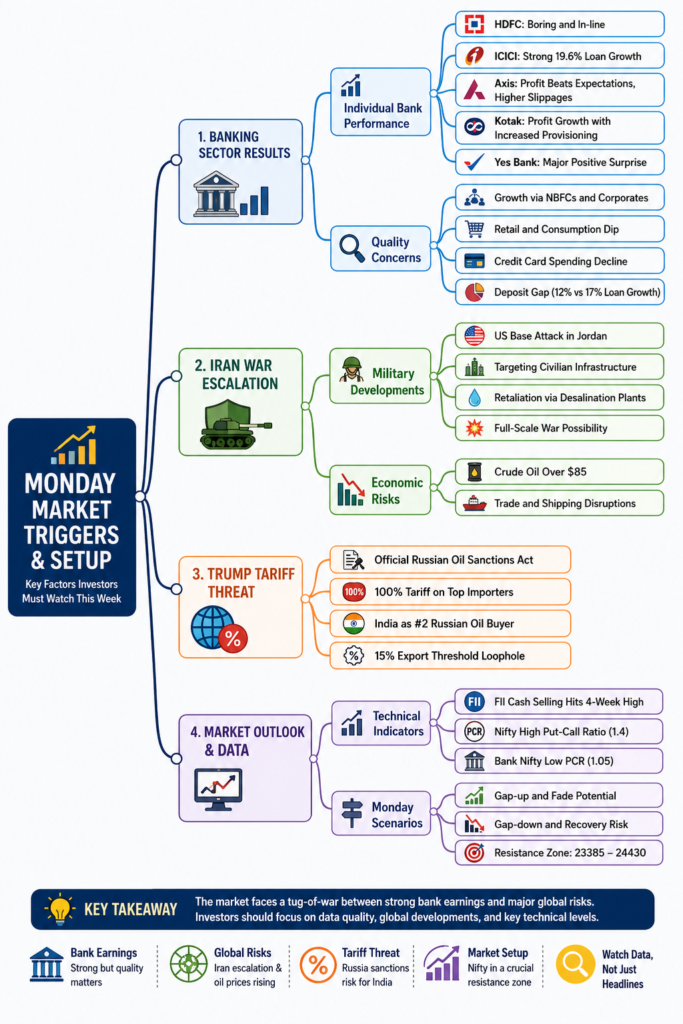
From a technical perspective, the market remains in an important decision zone.
Investors should closely watch:
Positive Signals
- Strong market breadth
- Improving earnings momentum
- Continued domestic institutional buying
- Stable corporate profitability
Risk Factors
- Elevated valuations
- Rising crude prices
- Weak global sentiment
- Geopolitical uncertainty
- Banking sector funding challenges
Unless Nifty decisively breaks above key resistance levels with strong volumes, volatility is likely to remain elevated.
Key Takeaways for Investors
Instead of focusing solely on quarterly profit growth, investors should evaluate the broader investment picture.
Ask yourself:
- Are earnings sustainable?
- Is loan growth supported by healthy deposits?
- Is asset quality improving?
- How exposed is the company to macroeconomic risks?
- Are global developments changing the investment thesis?
Successful investing is rarely about chasing the highest growth percentage.
It is about identifying businesses capable of delivering sustainable earnings across multiple market cycles.
Final Thoughts
The coming week presents an interesting contrast.
On one side, India’s banking sector continues to demonstrate resilience through healthy quarterly earnings.
On the other hand, slowing retail demand, funding challenges, geopolitical tensions, rising crude oil prices, and evolving global trade risks remind investors that markets rarely move in a straight line.
The smartest investors look beyond the headlines.
They focus on business quality, balance sheet strength, management discipline, and long-term sustainability.
Because in investing, what lies beneath the numbers often matters far more than the numbers themselves.
Frequently Asked Questions (FAQs)
Is strong profit growth enough to buy a banking stock?
No. Investors should also examine asset quality, deposit growth, loan growth, Net Interest Margin (NIM), and management guidance before making investment decisions.
Why are crude oil prices important for Indian markets?
India imports most of its crude oil. Rising oil prices increase inflation, widen the trade deficit, pressure the rupee, and reduce corporate profitability.
Why is deposit growth important for banks?
Deposits provide low-cost funding. If loan growth consistently exceeds deposit growth, funding costs increase, and banking profitability may come under pressure.
Should investors worry about geopolitical events?
Yes. Conflicts involving major energy-producing regions can influence crude oil prices, global markets, inflation, and investor sentiment, making them important macroeconomic factors.
Disclaimer: This article is intended solely for educational and informational purposes and should not be considered investment, financial, or legal advice. Market conditions, geopolitical developments, and company fundamentals can change rapidly. Investors should conduct their own research or consult a qualified financial advisor before making any investment decisions.
Other Strong SEO Titles
- 5 Hidden Market Triggers That Could Move the Indian Stock Market This Week
- Indian Stock Market Outlook: 5 Critical Risks Every Investor Should Watch
- Beyond Bank Profits: 5 Hidden Risks That Could Shake Indian Markets
- Stock Market This Week: Banking Earnings, Iran Tensions & Russia Sanctions Explained
- Why Smart Investors Are Looking Beyond Bank Earnings This Week
- Indian Stock Market Analysis: 5 Key Triggers That Could Decide Market Direction
- Bank Profits vs Global Risks: What Every Indian Investor Needs to Know This Week
- The Truth Behind India’s Banking Rally: 5 Warning Signs Investors Can’t Ignore
- 5 Big Market Catalysts That Could Impact Nifty and Bank Nifty This Week
- Indian Stock Market Weekly Outlook: Banking Boom or Bull Trap?