
1. Banking Valuation Paradox: Why Growth Didn’t Translate Into Returns
India remains the fastest-growing major economy, yet one of the biggest paradoxes in global banking has emerged. Since December 2019, India’s leading private banks have significantly underperformed despite strong economic growth.
| Bank/Index | Return Since Dec 2019 |
|---|---|
| Sensex | +89% |
| HDFC Bank | +29% |
| Kotak Mahindra Bank | +16% |
The reason isn’t weak business growth—it’s valuation compression.
Both HDFC Bank and Kotak Mahindra Bank entered the post-pandemic cycle trading at premium valuations.
- HDFC Bank: ~4.3x Price-to-Book
- Kotak Mahindra Bank: ~5.1x Price-to-Book
As profitability moderated and Return on Equity (ROE) declined, FIIs gradually reduced their exposure, leading to a significant valuation de-rating. Today, both banks trade near 2.1x book value, illustrating how even modest declines in profitability can have a large impact on shareholder returns.
Investment Lesson: Markets reward improving fundamentals bought at reasonable valuations—not simply high economic growth.
2. The ROE Trap: Growth Without Improving Shareholder Returns
Return on Equity (ROE) remains the most closely watched profitability metric for banks because it measures how efficiently management generates returns for shareholders.
ROE Comparison
| Bank | Earlier ROE | Recent ROE | Trend |
|---|---|---|---|
| HDFC Bank | 16.5% | 13.7% | ↓ Declining |
| Kotak Mahindra Bank | 13.7% | 11.4% | ↓ Declining |
Several structural factors have contributed to the decline:
- Rising deposit costs
- Slower CASA growth
- Lower Net Interest Margins (NIM)
- Shift toward lower-yield corporate lending
- Higher liquidity requirements
- Increased capital requirements
While earnings continue to grow, the quality of those earnings has weakened, leading institutional investors to reassess future return potential.
3. Private Banks Under Pressure While PSU Banks Lead the Rally
The latest earnings season highlighted a clear divergence between private and public sector banks.
Private Banks
| Bank | Share Price Reaction |
|---|---|
| HDFC Bank | -5% |
| Axis Bank | -5% |
| Kotak Mahindra Bank | -3% |
| YES Bank | Among top losers |
The primary reasons include:
- Margin compression
- Rising funding costs
- Shift toward lower-yield corporate lending
- Slower deposit growth
PSU Banks
In contrast, PSU banks benefited from improving operational performance.
Punjab National Bank (PNB)
- Share Price: +5%
- Q1 Net Profit: More than tripled to ₹5,253 crore
- Gross NPA: Improved from 3.78% to 2.78%
- Net Interest Margin: Sequential improvement
Rather than rewarding ownership structure, the market rewarded improving asset quality, better margins, and stronger earnings momentum.
4. ICICI Bank: The Private Sector Exception
Among private banks, ICICI Bank continues to outperform because it has consistently improved operational efficiency.
Key highlights include:
- Credit Growth: 19.9% YoY
- Sequential expansion in Net Interest Margin
- Credit Cost: 32 basis points, among the lowest in the sector
- Consistent improvement in ROE
- Strong retail loan franchise
ICICI demonstrates that investors reward improving execution rather than simply buying into sector narratives.
5. India’s Deposit Challenge Is Becoming Structural
The Indian banking sector is no longer constrained by credit demand—it is increasingly constrained by funding.
Recent trends show:
- Credit growth remains healthy.
- Deposit growth has slowed.
- CASA ratios have moderated.
- Banks are competing aggressively for deposits.
This has forced banks to offer higher deposit rates, increasing funding costs and putting pressure on Net Interest Margins.
If loan growth continues to outpace deposit mobilisation, profitability across the sector could face sustained pressure.
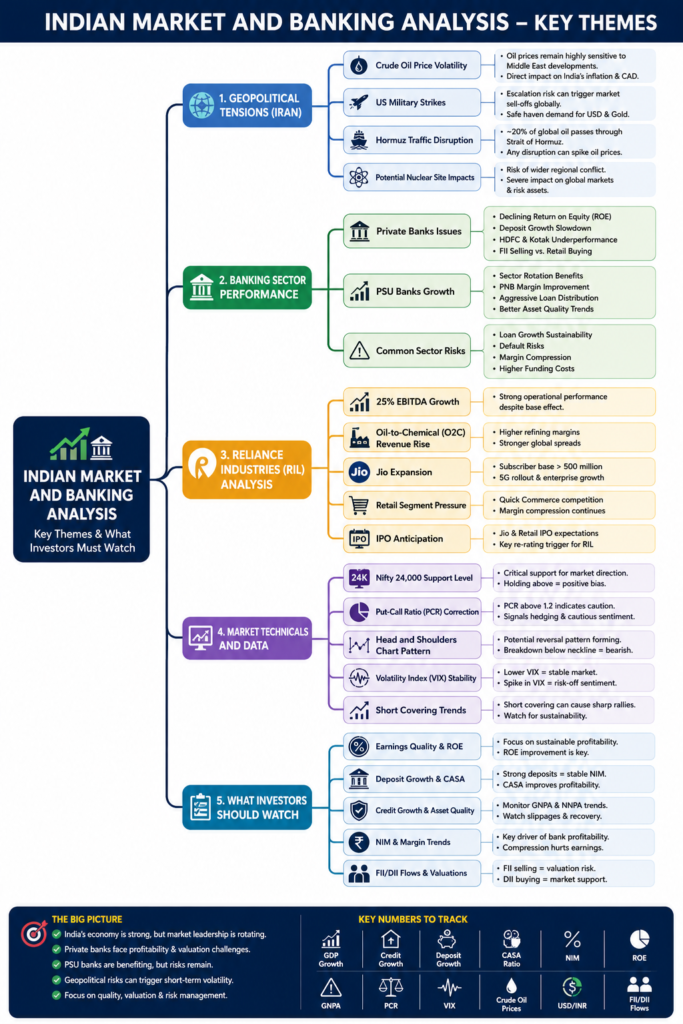
6. Reliance Industries: Strong Operations Hidden by the Base Effect
Reliance Industries reported a mixed headline performance for Q1 FY27.
| Metric | Q1 FY27 |
|---|---|
| Revenue | ₹3.12 lakh crore (+25% YoY) |
| EBITDA | ₹54,067 crore (+10%) |
| Net Profit | ₹20,946 crore (-22% YoY) |
The reported decline in profit was largely due to the previous year’s one-time gain of approximately ₹8,924 crore from the sale of listed investments. Excluding this base effect, the underlying operational performance remained healthy.
Reliance Segment Scorecard
Jio
The strongest contributor to long-term growth.
- Revenue: ₹39,173 crore (+11.8%)
- EBITDA Growth: +15.1%
- Profit Growth: +9.2%
- Subscriber Base: Over 503 million
Retail
Revenue growth remained healthy, but profitability came under pressure.
- Revenue: ₹90,408 crore (+7.4%)
- EBITDA Margin: 7.9% (down 80 bps)
- Net Profit: ₹2,805 crore (-14.1%)
Quick-commerce and online competition continue to weigh on margins.
JioStar
Media operations delivered encouraging growth.
- Revenue: ₹10,946 crore (+14%)
- EBITDA: ₹933 crore (+31%)
- Monthly Active Users: ~530 million
Oil-to-Chemicals (O2C)
- EBITDA: ₹17,010 crore (+17.2%)
- Revenue Growth: +30% YoY
- Singapore GRM: Around $25/bbl (+166% QoQ)
Although refining margins remain strong, this business continues to be cyclical and sensitive to crude oil prices and geopolitical developments.
7. Geopolitical Risks Continue to Influence Markets
The ongoing tensions in the Middle East remain a major macro risk for financial markets.
Recent developments include:
- Ninth consecutive night of military strikes.
- Three US troop casualties reported.
- Two oil tankers reportedly hit near the Strait of Hormuz.
- Bahrain issued fresh security advisories.
While crude prices have softened temporarily, any prolonged disruption to energy supply routes could increase inflation, pressure the Indian Rupee, and negatively impact corporate profitability.
8. Technical Outlook: 24,000 Remains the Key Battleground
From a technical perspective, investors should watch several important indicators.
Put-Call Ratio (PCR)
An elevated PCR suggests excessive optimism and often precedes periods of consolidation.
Head and Shoulders Formation
A potential Head and Shoulders pattern is developing on broader market indices. A confirmed breakdown could indicate:
- Weakening momentum
- Increased profit booking
- A shift toward a bearish trend
Key Support Level
The 24,000 level on the Nifty remains a crucial support zone.
- Above 24,000: The market may consolidate with a positive bias.
- Below 24,000: Selling pressure could intensify.
Final Thoughts
India’s long-term economic story remains intact, but the banking sector is entering a phase where quality of growth matters more than the pace of growth. Premium valuations alone are no longer enough to drive stock performance.
The contrast between underperforming private banks and improving PSU banks highlights an important lesson: markets reward efficient capital allocation, improving ROE, stable margins, and disciplined valuation, not simply headline GDP growth.
For long-term investors, the focus should remain on balance sheet strength, deposit franchise, earnings quality, and management execution. These fundamentals—not market narratives—will determine which banks create sustainable shareholder wealth over the next decade.
🔥 Top SEO Titles
- Why India’s Banking Giants Are Lagging Despite a Booming Economy: 5 Hidden Realities Every Investor Must Know
- India’s Banking Paradox: Why HDFC, Kotak & Private Banks Are Falling Behind in 2026
- India’s Banking Sector Faces a Reality Check: 5 Hidden Risks Investors Can’t Ignore
- Why HDFC Bank and Kotak Are Underperforming Despite India’s Economic Boom
- India’s Banking Boom or Banking Bubble? 5 Warning Signs Every Investor Should Watch
- Why India’s Biggest Banks Are Losing Momentum While the Economy Booms
- Private Banks vs PSU Banks: The Hidden Truth Behind India’s Banking Sector in 2026
- India’s Banking Giants Are Struggling: ROE, Valuation & Deposit Crisis Explained
- Why HDFC, Kotak & Reliance Are Under Pressure: 5 Key Market Realities for Investors
- India’s Banking Sector in 2026: 5 Reasons Private Banks Are Underperforming