
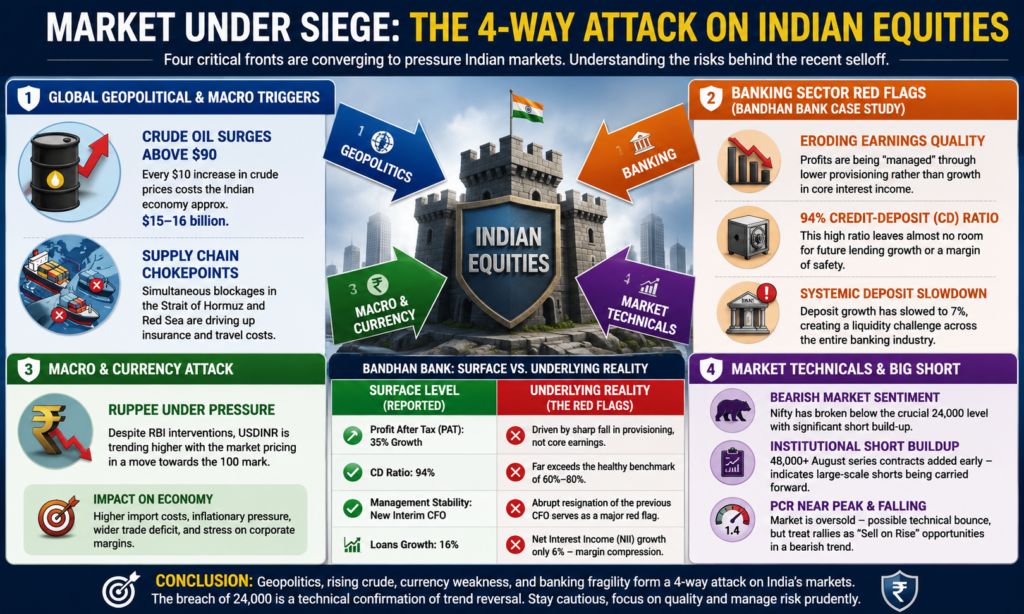
The 4-Pronged Siege: Deconstructing India’s “Fake Rally” and the Banking Risks Behind the Market Selloff
Introduction: Was the 1,500-Point Rally Just an Illusion?
India’s stock market recently witnessed a spectacular 1,500-point rally after hopes of easing geopolitical tensions in the Middle East. However, the optimism proved short-lived.
Within days, the market reversed sharply, with the Nifty slipping below the crucial 24,000 level, exposing what many investors now see as a liquidity-driven rally rather than a fundamentally supported uptrend.
While global geopolitical developments remain a major concern, the more significant issue lies within India’s domestic economy. Weak banking fundamentals, expensive crude oil, a depreciating rupee, and growing institutional caution have combined to create what can be described as a four-pronged attack on Indian financial markets.
The question investors now face is simple:
Is this just another correction, or the beginning of a deeper structural slowdown?
1. Geopolitical Risks Are Expanding Beyond the Middle East
The conflict surrounding Iran has evolved beyond a regional military issue.
Shipping routes through the Strait of Hormuz and the Red Sea have become increasingly vulnerable, creating uncertainty for global trade and energy markets.
For India, one of the world’s largest crude oil importers, every sustained increase in oil prices directly impacts:
- Inflation
- Trade deficit
- Fiscal balance
- Corporate profitability
Higher freight costs and supply disruptions also affect export-oriented businesses.
Companies with significant energy exposure or global logistics dependence could experience margin pressure if geopolitical tensions persist.
2. Rising Crude Oil Prices Continue to Pressure India’s Economy
Brent crude remaining above elevated levels creates multiple economic challenges.
Higher crude prices generally lead to:
- Expensive fuel imports
- Higher transportation costs
- Rising manufacturing expenses
- Inflationary pressure
- Weakening corporate margins
For an import-dependent economy like India, crude oil remains one of the most important macroeconomic variables.
3. Rupee Weakness Is Adding Another Layer of Risk
The Indian Rupee continues to face pressure against the U.S. Dollar.
A weaker rupee makes imports more expensive while increasing inflationary pressure across sectors.
Persistent currency weakness also impacts:
- Oil marketing companies
- Airlines
- Import-heavy industries
- Companies with foreign currency liabilities
Although the RBI actively manages currency volatility, markets continue to monitor whether depreciation becomes more structural.
4. Banking Sector: Strong Profits or Weak Fundamentals?
Banking stocks remain one of the biggest concerns.
Headline earnings may appear healthy, but investors increasingly focus on earnings quality rather than profit growth alone.
Important metrics include:
- Net Interest Margin (NIM)
- Net Interest Income (NII)
- Credit Cost
- Provision Coverage
- Deposit Growth
- Loan Growth
- Asset Quality
Markets typically reward sustainable earnings rather than one-time accounting adjustments.
Any slowdown in core banking profitability can significantly impact overall market sentiment because financial stocks carry substantial weight in benchmark indices.
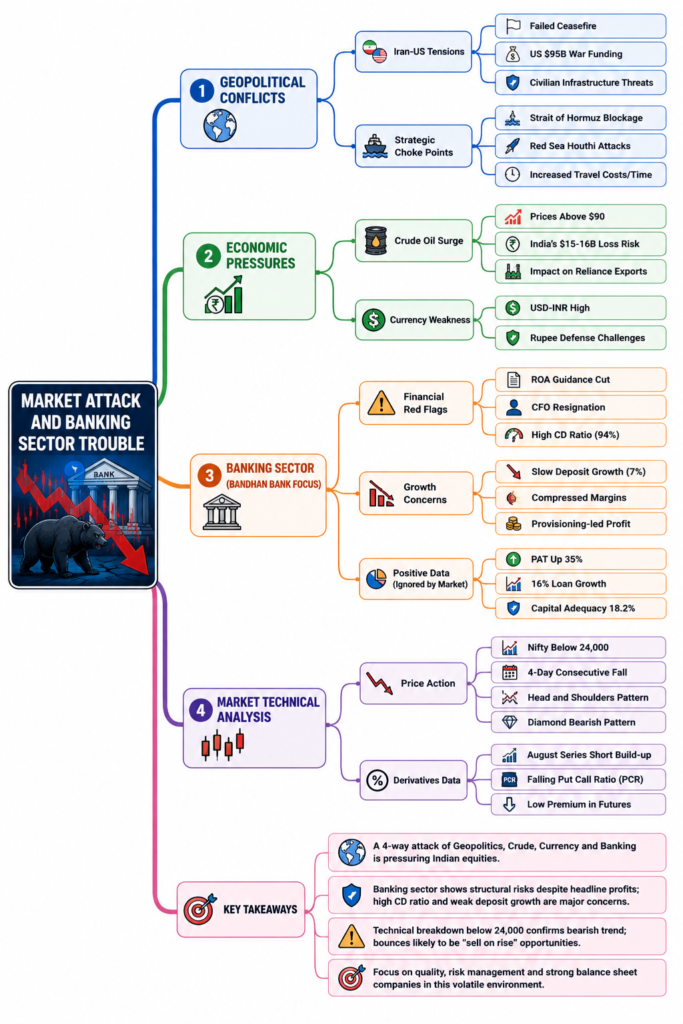
Credit-to-Deposit Ratio: A Critical Banking Indicator
One of the most closely watched banking metrics is the Credit-to-Deposit (CD) Ratio.
Generally,
Healthy Range
- 60%–80%
Elevated Risk
- Above 90%
A high CD ratio indicates banks have lent a large proportion of deposited funds.
Although this can support profitability during growth cycles, excessively high levels may reduce liquidity flexibility if deposit growth slows significantly.
Investors should evaluate this ratio alongside:
- CASA growth
- Deposit mobilisation
- Liquidity coverage
- Capital adequacy
rather than relying on a single metric alone.
Institutional Investors Are Becoming More Defensive
Professional investors often position themselves ahead of major market moves.
Recent market activity suggests increasing caution through:
- Higher volatility
- Defensive sector rotation
- Increased hedging
- Futures positioning
- Elevated India VIX
These developments indicate that institutional investors remain focused on risk management rather than aggressive buying.
Technical Picture: Nifty Below 24,000
Technically, the market has weakened after losing an important support zone.
Current observations include:
- Nifty below 24,000
- Higher volatility
- Weak market breadth
- Lower highs forming
- Bearish momentum indicators
However, markets rarely move in straight lines.
Short-term relief rallies remain possible even within broader corrective phases.
Investors should differentiate between:
- Technical rebounds
- Sustainable trend reversals
Investment Strategy During High Volatility
Periods of uncertainty require discipline rather than emotion.
Investors should focus on:
- Strong balance sheets
- Consistent cash flows
- Healthy capital allocation
- Reasonable valuations
- Diversified business models
Avoid making investment decisions solely based on daily news flow or market sentiment.
Long-term wealth creation continues to depend on business quality rather than short-term volatility.
Final Thoughts
India’s stock market is navigating one of its most complex macroeconomic environments in recent years.
The combination of:
- Geopolitical uncertainty
- Elevated crude oil prices
- Rupee weakness
- Banking sector stress
has increased volatility across asset classes.
Whether this develops into a prolonged bear market or remains a cyclical correction will depend on global developments, corporate earnings, inflation, monetary policy, and investor confidence.
For now, investors should prioritize risk management, focus on fundamentally strong companies, and avoid confusing short-term rallies with confirmed trend reversals.
High-CTR SEO Title Ideas
- The 4-Pronged Siege: Why India’s Stock Market Faces Its Biggest Test Yet
- India’s Stock Market Crash? 4 Hidden Risks Every Investor Should Know
- Nifty Below 24,000: Banking Crisis, Crude Oil & Rupee Risks Explained
- Why Smart Money Is Turning Cautious on Indian Markets
- The Hidden Banking Crisis Behind India’s Stock Market Volatility
- India’s 4 Biggest Market Risks: Banking, Oil, Rupee & Geopolitics Explained
- Beyond the Headlines: The Four Forces Shaking India’s Stock Market
- Is the Nifty Rally Over? The 4 Structural Risks Investors Can’t Ignore