
Beyond the Headlines: Decoding the Global Double Whammy Shaking India’s Markets
India’s financial markets are entering one of their most challenging macroeconomic environments in recent years.
Just as investors were digesting weaker-than-expected banking earnings and slowing corporate profit growth, two global developments have significantly increased uncertainty:
- Trump’s proposed pharmaceutical tariffs targeting Indian generic drug manufacturers.
- Escalating geopolitical tensions in the Middle East threatening global energy supplies.
The result has been immediate pressure across Indian financial assets.
The Nifty has slipped below the crucial 24,000 psychological level, the rupee continues to weaken, crude oil prices remain elevated, and volatility has started returning to the market.
The key question investors must now answer is:
Is this merely another correction in an ongoing bull market—or the beginning of a structural bear phase?
Trump’s “Move Manufacturing or Pay” Message
The biggest surprise came from the proposed U.S. pharmaceutical tariff policy.
Unlike previous trade measures that primarily affected patented medicines, the new proposal directly targets generic pharmaceutical manufacturers, where India dominates global supply.
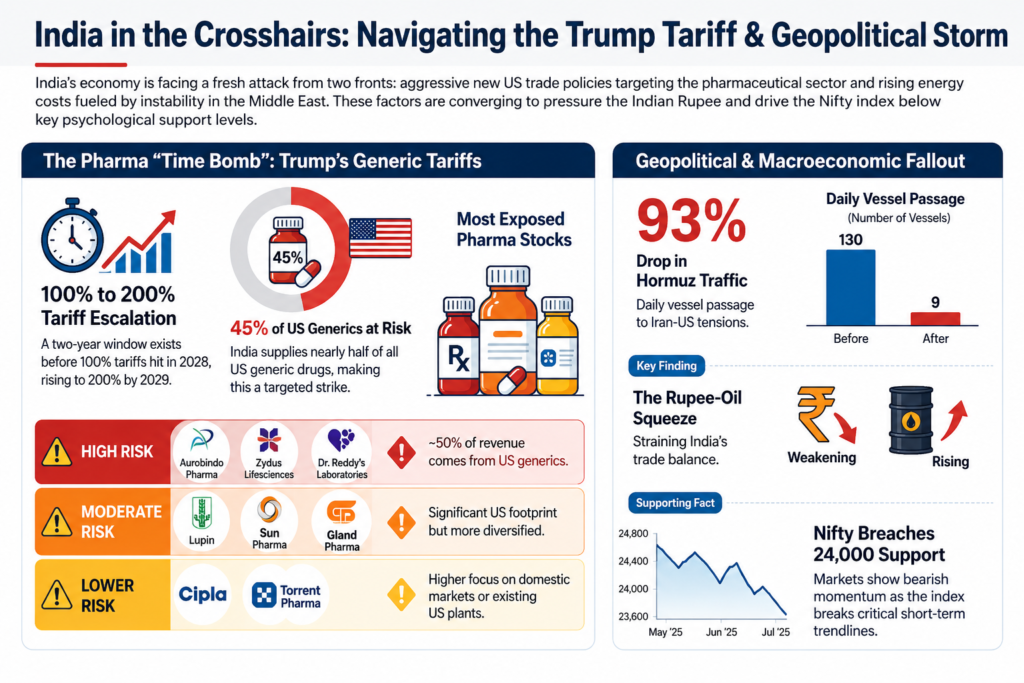
India exported nearly $9.7 billion worth of pharmaceuticals during FY25, supplying approximately 40–45% of generic medicines consumed in the United States.
The proposal effectively gives pharmaceutical companies until July 2028 to establish manufacturing facilities inside the United States.
Companies choosing not to relocate could reportedly face:
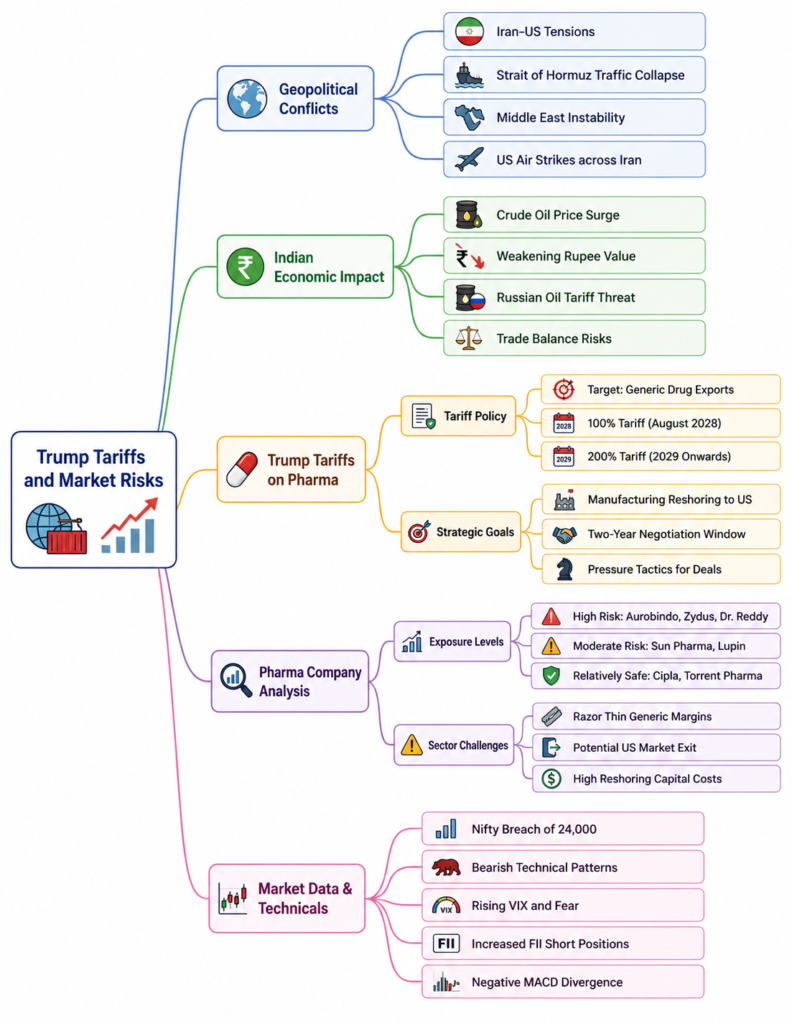
- 100% tariff from August 2028
- 200% tariff from 2029
Rather than being a traditional tariff policy, this is essentially a manufacturing ultimatum designed to shift production back to America.
For Indian pharmaceutical companies, the message is simple:
Build in America—or lose access to America’s largest pharmaceutical market.
Why Indian Pharma Is Especially Vulnerable
The generic drug business operates on extremely thin profit margins.
Unlike premium patented medicines, generic manufacturers compete almost entirely on price.
This means:
- Even a small tariff reduces profitability.
- A 100% tariff could make exports economically impossible.
- Many companies may choose to exit the U.S. market instead of selling at a loss.
That would create a serious problem for India’s export earnings because pharmaceuticals remain one of India’s strongest export industries.
The Second Shock: Middle East Crisis and the Strait of Hormuz
As tariff fears intensified, geopolitical risks added another layer of uncertainty.
The Strait of Hormuz—the world’s most critical oil shipping route—has become the center of renewed military tensions.
Reports indicate that commercial shipping activity declined sharply during periods of heightened regional conflict, raising fears of disruptions to global energy supplies.
Since nearly one-fifth of the world’s crude oil passes through this narrow waterway, any sustained disruption immediately affects oil prices.
For India, one of the world’s largest oil importers, this translates into:
- Higher crude oil prices
- Larger import bills
- Rising inflation
- Pressure on fiscal balances
- Higher transportation costs
Even if oil supply is not completely disrupted, the geopolitical risk premium alone keeps crude prices elevated.
The Hidden Tariff: India’s Russian Oil Challenge
An even more serious risk lies beneath the headlines.
There are discussions around imposing secondary tariffs on countries importing large quantities of Russian crude oil.
India has become one of the largest buyers of discounted Russian oil since the Ukraine conflict.
If India loses access to discounted crude while simultaneously facing reduced pharmaceutical exports, the consequences could be significant.
This combination would:
- Increase India’s import bill
- Reduce export earnings
- Widen the current account deficit
- Put additional pressure on the Indian Rupee
The rupee, already under pressure, could weaken further if both risks materialize simultaneously.
Rupee Under Pressure
Currencies generally weaken when:
- Imports become more expensive.
- Export income declines.
- Foreign investment slows.
- Oil prices remain elevated.
All four conditions are beginning to emerge together.
This explains why market participants have become increasingly cautious regarding the rupee’s medium-term outlook.
Which Pharma Companies Face the Highest Risk?
The impact will not be uniform across the pharmaceutical sector.
High Exposure
Companies generating a significant portion of revenue from U.S. generic medicines may experience the greatest pressure.
These include:
- Aurobindo Pharma
- Zydus Lifesciences
- Dr. Reddy’s Laboratories
- Lupin
- Gland Pharma
Their dependence on U.S. generic sales makes them more vulnerable if tariffs are implemented.
Better Positioned
Some pharmaceutical companies already possess strategic advantages.
These include:
- Sun Pharma
- Cipla
- Torrent Pharma
Existing U.S. manufacturing capacity and stronger domestic revenue reduce their dependence on exports alone.
Why This Isn’t Necessarily a Worst-Case Scenario
Despite alarming headlines, investors should remember that policy proposals do not always become permanent law.
Several factors could soften the eventual outcome:
1. Negotiation Window
The proposed implementation timeline extends to 2028, leaving room for trade negotiations between India and the United States.
2. Political Uncertainty
U.S. elections and future administrations could significantly reshape trade policy before implementation.
3. America’s Dependence on Indian Generics
Replacing India’s pharmaceutical manufacturing capacity overnight would be extremely difficult.
Doing so could substantially increase healthcare costs for American consumers.
This mutual dependence provides both countries with incentives to negotiate.
Technical Analysis: Nifty at a Critical Juncture
Technical indicators are also flashing caution.
Current market observations include:
- Nifty slipping below the 24,000 psychological level
- Rising India VIX indicating increasing uncertainty
- Bearish chart formations appearing on higher timeframes
- Weak market breadth
- Defensive sector rotation
However, one important point remains:
The market is currently trading near an important support zone.
That means aggressive short selling at current levels carries its own risks.
A technical relief rally remains possible before any larger directional move develops.
What Should Investors Do?
Instead of reacting emotionally, investors should focus on disciplined portfolio management.
Key considerations include:
- Avoid panic selling based solely on headlines.
- Prefer fundamentally strong companies with diversified revenue.
- Watch crude oil and rupee trends closely.
- Monitor developments in India-U.S. trade negotiations.
- Maintain adequate cash for future buying opportunities if volatility increases.
Long-term investors should remember that structural market corrections often create opportunities in quality businesses.
Final Thoughts
India currently faces a rare combination of external economic pressures.
On one side is the possibility of higher pharmaceutical tariffs.
On the other is rising geopolitical risk threatening global energy markets.
Together, these forces expose India’s dependence on:
- The United States for pharmaceutical exports.
- Imported crude oil for energy security.
The coming years will determine whether Indian companies successfully diversify manufacturing, negotiate favorable trade arrangements, and reduce external vulnerabilities.
Until greater clarity emerges, investors should expect higher volatility across the rupee, pharmaceutical stocks, and broader equity markets.
The current correction may ultimately become either a temporary scare—or the beginning of a larger structural transition in India’s economic story.
Only time, policy decisions, and global geopolitics will determine which path unfolds
SEO-friendly title options hain:
- Trump Tariffs & Middle East Crisis: Why India’s Stock Market Faces a Double Whammy
- Beyond the Headlines: How Trump Tariffs Could Shake India’s Pharma Industry and Stock Market
- India’s Stock Market Under Pressure: Trump Tariffs, Oil Prices & Rupee Weakness Explained
- Trump’s Pharma Tariffs Explained: What They Mean for India’s Economy, Rupee & Nifty
- Double Whammy for India: Trump Tariffs and Middle East Crisis Threaten Markets
- Will Trump’s Pharma Tariffs Trigger a Bear Market in India? Complete Analysis
- India’s Pharma Industry at Risk? Trump’s New Tariff Plan Explained
- Nifty Below 24,000: Trump Tariffs, Crude Oil & Global Risks Driving Market Volatility
- How Trump Tariffs and Middle East Tensions Could Impact India’s Economy in 2026
- The Global Double Whammy: Trump Tariffs, Oil Shock & India’s Market Outlook