
BankNifty 600 Points in 5 Minutes: What Really Happened?
The Indian stock market witnessed one of the most unusual closing-session moves of 2026 on Monday, August 31.
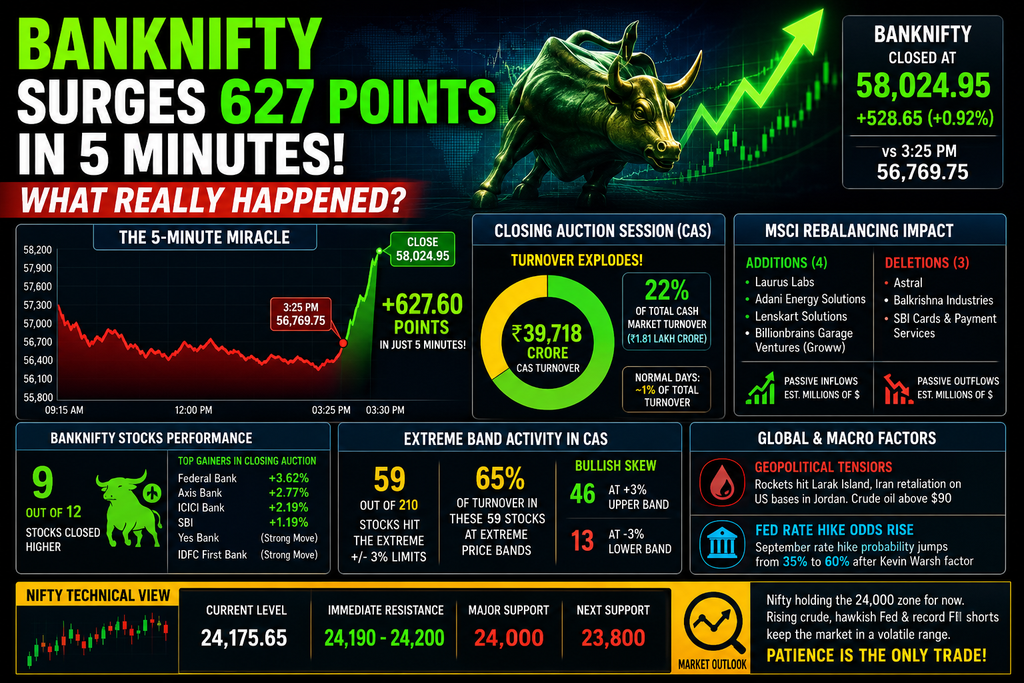
After remaining under pressure for most of the trading session, Nifty Bank suddenly jumped 627.6 points in the final five minutes, moving from around 56,769.75 at 3:25 PM to 58,024.95 at the close.
That translated into a 528.65-point gain, or approximately 0.92%, on a closing basis.
The move immediately triggered a bigger question across the market:
Was this genuine buying—or was the newly introduced Closing Auction Session (CAS), combined with MSCI index rebalancing, responsible for the extraordinary closing print?
The answer appears to be more complicated than a simple “bullish reversal.”
1. The BankNifty 5-Minute Shock
For most of the session, the market narrative was bearish.
Global risk sentiment was weak, crude oil was rising, bond yields were under pressure, and traders were worried about the possibility of tighter US monetary policy.
Yet the final five minutes produced a completely different picture.
BankNifty Closing Data
| Parameter | Data |
|---|---|
| BankNifty level around 3:25 PM | 56,769.75 |
| Final closing level | 58,024.95 |
| 5-minute move | +627.60 points |
| Closing gain | +528.65 points |
| Closing percentage gain | +0.92% |
| Key mechanism | Closing Auction Session (CAS) |
The magnitude and speed of the move are what made the session unusual.
Business Today reported that the banking index rose more than 627 points between 3:25 PM and the final closing calculation. SBI, Axis Bank and ICICI Bank also participated in the late move, while some other banking stocks recorded even larger percentage gains.
This is important because the move was not simply a single-stock event.
It was broad enough across banking constituents to materially affect the index.
2. What Is the Closing Auction Session (CAS)?
The key to understanding Monday’s move is the Closing Auction Session.
The NSE introduced the new CAS mechanism for eligible stocks with futures and options contracts from August 3, 2026.
Instead of simply taking the last traded price as the closing price, the auction mechanism allows orders to interact during a designated closing period to determine the official closing price.
That becomes particularly important when there is a very large imbalance between buyers and sellers.
Under normal market conditions, liquidity is distributed across the trading session.
But during a large index-rebalancing event, enormous institutional orders can become concentrated around the closing auction.
That creates a completely different market structure.
3. The MSCI Rebalancing Bomb
Monday was not an ordinary trading day.
It was the effective date of the latest MSCI India index rebalancing.
MSCI’s August review added four Indian stocks to the Standard Index:
- Laurus Labs
- Adani Energy Solutions
- Lenskart Solutions
- Billionbrains Garage Ventures, the parent of Groww
At the same time, three stocks were removed:
- Astral
- Balkrishna Industries
- SBI Cards and Payment Services
The changes were implemented after the August 31 close and became effective from September 1.
That means global passive funds tracking MSCI benchmarks had to rebalance their portfolios.
And when billions of dollars need to be repositioned at essentially the same time, the closing auction can become extremely important.
4. ₹39,718 Crore in CAS Turnover: The Real Story
This is perhaps the most important number from Monday’s session.
According to Business Standard, NSE’s Closing Auction Session generated approximately ₹39,718 crore of turnover.
For comparison, total NSE cash-market turnover was around ₹1.81 lakh crore.
That means the CAS accounted for roughly 22% of the day’s cash-market turnover.
The contrast with normal activity is striking.
Business Standard noted that CAS turnover during August had averaged only around 1% of NSE cash-market volume before this event.
So Monday was not just another high-volume day.
It was an extreme concentration of trading activity into the closing mechanism.
5. Why Did the Price Move So Fast?
The simplest explanation is order imbalance + concentrated liquidity + index rebalancing.
Imagine a stock normally trading with thousands of buyers and sellers throughout the day.
Now imagine a global index fund suddenly needs to buy a very large quantity at the close.
If there are not enough natural sellers at the existing price, the auction has to search for a price at which sufficient orders can match.
That can create a significant closing-price displacement.
The same mechanism works in reverse for stocks facing large passive outflows.
Therefore, the closing price may reflect institutional portfolio adjustment rather than the market’s fundamental assessment of the company.
This distinction is critical.
A stock closing sharply higher does not automatically mean that fresh discretionary investors suddenly became extremely bullish.
It may simply mean that a large quantity of benchmark-related orders had to be executed.
6. Why BankNifty Was So Sensitive
BankNifty is heavily influenced by large banking stocks.
During Monday’s closing auction, several major banking constituents moved sharply.
Reported moves included approximately:
- SBI: +1.19%
- Axis Bank: +2.77%
- ICICI Bank: +2.19%
- Federal Bank: up as much as 3.62%
- YES Bank: significant late-session gains
- IDFC First Bank: significant late-session gains
These simultaneous moves helped amplify the index-level effect.
This is why the BankNifty move looked much larger than what traders had observed just minutes earlier.
7. Was It a “Bullish Bias” in CAS?
This is where caution is necessary.
Some market participants may interpret the sharp upward closing moves as evidence that CAS has a bullish bias.
But the available evidence does not establish that the mechanism itself is structurally bullish.
A better interpretation is:
CAS can magnify order imbalances when liquidity becomes concentrated around the closing auction.
If buying pressure dominates, the closing price can jump.
If selling pressure dominates, the same mechanism can push prices lower.
Therefore, Monday’s upward BankNifty move should not automatically be interpreted as proof that the CAS mechanism favours bulls.
The direction was likely influenced by the specific distribution of institutional orders on that day.
8. MSCI Flows Were Much Bigger Than Normal Market Liquidity
Reuters reported that the closing auction generated approximately $4.1 billion in trades, nearly 40 times the average turnover since the new auction system was introduced.
That statistic puts the BankNifty move into perspective.
This was effectively a liquidity event.
The market had to process a huge amount of portfolio adjustment within a very short period.
The more concentrated the orders become, the more sensitive prices can become to relatively small changes in available liquidity.
This is especially relevant for stocks where expected index flows are large relative to their normal daily trading activity.
9. Reliance Was on the Other Side of the MSCI Trade
One of the most interesting names in the rebalancing was Reliance Industries.
Nuvama estimates cited in market reports suggested Reliance could face an MSCI-linked passive outflow of around $523 million, equivalent to roughly ₹5,000 crore at the cited exchange rate.
That helps explain why Reliance remained under pressure while some MSCI additions experienced buying interest.
In other words, the closing auction was not simply about “buying everything.”
It was about redistributing capital between index constituents.
Some stocks received passive inflows.
Others experienced passive outflows.
10. Laurus Labs and Adani Energy Solutions: The Other Side
Among the major MSCI additions were Laurus Labs and Adani Energy Solutions.
Market estimates had pointed to significant potential passive demand.
One estimate put expected inflows around:
- Laurus Labs: approximately $598 million
- Adani Energy Solutions: approximately $310 million
- Billionbrains/Groww: approximately $256 million
These figures help explain why relatively less-liquid stocks can experience unusually large price movements when benchmark-related orders arrive simultaneously.
The important point is that these are estimated passive flows, not guaranteed directional bets from discretionary traders.
11. HDFC Bank Added Another Layer of Uncertainty
The domestic market already had a major banking-sector issue to digest.
HDFC Bank came under pressure after MD and CEO Sashidhar Jagdishan announced that he would not seek reappointment and would retire on October 26.
The announcement created a succession-related uncertainty around one of India’s largest private-sector banks.
Reuters reported that HDFC Bank declined around 1.6% during Monday’s session.
That made the eventual BankNifty closing surge even more unusual because the broader banking narrative during the session was hardly euphoric.
12. Adani Stocks Also Faced Heavy Volatility
Adani-related stocks were another important part of Monday’s market story.
Adani Energy Solutions itself was simultaneously caught in the MSCI rebalancing flow while several Adani Group stocks experienced significant intraday pressure.
Reports showed Adani Energy Solutions trading around 5% lower at one point, while Adani Total Gas also came under pressure.
This illustrates an important point:
MSCI-related buying or selling does not necessarily dominate the entire trading session.
The stock can experience significant discretionary selling or buying during regular hours and then experience a completely different price impact during the closing auction.
13. The Global Risk Shock: Larak Island and Oil
The domestic market’s closing-auction drama was happening against a deteriorating global backdrop.
The United States carried out strikes against Iranian rocket launchers on Larak Island near the Strait of Hormuz.
Iran subsequently retaliated against US military positions in Jordan, according to reports.
The escalation immediately revived concerns about energy supply through the Strait of Hormuz.
Brent crude moved back above $90 per barrel, with Reuters reporting Brent reaching around $90.45 and an intraday high near $91.52.
For India, this is particularly important because a sustained oil shock can affect:
- inflation
- the current-account balance
- the rupee
- corporate margins
- transport costs
- interest-rate expectations
Therefore, the global macro environment remained distinctly challenging even while BankNifty produced its extraordinary closing rally.
14. The Kevin Warsh Factor and Fed Rate-Hike Odds
Another major source of volatility was the Federal Reserve.
Following Federal Reserve Chair Kevin Warsh’s remarks, markets substantially increased expectations for a September rate hike.
Market reporting placed the probability around 60%, up sharply from roughly 35% previously.
Higher rate expectations generally create pressure through:
Higher yields → stronger dollar/risk adjustment → tighter financial conditions → pressure on emerging-market assets
That does not mean Indian equities must fall immediately.
But it creates a more difficult background for a sustained risk-on rally.
15. Nifty’s 24,000 Zone Remains the Real Test
The broader Nifty picture remains more important than one extraordinary five-minute BankNifty candle.
Nifty had been trading around the 24,000–24,200 region, making this an important psychological and technical zone.
Friday’s Nifty close was 24,175.65, after an 84.80-point gain.
Market analysts had identified approximately:
Immediate resistance
24,190–24,200
A sustained move above this area could open the way toward:
24,300–24,350
Major support
24,000
Below that:
23,800
These levels matter because a break of 24,000 would change the short-term structure considerably, while a sustained move above 24,200 could weaken the immediate bearish setup.
16. The Most Important Lesson: Don’t Chase the Closing Candle
The BankNifty 627-point move creates a dangerous temptation for short-term traders.
A trader looking only at the final chart may see:
Huge bullish candle → strong buying → bullish reversal
But that conclusion can be misleading.
The move occurred inside a special closing mechanism during an exceptional MSCI rebalancing event.
Therefore, traders should distinguish between:
Normal price discovery
and
Event-driven price discovery
Monday’s final five minutes belonged much more to the second category.
That does not make the closing price meaningless.
It simply means the price needs to be interpreted in context.
17. What Could Happen Next?
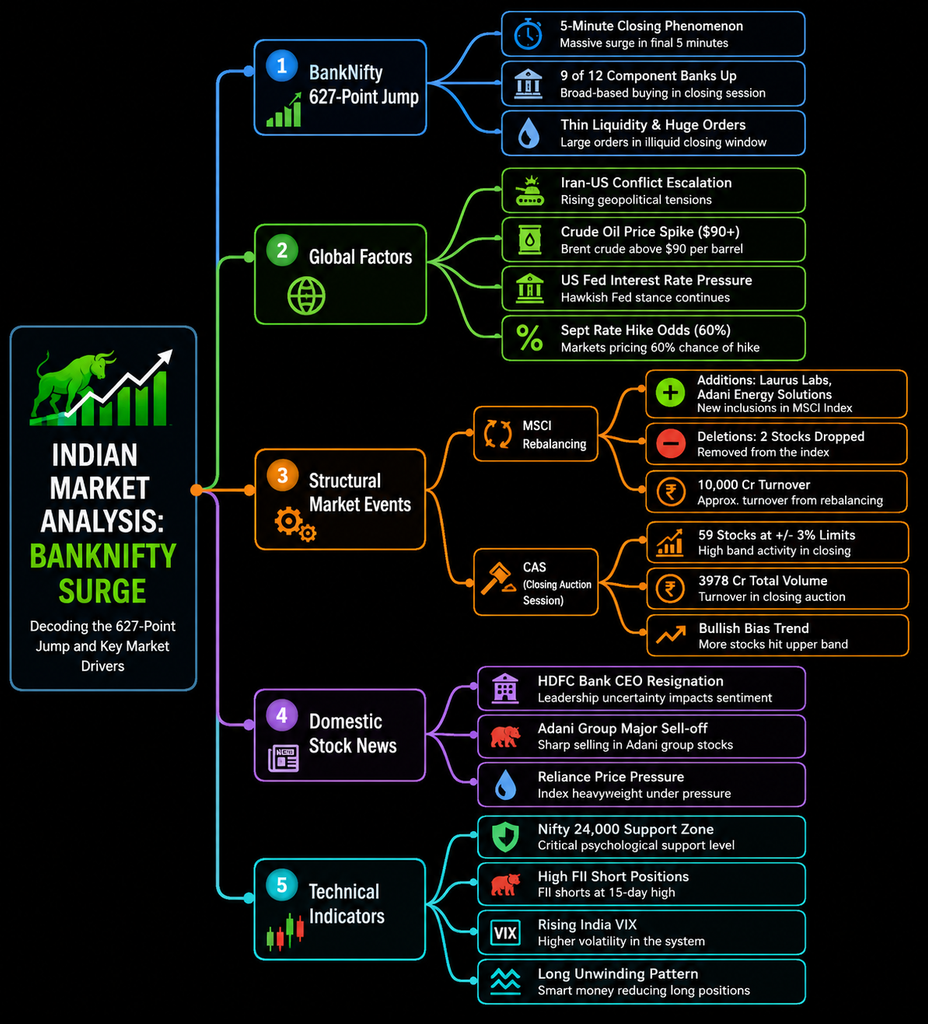
There are three possible scenarios.
Scenario 1: Bullish Follow-Through
If BankNifty holds the 58,000 area and banking stocks continue higher during normal trading hours—not just in the auction—then Monday’s closing move could become a genuine reversal signal.
Confirmation would require:
- sustained BankNifty strength
- positive breadth
- strong volume outside CAS
- Nifty reclaiming 24,200
- banking heavyweight participation
Scenario 2: The Auction Effect Fades
This is arguably the most important scenario.
If BankNifty opens strong but selling appears during regular market hours, Monday’s final five-minute move could prove to be primarily a rebalancing-driven event.
In that case, the market could return to its previous range.
Scenario 3: Nifty Breaks 24,000
This would be the bearish confirmation.
A decisive breakdown below 24,000, particularly with rising crude and higher US yields, could expose the next support around 23,800.
In that environment, Monday’s BankNifty rally would look increasingly like a temporary liquidity distortion rather than the beginning of a broader market reversal.
18. Final Verdict: Glitch, Manipulation or Genius?
Calling Monday’s move a “system glitch” would be premature.
There is currently no evidence proving that the CAS itself malfunctioned.
Calling it outright manipulation would also be inappropriate without evidence of wrongdoing.
The stronger explanation is a combination of:
MSCI rebalancing + enormous institutional order concentration + new CAS mechanics + limited closing-window liquidity.
The result was a dramatic repricing of several stocks within minutes.
Reuters described the event as a major test for India’s newly introduced closing auction mechanism, while market analysts highlighted the possibility of price dislocations when large passive flows interact with the new system.
So the real lesson from the “BankNifty 600-point kand” is not simply that bulls suddenly returned.
It is that the structure of Indian market closing-price discovery has changed.
And when a major index rebalance collides with that new structure, the final five minutes can produce moves that look almost impossible when viewed through the lens of ordinary intraday trading.
Conclusion: The 5-Minute Miracle Was a Liquidity Story
Monday’s BankNifty surge was extraordinary—but extraordinary does not automatically mean mysterious.
The numbers tell a clearer story.
A 627.6-point five-minute jump, nearly ₹39,718 crore of CAS turnover, a major MSCI index rebalance, billions of dollars of institutional portfolio adjustments, and a newly introduced closing-auction mechanism all collided on the same trading day.
At the same time, the macro environment remained hostile, with Brent crude back above $90 and markets pricing a substantially higher probability of a September Fed rate hike.
That is why traders should be careful about interpreting the final BankNifty candle in isolation.
The next real signal will not be what happened between 3:25 PM and 3:30 PM.
It will be what BankNifty and Nifty do during normal liquidity and normal price discovery in the sessions that follow.
If BankNifty holds its closing gains and Nifty reclaims 24,200, the bulls may have a genuine setup.
If the closing-auction gains disappear and Nifty slips below 24,000, Monday’s “miracle” may ultimately be remembered as one of the biggest examples of how institutional flows can distort the final five minutes of a trading day.
Disclaimer
This article is for educational and informational purposes only and should not be considered investment advice, a recommendation to buy or sell securities, or a trading strategy. Market conditions can change rapidly, particularly during index rebalancing and closing-auction periods. Readers should conduct their own research and consult a SEBI-registered financial adviser before making investment decisions.
Top 10 SEO Titles
- BankNifty Surges 627 Points in 5 Minutes: What Really Happened?
- BankNifty 600-Point Rally in 5 Minutes: MSCI Rebalancing Explained
- BankNifty’s 627-Point Shock: CAS, MSCI Rebalancing or Liquidity Trap?
- BankNifty 600 Points in 5 Minutes: The Biggest Closing Auction Mystery
- BankNifty Closing Shock: How MSCI Rebalancing Triggered a 627-Point Surge
- BankNifty Today: Why Did the Index Jump 627 Points in Just 5 Minutes?
- NSE Closing Auction Mystery: The Real Reason Behind BankNifty’s 600-Point Jump
- BankNifty 627 Points Higher: System Glitch, Smart Money or MSCI Flow?
- BankNifty’s 5-Minute Miracle: ₹39,718 Crore CAS Turnover Explained
- BankNifty 600-Point Kand Explained: CAS + MSCI Rebalancing Behind the Surge