
The Trump Tariff Trap: Why India’s Pharma Industry and Stock Market Face a Defining Moment
For decades, India’s pharmaceutical industry has been one of the country’s greatest economic success stories. Affordable manufacturing, strong regulatory expertise, and global-scale generic drug production transformed India into the “Pharmacy of the World.”
Today, that position faces one of its biggest geopolitical challenges.
A renewed wave of US trade protectionism, combined with rising geopolitical tensions in the Middle East and increasing energy prices, is creating a new risk environment for Indian businesses and investors.
For long-term investors, this isn’t simply another tariff announcement—it may represent the beginning of a structural shift in global pharmaceutical manufacturing.
A Perfect Storm for Indian Markets
Indian equity markets have already been under pressure.
- Banking earnings have become mixed.
- IT exports continue to slow.
- Global demand remains uncertain.
- Foreign investor sentiment has weakened.
Now another challenge has emerged.
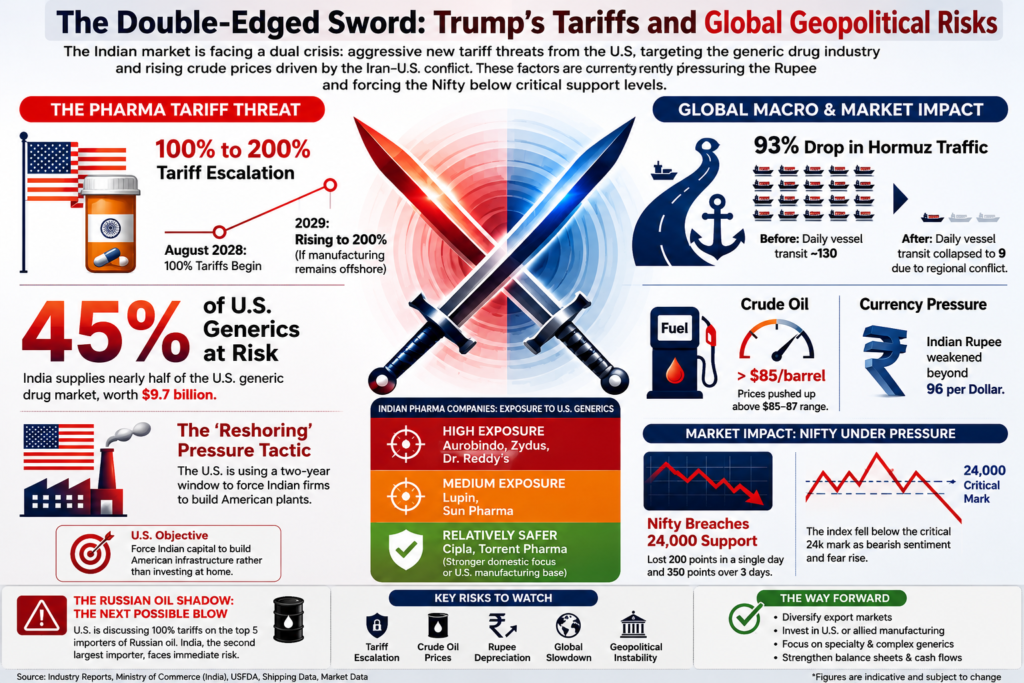
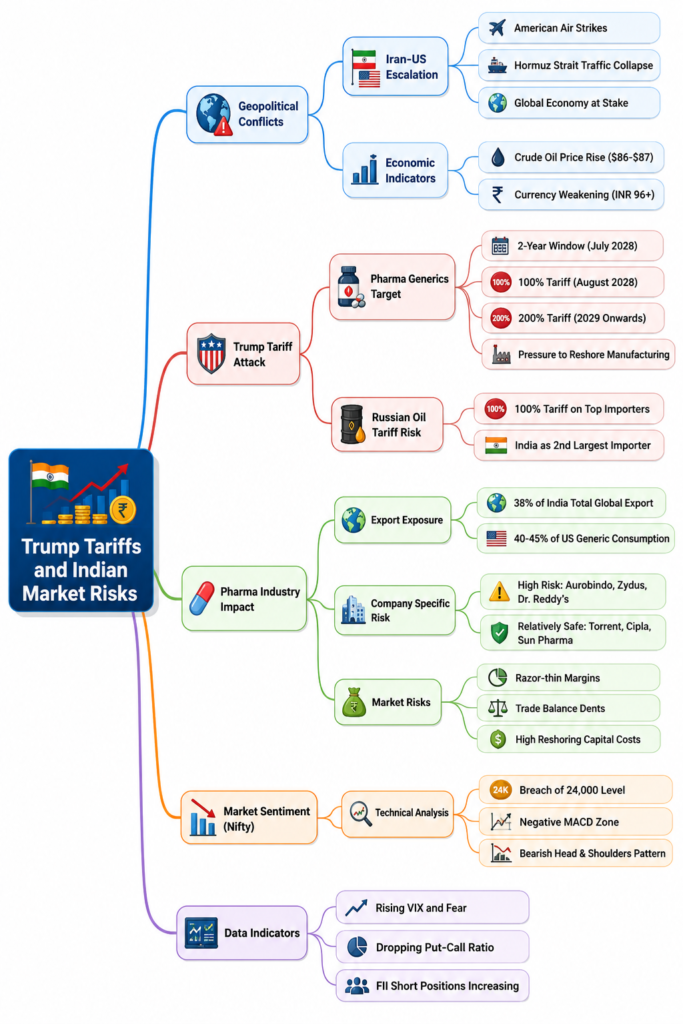
The United States is reportedly considering significantly higher tariffs on imported pharmaceutical products, particularly generic medicines.
Since pharmaceuticals remain one of India’s largest export industries, any disruption could have long-lasting consequences for corporate earnings, employment, and market sentiment.
Unlike previous trade disputes focused on patented medicines, the latest discussion directly affects generic drugs—the backbone of India’s pharmaceutical exports.
Why Generic Medicines Matter So Much
India dominates the global generic medicine industry.
Key facts include:
- India exports pharmaceutical products worth nearly US$9–10 billion annually to the United States, making America its largest pharma export destination.
- Indian companies supply roughly 40–45% of generic medicines used in the US healthcare system.
- India is among the world’s largest producers of USFDA-approved manufacturing facilities outside America.
Generic medicines operate on extremely thin profit margins.
Unlike patented drugs that generate large profits, generic manufacturers compete primarily on price.
Even moderate tariff increases can significantly reduce profitability.
If tariffs become exceptionally high, exporting to the US may no longer remain economically viable for many companies.
From Trade Pressure to Manufacturing Relocation
The larger objective appears to extend beyond tariffs.
The United States has increasingly emphasized domestic manufacturing across multiple industries.
A phased policy encouraging overseas companies to establish manufacturing facilities inside America would represent another step toward reshoring critical supply chains.
For Indian pharmaceutical companies, this creates difficult strategic choices:
- Invest billions of dollars in US manufacturing plants.
- Accept lower profit margins.
- Reduce exposure to the US market.
- Diversify exports toward Europe, Africa, Latin America, Southeast Asia, and emerging markets.
Each option involves significant costs.
Why Building Manufacturing in America Isn’t Easy
Constructing pharmaceutical manufacturing facilities in the United States requires:
- Large capital expenditure
- Regulatory approvals
- Skilled workforce
- Supply chain restructuring
- Higher operating costs
- Longer compliance timelines
Even if companies decide to invest today, achieving meaningful production capacity would likely take several years.
Meanwhile, shareholders may face:
- Lower earnings
- Reduced return on equity
- Margin compression
- Slower dividend growth
The Russian Oil Risk Adds Another Layer
Trade uncertainty doesn’t stop with pharmaceuticals.
Another major concern is India’s energy dependence.
India has become one of the world’s largest buyers of discounted Russian crude oil.
If secondary sanctions or tariffs targeting Russian oil buyers were introduced, India’s import costs could rise sharply.
Potential consequences include:
- Higher inflation
- Larger current account deficit
- Rupee depreciation
- Increased fiscal pressure
- Slower economic growth
For equity markets, rising crude oil prices historically reduce corporate profitability across several sectors.
Middle East Tensions and the Strait of Hormuz
Energy markets remain highly sensitive to developments in the Middle East.
The Strait of Hormuz handles a significant share of global oil shipments.
Any disruption can quickly impact:
- Global crude prices
- Shipping costs
- Insurance premiums
- Inflation expectations
India imports most of its crude oil requirements.
Therefore, sustained geopolitical instability directly affects:
- Fuel prices
- Manufacturing costs
- Corporate earnings
- Consumer spending
- Currency stability
Pressure on the Indian Rupee
Whenever crude prices rise while exports weaken, the Indian rupee typically faces additional pressure.
A weaker rupee increases:
- Import costs
- Corporate debt servicing
- Inflation
- Government subsidy burdens
Although exporters may benefit from currency depreciation, higher energy costs often offset much of that advantage.
Which Indian Pharma Companies Could Face Greater Risk?
Companies with substantial US generic exposure may experience greater uncertainty if tariffs increase significantly.
Examples include:
- Dr. Reddy’s Laboratories
- Aurobindo Pharma
- Zydus Lifesciences
- Lupin
- Sun Pharmaceutical (selected businesses)
Companies with stronger domestic businesses or diversified global revenue may be relatively better positioned, including:
- Cipla
- Torrent Pharmaceuticals
- Abbott India
- Alkem Laboratories
Investors should remember that actual business impact depends on:
- Product mix
- Manufacturing locations
- Existing US facilities
- Pricing power
- Regulatory approvals
Market Impact Beyond Pharmaceuticals
The consequences extend beyond one industry.
Potentially affected sectors include:
Banking
Lower corporate profitability may reduce credit demand while increasing business uncertainty.
Chemicals
Higher energy costs can increase raw material expenses.
Logistics
Shipping disruptions increase freight costs.
Healthcare
US healthcare costs could rise if cheaper generic medicines become less available.
Information Technology
Continued global slowdown may compound existing export challenges.
What Investors Should Watch
Rather than reacting emotionally, investors should monitor several important indicators:
- Official US tariff announcements
- India-US trade negotiations
- USFDA approvals
- Company guidance
- Crude oil prices
- Rupee movement
- Foreign Institutional Investor (FII) flows
- Quarterly earnings
- Capital expenditure plans
These factors will determine whether current concerns become temporary volatility or a long-term structural shift.
Opportunities Amid the Uncertainty
Every period of uncertainty also creates opportunities.
Companies with:
- Strong balance sheets
- Low debt
- Diversified export markets
- Domestic revenue growth
- Specialty pharmaceutical businesses
- Contract manufacturing capabilities
may emerge stronger over the next decade.
Investors focusing only on short-term headlines often miss long-term wealth creation opportunities.
Final Thoughts
The current geopolitical landscape marks one of the most significant challenges facing India’s pharmaceutical industry in recent years.
Higher US tariffs, reshoring initiatives, rising oil prices, and geopolitical instability together create a complex investment environment.
However, India’s pharmaceutical sector has repeatedly demonstrated resilience through regulatory changes, pricing pressure, and global competition.
The coming years may not signal the end of India’s pharmaceutical leadership—but they could redefine how Indian companies compete globally.
For investors, the priority should be careful stock selection, diversification, and close monitoring of policy developments rather than reacting solely to market volatility.
The next chapter of India’s pharmaceutical story will likely be shaped not just by manufacturing efficiency, but by geopolitical strategy, supply chain resilience, and the ability to adapt to a rapidly changing global trade landscape.
SEO-friendly title options:
- Trump Tariff Trap: How New US Tariffs Could Shake India’s Pharma Industry & Stock Market
- Trump’s Pharma Tariffs Explained: What They Mean for Indian Pharma Stocks and Investors
- India’s Pharma Industry Under Threat? Trump’s New Tariff Plan Explained
- Trump Tariffs 2026: Why Indian Pharma Stocks Could Face Their Biggest Challenge Yet
- US Tariff Shock: How Trump’s Trade Policy Could Impact India’s Pharma Exports
- Trump Tariff Trap: Will Indian Pharma Lose Its Biggest Export Market?
- Indian Pharma in Crisis? Trump’s Tariff Threat Could Reshape Global Drug Supply
- Trump’s Trade War Returns: What It Means for India’s Pharma Sector and Nifty
- Trump Tariffs vs Indian Pharma: Winners, Losers & Investment Strategy for 2026
- The Trump Tariff Trap: Why India’s Pharma Industry Faces a Defining Decade