
Introduction: Why Is the Market Rising While Investors Remain Worried?
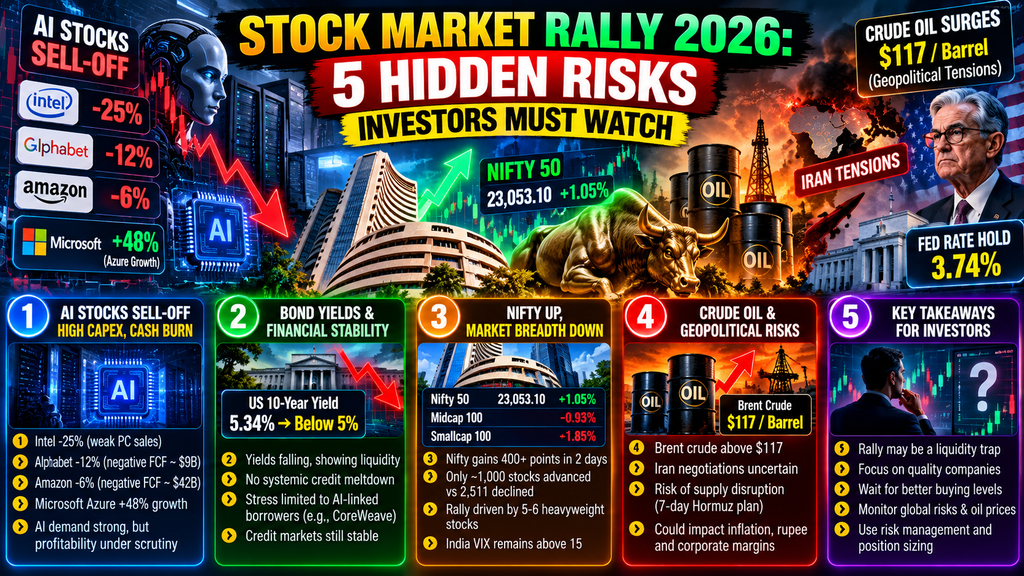
Global financial markets are sending mixed signals. India’s benchmark indices have recovered, while technology stocks in the United States face renewed pressure from concerns about artificial intelligence (AI) spending, cash flow, and future returns.
On October 30, 2026, the Nifty 50 closed at 23,053.10, gaining 116.35 points, or approximately 0.51%. The Sensex finished at 74,459.53, up 308.49 points. However, the broader market struggled: the Nifty Midcap 100 fell 0.93%, and the Nifty Smallcap 100 declined 1.85%.
Meanwhile, Brent crude futures rose to around $117 per barrel amid renewed concerns about supply disruptions in the Middle East. US technology stocks also came under pressure as investors questioned whether the enormous cost of building AI infrastructure would translate into adequate profits.
These developments raise an important question: Is the market recovery supported by sustainable economic strength, or are headline indices hiding risks that investors should not ignore?
The answer requires looking beyond daily index movements and examining corporate cash flows, market breadth, bond yields, derivatives positioning and geopolitical developments.
Here are five important takeaways that can help investors understand the current market environment.
1. AI Demand Is Growing, but the Cost of Building AI Infrastructure Is Becoming a Major Concern
The recent sell-off in US technology stocks has highlighted a growing tension in the AI industry.
Demand for cloud computing and AI processing capacity remains strong. However, companies are investing enormous amounts of money in data centres, advanced chips, networking equipment and electricity infrastructure.
Investors are increasingly asking whether these investments will generate sufficient returns.
Intel, Alphabet and Amazon: Three Different Stories
The recent pressure on technology stocks does not have a single explanation.
| Company | Recent Development | What Investors Should Understand |
|---|---|---|
| Intel | Shares fell sharply after the company warned about cash burn, manufacturing constraints and weaker PC demand. | PC-market weakness and supply problems are important company-specific risks. |
| Alphabet | Shares declined after earnings-related concerns about advertising performance, AI investment and negative free cash flow. | Strong cloud growth does not automatically guarantee stronger near-term cash generation. |
| Amazon | Shares came under pressure as investors assessed heavy capital expenditure, cash outflows, and the company’s revenue outlook. | Investors want evidence that AI infrastructure spending can produce attractive long-term returns. |
| Microsoft | Azure continued to report strong growth, with revenue increasing 48% in the reported quarter. | Strong AI-related demand can coexist with concerns about the cost of expanding infrastructure. |
The share-price declines reported during this period included after-hours trading. The figures and movements should not be interpreted as identical closing-price changes.
Why Is the Market Worried About AI Capital Expenditure?
Building AI infrastructure requires substantial upfront investment. Companies must invest in specialised processors, servers, data centres, energy supply, and cloud infrastructure before realising the full financial benefits.
This creates three important challenges.
1. Free cash flow pressure
Free cash flow represents the cash a company generates after capital expenditure. When spending rises faster than operating cash generation, free cash flow can deteriorate even when revenue is growing.
Amazon reported a trailing 12-month free cash flow outflow of approximately $42.4 billion. Alphabet also reported negative free cash flow of roughly $9 billion amid rising investment.
These figures have increased investor scrutiny of how quickly AI investments can generate returns.
2. Uncertain investment returns
AI infrastructure may support future revenue growth, but the eventual returns depend on customer demand, pricing, competition, operating costs and the useful life of the equipment.
High expenditure does not automatically mean that an investment will be profitable.
3. Increasing financing requirements
Some businesses may need to borrow money or raise additional capital to fund infrastructure expansion. Higher financing costs can make projects less attractive and increase financial risk.
Does the AI Sell-Off Mean the AI Boom Is Over?
Not necessarily.
Microsoft’s Azure growth and Alphabet’s cloud expansion illustrate that demand for cloud services remains an important business opportunity.
The market is increasingly distinguishing between AI demand and AI profitability. A company may have strong customer demand but still face pressure on its valuation if investors believe that future profits will not justify current spending.
Investors should examine revenue growth, operating margins, capital expenditure, free cash flow, and returns on invested capital rather than relying only on AI-related headlines.
Key takeaway: The AI industry may continue to expand, but investors are becoming more selective about which companies can convert that expansion into sustainable earnings and cash flow.
2. Falling US Bond Yields Offer Relief, but They Do Not Eliminate Financial Risks
When equity markets become volatile, investors often examine government bond yields for clues about economic expectations and risk appetite.
During the October 30 trading session, the US 10-year Treasury yield declined to approximately 4.91%. The move reflected demand for government bonds amid concerns about technology spending, economic risks and the outlook for interest rates.
However, falling yields should not automatically be interpreted as proof that the financial system is healthy or that a stock-market recovery is guaranteed.
Why Do Bond Yields Matter to Stock Investors?
Bond yields influence financial markets through several channels.
Valuation of growth stocks: Higher discount rates can reduce the present value of future earnings, particularly for companies whose valuations depend heavily on long-term growth.
Borrowing costs: Changes in government bond yields can influence financing costs across parts of the economy, although corporate borrowing rates also depend on credit risk and market conditions.
Investor allocation: When uncertainty rises, some investors move capital toward government bonds. This can place pressure on equities, especially highly valued growth stocks.
Economic expectations: Falling yields may reflect expectations of lower future inflation or slower growth. Their meaning depends on the broader economic context.
Is the AI Sell-Off a Systemic Financial Crisis?
The available evidence does not establish that the technology sell-off has developed into a systemic financial crisis.
However, it would also be premature to conclude that all financial risks are isolated simply because government bonds are attracting buyers.
Investors should monitor corporate borrowing, credit spreads, refinancing requirements, bank lending conditions and the ability of heavily indebted businesses to meet their obligations.
Companies with high capital expenditure and weak cash generation deserve particular attention when financial conditions become less supportive.
What Should Investors Monitor?
- US 10-year Treasury yields.
- Corporate credit spreads.
- Debt levels and interest coverage.
- Free cash flow among major technology companies.
- Financing conditions for data-centre and AI infrastructure businesses.
Key takeaway: Falling bond yields can provide temporary relief to equity valuations, but investors need confirmation from credit markets and corporate balance sheets before concluding that financial risks have diminished.
3. Nifty 50 Is Rising, but the Broader Market Is Sending a Warning
One of the most important developments in the Indian stock market is the divergence between benchmark indices and broader-market performance.
On October 30, the Nifty 50 closed at 23,053.10, gaining 0.51%. However, the Nifty Midcap 100 declined 0.93%, while the Nifty Smallcap 100 fell 1.85%.
Market reports also showed that declining stocks substantially outnumbered advancing stocks across the NSE.
This divergence helps explain why investors can see a positive Nifty closing figure while their own portfolios remain under pressure.
What Is Market Breadth?
Market breadth measures how widely a market’s advance or decline is distributed across individual stocks.
A positive market-breadth reading generally indicates that a relatively large number of stocks are participating in a rally. Negative breadth indicates that a greater number of stocks are declining.
A benchmark index can rise even when market breadth is weak because the Nifty 50 is weighted by market capitalisation. Large companies can have a disproportionate influence on the index compared with smaller companies.
Why Does a Narrow Rally Matter?
Consider the following example.
Suppose a few large-cap stocks rise significantly while many mid-cap and small-cap stocks decline. Their gains may be sufficient to lift the benchmark index even though the average stock is performing poorly.
Investors whose portfolios are concentrated in smaller companies may therefore experience losses despite a positive Nifty closing level.
This is not, by itself, proof of manipulation or an artificial rally. It is a consequence of differences in index weightings and individual stock performance.
Market Snapshot: October 30, 2026
| Index or Indicator | Closing Level | Daily Change |
|---|---|---|
| Nifty 50 | 23,053.10 | +0.51% |
| Sensex | 74,459.53 | +0.42% |
| Nifty Midcap 100 | 57,301.25 | -0.93% |
| Nifty Smallcap 100 | 18,463.60 | -1.85% |
| India VIX | Approximately 15.3 | Slightly higher |
Figures are based on published market reports for October 30, 2026. Index and volatility data may vary slightly between providers.
Is the Nifty Rally a Bull Trap?
A bull trap occurs when a market appears to break upward but subsequently reverses and falls below an important technical level, trapping traders who entered on the apparent breakout.
A positive index close combined with negative market breadth can justify caution. However, negative breadth alone cannot confirm a bull trap.
Traders should examine whether the index sustains its breakout, whether more stocks begin participating,g and whether buying continues over subsequent sessions.
What Should Indian Investors Watch?
- The number of advancing and declining stocks.
- Performance of the Nifty Midcap and Smallcap indices.
- Whether gains are concentrated in a small number of heavyweight stocks.
- India VIX and changes in option premiums.
- FII and DII cash-market activity.
- Index futures positioning and open-interest changes.
Key takeaway: The Nifty’s direction matters, but market breadth helps investors understand whether the rally is broad-based or concentrated in a few large stocks.
4. Crude Oil and Geopolitical Tensions Could Challenge the Market Recovery
Geopolitical developments remain a major source of uncertainty for global markets.
On October 30, Brent crude futures rose to approximately $117.15 per barrel for the December contract, which was due to expire that day. The more actively traded January contract was around $112.99 per barrel during the reported session.
The difference between contracts matters because futures prices can vary depending on expiry, liquidity and market expectations.
The rise in oil prices followed renewed concerns about supply disruptions, including a reported tanker attack in the Strait of Hormuz and uncertainty surrounding the US-Iran conflict.
Why Does Crude Oil Matter to India?
India imports a substantial share of the crude oil it consumes. A sustained rise in international oil prices can therefore affect the economy through several channels.
1. Inflationary pressure
Higher oil prices can increase transportation and manufacturing costs. These increases may eventually affect consumer prices.
2. Corporate profitability
Oil-sensitive businesses may experience margin pressure when energy costs rise faster than selling prices.
Industries that can be affected include airlines, paints, chemicals, logistics, and certain manufacturing businesses.
3. Rupee and external balances
Higher oil-import costs can increase demand for foreign currency and put pressure on India’s external balances. The actual effect on the rupee also depends on capital flows, monetary policy and global dollar movements.
4. Interest-rate expectations
If elevated energy prices contribute to persistent inflation, central banks may have less flexibility to ease monetary policy.
Could Oil Prices Rise Further?
A further increase is possible if supply disruptions intensify or shipping routes become less reliable. Prices could also decline if tensions ease and supply expectations improve.
Neither outcome is certain.
Investors should distinguish between diplomatic statements, actual developments affecting oil supply,y and the price movements observed in futures markets.
Which Sectors Could Be Affected?
| Sector | Potential Impact of Sustained High Oil Prices |
|---|---|
| Airlines | Higher aviation fuel costs may pressure margins. |
| Paints and chemicals | Input costs may increase, depending on the product mix. |
| Logistics and transportation | Fuel expenses may rise. |
| Oil marketing companies | Profitability can be affected by crude costs, refining margins and retail pricing. |
| Upstream oil producers | Higher realised crude prices may support revenue, depending on production and other factors. |
| Energy-intensive manufacturers | Higher operating costs may pressure profitability. |
The effect is not uniform across all companies. Pricing power, hedging, inventory costs and business models can materially change the outcome.
Key takeaway: Crude oil near elevated levels is an important risk variable for Indian equities. Monitor the oil price alongside the rupee, inflation expectations and sector-specific earnings.
5. Market Corrections Can Create Opportunities, but Buying Quality Requires Valuation Discipline
Market volatility can create attractive opportunities for long-term investors. However, a falling share price does not automatically mean that a stock has become cheap.
The most effective approach is to identify strong businesses, estimate their reasonable valuations, ns and establish potential buying levels before market volatility increases.
Why Do Some Investors Benefit From Market Corrections?
Investors who maintain a disciplined process may be better prepared to take advantage of temporary declines in high-quality businesses.
This process involves:
- Maintaining sufficient liquidity for future opportunities.
- Evaluating companies based on their fundamentals.
- Comparing market prices with estimated intrinsic value.
- Buying in stages when appropriate.
- Avoiding excessive concentration and leverage.
A correction may create an opportunity to buy a good business at a more reasonable price. However, it may also expose weaknesses that were previously hidden by strong market sentiment.
How Can Investors Evaluate a Quality Business?
A practical framework should include the following factors.
1. Revenue growth
Determine whether the company is expanding its business sustainably and whether growth depends on temporary conditions.
2. Profitability
Examine operating margins, net profit margins and return on capital.
3. Free cash flow
Assess whether the business generates sufficient cash after capital expenditure.
4. Balance-sheet strength
Review debt, interest costs, repayment schedules and liquidity.
5. Competitive advantage
Understand whether the company has durable advantages such as technology, distribution, brand strength, customer relationships or cost efficiency.
6. Valuation
Compare the share price with earnings, cash flow, growth expectations and relevant industry valuations.
Use Staggered Buying Carefully
Investors who have completed their research may consider dividing their intended investment into multiple tranches rather than committing all their capital at once.
For example, an investor planning to allocate ₹30,000 to a researched long-term opportunity could consider three tranches of ₹10,000 each, subject to the company’s valuation and the investor’s financial circumstances.
This approach can reduce the risk of committing the entire amount immediately before another decline. It does not guarantee a lower average purchase price or a profit.
If the company’s fundamentals deteriorate, the correct decision may be to avoid the investment altogether.
Why Intrinsic Value Matters
Suppose an investor estimates that a company’s intrinsic value is ₹200 per share. Buying at ₹500 would require the company to justify a substantially higher valuation through future growth or other factors.
However, intrinsic value is an estimate, not a guaranteed price target. Different assumptions about earnings, margins, discount rates and long-term growth can produce different valuations.
Investors should use reasonable assumptions and allow for a margin of safety.
Key takeaway: Market corrections are most useful to investors who have already identified quality businesses, assessed their financial strength and established reasonable valuation ranges.
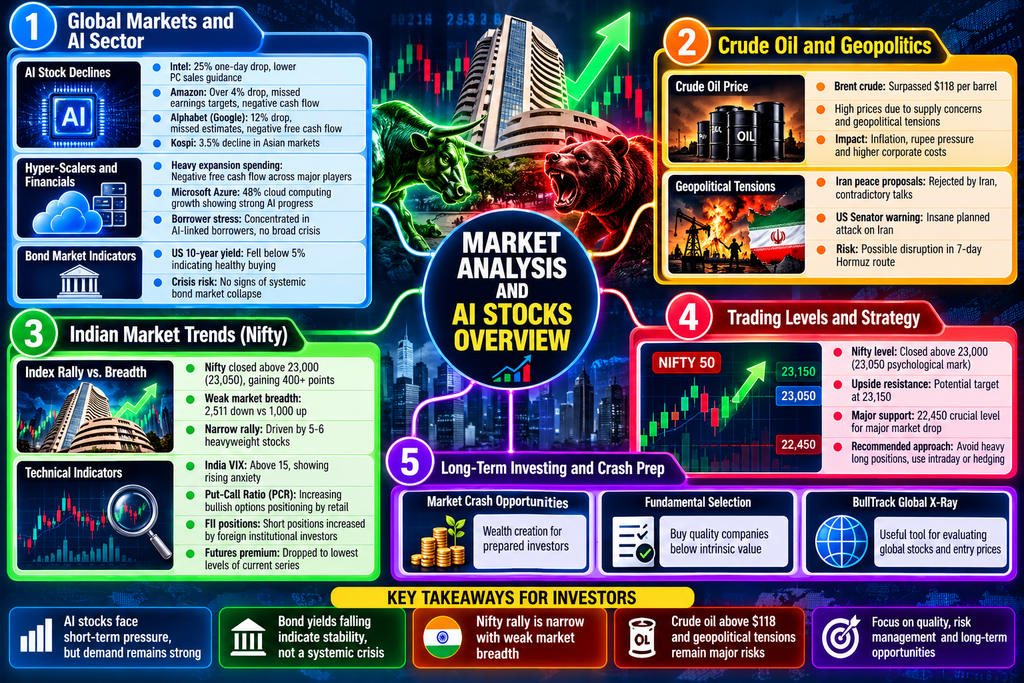
Nifty 50 Technical Outlook: Key Levels and Scenarios
The Nifty 50 closed at 23,053.10 on October 30, 2026, extending its recovery for a second consecutive session.
However, the weakness in mid-cap and small-cap indices indicates that the market recovery remains uneven.
The next move will depend on whether the index can sustain its advance, whether market breadth improves,ves and how global developments affect risk appetite.
Important Technical Zones
| Level or Zone | Potential Significance |
|---|---|
| 23,150 | An important near-term resistance reference based on the recent swing-high area. |
| 23,000 | A psychological level to monitor for short-term sentiment. |
| 22,450 | A lower support reference from the original analysis; it requires confirmation against the latest chart. |
These are reference levels, not guaranteed turning points. Traders should verify them using current price data before making trading decisions.
Bullish Scenario
The bullish case would strengthen if the Nifty sustains a move above nearby resistance and more stocks participate in the advance.
Confirmation could include improving market breadth, sustained buying volume and stronger performance across large-cap and broader-market indices.
Bearish Scenario
The bearish case would strengthen if the index fails at resistance, market breadth deteriorates further, and selling spreads across sectors.
A confirmed breakdown below a relevant support zone could increase downside risk. The 22,450 level should not be treated as a guaranteed trigger for a crash.
Range-Bound Scenario
If the index repeatedly moves between support and resistance without strong follow-through, a range-bound market may remain the most practical interpretation.
In this environment, traders should pay particular attention to stop-loss placement, position sizing, and the risk of sudden volatility.
Important: These scenarios are conditional. They are not price predictions or recommendations to buy or sell Nifty futures or options.
Investment Strategy: How to Navigate the Current Market
Investors do not need to predict every market movement to manage risk effectively.
A structured process can help reduce the influence of headlines and emotional decision-making.
For Long-Term Investors
- Focus on business fundamentals rather than daily index movements.
- Review valuations before adding to existing positions.
- Maintain diversification across companies and sectors.
- Keep sufficient liquidity for planned expenses and investment opportunities.
- Reassess a holding when its underlying business outlook deteriorates.
For Swing Traders
- Identify support and resistance using current charts.
- Wait for confirmation instead of chasing sudden moves.
- Review market breadth and sector strength.
- Set the maximum acceptable loss before entering a position.
- Avoid excessive exposure to correlated stocks.
For Futures and Options Traders
- Monitor implied volatility and changes in option premiums.
- Understand that option buyers can lose the entire premium paid.
- Account for time decay and changes in implied volatility.
- Use position sizing that reflects the risk of sudden price gaps.
- Avoid treating PCR, open interest,t or FII positioning as standalone trading signals.
Frequently Asked Questions (FAQs)
1. Why is the Nifty 50 rising while many stocks are falling?
The Nifty 50 is a market-capitalisation-weighted index. Gains in a limited number of heavyweight stocks can lift the benchmark even when many mid-cap, small-cap and individual stocks decline. Market breadth helps investors assess how widely a rally is being shared.
2. Does the AI stock sell-off mean the AI boom is over?
No. The sell-off reflects concerns about investment costs, free cash flow, financing requirements and future returns. AI demand may continue growing, but investors are increasingly evaluating whether companies can convert that demand into sustainable profits.
3. Why are investors worried about Amazon and Alphabet’s AI spending?
Both companies are investing heavily in infrastructure. These investments can support future growth but also reduce near-term free cash flow. Investors want evidence that the spending will generate attractive long-term returns.
4. How do US Treasury yields affect Indian stocks?
US Treasury yields influence global borrowing costs, equity valuations and international capital allocation. Changes in yields can affect emerging markets, including India, but the relationship also depends on the dollar, domestic earnings and investor risk appetite.
5. How do high crude oil prices affect the Indian stock market?
Higher crude oil prices can increase India’s import bill, put pressure on the rupee and raise costs for oil-sensitive businesses. The effects vary across sectors, and some upstream energy producers may benefit from higher realised prices.
6. Is the Nifty rally a bull trap?
It is too early to conclude that a rally is a bull trap solely because market breadth is weak. Traders should examine whether the index sustains its breakout, whether broader participation improves and whether subsequent sessions confirm the upward move.
7. Should investors buy stocks during a market correction?
A correction can create opportunities, but investors should evaluate business quality, financial strength and valuation first. A declining price alone does not establish that a stock is undervalued.
8. What should investors watch in November 2026?
Investors should monitor corporate earnings, AI-related capital expenditure, free cash flow, crude oil prices, US Treasury yields, Federal Reserve communications, geopolitical developments, FII flows and Indian market breadth.
Conclusion: Look Beyond the Headline Index
Global markets are facing a complex combination of strong AI demand, rising infrastructure costs, geopolitical uncertainty and changing investor expectations.
In India, the Nifty 50’s recovery above 23,000 has provided some relief, but the decline in mid-cap and small-cap indices shows that the improvement has not been broad-based.
At the same time, pressure on US technology stocks highlights the growing importance of cash flow, capital allocation and investment returns. Elevated crude oil prices add another source of uncertainty for the Indian economy and equity markets.
These developments do not prove that a major market crash is imminent. They do, however, reinforce the importance of distinguishing short-term momentum from sustainable business performance.
Investors should monitor market breadth, evaluate corporate fundamentals, verify important technical levels, ls and manage risk carefully. Long-term opportunities are best approached through disciplined valuation analysis rather than fear or excitement.
The bottom line: A rising index does not guarantee a healthy market, and a falling stock is not automatically a bargain. In uncertain conditions, evidence, valuation discipline, and risk management matter more than dramatic headlines.
Disclaimer
This article is for educational and informational purposes only. It does not constitute investment advice, a recommendation to buy or sell securities, or a prediction of future market performance. Stock-market investments and derivatives trading involve risk, including the potential loss of capital. Readers should conduct independent research and consult a SEBI-registered investment adviser where appropriate before making investment decisions.
Top 10 SEO Titles
- Stock Market Rally 2026: 5 Hidden Risks Investors Must Watch
- AI Stock Sell-Off: 5 Surprising Risks Behind the Market Rally
- Nifty 50 Rally 2026: Is It a Bull Trap or a Real Recovery?
- Why Are AI Stocks Falling While the Indian Stock Market Rises?
- Indian Stock Market Analysis: 5 Warning Signs Investors Should Know
- AI Stocks Crash? Amazon, Alphabet and Intel Face New Market Risks
- Nifty 50 Today: AI Sell-Off, Crude Oil and Global Market Outlook
- Stock Market Outlook 2026: AI Spending, Oil Prices and FII Activity
- Global Market Warning: 5 Risks That Could Impact Indian Stocks
- AI Boom vs Market Reality: Is the Stock Market Rally Sustainable?