
Indian Stock Market: Why Tata Stocks, IT and Private Banks Are Under Pressure
The Indian stock market is entering a phase where predictability is becoming more valuable than aggressive growth.
The recent sell-off has highlighted a striking divergence between sectors. Tata Group stocks, IT companies and several other high-weightage names have faced selling pressure, while PSU banks have periodically attracted buying interest.
But this is not simply a story of investors abandoning private companies for government-owned banks.
It is a story about risk, earnings visibility, liquidity and uncertainty.
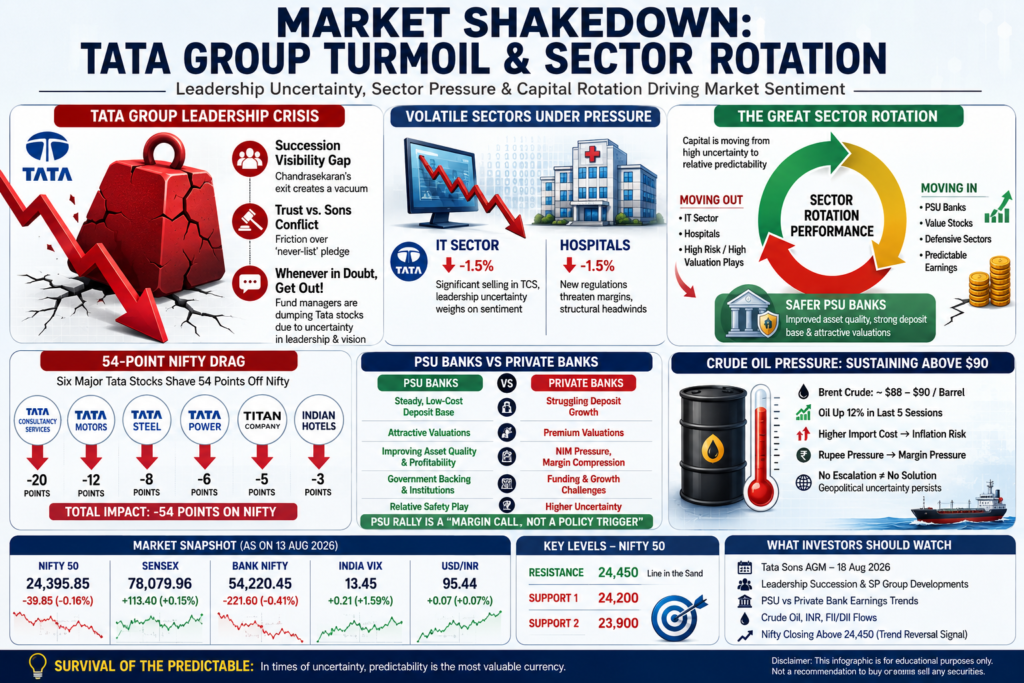
The latest market data shows how quickly sentiment can change. On August 13, 2026, the Nifty 50 closed at 24,395.85, down 0.16%, while the Sensex finished at 78,079.96, up 0.15%. Banking and financial stocks also remained under pressure, falling around 0.4% as concerns over proposed loan-pricing changes weighed on margins.
That makes the recent PSU-bank strength more interesting: investors are not necessarily betting on a permanent structural victory for PSU banks. They may simply be looking for relative safety and valuation support.
Tata Sons Crisis: The Biggest Corporate Governance Overhang
The most important corporate story behind the recent Tata-stock volatility is the uncertainty surrounding Tata Sons leadership.
N. Chandrasekaran has decided not to seek another term as Tata Sons chairman and will continue until his current term ends in February 2027.
The development comes after months of discussions involving Tata Trusts Chairman Noel Tata, Tata Sons leadership and strategic questions surrounding the group’s future.
The issue is bigger than one chairman.
It involves three interconnected questions:
- Who will lead Tata Sons after February 2027?
- What happens to the long-running Tata Sons listing debate?
- How will the group deal with its large shareholder and governance structure?
The Tata Sons AGM scheduled for August 18, 2026 has therefore become an important event for investors. Chandrasekaran’s directorship is on the agenda, while the broader leadership question remains a major source of uncertainty.
Why the Tata Sons listing issue matters
Tata Trusts own approximately 66% of Tata Sons, while the Shapoorji Pallonji Group owns approximately 18.4%.
The SP Group has repeatedly pushed for a public listing of Tata Sons, arguing that a listing could unlock value and provide an exit route for its substantial holding.
Earlier reports also indicated that Noel Tata had sought clarity on the group’s strategy, including the listing question and a possible solution for the SP Group’s stake.
This creates a difficult strategic triangle:
Tata Trusts → Tata Sons management → SP Group
And that triangle is now being closely watched by the market.
Why Tata Stock Weakness Matters So Much for Nifty
The Tata ecosystem has enormous representation across Indian equities.
Companies linked to the group span:
- IT
- Auto
- Steel
- Consumer
- Power
- Hotels
- Chemicals
- Retail and digital businesses
That means negative sentiment toward Tata companies can have a second-order impact on the broader Nifty.
TCS is particularly important because of its enormous market capitalization and index weight.
Tata’s own stock-data page currently shows TCS with a market capitalisation of roughly ₹7.89 lakh crore, while its one-year return was around -32% on the data displayed.
This illustrates the problem clearly:
When a heavyweight stock falls sharply, the market impact can be much larger than the company’s individual decline.
TCS and IT: Another Pressure Point
The Tata Sons uncertainty arrived at an already challenging time for the IT sector.
TCS has been under pressure, and the broader IT sector has also faced concerns around:
- weak global technology spending
- AI-driven changes in traditional outsourcing
- US economic uncertainty
- currency movements
- margin pressure
- slower discretionary technology spending
The market therefore has to distinguish between Tata-specific governance risk and TCS-specific business fundamentals.
They are not the same thing.
This distinction is critical for long-term investors.
A governance problem at Tata Sons does not automatically mean that every Tata-listed company has deteriorating fundamentals.
In fact, the market reaction on August 13 showed some differentiation. Tata Motors Passenger Vehicles gained around 3.9% after strong quarterly developments, demonstrating that investors can still reward individual Tata companies when operating fundamentals improve.
The Great Rotation: From Growth to Predictability
The bigger market story is not simply “Tata versus PSU banks.”
It is:
Growth versus predictability.
When uncertainty increases, investors often prefer companies where the next few quarters are easier to model.
That can temporarily benefit:
- PSU banks
- value stocks
- defensive sectors
- high-dividend companies
- companies with strong balance sheets
At the same time, investors may reduce exposure to:
- expensive growth stocks
- IT
- highly leveraged businesses
- companies facing regulatory uncertainty
- businesses with weak earnings visibility
This is why the recent PSU-bank movement deserves attention.
PSU Banks vs Private Banks: Is the Gap Really Closing?
The Indian banking sector has been undergoing an interesting transformation.
Private banks such as HDFC Bank, ICICI Bank, Axis Bank and Kotak Mahindra Bank have historically commanded premium valuations because of their:
- stronger technology platforms
- superior asset quality
- better return ratios
- stronger underwriting
- higher consistency
PSU banks, meanwhile, have often traded at significant valuation discounts.
But the equation is changing.
PSU banks have benefited from:
- improved asset quality
- lower credit costs
- better capitalisation
- stronger profitability
- improved balance sheets
- government-linked deposits
- comparatively attractive valuations
This has allowed investors to reconsider the sector.
For example, the Nifty PSU Bank universe includes major lenders such as SBI, Bank of Baroda, Canara Bank, PNB, Union Bank and Indian Bank.
The important point is that PSU banks are no longer being evaluated purely through their historical bad-loan narrative.
But Don’t Call It a PSU Bank Bull Market Yet
This is where investors need to be careful.
A sharp rally in PSU banks does not automatically mean the beginning of a multi-year structural bull market.
There are still several risks.
1. Deposit growth
Banks cannot grow loans indefinitely without sufficient deposits.
If deposit growth remains slower than credit growth, banks can face funding pressure.
2. Net Interest Margin
NIM is critical for banking profitability.
If funding costs remain elevated while loan yields cannot rise proportionately, margins can compress.
3. Asset quality
The biggest historical weakness of PSU banks has been asset quality.
Even after major improvements, investors must continue monitoring:
- GNPA
- NNPA
- credit costs
- restructuring
- slippages
- provision coverage
4. Economic cycle
If economic growth weakens significantly, corporate and retail credit stress can rise again.
Therefore, PSU-bank outperformance should be treated as a developing trend, not a guaranteed structural shift.
Why the $90 Crude Oil Zone Matters for India
Oil remains one of the most important macro risks for Indian equities.
India is heavily dependent on imported crude, which means higher oil prices can affect:
Crude ↑ → Import bill ↑ → Trade deficit ↑ → Inflation risk ↑ → Rupee pressure ↑ → Corporate margins ↓
On August 12, Brent crude was around $88.88 per barrel, after gaining roughly 12% across the previous five sessions.
On August 13, Brent remained elevated around the high-$80s, while the rupee closed near ₹95.44 per US dollar. Reuters also highlighted India’s vulnerability to Middle East disruptions because of its dependence on oil imports.
So the market’s concern is not simply whether crude crosses $90.
The bigger question is:
How long can crude remain near $90?
A temporary spike may be manageable.
A prolonged period near $90-$100 would be much more problematic for India’s inflation, current account, fiscal outlook and corporate margins.
Technical View: Nifty’s 24,450 Zone Remains Important
The 24,450 area has become an important psychological and technical reference point.
The market’s recent price action suggests that traders are watching this level closely.
A simple framework:
Bullish scenario
If Nifty decisively reclaims and sustains above 24,450, the recent breakdown could turn into a false breakdown.
That could open the door to:
- short covering
- recovery in IT
- buying in index heavyweights
- improvement in market breadth
Bearish scenario
If Nifty repeatedly fails around 24,450 and selling resumes, traders may continue treating rallies as opportunities to reduce positions.
The next important task for traders would then be identifying fresh support below the recent lows.
Most important confirmation
Do not judge the trend from one intraday candle.
Watch:
Price + Volume + Market Breadth + Bank Nifty + FII/DII flows
together.
One Important Reality Check: Bank Nifty Strength Is Not Permanent
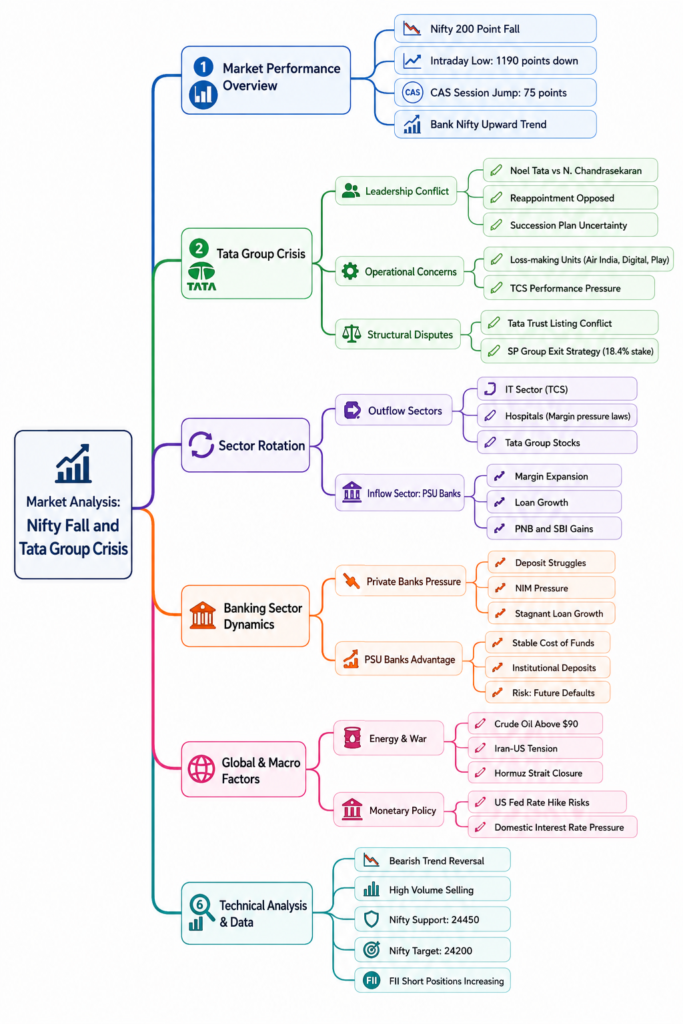
The recent divergence between Nifty and banking stocks should not be interpreted as a permanent shift toward PSU banks.
On August 13, banking and financial stocks were themselves under pressure, with the banking segment down around 0.4%.
This is important because it changes the interpretation.
The market may be rotating between pockets of the banking sector, rather than making a blanket “PSU banks over private banks” decision.
For investors, that means stock selection matters more than simply buying the entire sector.
What Investors Should Watch Next
The next few sessions could be extremely important.
Tata Group
Watch:
- Tata Sons AGM on August 18
- succession clarity
- Chandrasekaran’s transition
- Tata Sons listing debate
- SP Group developments
- performance of TCS and other major Tata companies
Banking
Track:
- NIM
- deposit growth
- loan growth
- credit costs
- GNPA/NNPA
- PSU vs private-bank relative performance
Macro
Monitor:
- Brent crude
- USD/INR
- US Treasury yields
- US Federal Reserve expectations
- Middle East developments
- FII flows
Nifty
The key technical question remains:
Can Nifty reclaim and sustain above 24,450?
If yes, the recent weakness could start looking like a correction.
If no, traders should remain cautious about assuming that every bounce is a new uptrend.
Tata Crisis vs PSU Bank Rally: What Does the Market Actually Want?
The current market message is surprisingly simple.
Investors are not necessarily saying:
“PSU banks are better than private banks.”
Nor are they saying:
“The Tata Group is fundamentally broken.”
The market is saying something more subtle:
In an uncertain environment, earnings visibility and valuation matter more than reputation alone.
Tata has one of India’s strongest corporate franchises, but governance uncertainty can temporarily increase the risk premium.
PSU banks, meanwhile, have spent years repairing balance sheets and improving profitability. Their valuations can therefore become attractive when investors seek value.
But history also provides a warning: cheap valuations alone do not guarantee sustainable returns.
Conclusion: The Market Is Choosing Predictability
The current Indian market environment is less about panic and more about risk repricing.
Tata Sons faces a leadership transition.
TCS and IT stocks are dealing with structural uncertainty.
Crude oil remains elevated.
The rupee is under pressure.
Private banks are navigating deposit and margin challenges.
And PSU banks are getting another opportunity to prove that their balance-sheet transformation is sustainable.
The upcoming August 18 Tata Sons AGM could become a major sentiment event.
For traders, the immediate technical line remains 24,450 on Nifty.
For investors, the bigger question is different:
Can India’s PSU banks sustain their improving fundamentals while Tata’s corporate governance uncertainty gets resolved?
That answer could determine whether the current rotation is merely a short-term defensive trade—or the beginning of a much larger change in Indian market leadership.
The market does not always reward the most famous company. Sometimes, it rewards the company whose future is easiest to predict.
Key Data Points at a Glance
| Indicator | Latest/Key Level | Why It Matters |
|---|---|---|
| Nifty 50 — Aug 13 | 24,395.85 | Below 24,450 technical reference |
| Sensex — Aug 13 | 78,079.96 | Broad market gauge |
| Brent crude | ~$88-$90/barrel | Inflation & import-cost risk |
| USD/INR — Aug 13 | ₹95.44 | Currency/import pressure |
| Tata Trusts stake in Tata Sons | ~66% | Controlling shareholder |
| SP Group stake in Tata Sons | ~18.4% | Key shareholder/listing issue |
| Tata Sons AGM | Aug 18, 2026 | Major governance event |
| Chandrasekaran current term | Until Feb 2027 | Succession uncertainty |
| Nifty technical reference | 24,450 | Key reclaim/confirmation level |
Disclaimer: This article is for educational and informational purposes only and should not be treated as investment advice. Market conditions, prices, and corporate developments can change rapidly.
SEO Title Options
- Tata Crisis vs PSU Banks: Why Indian Markets Are Rotating in 2026
- Tata Sons Crisis: Why PSU Banks Are Outperforming Private Banks
- Tata Stocks Under Pressure: Why Investors Are Turning to PSU Banks
- PSU Banks vs Private Banks: What the Tata Crisis Means for Nifty
- Tata Sons Leadership Crisis: Why Indian Markets Prefer PSU Banks
- Nifty Market Outlook: Tata Crisis, PSU Banks, Crude Oil & 24,450 Level
- Tata Group Crisis Explained: PSU Banks, TCS & Nifty Market Outlook
- Why PSU Banks Are Rising While Tata Stocks Face Selling Pressure
- Tata Sons Succession Crisis: Impact on TCS, Nifty & Indian Markets
- Indian Stock Market 2026: Tata Crisis, PSU Bank Rally & Nifty Outlook