

Why India Is Falling While the US Stock Market Keeps Rising
The global equity market is experiencing a fascinating divergence.
The S&P 500 has remained remarkably resilient, while Indian equities have faced pressure from crude oil, geopolitical uncertainty, foreign investor selling, and concerns over inflation.
On August 13, 2026, the Nifty 50 closed at 24,395.85, down 0.16%, while the Sensex gained 0.15% to 78,079.96. Crude oil was trading around $88 per barrel, adding pressure to India’s inflation and current-account outlook.
So the big question is:
If India is still one of the world’s fastest-growing major economies, why is its stock market struggling while US equities remain so strong?
The answer is not simply “India is weak, and America is strong.”
The real story is a combination of inflation, currency, sector composition, earnings expectations, valuations, foreign flows and investor positioning.
1. Inflation: India Has a Bigger Oil Problem
One of the most important differences between the two economies is inflation.
India’s latest available July 2026 CPI inflation came in at 4.45%.
Meanwhile, the US July 2026 CPI increased 3.4% year over year, down from 3.5% in June. Core CPI was 2.5%.
July 2026 Inflation Snapshot
| Indicator | India | US |
|---|---|---|
| Latest CPI | 4.45% | 3.4% |
| Core inflation | — | 2.5% |
| Key pressure | Food + energy + crude sensitivity | Shelter + services |
| Currency sensitivity | High | Lower |
| Monetary policy risk | Elevated | Data dependent |
The difference matters because India is significantly more sensitive to imported energy prices.
When crude oil rises, India faces pressure through:
- Fuel and transport costs
- Logistics expenses
- Manufacturing input costs
- Food distribution costs
- Current-account balance
- Rupee depreciation
- Inflation expectations
Therefore, crude at around $88/barrel becomes an important risk factor for Indian equities.
But there is an important correction.
It would be too aggressive to say that India is definitely heading toward a massive inflation shock.
The better interpretation is:
Higher crude creates an inflationary risk that could delay monetary easing or force the RBI to remain cautious.
That distinction is important for investors.
2. India Is Growing Fast — So Why Isn’t the Stock Market Rewarding It?
This is where many investors become confused.
India’s economy is still growing rapidly.
India’s GDP grew 7.8% year-on-year in the January–March 2026 quarter, while FY2025-26 growth was estimated at around 7.7%.
But stock markets don’t simply reward GDP growth.
Markets price:
Future earnings + valuation + liquidity + risk + expectations.
A company can grow earnings by 10%, but if investors expected 20%, its stock can still fall.
This is the essence of de-rating.
Economic Growth ≠ Stock Market Return
Suppose:
- Earnings growth = +10%
- Expected growth = +20%
- P/E falls from 25x to 20x
The stock can decline even though the company is still making more money.
This is why the Indian correction should not automatically be interpreted as an economic collapse.
It can instead represent a reset in expectations and valuations.
3. The Dollar Return Trap Is Real
For an Indian investor, looking only at rupee returns can be misleading.
For a foreign investor, the equation is different:
Dollar Return ≈ Equity Return + Currency Effect
If Indian equities fall and the rupee weakens at the same time, the loss for a dollar-based investor becomes even larger.
India’s currency has already moved toward the ₹95–₹97 per US dollar zone in 2026. RBI data showed USD/INR around ₹96.54 per dollar on July 24, 2026.
This creates a powerful psychological problem for foreign investors.
Example
Imagine an FII invests:
$100 million
If Indian stocks decline 8% and the rupee simultaneously depreciates by 5%, the dollar-based return can be materially worse than the headline Nifty return suggests.
This helps explain why currency risk matters so much to global investors.
4. Nifty vs S&P 500: The Sector Difference Is Huge
The composition of an index can tell you a lot about its behavior.
The S&P 500 currently has approximately:
- 38.0% Information Technology
- 11.8% Financials
- 9.7% Communication Services
- 9.3% Consumer Discretionary
- 8.9% Industrials
- 8.9% Healthcare
According to S&P Dow Jones Indices data as of June 30, 2026.
The Nifty 50, by contrast, has substantial exposure to Financial Services, with HDFC Bank, ICICI Bank, SBI, Axis Bank, Kotak Mahindra Bank, Bajaj Finance and other financial names among its largest constituents.
This creates a major difference in market DNA.
S&P 500
The US index is heavily influenced by:
AI + semiconductors + cloud + software + mega-cap technology + digital advertising
Nifty 50
The Indian index is more closely connected to:
Banks + financial services + energy + telecom + IT services + domestic consumption
Therefore, when global investors aggressively buy AI and technology leaders, the S&P 500 can receive a powerful earnings and valuation boost.
5. America’s AI Boom Is Changing the Market
The S&P 500 is no longer simply a representation of traditional American industry.
It has become heavily influenced by companies positioned around:
- Artificial intelligence
- Data centres
- Semiconductors
- Cloud computing
- Software
- Digital platforms
- Cybersecurity
- Automation
The S&P 500 Information Technology sector itself has 74 constituents, with companies such as Nvidia, Apple, Microsoft, Broadcom, Micron and AMD among major names.
This creates an important structural advantage.
The US mega-cap technology companies generate revenue across the entire world.
An American technology company can benefit from:
US + Europe + Asia + Middle East + Latin America
India’s large financial institutions are much more dependent on the domestic economy.
That difference matters during periods of global uncertainty.
6. But Don’t Assume the US Is Risk-Free
This is where investors need to be careful.
A strong S&P 500 does not automatically mean the US market is cheap.
The same technology concentration that drives US performance can also create vulnerability.
If:
- AI spending slows
- Earnings disappoint
- Bond yields rise
- Inflation accelerates
- US economic growth weakens
- Mega-cap valuations compress
then the S&P 500 can experience a sharp correction.
The current US market therefore represents a combination of strong corporate earnings expectations and high investor expectations.
The higher the expectations, the greater the punishment when companies disappoint.
7. FII Selling Is Making India’s Weakness Worse
Foreign institutional flows are another important part of the story.
When global investors become concerned about:
- crude oil
- geopolitical risks
- rupee depreciation
- Indian valuations
- domestic interest rates
- global trade
they can reduce exposure to Indian equities.
Reuters reported that foreign investors sold more than ₹606 billion ($6.53 billion) of Indian equities in March during a period of market stress and surging crude prices.
This creates a feedback loop:
FII selling → weaker equities → weaker sentiment → rupee pressure → more caution → additional FII selling
Domestic institutional investors can partially absorb this selling, but they cannot always completely offset global risk-off flows.
8. RBI Rate Risk: The Market Is Watching Inflation Carefully
The RBI currently has a policy repo rate of 5.25%, according to RBI data.
The key question is not simply:
“Will the RBI hike rates?”
The bigger question is:
Can the RBI continue easing if crude and inflation remain elevated?
That is much more important.
Higher crude can make monetary policy more complicated because the RBI has to balance:
Growth vs Inflation vs Currency Stability
If inflation rises sharply, the market may start pricing fewer rate cuts—or potentially a future hike.
That can negatively affect:
- Banks
- NBFCs
- Real estate
- Autos
- Consumer discretionary
- Highly leveraged businesses
However, higher rates aren’t automatically bad for every bank. Strong lenders with good asset quality can sometimes benefit from better margins.
9. India’s Problem May Be Valuation, Not Growth
This is arguably the most important investment lesson.
India can simultaneously have:
Strong GDP growth + good corporate earnings + weak stock market performance.
Why?
Because valuation matters.
If investors previously paid a premium for India’s growth story, then even excellent earnings may not be enough.
Imagine:
Old P/E = 25x
New P/E = 20x
Even if earnings increase, the market can fall because investors are no longer willing to pay the same premium.
This is called multiple compression.
And that is why the current phase can be described as:
A correction in expectations rather than necessarily a collapse in India’s economic fundamentals.
10. The Data Shows India Is Still Structurally Strong
It would be wrong to turn this article into an “India is finished” narrative.
There are several positives.
India continues to benefit from:
- Strong domestic consumption
- Large working-age population
- Infrastructure investment
- Digitalisation
- Manufacturing expansion
- Rising financialisation of savings
- Growing formal economy
- Strong banking-sector balance sheets
Fitch recently reaffirmed India’s sovereign rating at BBB- with a stable outlook and highlighted strong growth, contained inflation and external buffers, although it also warned about energy shocks and structural challenges.
So the investment thesis isn’t:
India = Bad
It is:
India = Strong long-term story, but potentially more demanding short-term valuation and macro environment.
11. The Most Important Numbers Investors Should Watch
Instead of trying to predict whether India will crash or the US will continue rising, investors should monitor these indicators.
India
1. CPI Inflation
Watch whether inflation remains near the RBI’s target or moves significantly higher.
2. Crude Oil
$80, $90, and $100 crude scenarios can have very different implications for India.
3. USD/INR
A weakening rupee increases imported inflation and reduces dollar returns.
4. FII Flows
Persistent selling can keep pressure on Indian equities.
5. Bank Nifty
Because financials have a major influence on Nifty, Bank Nifty strength or weakness is critical.
6. Earnings Growth
If earnings catch up with valuations, the market can recover without requiring a major multiple expansion.
12. India vs US: The Bigger Picture
| Factor | India | US |
|---|---|---|
| Economic growth | Strong | Slower |
| Latest CPI | 4.45% | 3.4% |
| Currency risk | High | Lower for US investors |
| Market leadership | Banks + domestic sectors | Technology + AI |
| Crude sensitivity | High | Lower relative impact |
| FII sensitivity | High | Lower |
| AI exposure | Lower | Very high |
| Domestic demand | Strong | Strong |
| Key risk | Inflation + crude + currency | Valuation + AI expectations |
| Main opportunity | Long-term structural growth | Technology + global earnings |
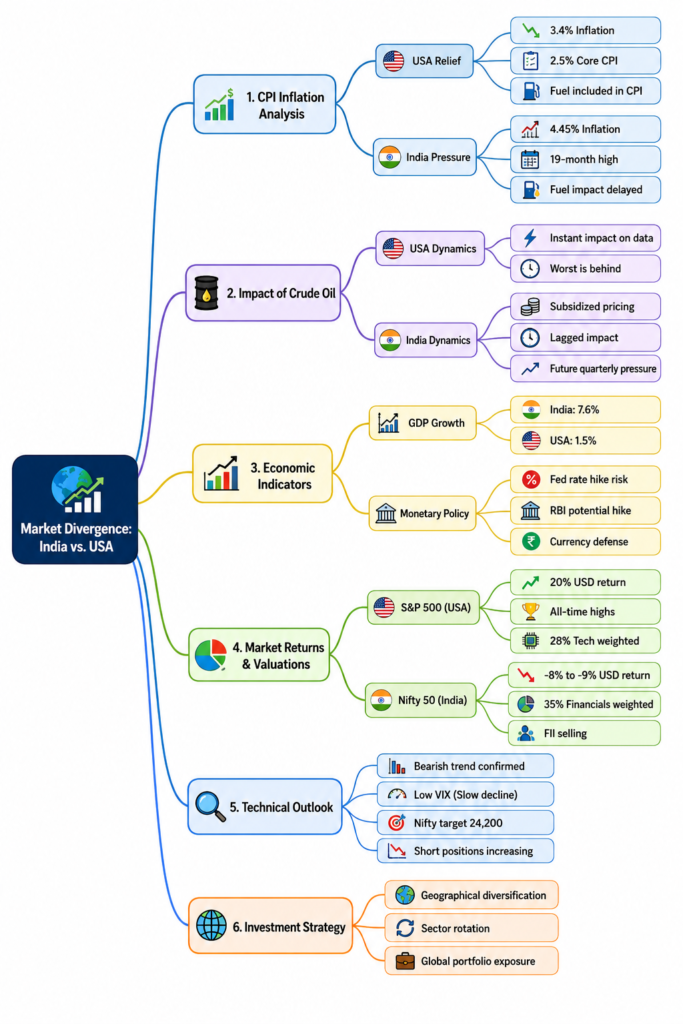
Is India Actually Crashing?
The word “crash” may be too extreme.
What we are seeing is better described as a combination of:
Correction + de-rating + foreign selling + crude shock + currency pressure + sector rotation.
On August 13, Nifty closed at 24,395.85, showing that volatility remains elevated, but that alone does not establish a structural economic collapse.
The more important question is what happens next.
If crude falls, inflation stabilises, earnings improve, and FII flows turn positive, Indian equities can recover rapidly.
But if crude remains elevated, the rupee weakens further and earnings disappoint, the de-rating process could continue.
The Real Lesson for Investors: Don’t Bet Everything on One Country
The biggest lesson isn’t:
“Sell India and buy America.”
It is:
Don’t allow geographical concentration to become your biggest portfolio risk.
India provides exposure to:
- Domestic consumption
- Infrastructure
- Financialisation
- Manufacturing
- Long-term economic expansion
The US provides exposure to:
- AI
- Semiconductors
- Cloud computing
- Global technology
- Global consumer platforms
- Highly profitable multinational companies
The two markets have different economic engines.
That makes geographical diversification potentially valuable.
Final Verdict
India’s current market weakness does not mean the Indian economy is failing.
And America’s market strength does not mean the US economy is invincible.
The real divergence is being created by different inflation dynamics, currency movements, sector compositions, valuation expectations, earnings structures and capital flows.
India is still growing quickly. But investors are asking whether that growth is already sufficiently reflected in valuations.
The US, meanwhile, is benefiting from an extraordinary technology and AI investment cycle—but investors are paying a premium for that growth.
The next major market battle may therefore come down to three variables:
Crude Oil + Earnings + Valuation
If crude stays high and earnings disappoint, India could remain under pressure.
If inflation cools and earnings accelerate, the Indian market could surprise on the upside.
And if US AI expectations become too aggressive, the same technology leadership that powered the S&P 500 higher could eventually become its biggest vulnerability.
The smart investor doesn’t ask which country will win every year.
The smart investor builds a portfolio capable of surviving when the winner changes.
Sources & Data Notes
- India’s July 2026 CPI: 4.45%, based on MoSPI data.
- US July 2026 CPI: 3.4%, with core CPI at 2.5%.
- India’s Q4 FY2025-26 GDP growth: 7.8% YoY; FY2025-26 growth estimated at 7.7%.
- RBI repo rate: 5.25%.
- USD/INR: around ₹96.54/$ in RBI’s July 24 data.
- S&P 500 sector weights as of June 30, 2026: IT 38.0%, Financials 11.8%, Communication Services 9.7%.
- Nifty 50 constituent weights show significant exposure to financial services, including HDFC Bank, ICICI Bank, and SBI.
Disclaimer: This article is for educational and informational purposes only and should not be treated as investment advice.
Top 10 SEO Titles
- Why India Stock Market Is Falling While US Stocks Rise in 2026
- India vs US Stock Market: Why Nifty Is Falling While S&P 500 Rises
- Why Is the Indian Stock Market Falling? 7 Reasons Explained
- Nifty vs S&P 500: Why India Is Underperforming the US in 2026
- India Stock Market Crash? The Real Reasons Behind Nifty’s Fall
- Why US Stocks Are Rising While Indian Stocks Are Falling in 2026
- Indian Stock Market Under Pressure: Inflation, Rupee & FII Selling Explained
- Why Is Nifty Falling in 2026? Crude Oil, Inflation and FII Selling
- India vs America: Why the US Stock Market Is Outperforming Nifty
- Nifty 50 vs S&P 500: The Hidden Reasons Behind India’s Market Weakness