
Introduction: Why Did the Nifty Rise While Global Markets Fell?
The Indian stock market delivered a surprising performance on October 13, 2026. While semiconductor and technology stocks faced heavy selling pressure across several Asian markets, Indian benchmark indices staged a strong recovery, led by information technology stocks and improving currency sentiment.
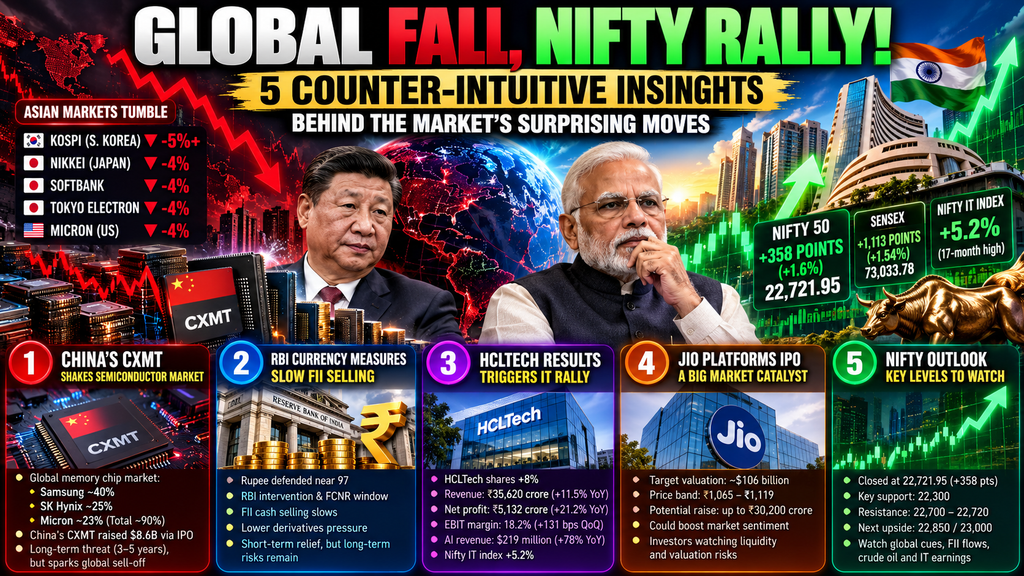
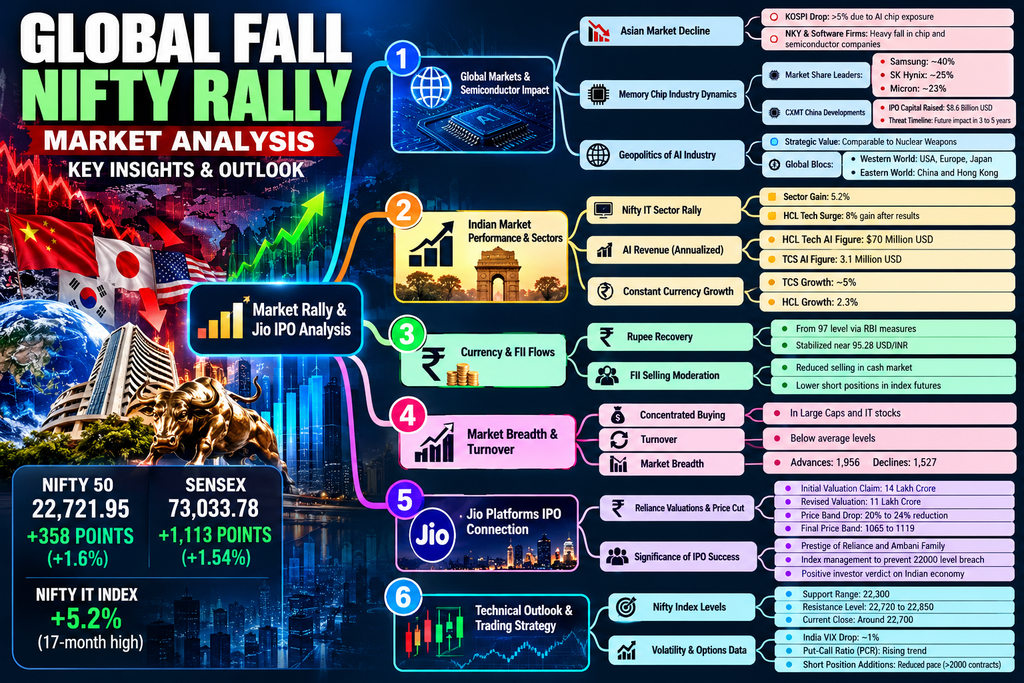
The Nifty 50 climbed 1.6%, gaining approximately 358 points to close at 22,721.95. The BSE Sensex advanced 1.54% to 73,033.78. Meanwhile, the Nifty IT index surged 5.2%, its strongest single-day performance in more than 17 months, according to Reuters.
HCL Technologies and Tata Consultancy Services were among the major contributors to the IT-led rally. HCLTech gained approximately 8.4%, while TCS rose 6.8%. The Indian rupee also strengthened to around ₹95.28 per US dollar amid measures introduced by the Reserve Bank of India (RBI) to ease currency pressure.
However, a domestic rally does not necessarily mean global risks have disappeared. Concerns about artificial intelligence valuations, semiconductor competition, elevated crude oil prices, foreign investor flows and the upcoming Jio Platforms IPO remain important variables for investors.
The central question is whether this rally represents a sustainable improvement in market fundamentals or a short-term recovery driven by earnings, currency relief and positioning.
1. China’s Semiconductor Ambitions Are Changing the Global AI Trade
Why are semiconductor stocks under pressure?
The global technology sell-off highlighted a growing concern among investors: the semiconductor industry may face more intense competition just as companies are investing heavily in artificial intelligence infrastructure.
On October 13, reports of progress by Chinese memory-chip manufacturer ChangXin Memory Technologies (CXMT) in DRAM architecture added to concerns about competition for established manufacturers. Comments from Broadcom CEO Hock Tan, who cautioned against excessive enthusiasm around AI investment, also contributed to investor nervousness.
Reported market moves included:
- South Korea’s Kospi falling sharply, with reports putting its decline at more than 6%.
- Samsung Electronics and SK Hynix facing substantial selling pressure.
- Tokyo Electron declining sharply in Japan.
- Micron Technology falling in US trading as investors reassessed semiconductor-sector risks.
These developments illustrate how quickly sentiment can change when investors question whether future AI-related revenues will justify the capital expenditure and valuations associated with the sector.
Why does memory-chip competition matter?
Memory chips are critical components in AI servers, data centres and high-performance computing systems. High-bandwidth memory (HBM), in particular, plays an important role in supplying data to advanced AI processors.
Established companies such as Samsung Electronics, SK Hynix and Micron have invested heavily in memory manufacturing and advanced products. If Chinese competitors eventually produce competitive products at scale, the industry could face pressure on pricing, market share and profit margins.
However, there is an important distinction between technological progress and immediate commercial disruption.
A new chip design or manufacturing announcement does not automatically mean a competitor can match established manufacturers in production yields, product quality, customer qualification or large-scale supply. Investors should therefore avoid assuming that one announcement will immediately overturn the industry’s competitive structure.
What should investors monitor?
Investors following semiconductor and AI infrastructure stocks should examine:
- HBM demand and production capacity.
- Memory-chip pricing and inventory levels.
- Capital expenditure by semiconductor manufacturers.
- AI infrastructure spending by large technology companies.
- Export restrictions and geopolitical developments.
Investment takeaway: AI remains a major long-term technology theme, but the distinction between AI adoption and AI-stock valuations is becoming increasingly important. Strong industry growth does not guarantee attractive returns at every purchase price.
2. RBI Currency Measures Helped Improve Market Sentiment
The second important factor behind India’s market recovery was the improvement in currency sentiment.
The rupee had been under pressure amid foreign portfolio outflows, international uncertainty and elevated energy-import costs. A weaker rupee can increase the cost of imported commodities, especially crude oil, and can affect inflation expectations and corporate margins.
On October 13, the rupee strengthened to around ₹95.28 per US dollar, while the RBI’s measures aimed at easing currency pressure helped support sentiment.
How can RBI intervention affect equities?
Currency movements influence the Indian stock market through several channels.
First, foreign investor returns: Foreign portfolio investors evaluate returns in their own currencies. If Indian stocks rise in rupee terms but the rupee depreciates significantly, their dollar-denominated returns can be reduced.
Second, imported inflation: India relies heavily on imported crude oil. A weaker rupee makes dollar-priced oil more expensive in domestic currency, potentially increasing fuel and transportation costs.
Third, investor confidence: A sharp currency decline can increase uncertainty about inflation, interest rates and capital flows. Measures that reduce disorderly currency movements may improve market sentiment.
Fourth, derivatives positioning: Changes in currency and index volatility can influence institutional hedging and futures positions. However, currency stabilisation alone does not prove that investors have reduced their bearish positions.
Can RBI measures reverse FII selling?
Not necessarily.
Central-bank intervention may reduce short-term currency volatility, but sustained foreign investment depends on multiple factors, including:
- Relative valuations between Indian and global equities.
- US interest rates and dollar strength.
- Corporate earnings growth.
- Global risk appetite.
- Geopolitical conditions.
- The rupee’s medium-term direction.
Investors should distinguish between a temporary improvement in sentiment and a lasting reversal in foreign portfolio flows.
Investment takeaway: RBI measures can provide short-term support, but a sustainable market recovery requires improving earnings expectations, stable macroeconomic conditions and stronger investor demand.
3. HCLTech’s Q2 FY2027 Results Triggered a Powerful IT-Sector Rally
The clearest company-specific catalyst for the Indian market’s October 13 rally was HCLTech’s September-quarter earnings.
According to the company’s official investor-relations results, HCLTech reported higher revenue, improved profitability and strong growth in its advanced AI business.
HCLTech Q2 FY2027 financial highlights
| Metric | Reported result |
|---|---|
| Revenue | ₹35,620 crore |
| Year-on-year revenue growth | 11.5% |
| Quarter-on-quarter revenue growth | 3.0% |
| Revenue in US dollars | $3.724 billion |
| Net income | ₹5,132 crore |
| Year-on-year net income growth | 21.2% |
| EBIT margin | 18.2% |
| Quarter-on-quarter EBIT margin improvement | 131 basis points |
| Advanced AI revenue | $219 million |
| Advanced AI revenue growth, year-on-year, constant currency | 78.0% |
Source: HCLTech’s official investor-relations results for Q2 FY2027.
These figures suggest that the quarter delivered more than a simple revenue increase. Profitability improved significantly, and the company reported strong momentum in its advanced AI business.
Why did HCLTech shares rise so sharply?
Stock prices respond to the difference between reported results and market expectations, not just to whether earnings increased.
HCLTech’s improved operating margin and profitability may have encouraged investors to reassess its near-term earnings outlook. Positive sentiment then spread to other major IT stocks, including TCS.
The Nifty IT index’s 5.2% advance was particularly important because large IT companies carry substantial weight in the broader market indices.
When several heavyweight constituents rise together, they can lift the Nifty 50 even if other sectors are experiencing more mixed conditions.
Does this mean the IT sector has entered a new bull market?
Not yet.
Investors must examine whether the earnings improvement can continue across future quarters. Important factors include:
- New deal wins and conversion into revenue.
- Client spending on technology and consulting.
- Demand for cloud migration and AI implementation.
- Operating margins and employee utilisation.
- Pricing pressure and competition.
- The possibility that AI automation changes traditional IT-services revenue models.
HCLTech reported total contract value of approximately $3.258 billion in new deal wins and advanced AI revenue of $219 million for the quarter. These are useful indicators, but they should be evaluated alongside actual revenue conversion, profitability and management guidance.
Investment takeaway: The earnings-led IT rally has a clearer fundamental catalyst than a rally based only on rumours. However, investors should assess each company’s valuation, growth outlook and margins before assuming that the entire sector offers the same opportunity.
4. The Jio Platforms IPO Could Influence Market Sentiment, but It Does Not Prove Index Manipulation
The upcoming Jio Platforms IPO is another major event investors are watching.
Jio Platforms, the telecom and digital-services business owned by Reliance Industries, is preparing for a potentially landmark listing. Reuters reported on October 9 that the company was targeting a valuation of approximately $106 billion, with a reported price range of ₹1,065–₹1,119 per share and potential fundraising of up to ₹30,200 crore.
These figures reflect reported IPO plans and should not be treated as a substitute for the final offer document. Investors should verify the latest official filing for confirmed issue terms and dates.
Why does the Jio IPO matter to the wider market?
A large IPO can affect market sentiment through several channels.
Institutional liquidity: Large investors may reserve capital for a major new issue, potentially affecting allocations to existing stocks.
Reliance Industries valuation: Because Reliance owns a substantial interest in Jio Platforms, investors may reassess Reliance’s value as more information about Jio’s standalone valuation becomes available.
Telecom-sector comparisons: A separately listed Jio Platforms could provide investors with a more direct way to value its telecom and digital businesses. It could also influence comparisons with other telecom companies.
Market sentiment: A successful large IPO may strengthen confidence in India’s equity market. Conversely, weak demand or disappointing valuation could affect sentiment.
Is the Nifty being supported to protect the Jio IPO?
This is a hypothesis, not a fact.
The timing of a strong market rally before a major IPO may encourage speculation about strategic index support. However, timing alone cannot demonstrate that institutions deliberately pushed the index higher to improve IPO demand.
The October 13 rally had a documented earnings catalyst: HCLTech’s results, followed by strong buying in major IT stocks. RBI currency measures also contributed to the improvement in market sentiment.
To establish a claim of deliberate index manipulation, investors would need reliable evidence of coordinated trading or other specific conduct. A sharp rally, by itself, is insufficient.
What should investors examine before the IPO?
- The final price band and issue size.
- Revenue growth and profitability.
- Debt and the intended use of IPO proceeds.
- Valuation relative to listed telecom and technology companies.
- The offer document’s risk factors.
- Demand from institutional and retail investors.
Investment takeaway: The Jio Platforms IPO may become an important market event, but investors should base their decisions on the company’s disclosed financials and valuation rather than speculation about index movements.
5. Nifty Technical Analysis: Can the Rally Continue?
The Nifty 50 closed at 22,721.95 on October 13, 2026, after gaining approximately 358 points.
This was a strong one-day advance, but one session cannot establish a durable trend reversal. Investors should combine price action with market breadth, turnover, volatility and derivatives positioning.
Key Nifty levels to watch
The following levels are taken from the technical framework in the supplied analysis. They are reference levels, not independently validated support or resistance guarantees.
| Technical level | Interpretation |
|---|---|
| 22,300 | Key support reference |
| 22,700–22,720 | Near-term resistance zone that the rally approached |
| 22,850 | Potential next upside reference if resistance breaks |
| 23,000 | Psychological resistance level |
Scenario 1: Bullish continuation
If the Nifty sustains a move above the 22,700–22,720 zone, traders may watch for a possible extension towards 22,850 and then 23,000.
Confirmation would be stronger if the move were accompanied by healthy trading turnover, broad participation across sectors and continued earnings-led buying.
A temporary move above resistance without follow-through may not be sufficient.
Scenario 2: Consolidation
After a sharp single-day gain, the index may consolidate as traders book profits and investors reassess the global environment.
In this scenario, the index may move sideways while market participants wait for additional earnings, currency and global macroeconomic signals.
Consolidation would not automatically invalidate the rally.
Scenario 3: Renewed weakness
If global technology selling intensifies, crude oil prices rise further, or the rupee comes under renewed pressure, investors may become more cautious.
A decline below the 22,300 reference level would warrant closer attention to price action and market breadth. However, a support break should be assessed using closing prices, volume and subsequent confirmation rather than a single intraday movement.
Why market breadth matters
An index can rise sharply because a few large companies carry substantial index weights. This can create a different picture from the performance of the average listed stock.
Investors should monitor:
- The number of advancing versus declining stocks.
- Large-cap versus mid-cap and small-cap performance.
- Sector participation in the rally.
- Trading turnover compared with recent averages.
- India VIX and changes in options positioning.
A rally supported by multiple sectors and healthy participation is generally more convincing than one concentrated in a few heavyweight stocks.
What about put-call ratios and short covering?
A rising put-call ratio, changes in open interest and reductions in futures short positions can help explain market positioning, but none of these indicators should be interpreted in isolation.
For example, a decline in bearish positions can contribute to a rally through short covering. Yet establishing that short covering was the dominant driver requires verified derivatives data, including the relevant contracts, expiry,y and open-interest changes.
Investment takeaway: The Nifty’s next direction will depend on whether the rally attracts sustained buying and whether the global environment becomes more supportive. Technical levels can help structure risk, but they cannot predict the market with certainty.
Global Markets vs Indian Equities: What Investors Should Compare
| Factor | Potential effect on Indian equities |
|---|---|
| Semiconductor competition | May increase volatility in global technology stocks |
| Strong IT earnings | Can support the Nifty through heavyweight constituents |
| Rupee stabilisation | May improve sentiment and reduce immediate currency concerns |
| Higher crude oil prices | Can increase import costs and inflation pressure |
| FII selling | Can weigh on valuations and market liquidity |
| Jio Platforms IPO | May influence institutional allocations and market sentiment |
| Rising bond yields | Can pressure bond prices and affect borrowing costs |
| Broad-based buying | Can make a market recovery more durable |
The important lesson is that domestic and global markets do not always move together over short periods. Indian equities can rise even when overseas markets fall if domestic earnings or policy developments provide a sufficiently strong catalyst.
However, sustained divergence becomes harder to maintain if global weakness begins to affect corporate earnings, capital flows or investor risk appetite.
What Investors Should Watch Next
1. IT earnings and management guidance
Track the next set of quarterly results from major IT companies. Pay particular attention to constant-currency growth, deal wins, margins, AI revenue and management commentary on client spending.
2. RBI policy and rupee movements
Monitor official RBI announcements, foreign-exchange movements, inflation data and crude oil prices. Currency stabilisation is helpful, but its durability matters more than a single day’s movement.
3. Foreign institutional investor flows
Examine published cash-market flow data over several sessions rather than concluding from one trading day. A sustained reduction in selling would provide a stronger signal than an isolated improvement.
4. Jio Platforms IPO disclosures
Use official offer documents to verify the issue structure, valuation, price band, risks and use of proceeds. Treat grey-market premiums and unofficial estimates cautiously.
5. Nifty market breadth and turnover
A continued rise supported by multiple sectors, healthy participation and stronger turnover would provide more convincing evidence of broad-based demand.
6. Global AI and semiconductor developments
Watch memory-chip prices, AI infrastructure spending, technology export restrictions and earnings guidance from major semiconductor companies.
Frequently Asked Questions (FAQs)
Why did the Nifty 50 rise while global technology stocks fell?
The October 13, 2026, rally was led by Indian IT stocks following HCLTech’s quarterly results. The Nifty rose approximately 1.6% to close at 22,721.95, while the Nifty IT index gained 5.2%. RBI currency measures also helped improve domestic market sentiment.
What were HCLTech’s Q2 FY2027 results?
HCLTech reported revenue of ₹35,620 crore, up 11.5% year-on-year, and net income of ₹5,132 crore, up 21.2%. Its EBIT margin reached 18.2%, while advanced AI revenue was $219 million.
Why are semiconductor stocks facing selling pressure?
Investors are reassessing competition in memory chips, the cost of AI infrastructure, and whether expected AI revenues justify current investment levels. Developments involving Chinese chipmaker CXMT added to concerns about competition.
Can RBI intervention permanently strengthen the rupee?
Not by itself. RBI measures can help manage currency volatility, but the rupee is also affected by global dollar movements, crude oil prices, capital flows, trade balances and investor confidence.
Will the Jio Platforms IPO push the Nifty higher?
There is no certainty. A major IPO may influence liquidity, investor allocations and sentiment, but its effect depends on valuation, demand and wider market conditions. It is not evidence that the index is being deliberately supported.
Is 22,850 the next Nifty target?
It is a potential technical reference if the index sustains a breakout above the 22,700–22,720 resistance zone. It is not a guaranteed target. Traders should look for confirmation and define their risk before entering a position.
Is this a good time to buy IT stocks?
That depends on each company’s valuation, earnings outlook, risk tolerance and investment horizon. Strong quarterly results can improve the outlook, but they do not automatically make every IT stock attractive at its current price.
Conclusion: A Strong Rally, but Confirmation Is Still Needed
The October 13, 2026, Nifty rally demonstrated how powerful domestic earnings catalysts can be even when global markets face significant pressure.
HCLTech’s improved profitability and AI-related growth helped lift the IT sector. RBI measures supported currency sentiment, while the upcoming Jio Platforms IPO remained an important event for investors to monitor.
Nevertheless, the rally does not eliminate concerns about global semiconductor competition, crude oil prices, foreign portfolio flows or equity valuations.
Investors should focus on the quality of earnings, breadth of market participation, currency stability and official corporate disclosures rather than assuming that one strong session marks the beginning of a sustained bull market.
The key question is not simply whether the Nifty can rise further, but whether the next phase of gains will be supported by durable earnings growth and broad-based buying.
Disclaimer
This article is for educational and informational purposes only and should not be considered investment advice or a recommendation to buy or sell any security. Stock prices, technical levels, earnings expectations and IPO valuations can change. Investors should verify the latest official disclosures, assess their own risk tolerance,e and consult a SEBI-registered investment adviser where appropriate. Past performance does not guarantee future returns.
Prepared for GBullsNBears.com.
Top 10 SEO Titles
- Nifty Rallies 358 Points Despite Global Sell-Off: 5 Key Insights
- Why Did the Nifty 50 Rally While Global Markets Crashed?
- Indian Stock Market Today: Nifty Rally, HCLTech Results & RBI Impact
- Nifty 50 Outlook: HCLTech Earnings, FII Selling and Jio IPO Explained
- HCLTech Shares Surge 8%: Can the IT Rally Push Nifty Higher?
- Global Market Crash vs Nifty Rally: 5 Surprising Reasons
- RBI Currency Measures and FII Selling: What Investors Should Know
- Jio Platforms IPO 2026: Valuation, Market Impact and Investor Risks
- Nifty 50 at 22,722: Key Support, Resistance and Market Outlook
- AI Chip Wars, HCLTech Results and Nifty Rally: What Comes Next?