
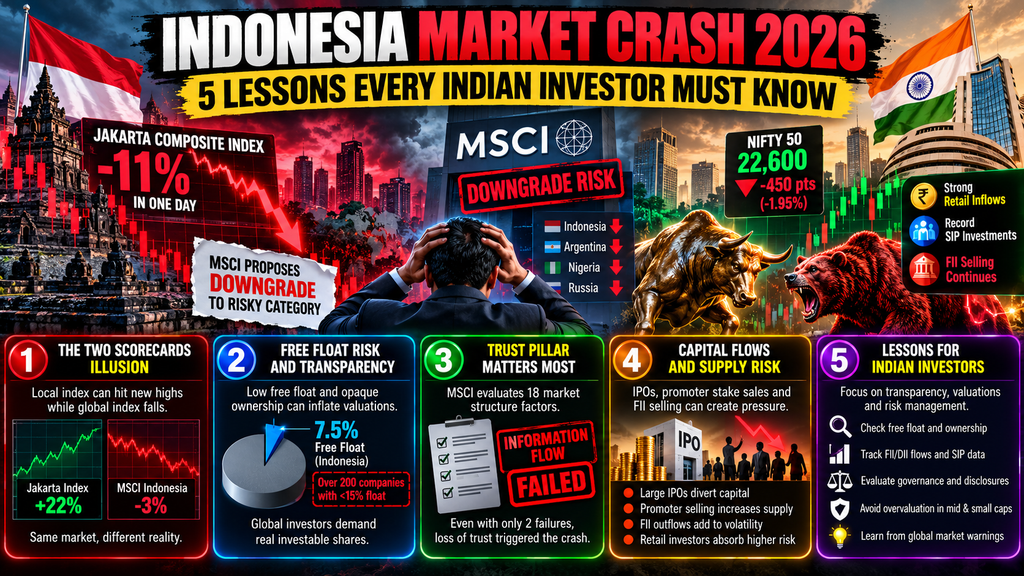
Introduction: When Record Highs Hide a Market’s Weakness
A rising stock market does not always tell the complete story.
Investors often judge a market by its headline index. When an index rises, the rally is commonly interpreted as evidence of strong investor confidence, economic growth and improving corporate prospects. However, the headline number may hide important weaknesses in market liquidity, share ownership, valuations and the ability of international investors to trade.
Indonesia’s stock market provided a striking example of these risks in October 2026.
On October 16, Indonesia’s Jakarta Composite Index plunged by approximately 11.6% after global index provider MSCI announced plans to consult on reclassifying Indonesia from an emerging market to a standalone market. MSCI’s concerns centred on market transparency, ownership information and the reliability of price formation. The Indonesian market had already suffered substantial losses during 2026.
The episode offers an important lesson for Indian investors: a strong domestic index is not, by itself, proof that a market is healthy, fairly valued or easily accessible to global capital.
India has a different market structure, regulatory framework and investor base. Indonesia’s experience should therefore not be treated as a prediction that India will experience the same crisis. Instead, it provides a framework for examining five important questions:
- Can a rising headline index hide weaknesses in market liquidity?
- Why does ownership transparency matter to global investors?
- What happens when domestic investors absorb heavy selling by institutions and promoters?
- Can large IPOs and stake sales put pressure on market liquidity?
- How can investors identify warning signs before a correction becomes severe?
Understanding these issues can help investors make better decisions in large-cap, mid-cap and small-cap stocks.
1. The Two-Scorecard Illusion: Why a Rising Index Can Hide Structural Risks
Market capitalisation is not the same as investable market value
A stock market can be evaluated using different measurements. Two particularly important concepts are total market capitalisation and free-float market capitalisation.
Total market capitalisation measures the market value of all outstanding shares of a listed company.
Free-float market capitalisation focuses on shares considered available for public investment, excluding holdings that are not regarded as freely tradable under the relevant index methodology.
Consider a hypothetical company with 100 million shares outstanding. Suppose each share trades at ₹100, giving the company a total market capitalisation of ₹1,000 crore.
However, assume promoters and strategic shareholders hold 90 million shares, leaving only 10 million shares available to public investors.
The company’s headline market value is still ₹1,000 crore, but its investable free-float value is only ₹100 crore under this simplified example.
This distinction matters because the price of a relatively small number of publicly traded shares can influence the quoted valuation of the entire company.
Low free float does not automatically mean that a stock is manipulated or overvalued. Nevertheless, limited tradable supply can make prices more sensitive to changes in demand, particularly when trading is concentrated.
Why global index providers examine free float
Global investment funds often use benchmark indices to determine how much capital to allocate to different countries and companies. Free-float adjustments help these benchmarks reflect the securities that international investors can realistically access.
If a stock’s reported ownership structure does not accurately represent its genuinely investable shares, its position in a global index may be affected.
That can have consequences for funds that track the index or use it as a benchmark.
Indonesia’s experience illustrates the significance of this issue. MSCI had already introduced restrictions on increases to certain index inclusion factors and on new additions to its investable indexes. In July 2026, MSCI said it would continue these measures and use shareholder-disclosure information to adjust free-float estimates where appropriate.
In October, the issue escalated when MSCI announced a consultation on moving Indonesia towards standalone-market status.
What should Indian investors learn?
Investors should look beyond a stock’s market capitalisation and examine:
- Promoter shareholding and changes in ownership.
- Public shareholding and available free float.
- Trading volume relative to market capitalisation.
- Whether price increases are supported by earnings growth.
- Whether the stock can be traded without substantial price impact.
- Whether disclosures are consistent, complete and easy to understand.
A company can have an impressive headline valuation while offering limited liquidity to investors who need to exit during a market downturn.
Investor takeaway: Do not judge a company solely by its market capitalisation or recent price performance. Examine how much of its equity is genuinely available for trading and whether the valuation is supported by business fundamentals.
2. The Trust Factor: Why Transparency Can Matter More Than Technical Market Strength
A stock market needs more than high trading volumes and a large number of listed companies. It also needs reliable information, transparent ownership, and confidence that market prices reflect genuine supply and demand.
This is one of the most important lessons from Indonesia’s crisis.
Why MSCI raised concerns about Indonesia
On October 15, 2026, MSCI announced a consultation on a proposal to reclassify Indonesia from emerging-market status to standalone-market status. The final decision is scheduled for no later than June 30, 2027.
MSCI cited concerns about opaque shareholding structures, suspected coordinated trading behaviour and insufficient evidence that announced transparency reforms were producing consistent improvements. It also confirmed that existing restrictions on certain Indonesian index changes would remain in place.
The distinction is important: MSCI has proposed reclassification; the final decision has not yet been made.
If a market loses emerging-market status, it could become ineligible for certain global emerging-market benchmarks. Funds tracking those benchmarks might then need to adjust their holdings, potentially creating substantial selling pressure.
However, the actual impact would depend on the final decision, fund mandates, index implementation and market conditions.
Why transparency matters to foreign investors
Before committing substantial capital to a country, international investors need confidence in several areas:
- Ownership transparency: Who ultimately owns the shares?
- Price discovery: Are prices determined by genuine market activity?
- Liquidity: Can investors buy and sell without excessive price impact?
- Regulatory enforcement: Are violations investigated and addressed consistently?
- Settlement and capital movement: Can investors complete transactions and repatriate funds under established rules?
Weakness in one area does not automatically mean a market will collapse. But multiple weaknesses can reduce confidence and increase the return investors demand for taking risk.
India versus Indonesia: A comparison, not a prediction
India and Indonesia should not be treated as identical markets. They have different regulatory arrangements, investor bases and market structures.
Nevertheless, Indonesia provides a useful reminder that global investors assess more than economic growth or headline index performance.
For India, the relevant questions include whether company disclosures are reliable, ownership structures are transparent, free-float calculations are appropriate,e and market rules are applied consistently.
Investor takeaway: Trust and transparency are part of a company’s investment quality. Investors should examine corporate governance, related-party transactions, promoter pledging, auditor qualifications and the consistency of financial disclosures—not just revenue growth or share-price momentum.
3. Domestic Retail Money Is Playing a Bigger Role in India’s Market
One major difference between markets is the balance between foreign institutional investment and domestic investment.
Foreign institutional investors, commonly referred to as FIIs, and foreign portfolio investors, or FPIs, can influence Indian share prices through large transactions. Domestic mutual funds, insurance companies and individual investors also contribute to market liquidity.
Over time, regular mutual-fund contributions through Systematic Investment Plans (SIPs) have become an important source of domestic investment.
SIP inflows: Evidence of growing participation
According to the Association of Mutual Funds in India (AMFI), monthly SIP contributions reached approximately ₹32,490 crore in September 2026. This demonstrates the scale of recurring contributions into Indian mutual funds.
SIPs can help investors build disciplined investment habits. Regular investing may also reduce the risk of committing an entire investment amount at an unfavourable point in the market.
However, SIP contributions do not guarantee positive returns or prevent market corrections.
Mutual funds invest according to their mandates, and their underlying portfolios can decline when stock prices fall.
What happens when domestic buying meets foreign selling?
Consider a simplified example.
Suppose foreign investors sell ₹10,000 crore worth of shares while domestic institutions purchase ₹8,000 crore worth.
Other market participants absorb the remaining supply, and prices adjust according to the available bids and offers.
This does not mean that domestic investors are necessarily making a mistake. Nor does foreign selling automatically mean that a company is fundamentally weak.
The important question is what prices buyers are willing to pay for the shares being sold.
If buyers continue to purchase shares at high valuations, the market can remain elevated even while some foreign investors reduce their exposure.
If buying demand weakens, the same market may experience a sharper correction.
Why small-cap and mid-cap investors should pay attention
Small-cap and mid-cap stocks can have lower trading liquidity than large-cap companies. Their prices may therefore be more sensitive to changes in investor demand.
During a bull market, strong inflows can support valuations. During a correction, falling demand can make it more difficult to sell large positions at expected prices.
Investors should not assume that a stock is safe simply because mutual funds or domestic institutions have invested in its sector.
Instead, examine valuation, earnings growth, balance-sheet quality, trading liquidity and the concentration of ownership.
A practical market-monitoring framework
| Indicator | What to examine | Why it matters |
|---|---|---|
| FII/FPI flows | Net buying and selling over several weeks | Helps identify changes in foreign investor positioning |
| DII flows | Domestic institutional buying and selling | Shows how domestic institutions are responding |
| SIP contributions | Monthly contribution trends | Indicates recurring mutual-fund investment activity |
| Market breadth | Number of advancing versus declining stocks | Shows whether a rally is broad or concentrated |
| Small-cap performance | Relative strength versus large caps | Helps identify changes in risk appetite |
| Earnings growth | Profit growth versus share-price growth | Helps assess whether valuations have fundamental support |
| Trading liquidity | Volume, bid-ask spreads and free float | Helps estimate the difficulty of exiting positions |
Investor takeaway: Domestic inflows can support the market, but they cannot eliminate valuation risk. Monitor both institutional flows and company fundamentals rather than treating any single flow indicator as a buy or sell signal.
4. The Hidden Supply Problem: IPOs, Promoter Sales and Government Stake Sales
Investors often focus on demand when analysing a stock market. They ask whether mutual funds are buying, whether foreign investors are returning and whether retail participation is increasing.
But supply also matters.
New IPOs, follow-on public offerings, promoter stake sales and government disinvestment can introduce additional shares into the market. These transactions may be beneficial for companies and investors, but they can also compete for available investment capital.
How new equity issuance affects liquidity
Imagine that investors have a fixed amount of capital available for Indian equities.
During one month, several companies launch IPOs while existing shareholders sell stakes in listed businesses. Investors must decide how to allocate their money between new offerings and existing shares.
Some capital may move towards primary-market offerings. Other investors may sell existing holdings to fund new investments.
This process can influence individual stocks and market segments, particularly when issuance activity is concentrated.
However, an IPO does not automatically cause the broader stock market to fall. The outcome depends on the issue size, investor demand, valuation, market conditions and where the funds originate.
Why promoter selling deserves attention
Promoters may sell shares for several legitimate reasons, including diversification, liquidity needs, regulatory requirements or a desire to monetise part of their holdings.
A promoter sale is not automatically a negative signal.
Nevertheless, investors should investigate the circumstances.
Important questions include:
- Is the promoter selling a small portion or a substantial stake?
- Is the transaction a fresh issue or an offer for sale?
- Is the sale part of a previously announced plan?
- Is promoter ownership falling gradually or sharply?
- Does the company have a history of strong financial reporting?
- Is the stock already trading at an unusually high valuation?
The purpose is not to assume that every seller knows something negative about the company. It is to understand the balance between available supply and investor demand.
Why the primary and secondary markets should be analysed separately
The primary market is where companies issue new securities or existing shareholders sell shares through offerings. The secondary market is where investors trade securities that have already been issued.
These markets are connected, but they are not identical.
A company can attract substantial IPO demand while existing listed shares experience selling pressure. Equally, weak performance in the secondary market does not necessarily mean every new IPO is unattractive.
Investor takeaway: Monitor the total supply of shares entering the market, but analyse each transaction individually. Do not assume that all IPOs are expensive or that all promoter sales are warning signs.

5. Regulatory Enforcement: Why Market Confidence Depends on Credible Rules
Indonesia’s experience highlights how concerns about ownership transparency and price formation can become broader market risks.
India’s regulatory framework provides a separate case study in the importance of enforcement.
The Securities and Exchange Board of India (SEBI) has taken action in matters involving alleged market manipulation and trading practices. One prominent example is its July 2025 interim order concerning Jane Street Group and alleged index manipulation. The order described trading patterns that SEBI considered potentially designed to influence index-expiry settlement values.
Because this was an interim enforcement action, allegations and regulatory findings must be described in their proper legal context rather than presented as a final judicial determination.
Why enforcement matters to investors
Effective regulation can support market confidence through:
- Disclosure requirements: Investors need timely, accurate information about companies and significant shareholdings.
- Market surveillance: Unusual trading patterns can be investigated.
- Fair price formation: Rules should discourage manipulation and misleading trading activity.
- Consistent enforcement: Market participants should expect rules to be applied predictably.
- Investor protection: Mechanisms should exist for investigating misconduct and addressing violations.
Strong regulation cannot prevent every loss or market correction. Prices can fall sharply even when markets function properly, particularly during economic shocks or periods of excessive valuations.
The objective is not to eliminate market risk. It is to maintain a framework in which investors can trade with reasonable confidence that information is available and market rules are enforced.
What would be a warning sign for India?
Investors should pay attention to developments that could weaken confidence in the market, including:
- Repeated failures to disclose material ownership information.
- Persistent questions about related-party transactions.
- Significant differences between reported financial performance and cash generation.
- Evidence of concentrated trading or unusual price movements requiring regulatory scrutiny.
- Unexpected restrictions affecting foreign investment or the movement of capital.
- Weak enforcement of disclosure or market-conduct requirements.
These are monitoring points, not evidence that India is facing an Indonesia-style crisis.
Investor takeaway: A country’s long-term investment appeal depends partly on the credibility of its market institutions. Investors should monitor regulatory developments without confusing ordinary market volatility with evidence of systemic failure.
What Could Indonesia’s Market Crisis Mean for Indian Investors?
Indonesia’s October 2026 sell-off does not establish that India will face a similar event. It does, however, offer a useful way to assess risks across different market conditions.
The following scenarios illustrate how investors might interpret changing conditions. They are analytical examples, not forecasts.
| Scenario | Potential market implication | What investors should monitor |
|---|---|---|
| Transparency improves and institutional confidence stabilises | Market confidence may recover over time | Regulatory announcements, ownership disclosures and foreign flows |
| Global investors reduce emerging-market exposure | Foreign selling pressure may increase in some markets | FII/FPI data, the dollar, bond yields and global risk appetite |
| Domestic inflows remain strong but valuations are stretched | Headline indices may remain resilient while individual stocks become vulnerable | Earnings growth, market breadth and valuation multiples |
| New equity supply increases sharply | Some capital may be redirected towards IPOs and stake sales | Issue sizes, subscription quality and secondary-market liquidity |
| Corporate governance concerns increase | Affected stocks may face valuation discounts or trading volatility | Audit qualifications, promoter transactions and regulatory actions |
Five practical rules for Indian investors
1. Avoid buying a stock solely because it is rising.
Check whether earnings, cash flow and business performance support its valuation.
2. Understand the free float.
Low free float can increase price sensitivity. Examine ownership concentration and trading liquidity before investing.
3. Diversify across companies and sectors.
Concentration in a few highly valued stocks can increase portfolio risk.
4. Treat SIPs as a method, not a guarantee.
Regular investing can support long-term discipline, but it does not remove market risk. Choose investments according to your goals, time horizon and ability to tolerate losses.
5. Define your risk before entering a trade.
Swing traders should determine position size, stop-loss levels and the conditions that invalidate a trade. Long-term investors should review business fundamentals and avoid making decisions solely because of short-term index movements.
Frequently Asked Questions (FAQs)
1. Why did Indonesia’s stock market crash in October 2026?
Indonesia’s market plunged on October 16, 2026, after MSCI announced a consultation on a proposal to reclassify the country from emerging-market to standalone-market status. The announcement followed concerns about shareholding transparency, investability and suspected coordinated trading behaviour. The Jakarta Composite Index fell approximately 11.6% that day.
2. Does Indonesia’s market crash mean India will crash too?
No. The two markets have different structures, regulations, investor bases and economic conditions. Indonesia’s experience is a warning about market transparency and liquidity risks, not a reliable forecast for the Indian stock market.
3. What is free-float market capitalisation?
Free-float market capitalisation measures the market value of shares considered available for public investment under the relevant methodology. It differs from total market capitalisation, which includes all outstanding shares.
4. Why is MSCI important for emerging markets?
MSCI publishes global equity indexes used by investment funds and other market participants as benchmarks. Changes in a country’s classification or index representation can affect the investment decisions of funds that track or benchmark against those indexes.
5. Can strong SIP inflows prevent a stock market crash?
No. SIP contributions provide a recurring source of mutual-fund investment, but they cannot guarantee that share prices will rise. Valuations, earnings, liquidity, economic conditions and investor sentiment continue to influence returns.
6. Is promoter selling always a bearish signal?
No. Promoters may sell shares for several legitimate reasons. Investors should examine the size, purpose, timing and context of the transaction before concluding.
7. What should Indian investors learn from Indonesia?
Investors should look beyond headline index levels, assess ownership transparency, understand free float, monitor institutional flows and avoid excessive exposure to stocks whose valuations are unsupported by fundamentals.
Conclusion: The Most Important Market Indicator May Not Be the Headline Index
Indonesia’s October 2026 market crisis demonstrates that market confidence depends on more than rising prices.
Transparency, credible disclosures, genuine liquidity and reliable market institutions all contribute to a market’s ability to attract and retain investment capital.
For India, the central lesson is not that an Indonesian-style crash is inevitable. It is that investors should examine the quality of a rally rather than judging it only by its size.
A market supported by sustainable earnings growth, transparent ownership and sound governance is fundamentally different from one whose valuations depend heavily on limited tradable supply or fragile investor confidence.
For individual investors, discipline remains essential: understand what you own, assess what you pay, diversify sensibly and define your risk before investing.
The key question is not simply whether the market is rising. It is whether the businesses and market structures behind those prices justify the confidence investors are placing in them.
Disclaimer
This article is for educational and informational purposes only. It does not constitute investment advice, a recommendation to buy or sell securities, or a prediction of future market performance. Stock markets involve risk, and investors should conduct independent research or consult a qualified financial adviser before making investment decisions. Market conditions and regulatory developments may change.
Top 10 SEO Titles
- Indonesia Market Crash 2026: 5 Lessons Every Indian Investor Must Know
- Indonesia Stock Market Crash: Could India Face a Similar Crisis?
- Indonesia Market Crash Explained: MSCI Warning and Its Impact on India
- Indian Stock Market Warning: 5 Lessons from Indonesia’s October 2026 Crash
- MSCI Indonesia Downgrade Risk: What Indian Stock Market Investors Should Know
- Indonesia vs India Stock Market: FII Selling, Retail Money and Hidden Risks
- Why Did Indonesia’s Stock Market Crash? 5 Critical Lessons for Investors
- Indian Stock Market Outlook 2026: FII Flows, SIP Inflows and Valuation Risks
- Stock Market Crash 2026: How Free Float and Foreign Investors Affect Share Prices
- Indonesia Market Crisis: 5 Warning Signs Indian Investors Should Never Ignore