
India is one of the fastest-growing economies in the world. Yet, despite strong GDP growth, rising SIP investments, and increasing retail participation, Foreign Institutional Investors (FIIs) continue to sell Indian stocks aggressively.
Recently, FIIs sold nearly ₹21,000 crore worth of Indian equities in a single day, creating panic among investors. While many analysts blamed MSCI rebalancing, the real story may be much bigger.
The question is:
Why are global investors pulling money out of India while India’s economy continues to grow?
This article explores the deeper reasons behind this trend and what it means for retail investors.
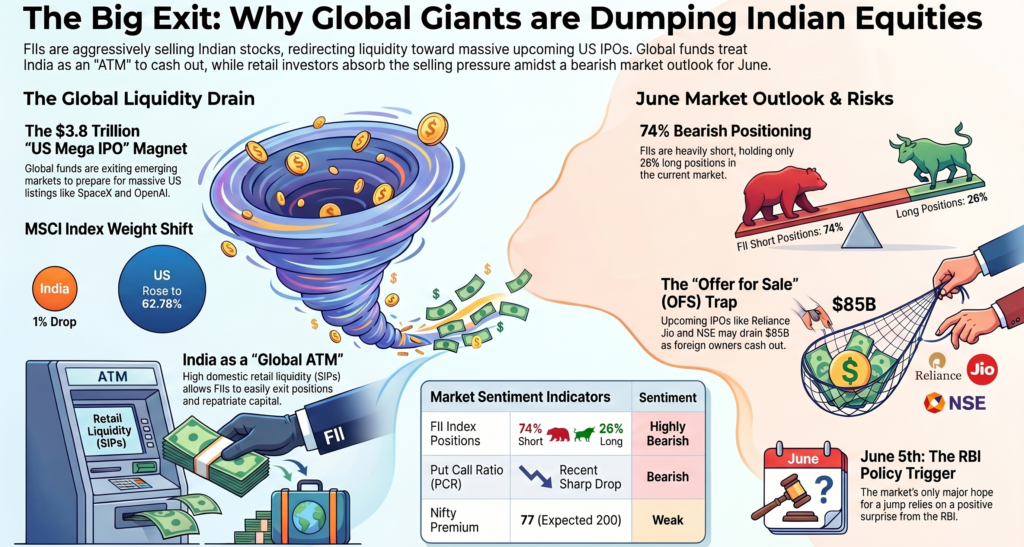
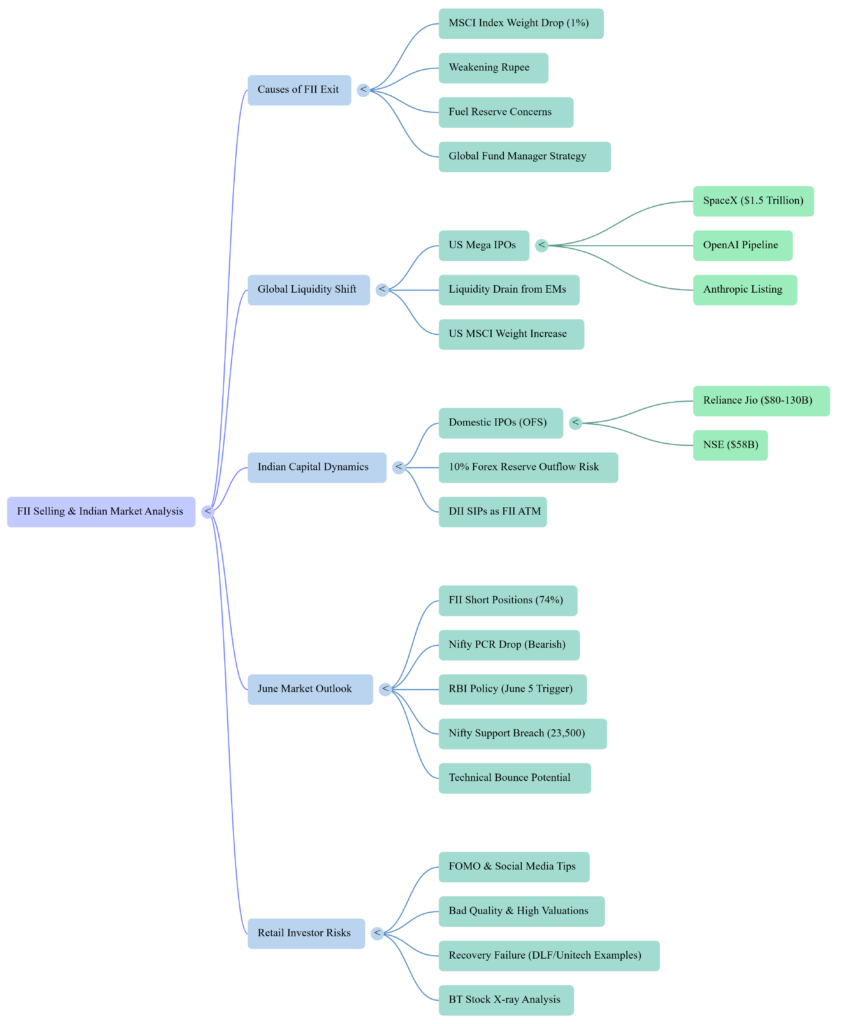
The Global Liquidity Shift
Global markets are witnessing a major shift in capital allocation.
Large investment funds are moving money from emerging markets like India into the United States. The reason is simple:
- Massive AI investments
- Upcoming mega IPOs
- Stronger US capital markets
- Better liquidity opportunities
Fund managers are raising cash by selling positions in emerging markets before investing in these new opportunities. India, being one of the most liquid markets, becomes an easy source of cash.
The SpaceX IPO Effect
One of the biggest events attracting global capital is the expected SpaceX IPO.
With a potential valuation running into trillions of dollars, institutional investors worldwide are preparing huge amounts of cash to participate.
Whenever a mega IPO arrives:
- Funds sell existing holdings.
- Cash is accumulated.
- Money shifts toward new opportunities.
This creates temporary liquidity pressure on stock markets around the world, including India.
MSCI Rebalancing: The Silent Seller
Another important factor is MSCI index rebalancing.
Many global funds simply track MSCI indices.
When India’s weight in these indices decreases:
- Index funds are forced to sell Indian stocks.
- The selling is automatic.
- It happens regardless of company fundamentals.
This mechanical selling often creates pressure even when Indian companies continue to perform well.
Why India Is Considered an “ATM” by Foreign Investors
India has one unique advantage:
Strong Domestic Buying
Every month:
- Retail investors invest through SIPs.
- Domestic Institutional Investors (DIIs) buy stocks.
- Mutual funds continue receiving inflows.
This creates a continuous stream of buyers.
As a result, foreign investors can easily sell their holdings without causing a major market crash.
In simple words:
FIIs know there will always be someone ready to buy their shares.
The Hidden Risk for Retail Investors
Many new investors enter the market based on:
- Social media tips
- YouTube recommendations
- Telegram groups
- FOMO (Fear of Missing Out)
Stocks with weak fundamentals often rise due to hype.
However, when liquidity tightens, these stocks fall sharply.
History shows that companies with:
- Strong profits
- Healthy balance sheets
- Sustainable growth
usually recover after market corrections.
Speculative companies often never return to previous highs.
Reliance Jio and NSE IPOs: Opportunity or Exit Route?
India is expected to witness some of the biggest IPOs in its history.
Examples include:
- Reliance Jio
- National Stock Exchange (NSE)
Many of these offerings could include significant “Offer for Sale” (OFS) portions.
In an OFS:
- Existing shareholders sell shares.
- The company itself may not receive fresh capital.
- Early investors get an exit opportunity.
Retail investors should carefully read IPO documents and understand where the money is going before investing.
What Should Retail Investors Do?
1. Focus on Fundamentals
Look for companies with:
- Consistent earnings growth
- Low debt
- Strong cash flow
- Good management
2. Avoid FOMO Investing
Never buy a stock only because:
- It is trending on social media.
- Everyone is talking about it.
- Influencers recommend it.
3. Continue SIP Investing
Market corrections often create long-term opportunities.
Regular SIP investing helps average costs over time.
4. Maintain Patience
Successful investing is not about quick profits.
It is about:
Income + Investing + Patience = Wealth
June Market Outlook
The market remains sensitive to:
- RBI policy decisions
- FII activity
- Global liquidity trends
- US economic developments
Short-term volatility may continue.
However, long-term investors should focus on quality businesses rather than daily market noise.
Final Thoughts
India remains one of the most promising long-term investment destinations in the world. However, investors must understand that global money flows often influence markets more than local headlines.
Instead of chasing hype, focus on businesses with strong fundamentals, disciplined investing, and long-term wealth creation.