
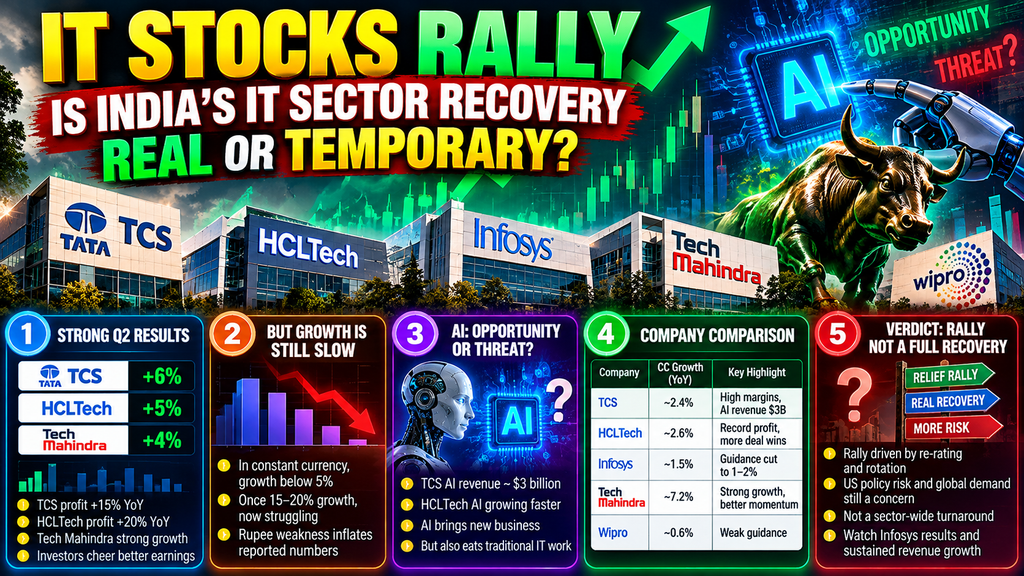
TCS, HCLTech and Tech Mahindra have rallied after their Q2 FY27 results. But with constant-currency growth still modest at several major IT companies, is the sector finally recovering—or are investors getting ahead of the fundamentals?
Indian IT stocks have staged a powerful comeback after a prolonged period of weakness. Better-than-expected quarterly results, improving operating margins, strong deal wins and growing artificial intelligence (AI) revenue have encouraged investors to return to the sector.
During the week ended October 16, 2026, the Nifty IT index surged approximately 11.7%—its strongest weekly gain in 18 years. TCS, Infosys, HCLTech and Tech Mahindra were among the major beneficiaries of the rally. However, a sharp rise in share prices does not automatically mean the underlying business cycle has turned.
The key question for investors is simple: Are Indian IT companies entering a new growth cycle, or is this primarily a relief rally driven by earnings, currency movements and a change in investor sentiment?
Let’s examine the latest Q2 FY27 numbers, the role of AI, company-level differences and the risks investors should monitor.
1. Why Are IT Stocks Rallying?
Three factors have contributed to the recent rebound.
Better-than-expected quarterly results
The September 2026 quarter delivered encouraging results at selected companies, particularly in profitability, margins and deal bookings.
- TCS: Reported quarterly revenue of approximately ₹73,188 crore, with annualised AI revenue exceeding $3 billion.
- HCLTech: Reported ₹35,620 crore in revenue, ₹5,132 crore in net income and record quarterly new bookings of approximately $3.3 billion.
- Tech Mahindra: Reported ₹16,180 crore in revenue and ₹1,586 crore in profit after tax, with constant-currency revenue growth of 7.2% year over year.
- Infosys: Reported ₹49,244 crore in revenue, but lowered its full-year FY27 constant-currency revenue-growth guidance to 1–2%.
These figures show that profitability and growth momentum differ significantly across companies. Tech Mahindra delivered stronger constant-currency growth, while TCS and HCLTech demonstrated their scale, profitability and AI-related business momentum. Infosys’s reduced guidance, meanwhile, highlights continuing demand uncertainty.
A change in investor sentiment
IT stocks had faced pressure from concerns about slower global technology spending, AI disruption and uncertain client budgets.
When quarterly results fail to produce a fresh negative surprise, investors who previously avoided a sector may begin buying again. This can trigger a sharp rebound, particularly after a prolonged decline.
That does not necessarily mean companies have returned to their historical growth rates.
Rotation towards beaten-down stocks
Another factor was a change in global investor positioning. During the October rally, some investors returned to traditional IT services stocks even as AI-linked shares in parts of Asia faced selling pressure.
This rotation can support Indian IT valuations in the short term. However, the argument that money will automatically move into Indian IT whenever global AI stocks fall is too simplistic.
Investors may move into cash, bonds or other sectors instead. More importantly, a global AI slowdown could affect the technology budgets of the very clients that Indian IT companies serve.
Verdict: The rally has identifiable fundamental and sentiment-driven reasons, but its sustainability depends on revenue growth and future demand.
2. The Constant-Currency Reality: Is Growth Still Too Slow?
One of the most important numbers to examine is constant-currency revenue growth.
Indian IT companies earn a substantial portion of their revenue in foreign currencies. When the rupee weakens against the US dollar, reported rupee revenue can rise even when the underlying business grows much more slowly.
Constant-currency figures help investors assess operating performance without the direct effect of exchange-rate movements.
Q2 FY27 results comparison
| Company | Q2 FY27 revenue | Year-on-year constant-currency growth | Key takeaway |
|---|---|---|---|
| TCS | ₹73,188 crore | +2.4% in reported USD terms | Large scale, strong margins and growing AI revenue |
| HCLTech | ₹35,620 crore | +2.6% | Record bookings and improving margins |
| Infosys | ₹49,244 crore | +1.5% | Modest growth; FY27 guidance reduced |
| Tech Mahindra | ₹16,180 crore | +7.2% | Strongest constant-currency growth among these four in Q2 |
| Wipro | ₹24,750 crore total revenue | +0.6% in IT services | Weak underlying growth and softer large-deal bookings |
Note: TCS’s reported USD revenue growth was 2.4% year over year; HCLTech’s and Tech Mahindra’s figures are company-reported constant-currency growth rates. Infosys’s figure is constant-currency growth. Wipro’s figure relates specifically to its IT services segment. These measures are not perfectly identical, so comparisons should be interpreted carefully.
The numbers reveal an important distinction: profit growth is not the same as revenue growth.
A company can increase its profit by controlling costs, improving utilisation, reducing hiring or increasing operational efficiency. These measures can protect earnings during a weak demand environment.
However, sustained long-term growth normally requires more client spending, larger projects, higher volumes or new revenue streams.
If revenue growth remains subdued for several quarters, investors may eventually question how much further margins can improve.
3. TCS: Profitability and Scale, but Where Is the Growth?
TCS remains one of India’s most established IT services companies, with a large global client base, diversified operations and strong cash-generation capabilities.
Its Q2 FY27 results included:
- Revenue of approximately ₹73,188 crore.
- Operating margin of 24%.
- Net profit of approximately ₹13,884 crore.
- Annualised AI revenue of approximately $3.1 billion.
- Quarterly total contract value (TCV) of $9.6 billion.
TCS’s AI revenue crossed 10% of total revenue on an annualised basis, indicating that AI-related work is becoming increasingly important to its business.
What is working?
1. Strong margins: TCS’s 24% operating margin demonstrates its ability to run a profitable, large-scale services business.
2. Cash generation: Strong operating cash flow provides flexibility to invest in technology, pay dividends and manage weaker demand periods.
3. AI monetisation: The company is generating measurable revenue from AI-related services rather than relying entirely on future promises.
4. Large enterprise relationships: Major clients often require help with cybersecurity, cloud infrastructure, enterprise software, data management and complex technology transformations.
What remains a concern?
The central question is whether AI-related work will create enough new revenue to offset pressure on traditional services.
If AI tools allow clients to automate software development, testing, maintenance and support, they may need fewer billable hours for certain projects. This could pressure the traditional outsourcing model.
TCS can respond by selling higher-value AI implementation, integration, consulting and transformation services. But the crucial question is whether these new services generate enough incremental revenue and profit.
My assessment: TCS offers scale, profitability and established client relationships. However, a premium valuation should ultimately be supported by sustainable growth, not just a strong balance sheet and an AI narrative.
4. HCLTech: Strong Deal Wins and Faster AI Momentum
HCLTech delivered one of the more encouraging operating performances in the September quarter.
Its Q2 FY27 results included:
- Revenue of ₹35,620 crore, up 11.5% year over year in reported rupee terms.
- Constant-currency revenue growth of 2.6% year over year.
- Net income of ₹5,132 crore, up 21.2% year over year.
- Operating margin of 18.2%.
- New bookings of approximately $3.3 billion, up 27% year over year.
- Annualised advanced AI revenue of $876 million.
The company also reported 78% year-on-year constant-currency growth in advanced AI revenue. Its full-year FY27 revenue-growth guidance was revised to 2.5–4% in constant-currency terms.
Why are investors paying attention?
HCLTech’s deal bookings are important because they indicate the value of contracts won during the quarter. A strong pipeline can support future revenue, although bookings do not translate into immediate revenue and can be delayed, reduced or cancelled.
Its advanced AI revenue is also growing rapidly. This suggests the company is developing business opportunities in areas such as enterprise AI adoption, AI infrastructure and AI-enabled services.
What should investors watch?
The main question is whether these contracts convert into revenue at attractive margins.
Investors should also distinguish between reported rupee growth and underlying constant-currency growth. HCLTech’s reported revenue increased 11.5%, but its constant-currency growth was 2.6%.
That difference matters when evaluating the company’s actual operating momentum.
My assessment: HCLTech currently has encouraging momentum in deal wins, margins, and advanced AI revenue. However, investors should monitor whether the growth translates into sustained improvements in total revenue and earnings.
5. Tech Mahindra: Stronger Growth, but Is the Recovery Sustainable?
Tech Mahindra reported a stronger constant-currency growth rate than the other three large companies discussed here.
Its Q2 FY27 results included:
- Revenue of ₹16,180 crore, up 15.6% year over year in reported rupee terms.
- Constant-currency revenue growth of 7.2% year over year.
- EBIT margin of 14.8%.
- Profit after tax of ₹1,586 crore, up 32.7% year over year.
- New deal wins worth approximately $1.02 billion, up 25.4% year over year.
The company also reported that its EBIT margin had expanded for the twelfth consecutive quarter.
What is working?
Tech Mahindra’s results show a combination of revenue growth, improving margins,s and higher profitability.
The improvement in operating performance may indicate that its restructuring and cost-control efforts are helping. Stronger deal wins could also support future business.
What are the risks?
Investors should determine how much of the improvement is sustainable and how much reflects easier comparisons, cost reductions or the timing of particular contracts.
The company also needs to demonstrate that margin expansion can continue without compromising its ability to invest in employees, technology and future growth.
My assessment: Tech Mahindra has encouraging operating momentum, but a rising share price should not replace a careful assessment of valuation, execution and future revenue growth.
6. The AI Paradox: Growth Opportunity or Threat to Traditional IT?
Artificial intelligence is arguably the biggest structural issue facing the Indian IT services industry.
The market is trying to answer two questions simultaneously:
- Can AI create a large new revenue opportunity for Indian IT companies?
- Will AI reduce the amount of traditional IT work that clients need to outsource?
Both outcomes can occur at the same time.
How AI can create new revenue
Businesses need help integrating AI into their existing systems. They may require:
- AI strategy and consulting.
- Enterprise data preparation and management.
- Cloud and AI infrastructure.
- AI model integration and deployment.
- Cybersecurity and governance.
- Automation of business processes.
- Modernisation of legacy software.
Indian IT services companies have established enterprise relationships and technical expertise that may help them capture this demand.
TCS’s annualised AI revenue of approximately $3.1 billion and HCLTech’s annualised advanced AI revenue of $876 million show that AI-related business is already becoming financially significant for these companies.
How AI can threaten existing revenue
AI can also automate parts of traditional software development, testing, maintenance and customer support.
If a client previously needed 100 employees or a certain number of billable hours to complete a project, AI may reduce the resources required.
That creates a difficult commercial question: will the IT provider earn more by selling AI-enabled services, or will the client simply pay less for the same outcome?
The answer will depend on pricing models, productivity improvements, demand for new projects, ts and how quickly companies adapt.
The key metric is not AI revenue alone.
Investors should examine whether AI produces net new revenue and sustainable profit growth.
A company could report rapidly growing AI revenue while its traditional services business slows. In that situation, AI growth may partly offset losses rather than create an entirely new growth cycle.
The best evidence of a genuine AI-led turnaround would be accelerating total constant-currency revenue, healthy margins and stronger cash generation over several quarters.
7. Why Global AI Stock Weakness Does Not Guarantee an Indian IT Rally
One narrative behind the recent rally is that investors may move money from expensive global AI-related stocks into Indian IT services companies.
This is possible, but it is not a dependable investment rule.
Indian IT services companies and global AI infrastructure businesses have different revenue models, customer exposures and valuations. A decline in semiconductor or AI-platform shares does not automatically improve the earnings outlook for an Indian IT services company.
In fact, if global AI investment slows sharply, enterprise technology spending could also weaken.
The relationship works in both directions:
- Potential positive: Investors may reconsider beaten-down Indian IT stocks if they look relatively attractive.
- Potential negative: Lower technology spending could delay client projects and reduce demand for outsourcing.
- Long-term uncertainty: AI adoption may create new services while reducing the resources needed for traditional work.
Therefore, investors should not confuse a short-term change in market positioning with an improvement in the industry’s long-term growth outlook.
8. Wipro Shows Why This Is Not Yet a Sector-Wide Turnaround
Wipro provides a useful counterexample to the idea that the entire sector has recovered.
For Q2 FY27, Wipro reported:
- IT services constant-currency revenue growth of just 0.6% year over year.
- IT services revenue that was flat sequentially in constant-currency terms.
- Operating margin of 16.5%.
- Total bookings of $2.595 billion.
- Large-deal bookings of $674 million, down 58.6% sequentially in constant-currency terms.
- A December-quarter IT services revenue outlook ranging from a 1.5% decline to 0.5% growth sequentially in constant-currency terms.
The company continued to generate operating cash flow, but its underlying revenue growth and deal-booking trends remained weak.
This matters because a sustained sector recovery normally requires improvement across a wider group of companies.
If only selected firms improve while others remain stagnant, the rally may be driven by stock-specific results, valuation changes and investor positioning rather than a broad increase in client demand.
9. Infosys Results: A Warning Against Overconfidence
Infosys announced its Q2 FY27 results on October 23, 2026.
The company reported:
- Revenue of ₹49,244 crore, up 10.7% year over year in rupee terms.
- Constant-currency revenue growth of 1.5% year over year.
- Operating margin of 21%.
- Large-deal total contract value of $5.2 billion.
- FY27 constant-currency revenue-growth guidance of 1–2%, reduced from the earlier range of 1.5–3%.
Infosys said its revised outlook reflected a more cautious view of demand, particularly in the United States, along with anticipated deflationary pressure from AI.
The strong large-deal pipeline is encouraging, but it does not eliminate uncertainty about how quickly those contracts will translate into revenue.
The reduced guidance is a reminder that large contract wins, improving profitability and a rising share price do not necessarily mean that revenue growth is accelerating.
For the broader sector, the next important signal will be whether companies can convert deal pipelines into consistent growth over successive quarters.
10. The Five Metrics Investors Should Watch Next
Rather than relying only on share-price momentum, investors can monitor five indicators to assess whether the IT sector is genuinely recovering.
1. Constant-currency revenue growth
This is one of the clearest indicators of underlying business momentum.
A sustained improvement across multiple quarters would be more convincing than a single quarter of rupee-driven revenue growth.
2. Deal wins and conversion into revenue
Large contract wins can support future growth, but the timing of revenue recognition matters.
Investors should watch whether strong bookings translate into higher revenue and whether contracts deliver acceptable margins.
3. AI revenue and profitability
Rapid AI revenue growth is encouraging, but investors should also examine its contribution to total revenue, operating margins and cash generation.
The critical question is whether AI expands the business or merely offsets weakness in traditional services.
4. Operating margins and cash flow
Cost discipline can support profits during periods of weak demand. However, continued margin expansion becomes more difficult if revenue growth remains low.
Consistent cash generation provides additional evidence of financial resilience.
5. Management guidance and US client spending
The United States remains an important market for Indian IT services companies. Changes in client budgets, project approvals, hiring, regulation and technology spending can affect future growth.
Investors should monitor management commentary alongside actual quarterly numbers rather than treating positive statements as proof of a recovery.
11. TCS vs HCLTech vs Tech Mahindra: Which Has the Stronger Case?
Each company offers a different investment proposition.
| Factor | TCS | HCLTech | Tech Mahindra |
|---|---|---|---|
| Main strength | Scale and profitability | Deal momentum and advanced AI growth | Stronger recent constant-currency growth |
| Q2 FY27 constant-currency or reported USD growth measure | +2.4% reported USD revenue growth | +2.6% constant currency | +7.2% constant currency |
| Operating margin | 24% | 18.2% | 14.8% EBIT margin |
| Key positive | Strong margins and AI revenue scale | $3.3 billion in quarterly bookings | Revenue growth and consecutive margin improvement |
| Key concern | Slow underlying growth | Contract conversion and growth sustainability | Execution and continued margin improvement |
| Investor focus | Growth quality and valuation | Bookings, AI monetisation and margins | Revenue growth, deal wins and margins |
Figures are based on company-reported Q2 FY27 results. EBIT and operating-margin definitions may differ between companies, so the figures should not be treated as perfectly like-for-like measures.
TCS may appeal to investors prioritising scale and profitability. HCLTech offers encouraging deal and AI momentum. Tech Mahindra has shown stronger recent underlying growth. Which is the better investment ultimately depends on valuation, future execution, risk tolerance and the investor’s time horizon.
A strong company is not automatically a good purchase at every price.
12. Is This the Right Time to Buy IT Stocks?
The recent rally has improved sentiment, but investors should avoid assuming that the sector has already returned to a high-growth phase.
A more disciplined approach is to separate three questions:
Business quality: Does the company have strong client relationships, cash generation, competitive capabilities and a credible AI strategy?
Growth quality: Is revenue growth improving in constant-currency terms? Are deal wins converting into business? Is AI creating incremental demand?
Valuation: Does the current share price already reflect an optimistic recovery scenario?
Investors who already hold IT stocks can evaluate their positions against these factors rather than reacting only to daily price movements.
New investors may prefer to avoid chasing a sharp rally without examining valuation and the next few quarters of operating performance.
There is no universally correct portfolio allocation for IT stocks. Exposure should reflect an investor’s financial goals, existing holdings, risk tolerance and investment horizon. A fixed allocation limit should not be treated as suitable for everyone.
Final Verdict: IT Stocks Are Recovering in the Market, but Has the Business Cycle Turned?
The recent IT rally is supported by genuine positives: stronger results at selected companies, improving margins, meaningful AI revenue and encouraging deal wins.
However, the underlying picture remains mixed.
TCS continues to demonstrate strong profitability, HCLTech has delivered encouraging deal and AI momentum, and Tech Mahindra has reported stronger recent constant-currency growth. At the same time, Infosys has lowered its FY27 growth guidance, while Wipro’s underlying IT services growth remains weak.
That is why it is premature to declare a complete sector-wide turnaround.
The more balanced interpretation is that Indian IT stocks may be going through a bottoming-out or selective recovery phase, but a durable recovery still needs confirmation from revenue growth, contract conversion and client spending.
The next few quarters will be important. If several major companies deliver improving constant-currency growth for two consecutive quarters while maintaining margins and cash flow, the case for a sustainable recovery will become stronger.
Until then, investors should distinguish between a rising share price and a genuine improvement in business fundamentals.
What Is Your View on Indian IT Stocks?
Do you believe TCS, HCLTech and Tech Mahindra have entered a new growth cycle, or is this rally mainly driven by valuation recovery and investor rotation?
Share your view in the comments.
Disclaimer: This article is for educational and informational purposes only and does not constitute investment advice or a recommendation to buy or sell any security. Stock-market investments are subject to risk. Please conduct independent research or consult a SEBI-registered investment adviser before making investment decisions.
Top 10 SEO Titles
- IT Stocks Rally: Is India’s IT Sector Recovery Real or Temporary?
- TCS, HCLTech & Tech Mahindra Rally: Is the IT Sector Back?
- Indian IT Stocks Outlook 2026: 5 Risks Investors Must Watch
- TCS vs HCLTech vs Tech Mahindra: Which IT Stock Looks Better in 2026?
- Why Are IT Stocks Rising? TCS, HCLTech and Infosys Results Explained
- Indian IT Stocks Rally: AI Boom, Slow Growth and Hidden Risks
- Is It the Right Time to Buy IT Stocks? TCS, Infosys and HCLTech Analysis
- AI vs IT Services: Can Indian IT Companies Protect Their Revenue Growth?
- Nifty IT Rally Explained: Earnings Growth or Just a Relief Rally?
- Indian IT Sector Analysis 2026: Revenue Growth, AI Risks and Stock Outlook