
Introduction: Jio Rallies 27%, but Reliance Falls—What Is the Market Telling Investors?
The Indian stock market witnessed a striking divergence on October 28, 2026. Jio Platforms made a powerful stock market debut, while its parent company, Reliance Industries Limited (RIL), came under selling pressure.
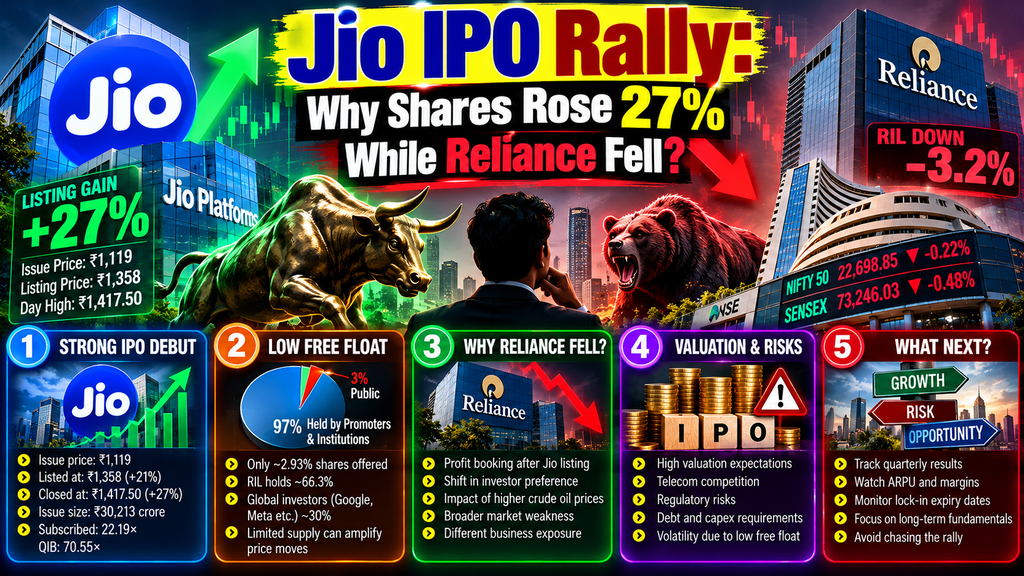
Jio Platforms shares listed at ₹1,358 against an IPO issue price of ₹1,119, delivering a listing premium of approximately 21.4%. The stock subsequently climbed to ₹1,417.50, ending its first trading session nearly 27% above the issue price.
At the same time, Reliance Industries fell approximately 3.2%. The Nifty 50 declined 0.22% to close at 22,698.85, while the Sensex lost 0.48% to settle at 73,246.03. Rising crude oil prices and concerns surrounding the global economic outlook also weighed on market sentiment.
This created an important question for investors:
If Jio Platforms is worth so much more after listing, why did Reliance Industries fall on the same day?
The answer involves IPO supply and demand, valuation expectations, the structure of a holding company, investor positioning and the difference between a stock’s market price and its underlying business value.
Jio’s debut was undoubtedly strong. But a spectacular listing gain does not automatically mean the stock is attractively valued, and Reliance’s decline does not necessarily mean investors have lost confidence in its business as a whole.
Let’s examine five key takeaways from the Jio IPO and what they could mean for the Indian stock market.
1. The 27% Listing Rally: Strong Demand or a Valuation Warning?
Jio Platforms launched one of India’s largest-ever IPOs, raising approximately ₹30,213 crore through a fresh issue of shares.
Jio Platforms IPO: Key Facts
| IPO Parameter | Details |
|---|---|
| IPO issue price | ₹1,119 per share |
| Listing date | October 28, 2026 |
| Opening price | ₹1,358 |
| First-day closing price | ₹1,417.50 |
| Listing premium | Approximately 21.4% |
| Gain over issue price at closing | Approximately 26.7% |
| Total issue size | Approximately ₹30,213 crore |
| Total subscription | 22.19 times |
| QIB subscription | 70.55 times |
| Retail subscription | 2.72 times |
| Approximate closing market capitalisation | ₹13.05 lakh crore |
The IPO attracted strong demand, particularly from qualified institutional buyers. Its total subscription reached 22.19 times, with the QIB category subscribed 70.55 times.
Why can a stock jump so sharply on listing day?
Several factors can contribute to a strong IPO debut:
1. Demand exceeds the shares available. Investors who do not receive their desired IPO allocation may try to buy shares in the secondary market after listing.
2. Limited initial supply can amplify price movements. When a relatively small proportion of a company’s equity is publicly traded, a surge in demand can have a disproportionate impact on the price.
3. Investor expectations can be optimistic. Strong demand for a well-known brand may reflect expectations about future growth, market leadership and profitability.
4. Momentum attracts additional buyers. A strong opening can attract short-term traders who expect the rally to continue.
However, these mechanisms do not establish that a rally has been artificially manufactured. Proving manipulation would require specific evidence of improper conduct.
The important valuation question
A stock that rises 27% on its first day may be responding to genuine demand, optimistic future expectations, or both.
Investors must still determine whether the resulting valuation is justified by future revenue growth, cash flow, earnings and competitive advantages.
Key takeaway: Jio’s strong debut demonstrates substantial investor demand. It does not, by itself, prove that the stock is undervalued or that further gains are guaranteed.
2. The Low-Free-Float Effect: Why Limited Supply Matters
One of the most important structural features of the Jio IPO is the relatively small proportion of equity offered to the public.
According to the IPO prospectus, the fresh issue represented approximately 2.93% of Jio Platforms’ post-issue paid-up equity share capital. The offer was a fresh issue rather than an offer for sale by existing shareholders.
This distinction is important.
What is free float?
Free float generally refers to shares available for public trading, excluding holdings that are not considered freely tradable under the relevant methodology.
A low free float can make a stock more sensitive to changes in demand and supply.
For example:
- Strong buying can move the share price sharply higher.
- Selling by a relatively small number of large holders can create substantial volatility if available liquidity is limited.
- The quoted market capitalisation can change significantly even though only a fraction of the company’s shares trade regularly.
This is not unique to Jio. It is a general feature of stocks with limited trading supply.
Does a 27% rally mean the entire company has become 27% more valuable fundamentally?
Not necessarily.
Market capitalisation is calculated by multiplying the share price by the total number of shares outstanding.
When the market price rises, the implied value of the entire company rises—even though only a portion of its shares may have changed hands.
That is a normal feature of equity markets. However, it means investors should not confuse the marginal price established in the market with a guaranteed price at which every shareholder could sell a large holding.
What should investors monitor?
The most useful indicators include:
- Trading volume and liquidity.
- The proportion of shares available for public trading.
- Future changes in promoter and institutional holdings.
- Lock-in expiry dates disclosed in official documents.
- The relationship between valuation and financial performance.
Lock-in expiry does not automatically mean shareholders will sell. It simply removes a contractual restriction, where applicable, and may change the potential supply of shares.
Key takeaway: Jio’s limited initial free float can amplify price movements in either direction. It is a reason to monitor volatility, not proof that the price is being manipulated.
3. The Global Investor Exit Theory: What Is Known and What Is Speculation?
One interpretation of the Jio listing is that global private-equity and technology investors may eventually seek liquidity as lock-in restrictions expire.
This possibility deserves attention because Jio has prominent international investors, including Google and Meta.
However, it is important to separate three different things:
- The ownership stakes investors hold.
- The dates and conditions under which their shares become eligible for sale.
- Whether those investors actually intend to sell.
Only the first two can be assessed using the relevant ownership disclosures and IPO documents. An intention to sell must be supported by additional evidence.
Could global investors eventually sell shares?
Yes. Investors in listed companies can change their holdings for many reasons, including portfolio rebalancing, liquidity requirements, investment opportunities and changes in their view of a company’s valuation.
But the possibility of a future sale does not establish that a coordinated exit strategy is already underway.
Claims that international investors will sell Jio shares specifically to fund investments in upcoming US AI companies should therefore be treated as speculation unless supported by reliable disclosures or reporting.
Why does this matter for retail investors?
A stock can attract strong institutional demand during an IPO and still face future selling pressure.
Institutional investors do not have identical objectives, investment horizons, or valuations. Some may hold shares for years, while others may eventually reduce their positions.
Retail investors should not assume that an institution’s participation guarantees future returns.
Key takeaway: Monitor actual shareholding disclosures, lock-in schedules and reported transactions. Do not base an investment decision solely on an unverified theory about what global funds intend to do.
4. The Reliance Industries Paradox: Why Did RIL Fall When Jio Surged?
Jio’s strong debut and Reliance Industries’ decline were among the most notable features of the October 28 session.
Reuters reported that Reliance fell approximately 3.2% while Jio Platforms surged on its first day of trading. One possible explanation is that some investors who previously held Reliance for exposure to its digital business may now prefer direct exposure to Jio. However, this is an interpretation of market behaviour, not proof of the motives of every seller.
There are several reasons why the two stocks can move in opposite directions.
Reason 1: Investors can now evaluate Jio separately
Before Jio’s listing, investors obtained exposure to its business through Reliance Industries.
Following the listing, they can buy Jio Platforms shares directly, allowing the market to establish a separate price for the telecom and digital services business.
This may change how some investors allocate their money between the two companies.
Reason 2: Reliance is more than Jio
Reliance Industries has several major businesses, including:
- Oil-to-chemicals operations.
- Retail.
- Telecom and digital services through its Jio business.
- Other consumer and infrastructure-related interests.
Consequently, Reliance’s share price reflects expectations for multiple businesses rather than Jio alone.
Changes in crude oil prices, refining and petrochemical margins, retail performance, capital expenditure and debt can all influence RIL’s valuation.
Reason 3: Separate stocks can attract different investors
An investor seeking direct exposure to telecom and digital services may choose Jio.
Another investor may prefer Reliance because it provides exposure to a broader set of businesses.
A third investor may sell both stocks if market conditions deteriorate.
These decisions can produce different price movements even when the companies are closely related.
Understanding the holding-company discount
A holding company may trade below the estimated value of its underlying assets. This is commonly known as a holding-company discount.
Investors may apply a discount because of corporate expenses, taxes, capital-allocation uncertainty, complex ownership structures and the difficulty of directly realising the full value of all underlying businesses.
A sum-of-the-parts, or SOTP, valuation attempts to estimate the value of each business separately and then combine those estimates, accounting for liabilities and other relevant factors.
However, an SOTP calculation is not a guaranteed share-price target.
A credible valuation should account for each business’s earnings, growth prospects, debt, ownership percentage, taxes, capital requirements and an appropriate valuation multiple.
Key takeaway: Jio’s listing gives investors a separate way to value its business. But RIL’s share price will continue to depend on its other operations and the valuation investors assign to the overall conglomerate.
5. Is Jio a Better Investment Than Reliance Industries?
The answer depends on what an investor wants to own.
Jio offers more direct exposure to telecom and digital services. Reliance provides broader exposure to multiple industries through a single company.
Neither structure is automatically superior.
| Factor | Jio Platforms | Reliance Industries |
|---|---|---|
| Primary exposure | Telecom and digital services | Diversified conglomerate |
| Business focus | Connectivity, digital platforms and related services | Telecom, retail, oil-to-chemicals and other businesses |
| Direct exposure to Jio | Yes | Through its ownership interest |
| Key valuation consideration | Subscriber economics, growth, cash flow and AI/digital opportunities | Combined business value, liabilities, capital allocation and holding-company discount |
| Important risk | Competition, regulation, investment requirements and valuation | Exposure to several industries, including energy and retail, alongside Jio |
| Investor question | Is Jio’s standalone valuation justified? | Does the combined business justify RIL’s market valuation? |
Why a rising Jio price does not translate one-for-one into RIL gains
Reliance owns a substantial interest in Jio, but its share price does not mechanically move by the same percentage as Jio.
A simplified illustration shows why.
Suppose a holding company owns an asset worth ₹100. That asset rises in value by 20%, increasing its value to ₹120.
The holding company’s total value will not necessarily rise by 20%, because the holding company may also own other assets and have liabilities, costs,s and a valuation discount.
The percentage change in the holding company’s share price will depend on all these factors.
This is why a formula such as “every ₹100 increase in Jio automatically creates a ₹31 gain in Reliance” is not a valid general rule. The relationship depends on ownership, the size of Jio within RIL’s overall value,ue and changes in the market’s valuation of the other businesses.
What should investors do?
Investors comparing the two stocks should consider:
- Jio’s standalone valuation relative to its earnings and cash flow.
- Reliance’s ownership interest in Jio.
- The financial performance of Reliance’s non-Jio businesses.
- Debt and future capital expenditure.
- The discount or premium implied by a properly constructed SOTP valuation.
- Their existing portfolio exposure and investment horizon.
Key takeaway: Jio may be more suitable for investors seeking direct telecom and digital exposure, while RIL may appeal to investors seeking a diversified conglomerate. The right choice depends on valuation and risk—not simply which stock rose more on listing day.
6. The 2020 Reliance Comparison: A Useful Lesson, Not a Guaranteed Forecast
The draft comparison with Reliance’s 2020 fundraising period raises an important investment lesson: a compelling corporate narrative can generate strong short-term enthusiasm without guaranteeing attractive long-term returns.
During periods of market uncertainty, investors often respond to major strategic developments, large investments by global funds,nds and promises of future growth.
But the long-term performance of a stock depends on what happens after the announcement.
Investors should examine:
- Revenue growth.
- Earnings per share.
- Free cash flow.
- Debt and financing costs.
- Return on invested capital.
- Valuation at the time of purchase.
- Dividends and other shareholder distributions.
A five-year return comparison must use consistent starting and ending dates, adjusted prices, and a clearly defined return methodology. Without those details, a claim that a stock delivered a compound annual growth rate below 1% should not be repeated as a fact.
What is the broader lesson?
A high-profile investment, fundraising announcement or IPO can improve a company’s strategic position. But investors still need to assess whether the improvement is reflected in future earnings and cash flow.
The price paid matters just as much as the quality of the business.
7. Jio’s Real Growth Drivers: What Could Justify Its Valuation?
To evaluate Jio beyond its listing-day performance, investors should focus on the business drivers that could support long-term growth.
1. Subscriber growth and customer engagement
Jio’s telecom business serves a very large customer base. The ability to retain subscribers, improve customer engagement, and increase revenue per user can influence future revenue.
Investors should monitor subscriber additions, churn and average revenue per user (ARPU).
2. Tariff increases
Telecom tariff changes can influence revenue per user and operating profitability.
However, higher tariffs may also affect customer behaviour and competition. The net impact depends on pricing, subscriber retention and the costs required to maintain service quality.
3. Digital services
Jio’s wider digital ecosystem could create opportunities beyond basic connectivity.
Potential areas include enterprise services, cloud solutions, connected devices and digital applications.
The key question is how successfully the company converts these opportunities into recurring revenue and cash flow.
4. AI and cloud opportunities
AI and cloud computing could create new business opportunities for telecom and digital infrastructure providers.
However, these opportunities require investment in technology, infrastructure, partnerships and skilled employees. Investors should distinguish between strategic ambition and revenue that has already been demonstrated.
5. Debt reduction
The IPO’s stated use of proceeds included repayment of borrowings at Jio’s material subsidiary, Reliance Jio Infocomm. The prospectus specified that approximately ₹27,500 crore would be used for this purpose.
Reducing debt can lower financing costs and strengthen the balance sheet, although the ultimate benefit depends on the amount of debt repaid, the associated interest savings and future funding requirements.
The fundamental test
For a valuation to remain sustainable, Jio must demonstrate that growth opportunities translate into durable revenue, profitability and free cash flow.
A strong brand and large customer base are advantages, but they do not eliminate competition, regulatory risks or valuation risk.
8. The Nifty Warning: Was the Market Selling Off Because of Jio?
Jio’s debut occurred during a difficult session for Indian equities.
On October 28, 2026:
- Nifty 50 closed at 22,698.85, down 0.22%.
- Sensex closed at 73,246.03, down 0.48%.
- Reliance Industries declined approximately 3.2%.
- Crude oil prices rose to around $115 per barrel.
- Seven of the 16 major sectors tracked in the Reuters report declined.
The market was also focused on the US Federal Reserve’s policy decision and concerns about higher oil prices and inflation.
These developments provide context for the broader sell-off.
Did money move from other sectors into Jio?
That is possible in individual portfolios, but the available price movements alone do not establish that Jio’s IPO caused sector-wide selling.
To demonstrate such a relationship, investors would need evidence from fund flows, institutional transactions and trading data.
A simultaneous rise in one stock and decline in other stocks does not prove that money moved directly from the latter into the former.
What about the 22,450 Nifty support level?
The original draft identifies 22,450 as a critical technical support level.
That level should be treated as a technical scenario to monitor, not a guaranteed breakdown trigger. A sustained close below a support zone may increase the probability of further weakness, but it cannot predict the size or timing of the next market move with certainty.
Investors should also consider market breadth, trading volume, derivatives positioning, global markets, crude oil and upcoming economic announcements.
Why global factors matter
India imports a substantial amount of its crude oil requirements. Higher oil prices can affect inflation, the trade balance, corporate costs and market sentiment.
At the same time, global central-bank decisions can influence interest-rate expectations, currency movements and foreign investor positioning.
These forces can affect the broader market regardless of how well an individual IPO performs.
Key takeaway: Jio’s debut and the market decline occurred together, but investors should avoid attributing the entire market move to the IPO without supporting flow data.
9. Five Risks Investors Should Not Ignore
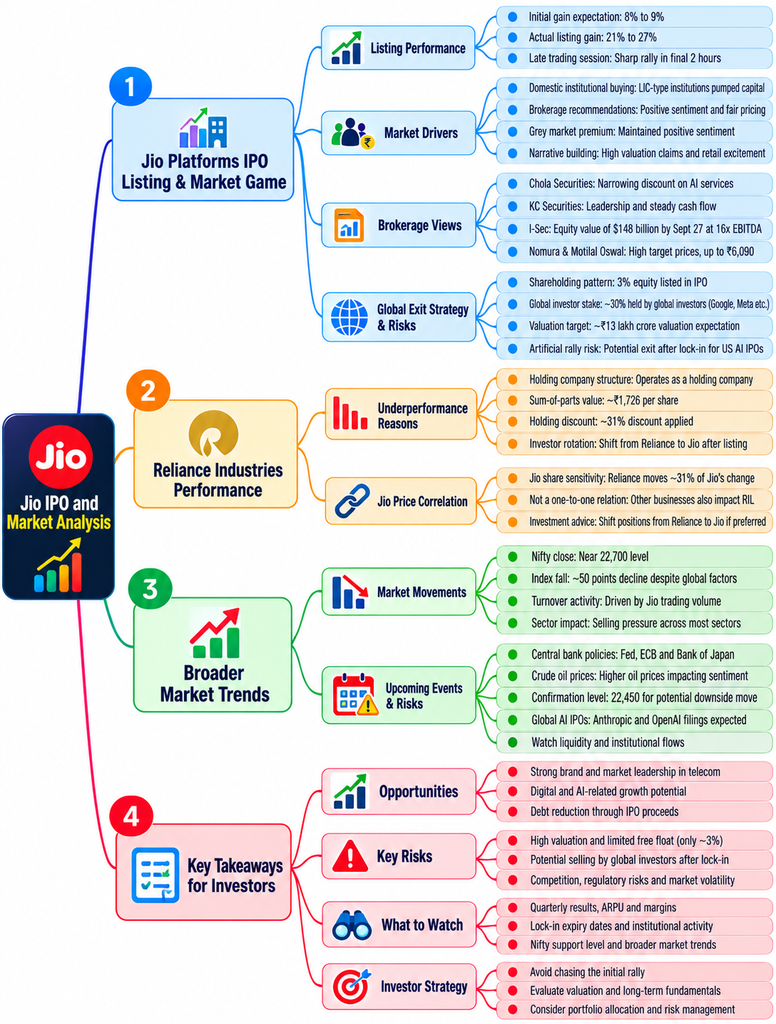
Despite Jio’s strong debut, several risks remain relevant.
Risk 1: Valuation risk
A stock that rises sharply can become more sensitive to disappointing earnings or slower growth.
Even a successful company can deliver poor investment returns if purchased at an excessive valuation.
Risk 2: Limited free float
A relatively small public float can amplify price fluctuations, particularly when demand or selling pressure changes quickly.
Risk 3: Telecom competition
Jio operates in a competitive sector where pricing, network investment, customer retention and regulatory developments can influence profitability.
Risk 4: Capital expenditure and debt
Telecom infrastructure, digital services and technology expansion require investment. Investors must assess whether future cash flows justify these spending requirements.
Risk 5: Global and domestic uncertainty
Changes in interest rates, crude oil prices, regulation, competition and investor sentiment can influence both Jio and Reliance Industries.
These risks do not mean that Jio’s investment case is weak. They mean that the share price must be assessed alongside the business fundamentals.
10. Investor Strategy: How to Approach Jio After Its Strong Listing
The temptation to chase a stock after a 27% first-day gain can be considerable. But a disciplined approach is more useful than reacting to momentum alone.
For IPO allottees
Investors who received shares in the IPO should assess their original investment thesis, risk tolerance,e and the proportion of their portfolio exposed to the company.
A large listing gain may change the risk profile of a position. Investors should not assume that the first-day performance will continue.
For investors who missed the IPO
Missing a listing gain does not mean an investor must buy immediately.
Potential investors can evaluate:
- The company’s financial results.
- Its valuation relative to expected earnings and cash flow.
- Subscriber and ARPU trends.
- Debt reduction and capital expenditure.
- Future shareholding disclosures.
- Price volatility and available liquidity.
Waiting for more information may be preferable to buying solely because a stock is rising.
For Reliance Industries shareholders
RIL investors should evaluate the conglomerate as a whole.
Jio’s standalone valuation is important, but Reliance’s retail, oil-to-chemicals and other businesses also influence its overall value.
Investors should not assume that a rise in Jio guarantees a proportionate increase in RIL.
For short-term traders
IPO-related volatility can create trading opportunities, but it can also produce sharp reversals.
Traders should define their entry, exit, stop-loss and position-size rules before entering a position. Liquidity, price gaps and changing market conditions can cause actual execution prices to differ from expected prices.
No single trading strategy guarantees a profit.
Final Verdict: Jio’s 27% Rally Is Impressive, but the Valuation Test Begins Now
Jio Platforms’ market debut was a major event for India’s equity market. The company raised approximately ₹30,213 crore through its IPO, attracted substantial institutional demand, and closed its first trading session nearly 27% above the issue price.
At the same time, Reliance Industries fell, ell and the broader market closed lower amid concerns about crude oil prices and global uncertainty.
The divergence highlights three important lessons.
First, limited free float can amplify a stock’s price movements. Investors should distinguish between strong trading demand and proof of long-term fundamental value.
Second, Jio and Reliance Industries are not interchangeable investments. Jio offers direct exposure to telecom and digital services, while Reliance’s value also depends on its other businesses and the way investors value the conglomerate.
Third, a successful listing does not eliminate valuation risk. Future returns will depend on earnings, subscriber economics, cash flow, investment requirements and the price investors pay.
The evidence supports a strong debut and substantial investor demand. It does not, by itself, establish that the market was manipulated, that global funds are preparing a coordinated exit or that the Nifty must fall below a particular level.
The most useful approach is to follow verified company disclosures, financial performance, valuation and actual institutional transactions rather than relying on dramatic market narratives.
The central question for investors is not simply whether Jio can rise further. It is whether its future earnings and cash flows can justify the valuation established on listing day.
Frequently Asked Questions (FAQs)
1. What was the issue price of the Jio Platforms IPO?
The Jio Platforms IPO was priced at ₹1,119 per share. The IPO raised approximately ₹30,213 crore through a fresh issue of shares.
2. How much did Jio Platforms shares gain after listing?
Jio Platforms shares listed at ₹1,358 per share, approximately 21.4% above the issue price. The shares subsequently closed around ₹1,417.50, nearly 26.7% above the IPO issue price.
3. Why did Jio Platforms shares rise while Reliance Industries shares fell?
Jio Platforms and Reliance Industries offer investors different exposure. Some investors may prefer direct exposure to Jio’s digital and telecom businesses, while Reliance shares reflect its broader business portfolio. Market movements can also be influenced by crude oil prices, overall sentiment and profit-booking. The IPO alone should not be considered the only reason for Reliance’s share-price movement.
4. What is the free-float concern surrounding the Jio Platforms IPO?
The IPO was a fresh issue representing approximately 2.93% of post-issue equity capital. A relatively small publicly available shareholding can influence price discovery and increase volatility, particularly when investor demand is strong. However, a limited free float does not automatically mean that a stock is overvalued or being manipulated.
5. Is Jio Platforms stock a good investment after its IPO rally?
The investment decision depends on Jio’s valuation, revenue growth, profitability, cash flow, debt position, and future business prospects. Investors should compare the current market price with reasonable valuation estimates rather than buying solely because the stock has rallied after listing.
6. How will Jio Platforms use the IPO proceeds?
The IPO proceeds were primarily intended to repay borrowings of Reliance Jio Infocomm, a material subsidiary. Debt reduction may improve the subsidiary’s financial position, but investors should also assess future capital expenditure and cash-flow requirements.
7. What are the major risks for Jio Platforms investors?
Key risks include an expensive valuation, competition in telecommunications, regulatory changes, execution risks in digital and AI-related businesses, and volatility following the IPO. A limited public float may also contribute to larger price movements.
8. Can Jio Platforms’ rally continue?
The rally could continue if earnings growth, subscriber economics, profitability and investor demand support the valuation. However, the share price could also correct if expectations become too optimistic or market sentiment weakens. Neither outcome is guaranteed.
9. Does Jio Platforms’ performance directly determine Reliance Industries’ share price?
No. Jio Platforms is an important part of Reliance Industries’ business, but Reliance’s valuation also reflects its other businesses, liabilities, capital allocation and market conditions. The relationship between the two share prices is therefore not one-to-one.
10. What should investors watch after the Jio Platforms IPO?
Investors should monitor quarterly financial results, subscriber growth, average revenue per user (ARPU), margins, debt reduction, capital expenditure, competitive developments and valuation multiples. They should also track broader market conditions and avoid making decisions based solely on short-term price movements.
What Is Your View on Jio Platforms?
Do you believe Jio’s 27% listing gain reflects its long-term growth potential, or has the market priced in too much optimism too quickly?
And after Jio’s listing, would you prefer direct exposure to Jio Platforms or diversified exposure through Reliance Industries?
Share your view in the comments.
Disclaimer
This article is for educational and informational purposes only. It is not investment advice or a recommendation to buy or sell any security. Stock-market investments are subject to market risks, including the possible loss of capital. Investors should review official company disclosures and consult a SEBI-registered investment adviser when appropriate.
Top 10 SEO Titles
- Jio IPO Rally: Why Shares Rose 27% While Reliance Fell
- Jio Platforms IPO Analysis 2026: Valuation, Risks and Growth Potential
- Jio IPO 2026: 7 Key Risks Investors Should Know After the Rally
- Jio vs Reliance Shares: Which Is Better for Investors in 2026?
- Jio Platforms Share Price: Is the 27% IPO Rally Sustainable?
- Jio IPO Listing Explained: Valuation, Free Float and Market Risks
- Why Did Reliance Industries Fall While Jio Platforms Surged?
- Jio Platforms IPO: Issue Price, Listing Gains and Future Outlook
- Jio IPO Valuation 2026: Is the Stock Overvalued After Listing?
- Jio IPO Paradox: 27% Rally, Reliance Discount and Hidden Risks