
Introduction: Strong Earnings, Weak Market?
The Indian stock market is entering another week where the headline numbers look stronger than the underlying market mood.
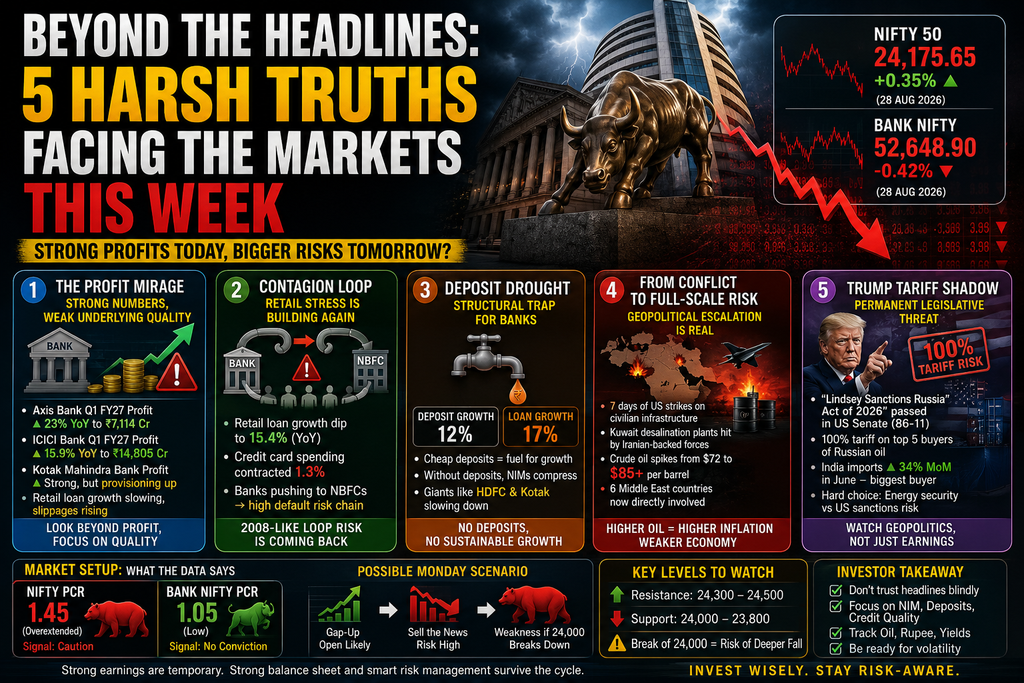
Indian banks have reported strong quarterly earnings. Axis Bank’s Q1 FY27 standalone profit rose about 23% year-on-year to ₹7,114 crore, while net interest income increased 8%. ICICI Bank reported a 15.9% increase in profit after tax to ₹14,805 crore.
At the broader market level, Nifty 500 companies recorded around 13% earnings growth in Q1 FY27, while earnings growth excluding oil-marketing companies was around 23%, according to Motilal Oswal data reported by The Times of India.
So why isn’t the market celebrating?
Because investors are increasingly looking beyond profit growth.
They are asking:
How sustainable are these profits when funding costs, credit quality, crude oil, currency risk and geopolitical uncertainty are all moving in opposite directions?
That is the real market story this week.
1. Harsh Truth #1: Strong Bank Profits Don’t Automatically Mean Strong Bank Stocks
The first trap is assuming that a 20%+ profit-growth number means everything is healthy.
Take Axis Bank.
Its Q1 FY27 profit rose 23%, deposits increased 18%, and advances increased 19%. On the surface, these are impressive numbers.
But look deeper.
Axis Bank’s:
- NIM was 3.46%
- Retail loans grew only 8%
- Corporate loans grew 38%
- SME loans grew 25%
- Deposits grew 18%
- Advances grew 19%
That tells us something important.
The bank is still growing strongly, but the composition of growth is changing.
Corporate and SME lending are growing substantially faster than retail lending.
This isn’t necessarily bad.
Corporate credit can be highly profitable when asset quality remains strong.
But it changes the risk profile of the bank.
The important question is therefore not:
“Did profit grow?”
It is:
“Where did the profit growth come from, and what will happen to NIM and credit quality six months from now?”
2. NIM Is Becoming More Important Than PAT
Bank investors often focus heavily on PAT.
But in the current environment, Net Interest Margin (NIM) may tell a more important story.
Axis Bank’s NIM declined to 3.46% from 3.62% in the previous quarter, even though profit increased strongly. Reuters also noted that the bank’s provisions fell sharply, helping support quarterly earnings.
This creates an interesting combination:
Profit ↑
but
NIM ↓
That doesn’t mean earnings are fake.
It means investors need to understand the quality and sustainability of the earnings improvement.
A bank can temporarily grow PAT through:
- Lower provisions
- Recoveries
- Treasury gains
- Cost control
- Strong fee income
- Balance-sheet growth
But long-term banking profitability ultimately depends heavily on:
NIM + credit growth + asset quality + operating efficiency.
3. Kotak Shows Why “Profit” Alone Isn’t Enough
Kotak Mahindra Bank’s Q1 FY27 standalone numbers were also strong.
The bank reported:
- PAT: ₹4,123 crore
- Deposits: ₹5.73 lakh crore
- NIM: 4.53%
- Net NPA: 0.27%
- CASA ratio: 40.3%
Those numbers do not suggest a bank in immediate distress.
In fact, the balance sheet looks relatively strong.
That’s precisely why investors should avoid simplistic claims that strong bank profits are merely “accounting wizardry.”
The better argument is:
Strong earnings are real, but the market must determine whether the earnings are sustainable through the next credit and liquidity cycle.
That’s a much stronger investment thesis.
4. Harsh Truth #2: Credit Growth Is Strong—but the Mix Matters
India’s credit cycle remains healthy in many areas.
Axis Bank’s advances grew 19%, while corporate loans increased 38% and SME loans 25% in Q1 FY27.
But retail credit is no longer growing at the same pace.
Axis Bank’s retail loan growth was only 8%.
That creates an interesting structural shift:
Earlier cycle
Retail credit → Personal loans → Housing → Consumer spending
Current transition
Corporate credit → Infrastructure → Manufacturing → Data centres → SME
This isn’t necessarily a warning.
In fact, corporate capex-led credit growth could be healthier than aggressive unsecured retail lending.
But investors need to watch asset quality with a lag.
Loans created today can become stressed 12–24 months later.
That’s why the most important question is not:
“How fast are banks lending?”
It is:
“How fast are they lending relative to the quality of borrowers?”
5. Harsh Truth #3: The Deposit War Is Real
One of the biggest structural challenges for Indian banks is the competition for deposits.
Banks need deposits to fund loans.
And the cost of those deposits directly affects NIM.
Axis Bank offers an interesting example.
Its deposits grew 18%, while advances grew 19%. At the same time, its cost of funds declined 35 basis points year-on-year.
That is actually a positive development.
So the current banking story is not:
“Deposits are collapsing.”
It is:
“Banks need to compete aggressively for deposits while maintaining loan growth and protecting margins.”
That distinction matters.
The banks that can attract sticky CASA deposits have an advantage.
Banks dependent heavily on expensive term or wholesale funding could face greater NIM pressure.
6. The RBI Rate Environment Is Not as Easy as It Looks
The RBI’s policy repo rate stood at 5.25% in August, while the Standing Deposit Facility rate was 5.00% and the MSF/Bank Rate was 5.50%.
At first glance, this appears supportive for borrowers.
But investors are now dealing with a more complicated combination:
Repo rate relatively low
Bond yields elevated
Rupee under pressure
Crude oil volatility
Inflation risk
That makes the next phase of monetary policy harder to predict.
The market cannot simply assume:
“Lower rates = bullish banks.”
If inflation and currency pressures rise, the RBI may have less room to ease aggressively.
7. Harsh Truth #4: Oil Is India’s Hidden Tax
The biggest external risk for India may not be the banking sector.
It may be crude oil.
India imports a huge amount of its crude requirement.
Therefore:
Crude ↑
↓
Import bill ↑
↓
Dollar demand ↑
↓
Rupee pressure ↑
↓
Inflation risk ↑
↓
Interest-rate expectations ↑
↓
Equity valuation pressure
The recent Middle East conflict has already demonstrated how quickly energy markets can become geopolitical markets.
The conflict has affected shipping routes and raised concerns around the Strait of Hormuz. Reuters reported that Iran has threatened further disruption of oil exports and that regional attacks could affect energy infrastructure.
Kuwait also suffered damage to a power and desalination facility following Iranian strikes in July.
For India, the danger isn’t simply that oil reaches $100.
The bigger problem is:
Oil staying elevated for long enough to damage the currency, inflation expectations and corporate margins.
8. India’s Oil Import Bill Shows Why This Matters
India’s April–June crude import bill rose 61% year-on-year to approximately $49.8 billion, even though import volumes fell around 4%, according to PPAC data reported by Moneycontrol.
That’s a critical statistic.
It demonstrates that India can experience a much larger energy bill even without importing more barrels.
Price matters.
And this is why crude oil can become a direct tax on:
- Consumers
- Airlines
- Logistics companies
- Chemical companies
- Paint companies
- Tyre manufacturers
- OMCs
- Manufacturing companies
At the same time, higher fuel costs can influence inflation.
So crude isn’t merely an energy-sector problem.
It’s a market-wide variable.
9. Harsh Truth #5: The Russia-Oil Problem Has Become a Market Risk
This is one of the most underappreciated risks for Indian investors.
India’s Russian crude imports surged 34% month-on-month in June, reaching a record level, according to CREA data reported by several outlets. India purchased approximately €4.5 billion of Russian crude in June.
That makes India particularly sensitive to changes in US policy toward buyers of Russian energy.
And Washington has already moved beyond rhetoric.
The US Senate passed the Lindsey O. Graham Sanctioning Russia and Iran Act of 2026 by 86–11.
The legislation would give the President authority to impose tariffs of up to 100% on countries heavily purchasing Russian oil and gas.
However—and this is extremely important—the tariffs do not automatically take effect simply because the Senate passed the bill. The legislation still faces the House and other procedural steps, and presidential discretion would be required.
So investors should price this as:
Risk — not certainty.
10. Why a 100% Tariff Threat Matters to India
India’s energy strategy has benefited significantly from discounted Russian crude.
If sanctions or secondary tariffs materially restrict that trade, India could face three possible outcomes:
Scenario A — Replace Russian crude
Buy more from:
- Middle East
- US
- Africa
- Other suppliers
But potentially at a higher price.
Scenario B — Continue buying Russian oil
Then Indian companies could face higher geopolitical and trade-policy risk.
Scenario C — Negotiate exemptions
This could reduce the economic damage but prolong uncertainty.
The market therefore has to price a range of outcomes.
And uncertainty itself can increase volatility.
11. The Nifty Is Already Showing Signs of Fatigue
The latest market data is not screaming “panic.”
But it isn’t particularly comfortable either.
On August 28, the Nifty 50 closed at 24,175.65, up 0.35% on the day.
Yet the index recorded its third consecutive weekly decline, down around 0.3% for the week.
That is important.
A market can rise on Friday and remain structurally weak.
The recent pattern is:
Small rebounds
↓
Selling near resistance
↓
Another decline
↓
Short-term recovery
This is typical of a market caught between earnings optimism and macro uncertainty.
12. The Banking Sector Is Becoming the Market’s Stress Indicator
Bank stocks are particularly important because financials have a large influence on the Nifty.
If banks remain weak despite strong earnings, investors should ask:
What is the market discounting?
Possible answers include:
- Lower future NIM
- Deposit-cost pressure
- Slower retail credit
- Bond-market volatility
- Currency risk
- Higher provisioning later
- Global risk-off flows
Recent market action supports this concern.
On August 27, Nifty fell 0.48% to 24,090.85, with HDFC Bank among the major drags.
The next day, however, Nifty recovered 0.35%.
This is exactly why investors should focus on trend confirmation rather than one-day moves.
13. The PCR Trap: Don’t Treat 1.45 as a Standalone Sell Signal
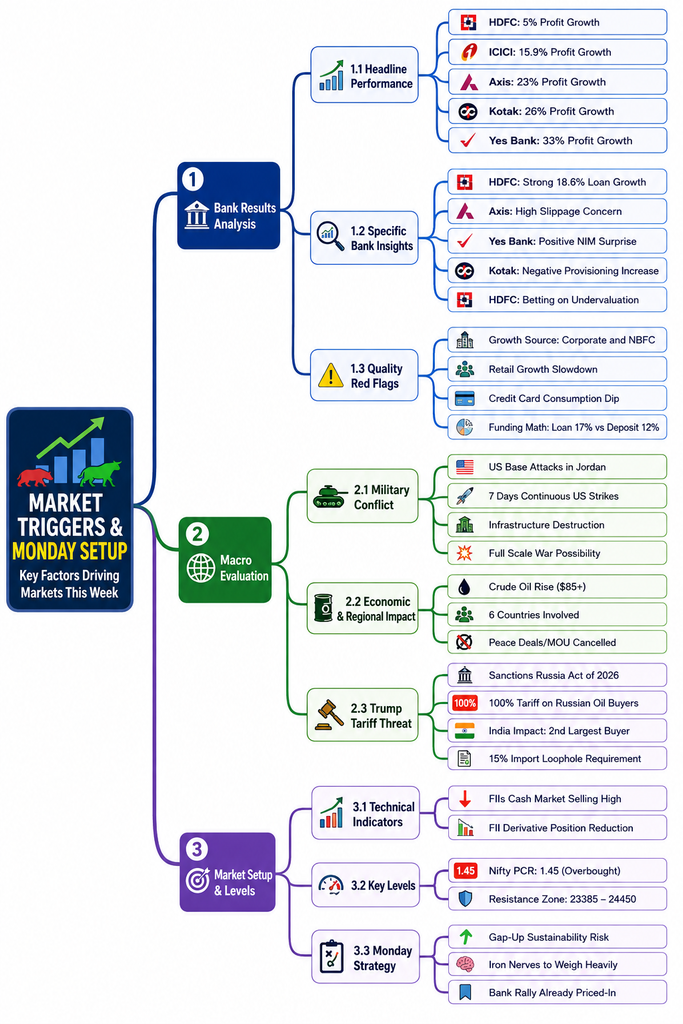
The original thesis highlights a Nifty PCR around 1.45 and Bank Nifty PCR around 1.05.
These numbers can be useful—but they need context.
A high Put-Call Ratio can indicate:
- Heavy put positioning
- Put writing
- Hedging
- Support-building
- Or potentially crowded bullish positioning
It does not automatically mean the market must fall.
Similarly, a PCR near 1 does not automatically mean professional traders are bearish.
The better framework is:
PCR + OI + Price + VIX + Futures Basis
For example:
Nifty rises + Call OI falls + Put OI rises + VIX falls
= potentially bullish.
But:
Nifty fails at resistance + Call OI rises + Put OI unwinds + VIX rises
= stronger bearish confirmation.
Therefore:
PCR is a positioning indicator, not a crystal ball.
14. The Real “Profit Mirage”
Now we can bring the five issues together.
India’s corporate earnings are genuinely improving.
Nifty 500 earnings grew approximately 13% in Q1 FY27, with earnings growth excluding OMCs around 23%.
Axis Bank’s PAT rose 23%.
ICICI Bank’s PAT rose 15.9%.
Kotak continues to maintain strong profitability and capital ratios.
These are not fake numbers.
The problem is that strong earnings do not exist in isolation.
Investors are simultaneously pricing:
Bank earnings
Oil
Rupee
US yields
Russia sanctions
Geopolitical risk
Valuations
That is the real reason markets can remain weak despite good corporate results.
15. The Five Numbers Investors Should Watch This Week
Instead of reacting to every headline, watch these five variables.
| Indicator | Bullish Signal | Warning Signal |
|---|---|---|
| Nifty 50 | Sustains above 24,200 | Breaks 24,000 |
| Bank Nifty | Outperforms Nifty | Continues underperforming |
| Crude Oil | Moves below $85 | Sustains above $90–95 |
| USD/INR | Stabilises | Sharp rupee depreciation |
| 10Y G-Sec | Yield stabilises/falls | Further sharp rise |
And for banks specifically:
NIM + Deposit Growth + Credit Growth + Slippages
are more important than headline PAT alone.
16. The Monday Setup: Gap-Up Doesn’t Mean Bull Market
The most dangerous setup for traders is a strong opening that lacks follow-through.
Suppose:
Friday close strong
↓
Global cues positive
↓
Banks gap up
↓
Retail buying increases
But then:
Bank Nifty fails at resistance
↓
Call OI increases
↓
VIX rises
↓
Nifty loses VWAP
↓
Selling accelerates
That becomes a classic gap-up fade.
Conversely, if the market opens weak but:
- Bank Nifty stabilises
- VIX falls
- Put writing increases
- Breadth improves
- Nifty reclaims VWAP
then the initial weakness could turn into a buying opportunity.
Therefore, traders should wait for price + derivatives confirmation.
17. Bull Case vs Bear Case
🟢 Bull Case
The bullish scenario would require:
- Bank earnings remain strong
- NIMs stabilise
- Deposits continue growing
- Crude remains below major resistance
- Rupee stabilises
- US yields cool
- Russia-sanctions risk doesn’t escalate
- FII selling slows
- Nifty holds 24,000–24,200
Under this scenario, the current correction could become a consolidation phase.
🔴 Bear Case
The bearish scenario becomes stronger if:
- Crude moves toward $95–100
- Rupee weakens sharply
- Indian bond yields continue rising
- Bank NIMs compress
- Retail credit slows further
- Asset-quality stress increases
- Russia sanctions become more restrictive
- Bank Nifty continues underperforming
- Nifty breaks 24,000 decisively
Then the market could shift from:
“Buy the dip”
to
“Sell the rally.”
Conclusion: Don’t Confuse Earnings With Economic Immunity
The Indian market doesn’t have a simple problem.
It has a collision of strong earnings and rising macro uncertainty.
Banks are reporting impressive profits.
Credit is still growing.
Deposits are expanding at major private lenders.
Capital ratios remain strong.
But investors are looking forward.
They are asking whether today’s earnings can survive:
higher funding costs + weaker retail credit + oil shocks + currency pressure + global yields + geopolitical uncertainty.
That is the real test.
The Indian market doesn’t need a recession to correct sharply.
Sometimes all it needs is:
A change in the assumptions investors are willing to pay for.
And right now, those assumptions are being tested.
The biggest lesson for investors this week:
Don’t look at PAT alone.
Look at:
PAT → NIM → Deposits → Credit Quality → Oil → Rupee → Bond Yields → Valuation.
That chain will tell you far more about the next market move than a single headline earnings number.
Disclaimer
This article is for educational and informational purposes only and is not investment advice. Market conditions, derivatives positioning, geopolitical developments, crude prices, currency movements, and banking-sector fundamentals can change rapidly. Investors should conduct their own research and consult a qualified financial professional before making investment decisions.
SEO Titles — Top 10
- Indian Stock Market: 5 Harsh Truths Investors Must Watch This Week
- Nifty 50 Outlook: 5 Hidden Risks That Could Shake Indian Markets
- Indian Stock Market Under Pressure: Banks, Crude Oil and Rupee Risks Explained
- Nifty 50 at a Crossroads: Why Strong Bank Profits May Not Be Enough
- Indian Banks Are Reporting Record Profits—But 5 Risks Are Rising
- Banking Stocks Under Pressure: NIM, Deposits, Crude Oil and Nifty Explained
- Nifty 50 Weekly Outlook: 5 Critical Signals Every Investor Should Watch
- India’s Market Profit Mirage: Why Strong Earnings Aren’t Telling the Full Story
- Bank Nifty Outlook: Deposit War, NIM Pressure and Global Risks to Watch
- Nifty 50 Crash Risk? 5 Warning Signals Investors Cannot Ignore This Week