
Why Is India Suddenly Rolling Out the Red Carpet for Foreign Investors?
For years, the Indian government projected confidence in domestic capital and often appeared less dependent on Foreign Institutional Investors (FIIs). However, the situation has changed dramatically in 2026.
With the Indian Rupee under pressure, rising crude oil prices, and concerns over weak economic growth, the government has introduced an emergency-style “Tax-Zero” strategy to attract foreign investment into Indian government bonds.
The move signals that protecting the Rupee has become a top national priority.
Let’s examine the five biggest realities behind this policy shift.
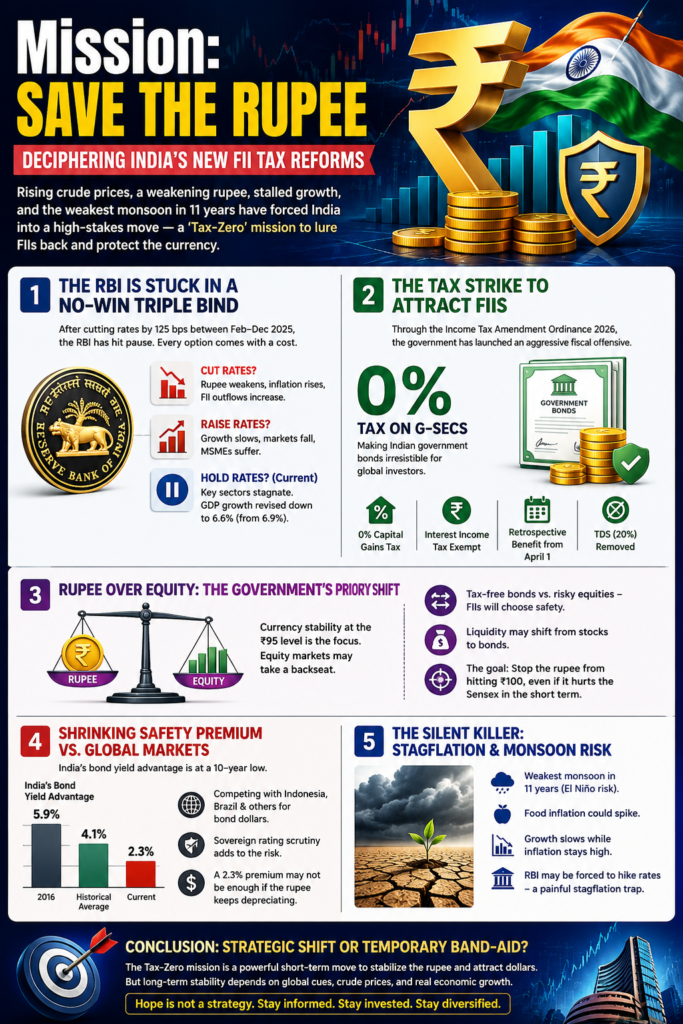
1. The RBI Is Trapped in a Difficult Situation
The Reserve Bank of India (RBI) has very limited options after aggressively reducing interest rates by approximately 125 basis points between February and December 2025.
Now the central bank has maintained a neutral stance for multiple policy meetings because every option carries significant risks.
If RBI Cuts Rates Again
- The Rupee could weaken further.
- Inflation may increase.
- FIIs could pull money out of India.
If the RBI Raises Rates
- Economic growth may slow sharply.
- Equity markets could face heavy selling pressure.
- MSMEs and borrowers would struggle with expensive credit.
If the RBI Keeps Rates Unchanged
- Interest-sensitive sectors like automobiles and real estate remain under pressure.
- Economic momentum stays weak.
As a result, India’s GDP growth expectations have already been revised lower, reflecting increasing uncertainty.
2. The Government’s “Tax-Zero” Mission for Government Bonds
Since monetary policy alone may not stabilize the economy, the government has introduced a major fiscal initiative through the Income Tax Amendment Ordinance 2026.
The objective is simple:
Make Indian Government Securities (G-Secs) highly attractive for global investors.
The policy includes:
- ✅ Capital Gains Tax exemption on eligible government bonds
- ✅ Interest income is made effectively tax-free for qualifying investors
- ✅ Retrospective benefits from April 1 to encourage existing investors
- ✅ Removal of withholding tax (TDS), improving liquidity
These measures aim to increase foreign capital inflows and strengthen the Rupee by attracting more dollar investments into India.
3. The Rupee Has Become More Important Than the Stock Market
One of the biggest implications of this strategy is that currency stability appears to be taking priority over equity market performance.
If foreign investors receive tax advantages in government bonds while corporate earnings remain under pressure, many may prefer safer debt investments over equities.
This creates a potential liquidity shift:
- More money into bonds
- Less money into stocks
- Possible pressure on equity valuations
In short, policymakers seem focused on preventing the Rupee from weakening further rather than maximizing stock market returns.
4. India’s Yield Advantage Is Shrinking
Historically, India attracted foreign investors by offering significantly higher bond yields compared to developed markets.
However, that advantage has narrowed considerably.
Yield Spread Comparison
| Period | Approximate Yield Gap |
|---|---|
| 2016 | 5.9% |
| Historical Average | 4.1% |
| Current | Around 2.3% |
India now competes directly with other emerging markets such as Indonesia and Brazil for global investment flows.
Even with tax exemptions, continued Rupee depreciation could reduce returns for foreign investors when measured in US dollars.
5. The Biggest Risk: Stagflation and Weak Monsoon
Perhaps the greatest concern is the possibility of stagflation, where inflation remains high while economic growth slows.
Forecasts of a weak monsoon raise additional risks:
- Food inflation could rise.
- Consumer spending may weaken.
- Economic growth could slow further.
- The RBI may face pressure to increase rates despite slowing growth.
This combination creates a difficult environment for both policymakers and investors.
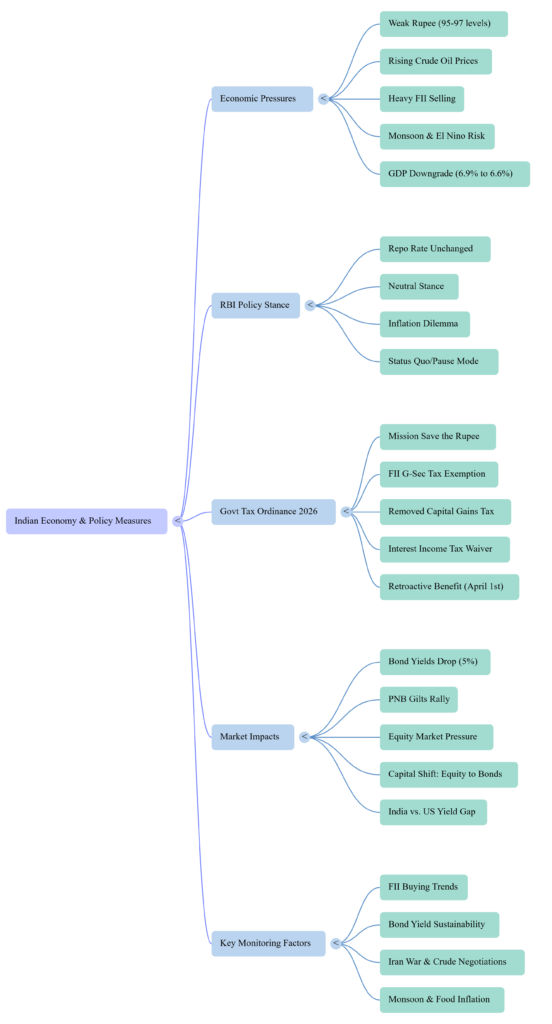
What Does This Mean for Retail Investors?
Investors should remain cautious and diversified.
Key considerations include:
- Monitor RBI policy decisions.
- Track the Rupee movement against the US Dollar.
- Watch crude oil prices and inflation data.
- Avoid making investment decisions based solely on short-term optimism.
- Focus on quality businesses with strong fundamentals.
Conclusion
India’s new “Tax-Zero” mission for FIIs represents one of the most significant policy shifts in recent years. By offering major tax incentives on government bonds, policymakers are attempting to attract foreign capital and stabilize the Rupee during a challenging economic period.
Whether this strategy becomes a long-term solution or merely a temporary relief measure will depend on several external factors, including global interest rates, crude oil prices, inflation, and domestic economic growth.
For investors, the key takeaway is clear: understanding macroeconomic trends is now just as important as selecting individual stocks.
Frequently Asked Questions (FAQs)
What is India’s Tax-Zero Mission for FIIs?
It is a policy initiative designed to attract foreign institutional investors by offering tax benefits on eligible government securities.
Why is the government focusing on FIIs?
Foreign investment brings US dollars into the economy, which can help stabilize the Rupee and support financial markets.
Will this benefit the stock market?
Not necessarily. Some investors may shift funds toward government bonds if they become more attractive than equities.
Why is the Rupee under pressure?
Factors such as rising crude oil prices, global uncertainty, capital flows, and domestic economic conditions can all influence the Rupee’s value.
What should retail investors do?
Maintain diversification, focus on long-term investing, and monitor macroeconomic developments before making major investment decisions.