
The Great Migration of Wealth
Imagine owning a fraction of a luxury apartment in Mumbai, a commercial office tower in New York, or a vault of gold bullion in Switzerland with just ₹1,000.
For decades, premium assets remained inaccessible to ordinary investors. Real estate required crores of capital, private equity demanded institutional connections, and alternative investments were reserved for the wealthy elite.
That reality is rapidly changing.
According to industry estimates, asset tokenization could unlock between $5 trillion and $16 trillion worth of assets by 2030. Financial giants such as BlackRock, Franklin Templeton, and major global banks are actively building infrastructure for a tokenized financial future.
The result is a historic transformation where physical assets become digital, tradable, and accessible to investors worldwide.
What Is Asset Tokenization?
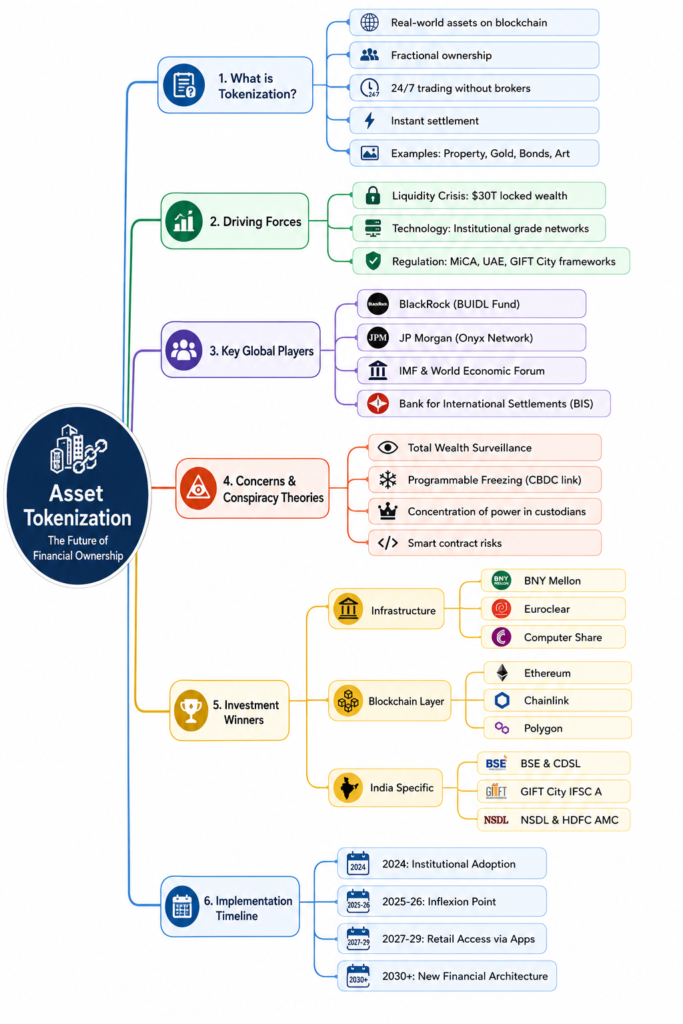
Asset tokenization is the process of converting ownership rights of a real-world asset into digital tokens recorded on a blockchain.
These assets can include:
| Asset Type | Example |
|---|---|
| Real Estate | Apartments, offices, warehouses |
| Precious Metals | Gold, Silver |
| Private Equity | Startup shares |
| Bonds | Government & Corporate Bonds |
| Art & Collectibles | Paintings, Luxury Watches |
| Commodities | Oil, Carbon Credits |
Instead of buying an entire asset, investors purchase fractional digital ownership.
1. Fractional Ownership: The End of High Entry Barriers
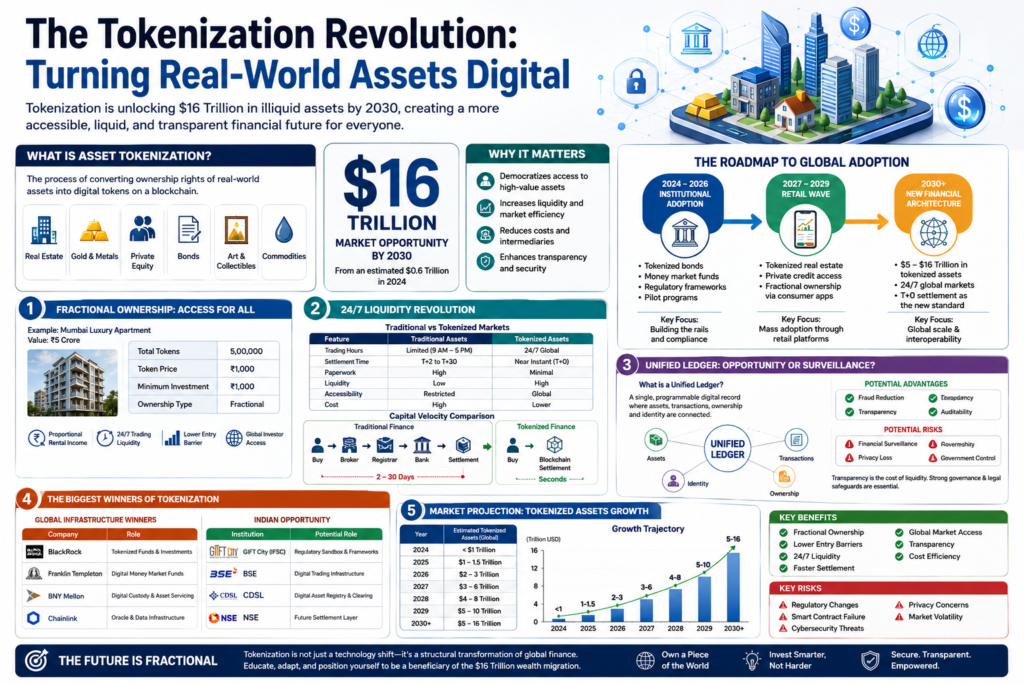
Consider a luxury apartment in Mumbai worth ₹5 Crore.
Traditionally, an investor would need enormous capital to participate.
Through tokenization:
| Property Value | ₹5 Crore |
|---|---|
| Total Tokens | 5,00,000 |
| Token Price | ₹1,000 |
An investor purchasing just 10 tokens can gain exposure to the property.
Benefits
✅ Fractional Ownership
✅ Rental Income Distribution
✅ Portfolio Diversification
✅ Lower Capital Requirement
✅ Global Investor Access
Example
| Investment Type | Minimum Capital |
|---|---|
| Traditional Real Estate | ₹50 Lakh – ₹5 Crore |
| Tokenized Real Estate | ₹1,000 – ₹10,000 |
This democratizes access to institutional-grade investments.
2. The 24/7 Liquidity Revolution
One of the biggest problems in traditional finance is liquidity.
Selling a property can take months.
Bond settlements often require days.
Paperwork creates delays and costs.
Tokenized assets operate on blockchain networks that function continuously.
Traditional vs Tokenized Markets
| Feature | Traditional Assets | Tokenized Assets |
|---|---|---|
| Trading Hours | Limited | 24/7 |
| Settlement | T+2 to T+30 | Near Instant |
| Paperwork | High | Minimal |
| Accessibility | Restricted | Global |
| Liquidity | Low | High |
Capital Velocity Chart
Traditional Finance

Buy → Broker → Registrar → Bank → Settlement
                     ↓
                 2-30 Days

Tokenized Finance

Buy → Blockchain Settlement
                     ↓
                  Seconds
The result is faster movement of capital and improved market efficiency.
3. Unified Ledger: Opportunity or Surveillance?
A major concept driving tokenization is the Unified Ledger.
What Is a Unified Ledger?
A unified ledger is a programmable digital record where:
• Assets
• Transactions
• Ownership
• Identity Verification
are connected into a single system.
Potential Advantages
| Advantage | Impact |
|---|---|
| Fraud Reduction | High |
| Transparency | High |
| Settlement Speed | High |
| Auditability | High |
Potential Risks
| Risk | Concern |
|---|---|
| Financial Surveillance | High |
| Privacy Loss | Medium |
| Account Restrictions | Possible |
| Government Control | Debated |
This is where the debate between innovation and financial freedom becomes increasingly important.
4. The Biggest Winners of Tokenization
Throughout history, infrastructure providers often benefit more than users.
The same pattern may occur here.
Global Infrastructure Winners
| Company | Role |
|---|---|
| BlackRock | Tokenized Funds |
| Franklin Templeton | Digital Money Market Funds |
| BNY Mellon | Digital Custody |
| Chainlink | Blockchain Data Infrastructure |
Infrastructure Stack
Investors
    ↓
Tokenized Assets
    ↓
Blockchain Networks
    ↓
Oracle Providers
    ↓
Custody Providers
    ↓
Settlement Systems
Indian Opportunity
India is positioning itself through:
| Institution | Potential Role |
|---|---|
| GIFT City | Regulatory Sandbox |
| BSE | Digital Trading Infrastructure |
| CDSL | Digital Asset Registry |
| NSE | Future Settlement Layer |
The winners may not be the assets themselves, but the financial “pipes” enabling them.
5. The Roadmap to 2030
Phase 1: Institutional Adoption (2024–2026)
Current Focus:
- Tokenized Bonds
- Money Market Funds
- Regulatory Frameworks
- Pilot Programs
Phase 2: Retail Expansion (2027–2029)
Expected Developments:
- Tokenized Real Estate
- Fractional Commercial Property
- Private Credit Access
- Consumer App Integration
Platforms may eventually allow investors to buy portions of premium assets as easily as purchasing stocks.
Phase 3: New Financial Architecture (2030+)
Industry Projection
| Year | Estimated Tokenized Assets |
|---|---|
| 2024 | <$1 Trillion |
| 2026 | $2–3 Trillion |
| 2030 | $5–16 Trillion |
Growth Chart
Tokenized Assets Market

2024 | █
2025 | ██
2026 | ████
2027 | ██████
2028 | █████████
2029 | █████████████
2030 | ███████████████████
The transition could become one of the largest financial transformations since electronic trading.
Key Benefits of Asset Tokenization
| Benefit | Impact |
|---|---|
| Fractional Ownership | Very High |
| Lower Entry Barriers | Very High |
| Faster Settlement | High |
| Greater Liquidity | High |
| Global Market Access | High |
| Transparency | High |
Key Risks Investors Must Understand
| Risk | Severity |
|---|---|
| Regulatory Changes | High |
| Smart Contract Failure | Medium |
| Cybersecurity Issues | Medium |
| Privacy Concerns | High |
| Market Volatility | Medium |
Investors should balance innovation with risk management.
Conclusion: The Future Is Fractional
Asset tokenization represents far more than a technology trend.
It is a fundamental restructuring of ownership itself.
The world is moving from physical certificates, paperwork, and intermediaries toward digital, programmable assets that can be traded globally around the clock.
By 2030, trillions of dollars in real estate, bonds, commodities, and private assets may exist on blockchain networks.
The question is no longer whether tokenization will happen.
The real question is:
Will investors adapt early enough to benefit from the largest wealth migration of the digital age?
As the financial system becomes increasingly fractional, programmable, and interconnected, understanding asset tokenization may become as essential as understanding stocks and mutual funds today.