
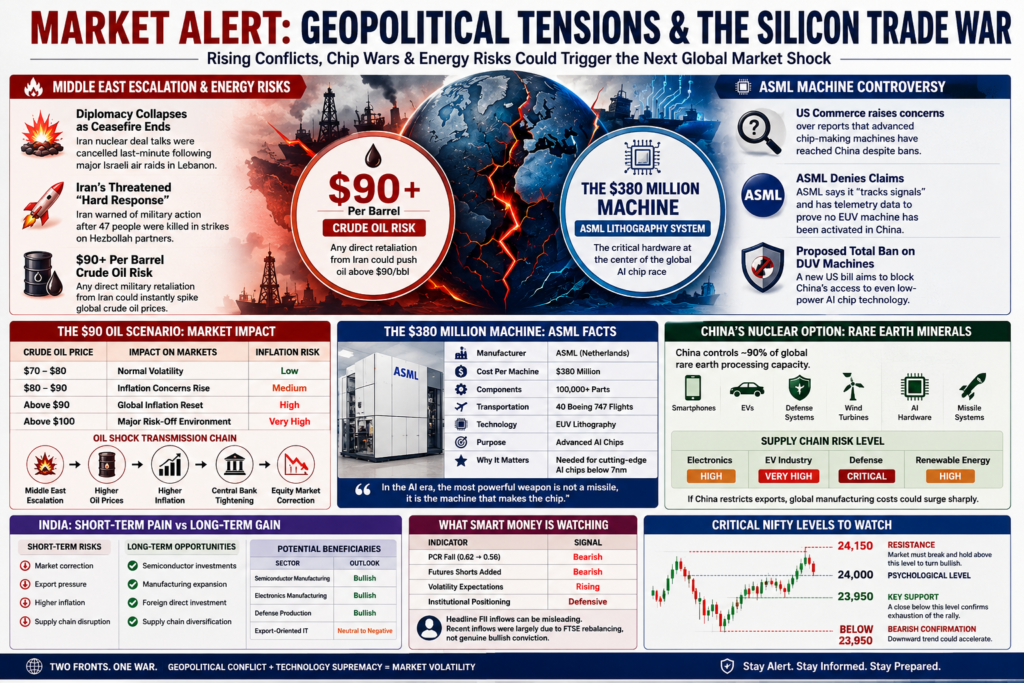
A $380 million chip-making machine, a collapsing Middle East ceasefire, and a growing US-China technology war are creating a perfect storm for global markets. Discover why investors should prepare for rising volatility, oil shocks, and a possible second wave of trade war.
The $380 Million Mystery: Why One Machine and a Broken Ceasefire Are Shaking Global Markets
Global markets appear calm on the surface, but underneath, powerful geopolitical forces are colliding. A renewed military conflict in the Middle East and an escalating semiconductor war between the United States and China are creating risks that investors cannot ignore.
The recent market rally may actually be a Liquidity Mirage—a temporary illusion of stability before a major volatility event.
Middle East Conflict Reignites Market Fears
The fragile ceasefire hopes in the Middle East collapsed when Israel launched a large-scale offensive in Southern Lebanon shortly after a ceasefire deadline expired.
Key Developments
| Event | Impact on Markets |
|---|---|
| Israeli airstrikes in Lebanon | Increased geopolitical risk |
| Ceasefire collapse | Reduced chances of regional stability |
| Iran’s warning of retaliation | Potential oil price shock |
| Diplomatic negotiations canceled | Higher uncertainty |
Why Investors Should Care
A wider regional conflict could disrupt energy supplies and push crude oil prices sharply higher.
The $90 Oil Scenario
Markets were expecting progress on Iran’s nuclear negotiations. However, the cancellation of a critical diplomatic meeting in Switzerland changed sentiment dramatically.
Potential Impact of an Iranian Response
| Crude Oil Price | Market Impact |
|---|---|
| $70-$80 | Normal volatility |
| $80-$90 | Inflation concerns rise |
| Above $90 | Global inflation reset |
| Above $100 | Major risk-off environment |
Oil Shock Transmission Chain
Middle East Escalation
          ↓
Higher Oil Prices
          ↓
Higher Inflation
          ↓
Central Bank Tightening
          ↓
Equity Market Correction
The $380 Million Machine at the Center of the AI War
The most important asset in the global AI race is not ChatGPT, Gemini, or any AI model.
It is the ASML lithography machine.
ASML Machine Facts
| Specification | Details |
|---|---|
| Manufacturer | ASML |
| Cost Per Machine | $380 Million |
| Components | 100,000+ Parts |
| Transportation | 40 Boeing 747 Flights |
| Technology | EUV Lithography |
| Purpose | Advanced AI Chips |
Without these machines, producing the world’s most advanced semiconductors becomes nearly impossible.
Why the US Is Concerned
The United States suspects China may have gained access to restricted chip-making technology.
Although ASML publicly stated there is no evidence that advanced EUV systems are operating in China, the concerns have intensified calls for stricter export controls.
The New Era of AI Protectionism
The United States is no longer restricting technology based solely on geography.
A new strategy is emerging:
Old Model
Country-Based Restrictions
New Model
Identity-Based Restrictions
        +
Technology-Based Restrictions
This means access to advanced AI systems and semiconductor technology may increasingly depend on citizenship, nationality, and strategic alignment.
China’s Nuclear Option: Rare Earth Minerals
China controls approximately 90% of global rare-earth processing capacity.
These minerals are essential for:
- Smartphones
- Electric Vehicles
- Defense Systems
- Wind Turbines
- AI Hardware
- Missile Guidance Systems
Supply Chain Risk
| Sector | Risk Level |
|---|---|
| Electronics | High |
| EV Industry | Very High |
| Defense | Critical |
| Renewable Energy | High |
If China restricts exports, global manufacturing costs could surge.
India: Winner or Victim?
India faces a difficult short-term versus long-term tradeoff.
Short-Term Risks
❌ Market correction
❌ Export pressure
❌ Higher inflation
❌ Supply chain disruption
Long-Term Opportunities
✅ Semiconductor investments
✅ Manufacturing expansion
✅ Foreign direct investment
✅ Supply chain diversification
Potential Beneficiaries
| Sector | Outlook |
|---|---|
| Semiconductor Manufacturing | Bullish |
| Electronics Manufacturing | Bullish |
| Defense Production | Bullish |
| Export-Oriented IT | Neutral to Negative |
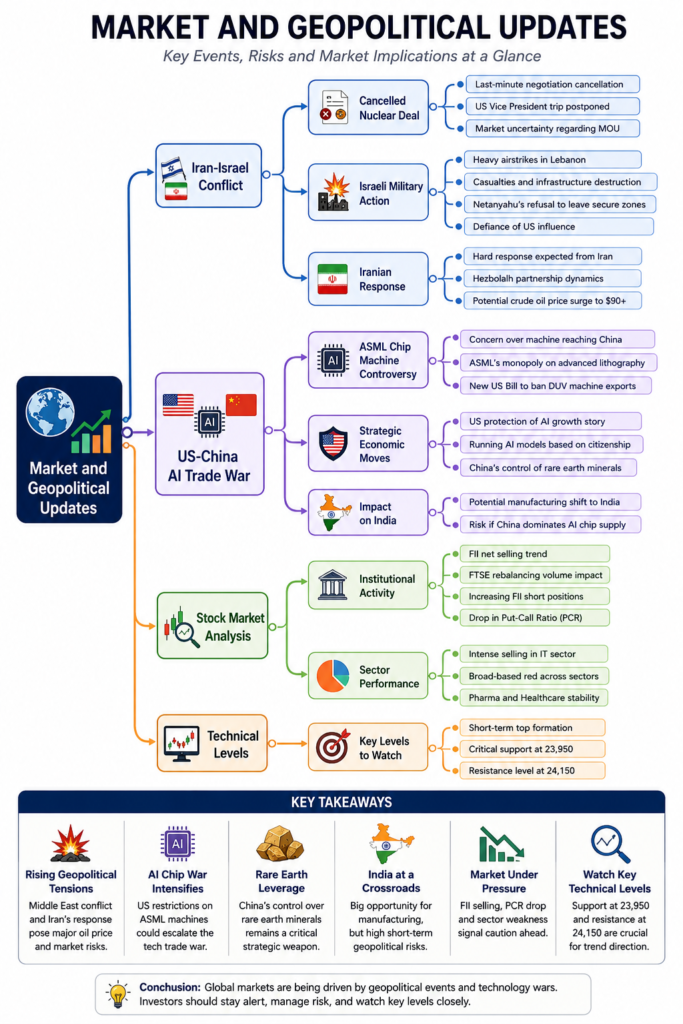
What Smart Money Is Watching
Headline FII inflows can sometimes be misleading.
A large portion of recent buying activity was linked to index rebalancing rather than genuine bullish conviction.
Professional Money Indicators
| Indicator | Signal |
|---|---|
| PCR Fall (0.62 → 0.56) | Bearish |
| Futures Shorts Added | Bearish |
| Volatility Expectations | Rising |
| Institutional Positioning | Defensive |
Critical Nifty Levels to Watch
| Level | Importance |
|---|---|
| 24,150 | Resistance |
| 24,000 | Psychological Level |
| 23,950 | Key Support |
| Below 23,950 | Bearish Confirmation |
Nifty Technical Structure
24,150 Resistance
      ▲
      │
Current Zone
      │
23,950 Support
      ▼
Bearish Breakdown Zone
Conclusion: The Next Volatility Cycle May Already Have Started
Investors are facing two powerful forces at the same time:
- A military conflict stretching across the Middle East.
- A technology war centered around semiconductor supremacy.
The global economy is increasingly being driven by geopolitics rather than traditional fundamentals.
A missile strike in Lebanon, an export restriction in Washington, or a shipping container leaving Europe can now move markets more than earnings reports.
The question investors should ask is not whether volatility is coming—but whether their portfolio is prepared for it.
Key Takeaways
✔ Watch crude oil closely.
✔ Monitor US-China semiconductor restrictions.
✔ Track rare earth developments.
✔ Keep an eye on Nifty support at 23,950.
✔ Expect higher market volatility in the months ahead.
The era of easy liquidity is ending. The era of geopolitical investing has begun.
- The $380 Million Machine: How the AI Chip War Could Crash Global Markets
- US-China Chip War and Middle East Conflict: The Perfect Storm for Investors
- Why Oil, AI Chips, and Geopolitics Are Driving the Next Market Crisis
- The Hidden Link Between Iran, China, ASML, and Global Stock Markets
- Global Market Warning: The $380 Million Machine Behind the Next Trade War