
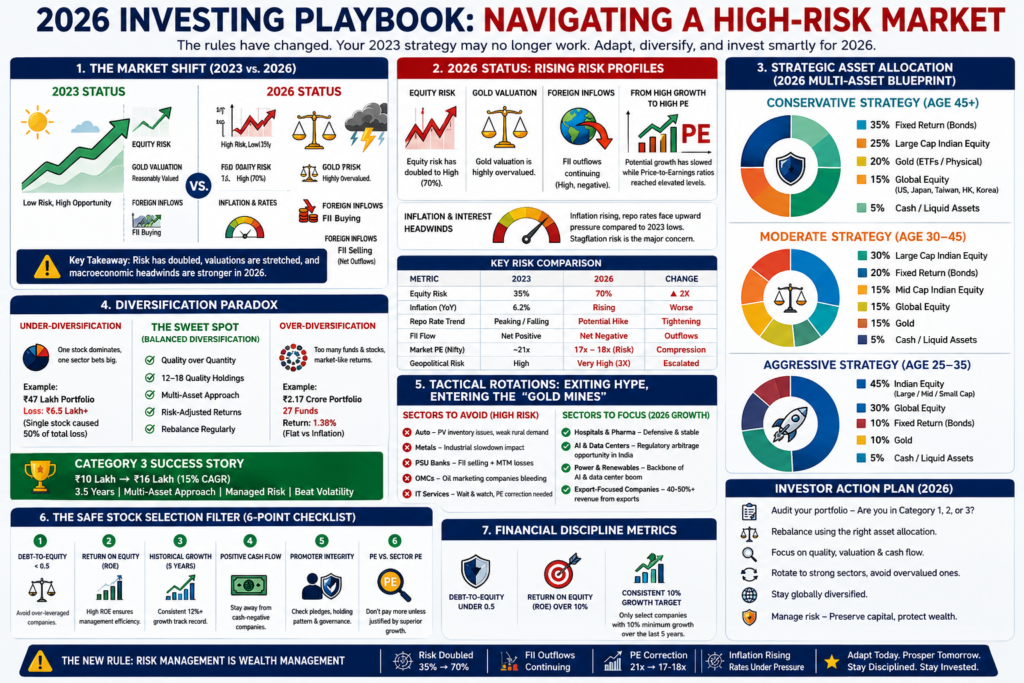
The 2026 Investing Playbook: Why Yesterday’s Winning Strategy May No Longer Work
The market has changed dramatically.
In 2023, investors benefited from abundant liquidity, improving economic growth, and optimism following the pandemic recovery.
By 2026, the landscape looks very different.
Higher interest rates, persistent inflation, geopolitical uncertainty, elevated valuations, and slower earnings growth are forcing investors to rethink how they build portfolios.
The biggest risk today isn’t market volatility.
It’s using yesterday’s strategy in today’s market.
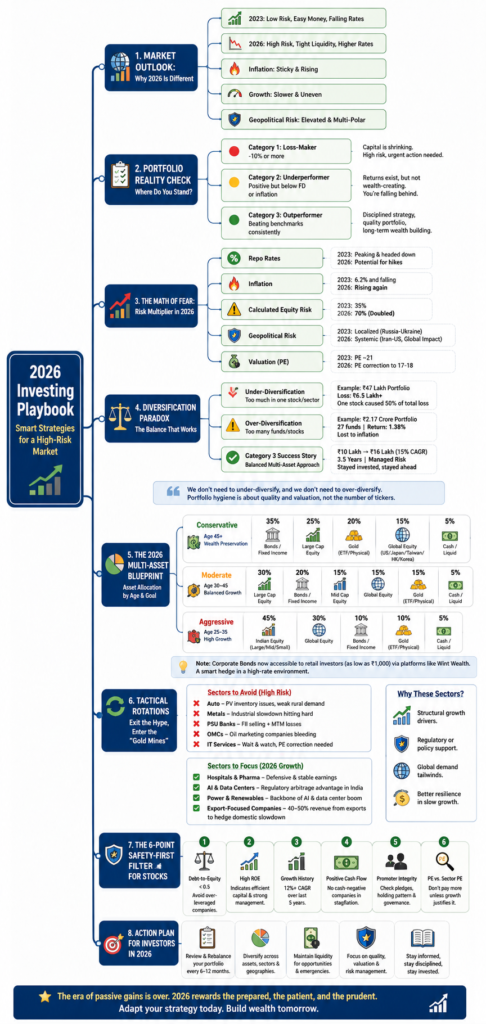
Portfolio Reality Check
Most portfolios today fall into one of three categories.
| Portfolio Type | Performance | Investor Situation |
|---|---|---|
| 🔴 Loss Maker | Negative Return | Capital Erosion |
| 🟡 Underperformer | Positive but below inflation or benchmark | Wealth Stagnation |
| 🟢 Outperformer | Beats benchmark consistently | Long-term Wealth Creation |
The goal isn’t simply earning positive returns.
The goal is to outperform inflation and build sustainable wealth over time.
How the Market Environment Changed
2023 vs 2026
| Factor | 2023 | 2026 |
|---|---|---|
| Interest Rates | Peaking | Elevated / Data Dependent |
| Inflation | Falling | More Persistent |
| Liquidity | High | Tight |
| Market Leadership | Growth Stocks | Selective Leadership |
| Volatility | Moderate | Higher |
| Geopolitical Risk | Moderate | Elevated |
The Risk Multiplier
Higher Inflation
        │
        ▼
Higher Interest Rates
        │
        ▼
Lower Liquidity
        │
        ▼
Lower Valuation Multiples
        │
        ▼
Higher Market Volatility
Why Diversification Matters More Than Ever
Many investors make one of two mistakes.
Under-Diversification
- Too much money in one stock
- One sector dominates the portfolio
- Higher downside risk
Over-Diversification
- Too many stocks
- Too many mutual funds
- Difficult to outperform benchmarks
Balanced Diversification
The objective is not owning more assets.
It is owning the right assets.
Example Portfolio Outcomes
| Portfolio | Allocation | Outcome |
|---|---|---|
| Concentrated | 5 Stocks | High Risk |
| Over Diversified | 30+ Holdings | Low Return |
| Balanced | 12–18 Quality Holdings | Better Risk-Adjusted Return |
The 2026 Asset Allocation Blueprint
Conservative Investor (45+)
| Asset | Allocation |
|---|---|
| Bonds / Fixed Income | 35% |
| Large Cap Equity | 25% |
| Gold | 20% |
| Global Equity | 15% |
| Cash | 5% |
Moderate Investor (30–45)
| Asset | Allocation |
|---|---|
| Large Cap | 30% |
| Mid Cap | 15% |
| Bonds | 20% |
| Gold | 15% |
| Global Equity | 15% |
| Cash | 5% |
Aggressive Investor (25–35)
| Asset | Allocation |
|---|---|
| Indian Equity | 45% |
| Global Equity | 30% |
| Bonds | 10% |
| Gold | 10% |
| Cash | 5% |
Diversification Diagram
                Portfolio

                    │

────────────────────────────────

Indian Equity   Global Equity

Gold            Fixed Income

Cash            Alternatives
Sector Rotation: Where Opportunities May Be
Sector leadership changes over time.
Investors often benefit from reviewing allocations as economic conditions evolve.
Sectors to Watch
| Sector | Theme |
|---|---|
| Healthcare | Defensive Growth |
| Pharmaceuticals | Stable Demand |
| Power & Utilities | Infrastructure Investment |
| Data Centers | Digital Economy |
| Renewable Energy | Long-Term Structural Growth |
| Export-Oriented Businesses | Global Revenue Diversification |
Sectors Requiring Careful Evaluation
| Sector | Key Consideration |
|---|---|
| Automobiles | Demand Trends |
| Metals | Global Economic Cycle |
| PSU Banks | Interest Rate Sensitivity |
| Oil Marketing | Energy Price Volatility |
| IT Services | Valuation & Earnings Outlook |
Sector performance depends on company fundamentals and broader economic conditions.
Risk Management Framework
Stock Selection

       │

Financial Strength

       │

Cash Flow

       │

Debt Level

       │

Management Quality

       │

Reasonable Valuation

       │

Long-Term Investment
The 6-Point Stock Selection Checklist
Before investing, consider reviewing:
1. Debt-to-Equity
Lower debt generally provides greater financial flexibility.
2. Return on Equity (ROE)
Consistently healthy ROE may indicate efficient capital allocation.
3. Revenue & Earnings Growth
Look for companies with sustainable long-term growth rather than short-term spikes.
4. Free Cash Flow
Positive cash generation supports future investment and resilience.
5. Corporate Governance
Review promoter shareholding, pledging, board quality, and disclosures.
6. Valuation
Compare valuation with:
- Industry peers
- Historical averages
- Growth expectations
Global Diversification
Modern portfolios increasingly include international exposure.
Potential regions include:
🇺🇸 United States
🇯🇵 Japan
🇰🇷 South Korea
🇹🇼 Taiwan
🇸🇬 Singapore
🇪🇺 Europe
Global diversification may help reduce concentration risk, though it also introduces currency and geopolitical considerations.
Market Environment Dashboard
| Indicator | Current Trend |
|---|---|
| Inflation | Elevated |
| Interest Rates | Higher |
| Liquidity | Tight |
| Volatility | High |
| Earnings | Mixed |
| Geopolitics | Elevated |
Asset Allocation Pyramid
           Cash

        Gold

   Fixed Income

Global Equity

Indian Equity
Portfolio Health Checklist
✔ Emergency Fund
✔ Diversified Portfolio
✔ International Exposure
✔ Gold Allocation
✔ Debt Allocation
✔ Annual Rebalancing
✔ Tax Efficiency
✔ SIP Discipline
Common Investor Mistakes
❌ Chasing Momentum
❌ Overtrading
❌ Ignoring Asset Allocation
❌ Buying Expensive Stocks Without Fundamental Analysis
❌ Concentrating Too Much on One Sector
❌ Emotional Investing During Volatility
Frequently Asked Questions
Is diversification still important?
Yes. Diversification helps reduce concentration risk, although it cannot eliminate market risk.
Why include gold?
Gold has historically acted as a diversification tool during periods of uncertainty and inflation, though its performance varies over time.
Should investors have global exposure?
International investments may reduce home-country concentration risk and provide access to different growth opportunities.
Is cash a wasted asset?
Not necessarily. Holding some liquidity can provide flexibility during periods of market volatility.
Key Takeaways
✅ Markets evolve, and investment strategies should be reviewed periodically.
✅ Asset allocation often has a greater long-term impact than stock selection alone.
✅ Diversification should balance risk without becoming excessively fragmented.
✅ Sector leadership changes with economic cycles.
✅ Risk management and valuation discipline remain essential regardless of market conditions.
Final Thoughts
Successful investing is not about predicting every market move.
It is about building a resilient portfolio that can adapt to changing economic conditions.
The strategies that worked during periods of abundant liquidity may require adjustment when inflation, interest rates, and geopolitical risks become more prominent.
Rather than chasing the next market trend, investors may benefit from focusing on quality businesses, thoughtful diversification, disciplined asset allocation, and long-term financial goals.
🔥 Top 10 Best Titles
- The 2026 Investing Playbook: Why Your 2023 Strategy Is Quietly Destroying Your Wealth
- Why Your 2023 Investment Strategy Is Failing in 2026
- The New Rules of Investing: How to Build Wealth in the 2026 Market
- The Great Portfolio Reset: Why 2026 Demands a Completely New Investment Strategy
- Stop Investing Like It’s 2023: The 2026 Portfolio Survival Guide
- The 2026 Wealth Blueprint: How Smart Investors Are Beating the Market
- The End of Easy Money: Why Your Portfolio Needs a 2026 Upgrade
- From Bull Market to Survival Mode: The 2026 Investing Playbook
- The $1 Million Mistake: Why Most Investors Are Using the Wrong Strategy in 2026
- The Portfolio Reality Check: Why Most Investors Will Underperform in 2026