
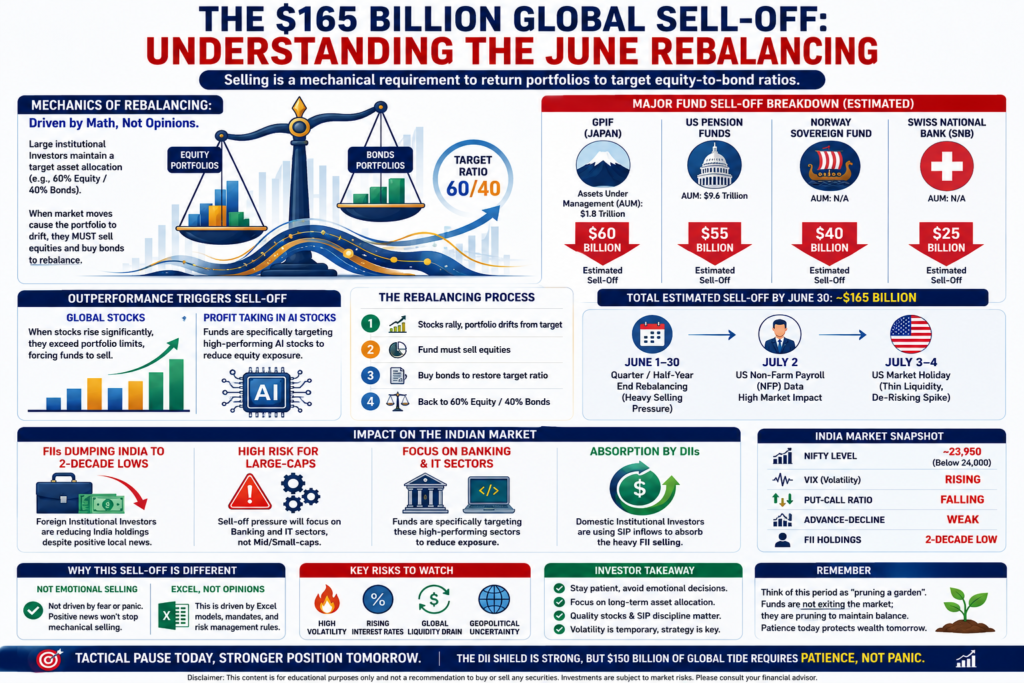
The $165 Billion Selloff: Why Markets Are Falling Despite Easing Geopolitical Risks
At first glance, the market reaction doesn’t make sense.
Oil prices have cooled.
Middle East tensions have eased.
Diplomatic talks have resumed.
Yet global stock markets continue to weaken.
The reason isn’t fear.
It’s mathematics.
Behind the scenes, some of the world’s largest pension funds, sovereign wealth funds, and institutional investors are executing mandatory portfolio rebalancing—a process driven by investment rules rather than market sentiment.
This mechanical selling could temporarily outweigh positive news, creating volatility even when the economic outlook appears to improve.
Global Market Snapshot
| Indicator | Current Trend | Market Impact |
|---|---|---|
| Oil Prices | Falling | Positive |
| Middle East Risk | Moderating | Positive |
| Institutional Selling | Rising | Negative |
| Bond Yields | Elevated | Negative |
| Global Liquidity | Tight | Negative |
| Volatility (VIX) | Rising | Risk-Off |
Why Markets Are Falling
The market isn’t reacting to headlines.
It is reacting to portfolio mathematics.
Large institutional investors rebalance portfolios at the end of every quarter.
If equities outperform bonds…
They must sell stocks.
Regardless of market sentiment.
How Institutional Rebalancing Works
Target Portfolio

60% Equity
40% Bonds

        │

Stocks Rally

        ▼

68% Equity
32% Bonds

        ▼

Mandatory Selling

        ▼

Back to

60% Equity
40% Bonds
This process is automatic for many institutional portfolios.
Understanding the $165 Billion Selloff
Estimated institutional portfolio adjustments:
| Institution | Estimated Rebalancing Volume |
|---|---|
| Japan GPIF | ~$60 Billion |
| US Pension Funds | ~$55 Billion |
| Norway Sovereign Wealth Fund | ~$40 Billion |
| Swiss National Bank | ~$25 Billion |
Illustrative estimates only. Actual rebalancing amounts depend on market movements and portfolio policies.
Why Winning Stocks Get Sold
Ironically…
The best-performing stocks often become the biggest victims.
Large funds typically sell:
- Mega-cap technology
- Banking
- Large-cap indices
- AI leaders
- Highly liquid stocks
These positions are easiest to reduce quickly.
The Liquidity Drain
AI Rally

      │

Equity Outperformance

      │

Portfolio Drift

      │

Institutional Rebalancing

      │

Large-Cap Selling

      │

Market Correction
India’s Position
India remains one of the fastest-growing major economies.
However, during global portfolio rebalancing, emerging markets may experience temporary foreign outflows as global investors adjust allocations.
Domestic Institutional Investors (DIIs) and regular SIP flows can help absorb part of this selling pressure, although they may not offset every global flow in the short term.
FII vs DII Flow
Foreign Selling
█████████████

Domestic Buying
████████
Domestic buying cushions volatility…
But doesn’t always eliminate it.
Technical Market Signals
| Indicator | Interpretation |
|---|---|
| Rising VIX | Higher Volatility |
| Weak Market Breadth | Limited Participation |
| Lower Put-Call Ratio | Cautious Sentiment |
| Falling Premiums | Reduced Risk Appetite |
| Large-Cap Weakness | Institutional Selling |
Why Payroll Data Matters
The next major catalyst is the US Non-Farm Payroll (NFP) report.
Markets watch it because it influences expectations for:
- Interest Rates
- Inflation
- Bond Yields
- Federal Reserve Policy
Possible Scenarios
| Payroll Outcome | Market Interpretation |
|---|---|
| Strong Jobs | Higher Rate Expectations |
| Moderate Jobs | Balanced Outlook |
| Weak Jobs | Possibility of Easier Monetary Policy |
Markets react to the full employment report, including wages and unemployment, not just headline payroll growth.
Market Pressure Timeline
Quarter-End Rebalancing

          │

Institutional Selling

          │

Payroll Data

          │

Fed Expectations

          │

Higher Volatility
Why Large Caps Are Under Pressure
Institutional investors need liquidity.
That usually means selling:
✔ Banking
✔ Technology
✔ Index Heavyweights
✔ Mega Caps
Small-cap stocks often see less institutional participation simply because they are less liquid.
Short-Term Winners
Historically, during uncertain periods investors sometimes rotate toward:
| Asset | Why Investors Consider It |
|---|---|
| Gold | Diversification |
| Government Bonds | Defensive Allocation |
| Utilities | Stable Cash Flows |
| Healthcare | Defensive Earnings |
| Cash | Flexibility |
Performance varies by market cycle and is not guaranteed.
Risks Investors Should Monitor
Economic Risks
- Inflation
- Interest Rates
- Bond Yields
Market Risks
- Valuation Compression
- Liquidity Reduction
- Institutional Selling
Global Risks
- Geopolitics
- Energy Prices
- Currency Volatility
Investor Checklist
✅ Maintain Asset Allocation
✅ Review Risk Exposure
✅ Avoid Emotional Decisions
✅ Diversify Globally
✅ Keep Emergency Liquidity
✅ Focus on Quality Companies
Frequently Asked Questions
Why are markets falling if geopolitical tensions are easing?
Markets respond to many factors simultaneously. Institutional portfolio rebalancing, interest-rate expectations, valuations, and liquidity conditions can outweigh positive geopolitical developments in the short term.
What is institutional rebalancing?
Large investment funds periodically adjust portfolios back to target allocations (such as 60% equities and 40% bonds), which may require buying or selling assets regardless of market sentiment.
Why are large-cap stocks affected first?
Large-cap stocks generally offer greater liquidity, making them easier for large institutions to trade in significant volumes.
Should long-term investors panic?
Short-term volatility is a normal feature of financial markets. Long-term investors typically benefit from reviewing their asset allocation, maintaining diversification, and aligning investments with their financial goals rather than reacting solely to market swings.
Key Takeaways
✅ Institutional portfolio rebalancing can create temporary selling pressure independent of news headlines.
✅ Large-cap stocks often bear the brunt of mechanical selling because of their liquidity.
✅ Payroll data and central bank expectations remain important market catalysts.
✅ Diversification and disciplined asset allocation remain essential during periods of elevated volatility.
✅ Market corrections driven by liquidity adjustments do not necessarily indicate deterioration in the long-term fundamentals of every company.
Final Thoughts
Financial markets don’t always move because investors become optimistic or fearful.
Sometimes they move because investment mandates require portfolios to be rebalanced.
Understanding the difference between fundamental changes and mechanical market flows can help investors better interpret short-term volatility and avoid making decisions based solely on headlines.
Patience, diversification, and disciplined risk management remain some of the most valuable tools during uncertain market environments.
Data Visualization
Global Liquidity Flow
AI Rally
     │
     ▼
Portfolio Drift
     │
     ▼
Quarter-End Rebalancing
     │
     ▼
Large-Cap Selling
     │
     ▼
Higher Volatility
Market Risk Dashboard
| Indicator | Risk Level |
|---|---|
| Institutional Selling | 🔴 High |
| Bond Yield Pressure | 🟠 Medium-High |
| Oil Volatility | 🟡 Moderate |
| Geopolitical Risk | 🟡 Moderate |
| Market Liquidity | 🔴 Tight |
| Payroll Event Risk | 🟠 High |
🔥 Top 10 Titles
- The $165 Billion Selloff: Why Global Markets Are Falling Despite Easing War Fears
- The $165 Billion Liquidity Shock: The Hidden Force Behind the Market Selloff
- Why the Market Is Falling: The $165 Billion Selloff Nobody Is Talking About
- The Great Portfolio Reset: How $165 Billion Could Shake Global Markets
- War Isn’t the Problem—The $165 Billion Selloff Is
- The Silent Market Crash: Inside the $165 Billion Institutional Selloff
- The Market’s Hidden Enemy: Why $165 Billion in Selling Could Trigger the Next Correction
- Why Smart Money Is Selling: The Truth Behind the $165 Billion Market Shake-Up
- The Biggest Selloff of 2026? Why Institutions Are Dumping Billions in Stocks
- The $165 Billion Warning: What Every Investor Needs to Know Before the Next Market Move