
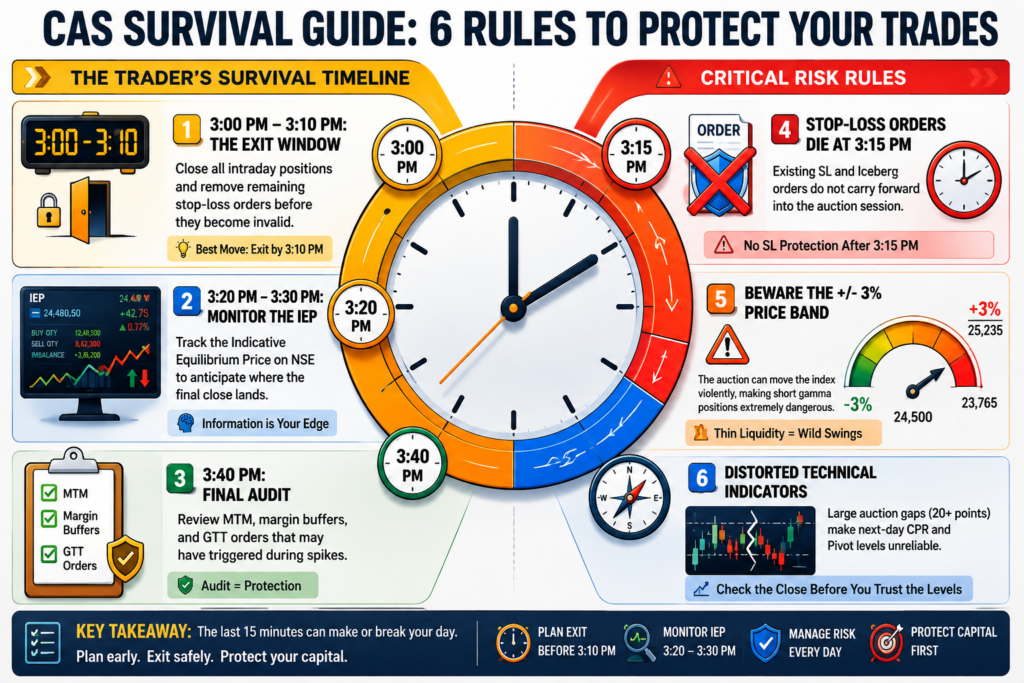
For years, the final few minutes of the Indian stock market were relatively predictable. Traders squared off positions, institutions completed portfolio adjustments, and the closing price was largely determined by a broad market consensus.
That has changed.
With the introduction of the new Closing Auction Session (CAS) framework, the period after 3:15 PM has become one of the most unpredictable parts of the trading day. Many retail traders have witnessed sudden price swings, unexpected MTM changes, distorted technical levels, and confusing differences between Spot and Futures prices.
Whether you are an intraday trader, swing trader, option seller, or long-term investor, understanding these changes is becoming increasingly important.
This article explains seven practical rules that can help traders reduce unnecessary risk during the final minutes of the trading session.
Rule 1: Understand What Happens to Your Stop-Loss After 3:15 PM
One of the biggest misconceptions among retail traders is assuming that every pending order continues to protect their position during the auction.
In reality, certain order types may not participate in the Closing Auction Session depending on exchange rules and broker implementation. Many brokers also advance their intraday square-off timing to avoid auction-related uncertainty.
Practical Takeaway
If you’re an intraday trader:
- Complete exits before your broker’s cut-off.
- Never assume your stop-loss will behave exactly as it does during continuous trading.
- Check your broker’s latest CAS policy before holding positions close to market close.
Capital protection always comes before chasing the final few points.
Rule 2: Don’t Misread Spot vs Futures During the Auction
Between 3:15 PM and 3:30 PM, the cash market enters the auction process while index futures continue trading until later.
This creates a temporary disconnect:
- Spot prices may appear unchanged.
- Futures continue reacting to market expectations.
- Premium and discount calculations become temporarily distorted.
Many inexperienced traders mistake this temporary divergence as an arbitrage opportunity.
In most cases, it isn’t.
Avoid making trading decisions solely based on temporary basis movement during this period.
Rule 3: Closing Price Volatility Can Increase Significantly
The auction determines a single equilibrium closing price based on buy and sell orders.
If order imbalance becomes unusually high or liquidity is relatively thin, the final closing price can differ meaningfully from prices seen just before the auction.
This becomes especially important for:
- Option sellers
- Expiry-day traders
- High-leverage positions
- Large overnight portfolios
Even relatively small percentage changes near the close can significantly affect MTM and option pricing.
Rule 4: Hedging May Behave Differently Near Market Close
Most option strategies rely on stable relationships between:
- Spot Price
- Futures Price
- Option Premium
- Implied Volatility
During the Closing Auction Session, these relationships may temporarily become less reliable because different market segments are updating at different times.
As a result:
- Delta hedges may appear inaccurate.
- Option Greeks may fluctuate unexpectedly.
- Futures may react before the underlying cash market updates.
This doesn’t necessarily mean the hedge is broken—but traders should recognize that pricing relationships can become temporarily unstable.
Rule 5: Verify Tomorrow’s Pivot Levels
Many technical indicators use today’s closing price.
These include:
- CPR (Central Pivot Range)
- Classic Pivot Points
- Camarilla Levels
- Fibonacci Pivot Levels
If the auction produces an unusually large closing move, tomorrow’s calculated support and resistance levels may differ substantially from levels based on the 3:15 PM market price.
Professional traders often compare:
- 3:15 PM reference price
- Final auction close
If the difference is unusually large, they interpret technical levels with additional caution rather than treating them as absolute support or resistance.
Rule 6: Monitor the Indicative Equilibrium Price
The Closing Auction isn’t completely invisible.
During the auction, exchanges publish an Indicative Equilibrium Price (IEP) along with order imbalance information.
Monitoring these values can help traders understand:
- Expected closing price
- Buy/Sell imbalance
- Direction of auction pressure
Instead of waiting for the final closing print, traders can use this information to better understand what’s developing before the auction concludes.
Rule 7: Review Pending Orders and Margin Before Market Close
Closing auction volatility doesn’t only affect open positions.
It can also impact:
- GTT orders
- Margin utilisation
- Overnight exposure
- MTM calculations
Before market close, review:
- Pending trigger orders
- Open option positions
- Margin availability
- Overnight leverage
Maintaining an additional margin buffer can help reduce the likelihood of unexpected margin shortages caused by auction-related price movements.
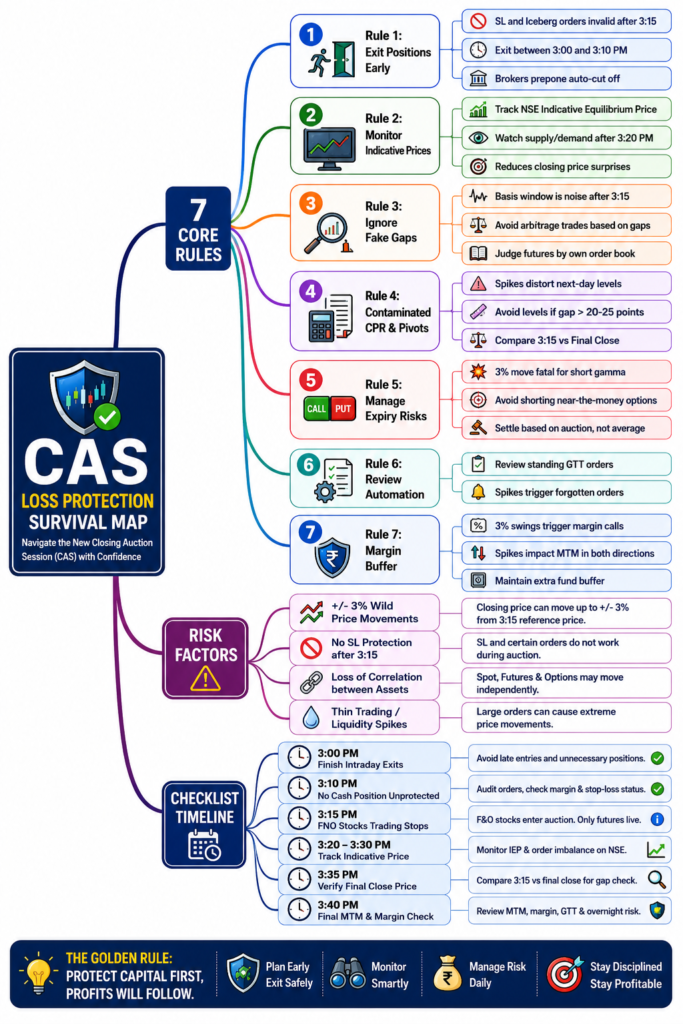
A Simple End-of-Day Survival Checklist
Before 3:00 PM
- Complete most intraday exits.
- Avoid unnecessary late entries.
Around 3:05–3:10 PM
- Review pending orders.
- Check broker square-off timings.
- Confirm stop-loss status.
3:15 PM Onward
- Understand that auction dynamics have started.
- Avoid emotional trading based on temporary price differences.
After Market Close
- Review MTM.
- Verify margin.
- Check tomorrow’s technical levels.
- Confirm no unintended overnight orders remain active.
Risk Management Matters More Than Ever
The Closing Auction Session is designed to improve price discovery and establish a fair official closing price. However, it also introduces a different trading environment during the final minutes of the session.
Instead of reacting emotionally to sudden moves, experienced traders focus on:
- Position sizing
- Risk control
- Broker rules
- Margin discipline
- Capital preservation
Markets will continue evolving, and successful traders evolve with them.
Final Thoughts
The last fifteen minutes of the trading day are no longer just another part of the session—they deserve their own trading plan.
Whether you’re trading equities, index futures, or options, the smartest decision isn’t always finding one more profitable trade. Sometimes, it’s protecting the profits you’ve already earned.
As the market structure evolves, discipline becomes your biggest edge. Understanding how the Closing Auction Session works—and preparing for it—can help you avoid unnecessary surprises and become a more resilient trader.
FAQ
What is the Closing Auction Session (CAS)?
The Closing Auction Session is the market mechanism used to determine the official closing price of eligible securities through an auction-based price discovery process.
Can I place a stop-loss order during the Closing Auction Session?
Order availability depends on exchange rules and your broker’s implementation. Always check your broker’s latest guidelines.
Why do Spot and Futures prices differ after 3:15 PM?
The cash market enters the auction process while futures continue trading, causing temporary pricing differences.
Does CAS affect option traders?
Yes. Option pricing, implied volatility, MTM, and hedging efficiency can all be influenced during the closing auction, particularly on expiry days.
Should intraday traders hold positions into the auction?
That depends on individual strategy, broker policies, and risk tolerance. Many traders choose to reduce exposure before the auction to avoid additional uncertainty.
high CTR aur SEO:
- The 3:15 PM Trap: 7 Rules Every Indian Trader Must Know About the Closing Auction Session
- New NSE Closing Auction Explained: 7 Critical Rules to Protect Your Capital
- Why Smart Traders Exit Before 3:15 PM: The New Closing Auction Strategy
- Closing Auction Session (CAS): 7 Hidden Risks Every Trader Should Know
- The Truth About India’s New Closing Auction: What Happens After 3:15 PM?
- 3:15 PM to 3:30 PM Explained: How the New CAS Can Impact Your Trades
- Avoid These 7 Costly Mistakes During India’s Closing Auction Session
- How the New NSE Closing Auction Can Destroy Your Intraday Profits
- Closing Auction Chaos: 7 Survival Rules for Intraday and Options Traders
- NSE Closing Auction Guide 2026: Everything Traders Need to Know
- The 3:15 PM Trading Trap: Protect Your Money During the Closing Auction
- Why the Last 15 Minutes of Trading Have Become So Dangerous
- CAS Explained: How India’s New Closing Auction Changes Intraday Trading
- 3:15 PM Market Shock: The Complete Survival Guide for Indian Traders
- NSE’s New Closing Auction: 7 Essential Risk Management Rules