
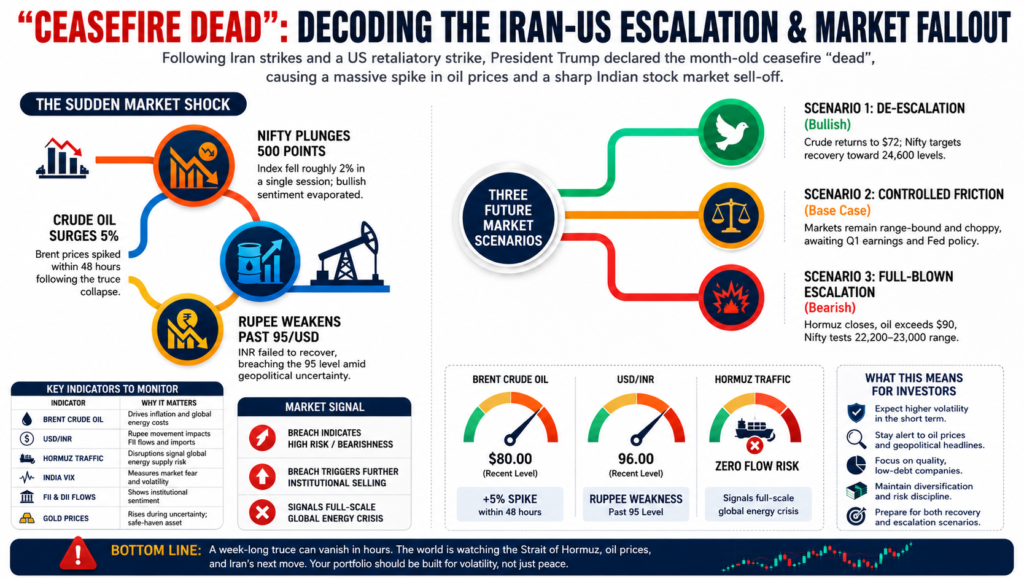
For several weeks, global financial markets appeared surprisingly calm. Investors embraced risk assets, volatility declined, and hopes of geopolitical stability encouraged a strong rally across equities.
That optimism ended abruptly.
Renewed tensions between the United States and Iran, along with uncertainty around shipping through the Strait of Hormuz, pushed oil prices higher and triggered a global risk-off move. President Donald Trump declared that the interim agreement with Iran was “over,” reigniting fears of prolonged conflict and disrupting market sentiment.
The key question for investors is no longer whether geopolitics matters—it is how long this new phase of uncertainty could last and what it means for portfolios worldwide.
Market Snapshot
| Asset | Recent Market Reaction |
|---|---|
| Brent Crude Oil | ▲ Sharp rise on supply concerns |
| Global Equity Markets | ▼ Broad-based weakness |
| US Dollar | ▲ Safe-haven demand |
| Gold | ▲ Increased risk hedging |
| India VIX | ▲ Higher volatility |
| Emerging Markets | ▼ Pressure from global risk aversion |
Why the Strait of Hormuz Matters
The Strait of Hormuz is one of the world’s most strategically important maritime routes.
Around 20% of global oil trade passes through this narrow shipping lane.
Any disruption immediately affects:
- Global oil prices
- Shipping costs
- Inflation expectations
- Currency markets
- Equity valuations
Global Energy Flow
Middle East Oil Production
            │
            ▼
      Strait of Hormuz
            │
            ▼
 Global Energy Supply
            │
            ▼
 Oil Prices & Inflation
            │
            ▼
 Global Stock Markets
Takeaway 1: Temporary Peace Doesn’t Remove Structural Risk
Markets often react positively to ceasefires because they reduce immediate uncertainty.
However, temporary agreements do not always resolve the underlying political disputes.
Recent developments illustrate how quickly market sentiment can reverse when negotiations stall or hostilities resume.
Takeaway 2: Oil Is the Market’s Biggest Risk
Energy remains the fastest transmission channel between geopolitics and financial markets.
Higher oil prices increase:
- Transportation costs
- Manufacturing expenses
- Inflation
- Central bank pressure
Oil Price Chain Reaction
Conflict
    │
    ▼
Higher Oil Prices
    │
    ▼
Higher Inflation
    │
    ▼
Higher Interest Rates
    │
    ▼
Pressure on Equity Markets
Takeaway 3: Institutional Money Often Moves First
Professional investors usually monitor:
- Volatility Index (VIX)
- Options positioning
- Futures premium
- Open Interest
- Foreign Institutional Investor (FII) flows
These indicators often change before major market moves become obvious to retail investors.
Market Sentiment Indicator
| Indicator | Bullish Signal | Bearish Signal |
|---|---|---|
| India VIX | Falling | Rising |
| FII Flow | Buying | Selling |
| PCR | Healthy Range | Extreme Fear |
| Market Breadth | Broad Participation | Narrow Rally |
Takeaway 4: Why Geopolitics Drives Inflation
Military tensions affect far more than oil.
They also influence:
- Freight costs
- Insurance premiums
- Commodity prices
- Supply chains
- Currency stability
When these costs rise together, inflation can remain elevated for longer.
Inflation Cycle
Geopolitical Conflict
          │
          ▼
Higher Energy Cost
          │
          ▼
Higher Inflation
          │
          ▼
Central Banks Stay Cautious
          │
          ▼
Equity Valuation Pressure
Takeaway 5: What It Means for India
India imports a significant portion of its crude oil requirements.
Higher crude prices may affect:
| Sector | Likely Impact |
|---|---|
| Aviation | Negative |
| Paints | Negative |
| Chemicals | Negative |
| Oil Marketing Companies | Mixed |
| IT | Depends on global demand |
| Banking | Sensitive to capital flows |
| FMCG | Margin pressure if input costs rise |
Key Indicators Investors Should Watch
| Indicator | Importance |
|---|---|
| Brent Crude | Inflation outlook |
| US Dollar Index (DXY) | Capital flows |
| US 10-Year Treasury Yield | Global liquidity |
| India VIX | Market volatility |
| USD/INR | Currency stability |
| FII & DII Flows | Institutional sentiment |
| Gold Prices | Risk appetite |
| Shipping Activity | Supply-chain health |
Scenario Analysis
Scenario A – Controlled De-escalation
Diplomatic Progress
        │
        ▼
Oil Stabilizes
        │
        ▼
Inflation Eases
        │
        ▼
Market Recovery
Possible outcome:
- Lower volatility
- Improving risk appetite
- Better FII sentiment
- Recovery in cyclical sectors
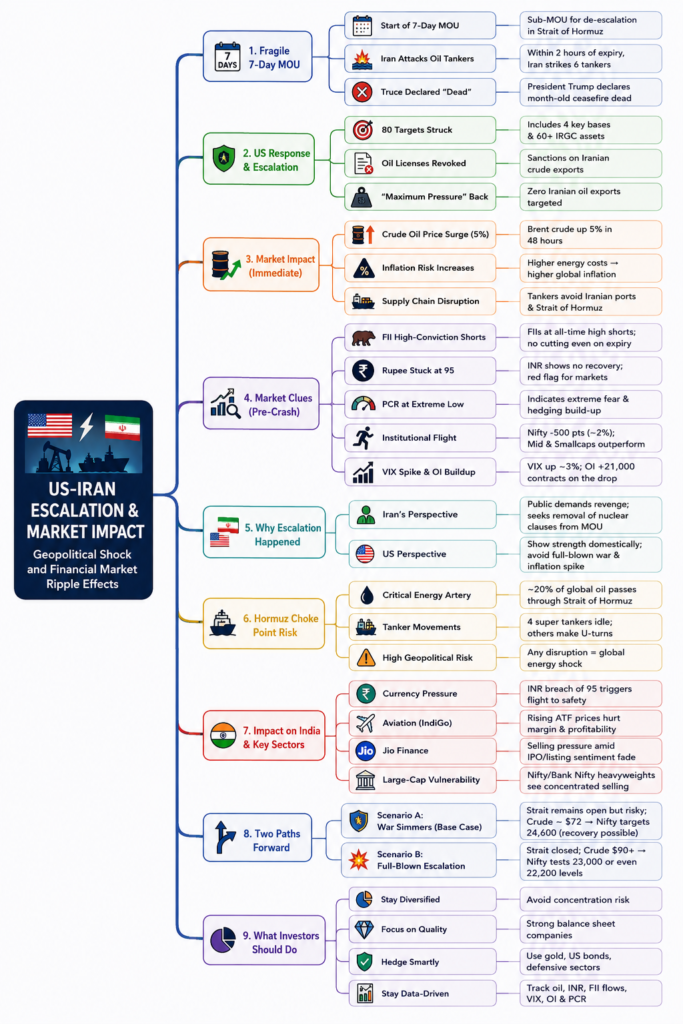
Scenario B – Escalation Continues
Conflict Expands
        │
        ▼
Oil Prices Rise
        │
        ▼
Inflation Accelerates
        │
        ▼
Central Banks Stay Hawkish
        │
        ▼
Global Market Correction
Possible outcome:
- Higher volatility
- Defensive sectors outperform
- Pressure on emerging markets
- Safe-haven assets gain
Portfolio Strategy During Geopolitical Uncertainty
Consider Focusing On
✅ High-quality large-cap companies
✅ Strong balance sheets
✅ Low-debt businesses
✅ Healthcare
✅ Consumer staples
Avoid Excessive Exposure To
❌ Highly leveraged companies
❌ Speculative momentum stocks
❌ Over-concentrated portfolios
Final Thoughts
The recent deterioration in US-Iran relations has reminded investors that geopolitical risk can return quickly after periods of optimism. Recent reports indicate renewed military exchanges, higher oil prices, and increased uncertainty surrounding shipping through the Strait of Hormuz, all of which have weighed on global markets.
Rather than trying to predict every headline, investors should focus on risk management, diversification, and company fundamentals. Geopolitical events can create sharp short-term volatility, but portfolios built around quality businesses, reasonable valuations, and disciplined asset allocation are generally better positioned to navigate uncertain markets.
🔥 Top 10 High-CTR SEO Titles
- The 7-Day Illusion: How the US-Iran Truce Collapse Could Trigger the Next Global Market Sell-Off
- US-Iran Truce Collapse Explained: Why Oil Prices, Nifty & Global Markets Are Under Pressure
- The End of the US-Iran Truce: 5 Market Risks Every Investor Should Know
- Oil Shock Ahead? How the US-Iran Crisis Could Impact Global Markets and Your Portfolio
- From Hormuz to Wall Street: How the US-Iran Conflict Could Reshape Global Markets
- Global Market Alert: US-Iran Tensions, Rising Oil Prices & the Next Big Market Move
- The New Oil Crisis? Why the US-Iran Conflict Could Trigger Market Volatility Worldwide
- US-Iran Conflict 2026: What Rising Crude Oil Prices Mean for Indian Investors
- The Strait of Hormuz Crisis: How Geopolitics Could Shake Stocks, Oil & the Global Economy
- Global Markets on Edge: The US-Iran Crisis, Oil Shock & Nifty Outlook Explained