
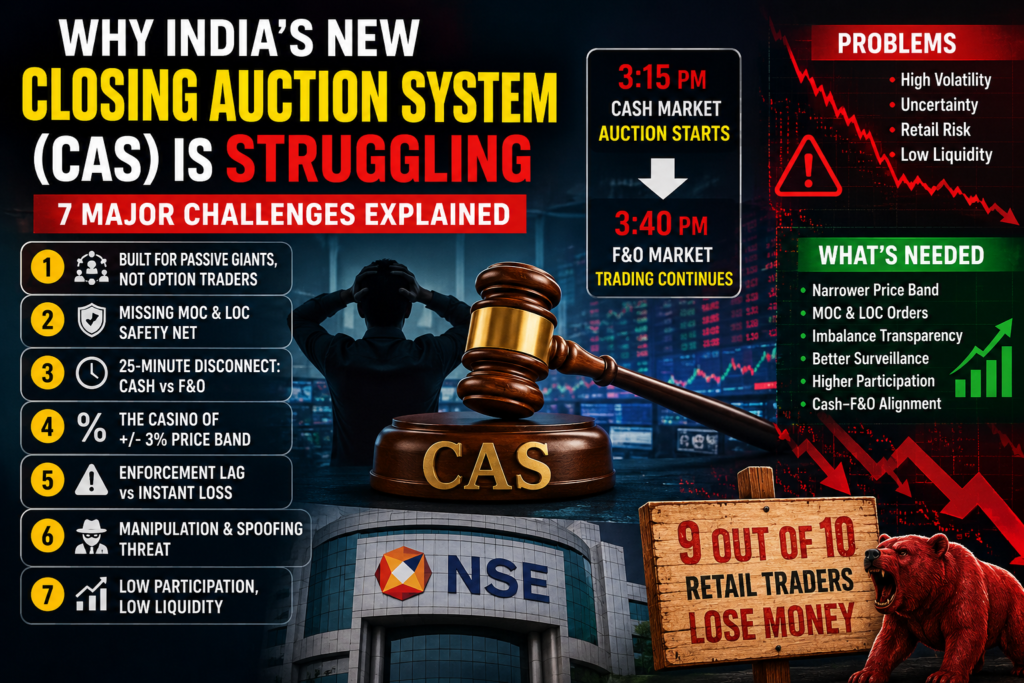
The Indian stock market recently introduced the Closing Auction System (CAS) with the objective of making the official closing price more transparent and globally aligned. While similar systems have been successfully used in the United States and Europe for years, India’s implementation has generated widespread debate among traders.
Many retail investors believe the new system has introduced greater uncertainty, unexpected price swings, and settlement risks, particularly for intraday traders and options participants.
The key question is:
Has India copied a global model without adapting it to Indian market conditions?
Let’s examine the biggest concerns.
What is the Closing Auction System (CAS)?
The Closing Auction System is a mechanism where the final market closing price is determined through an auction instead of simply taking the last traded price.
Participants place buy and sell orders during the auction window, and the exchange calculates a single equilibrium price where the maximum quantity can be matched.
Globally, this helps create:
- Better price discovery
- Lower closing volatility
- Fairer benchmark prices
- Improved execution for large institutional investors
However, success depends heavily on market structure and liquidity.
1. CAS Was Designed for Passive Investing, Not India’s Derivatives Market
The biggest structural difference between India and developed markets is the composition of market participants.
In countries like the US:
- Passive ETFs dominate trading volumes.
- Large index funds must execute at the official closing price.
- Institutions naturally provide auction liquidity.
India looks very different.
The country hosts one of the world’s largest derivatives markets by trading volume, while passive investing still represents a much smaller share of overall assets.
Early auction participation numbers also suggested that only a small fraction of active traders participated in the closing auction.
The result is a market where:
- Institutional investors benefit.
- Retail options traders face greater uncertainty.
- Liquidity remains concentrated among a limited group of participants.
2. India Adopted the Auction Without MOC and LOC Order Types
Developed exchanges don’t rely solely on the auction mechanism.
They also provide specialized order types such as:
- Market on Close (MOC)
- Limit on Close (LOC)
These orders guarantee execution at the official closing price or within specified limits.
In addition, mature exchanges publish auction imbalance information before the close, allowing liquidity providers to offset buy or sell pressure.
Currently, Indian traders have limited visibility into auction dynamics.
This creates several problems:
- Reduced transparency
- Lower confidence
- Less predictable execution
- Higher perceived execution risk
Without supporting infrastructure, the auction loses much of the efficiency seen in overseas markets.
3. The 25-Minute Cash–F&O Disconnect Creates Settlement Risk
One of the most debated aspects of India’s CAS is the temporary disconnect between the cash market and derivatives.
During the auction period:
- Cash market enters auction mode.
- Futures and options continue trading.
This creates a situation where:
- Spot price appears frozen.
- Derivatives continue moving.
- Traders cannot accurately estimate the final settlement price.
As a result:
- Option premiums fluctuate sharply.
- Hedge effectiveness declines.
- End-of-day risk increases.
For intraday traders, the final minutes become significantly more difficult to manage.
4. The ±3% Auction Price Band Appears Too Wide
Current auction rules permit bids within a relatively wide price range around the reference price.
While such flexibility may be useful during exceptional market conditions, critics argue that it can become problematic when auction liquidity is limited.
A wide permissible range combined with thin participation can produce:
- Large closing adjustments
- Sudden index movements
- Increased settlement uncertainty
- Reduced confidence among retail traders
Many market participants have suggested that a narrower auction band could improve price stability.
5. Retail Traders Lack Risk Management Tools Inside the Auction
Unlike continuous trading, auction sessions provide fewer opportunities for active risk management.
Common concerns include:
- No conventional stop-loss execution during the auction.
- Limited ability to react once orders are placed.
- Greater exposure to unexpected closing prices.
For smaller traders, this creates an asymmetric situation where institutional participants often possess superior execution capabilities.
6. Market Manipulation Concerns Remain
Every auction system must guard against practices such as:
- Spoofing
- Layering
- Artificial order placement
- Closing price manipulation
Although Indian exchanges maintain sophisticated surveillance systems, many traders remain concerned that enforcement actions often take considerable time after suspicious activity occurs.
This creates a perception gap:
- Financial losses occur immediately.
- Investigations may take months or even years.
- Retail confidence can suffer even when surveillance eventually identifies misconduct.
Strong real-time monitoring will remain essential for maintaining trust.
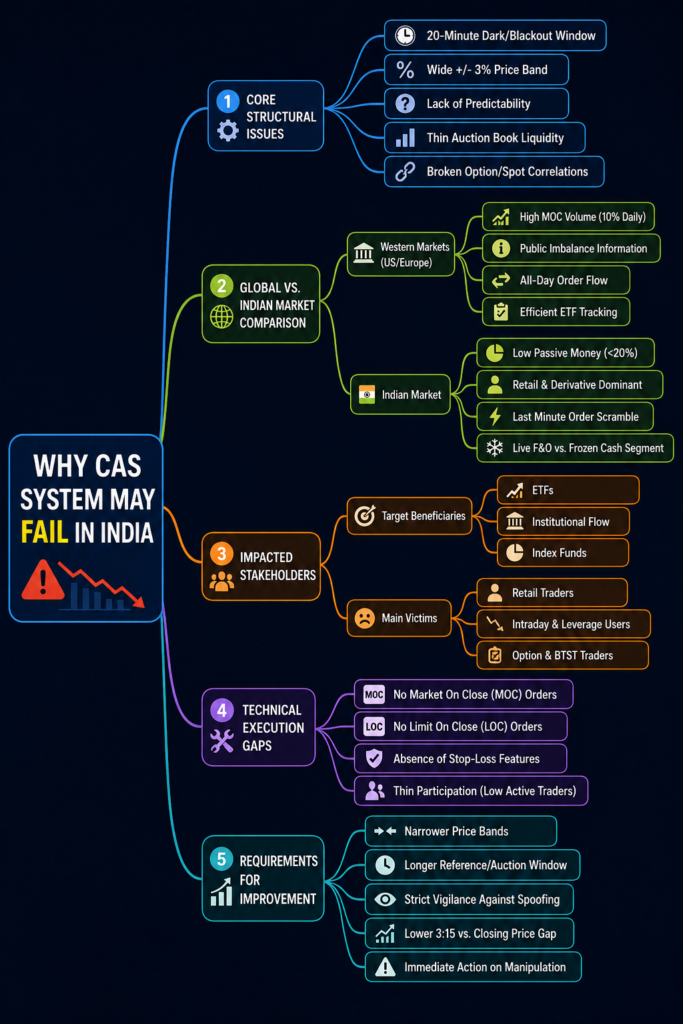
7. What Should Be Improved?
Several market experts have proposed practical improvements that could make India’s Closing Auction System more effective.
Potential reforms include:
- Narrowing the auction price band.
- Introducing MOC and LOC order types.
- Publishing auction imbalance information.
- Increasing auction participation through better market design.
- Enhancing real-time surveillance against spoofing.
- Improving coordination between the cash and derivatives markets.
These measures could reduce uncertainty while improving liquidity and price discovery.
Will CAS Eventually Benefit Indian Markets?
The Closing Auction System is not inherently flawed.
In many global markets, it has become a highly efficient mechanism for determining benchmark closing prices.
However, every market has unique characteristics.
India’s heavy derivatives participation, rapidly growing retail base, and different liquidity profile mean that simply replicating international practices may not produce identical results.
The long-term success of CAS will likely depend on whether policymakers continue refining the system based on market feedback and empirical data.
Final Thoughts
The objective behind India’s Closing Auction System is to improve price discovery and align domestic markets with global standards. However, its early implementation has highlighted several operational and structural challenges.
For retail traders, the key concerns remain liquidity, transparency, execution certainty, and effective risk management during the closing session.
As participation grows and the regulatory framework evolves, the system may mature into a more balanced mechanism. Until then, continued monitoring, incremental improvements, and open dialogue between regulators, exchanges, institutions, and retail investors will be essential.
FAQ
Is India’s Closing Auction System mandatory?
Yes. The official closing price is determined through the auction process according to exchange rules.
Why are retail traders worried about CAS?
Many traders believe limited liquidity, settlement uncertainty, and reduced risk-management flexibility make the closing session more difficult.
Does the US use a Closing Auction System?
Yes. Major US exchanges have used closing auctions for many years, supported by additional order types such as Market-on-Close (MOC) and Limit-on-Close (LOC).
Can CAS improve over time?
Yes. As participation increases and supporting infrastructure evolves, the system could become more efficient and predictable.
High-CTR, SEO-friendly title options are:
- Why India’s New Closing Auction System (CAS) Is Failing: 7 Major Problems Every Trader Must Know
- India’s Closing Auction System Explained: Why Retail Traders Are Worried
- SEBI’s New Closing Auction System: Benefits, Risks & Hidden Challenges
- Closing Auction System (CAS): How India’s New Market Rule Affects Nifty & Options, Traders
- Why India’s Closing Auction Is Creating Volatility: The Truth Behind CAS
- India’s New Closing Auction System: Is It Helping Institutions More Than Retail Traders?
- Closing Auction System in India: Everything You Need to Know Before Trading
- SEBI Closing Auction System Explained: Why Nifty’s Closing Price Has Become More Volatile
- The Truth About India’s Closing Auction System: Pros, Cons & Retail Impact
- India’s New Closing Auction System (CAS): 7 Reasons It Needs Immediate Improvements