
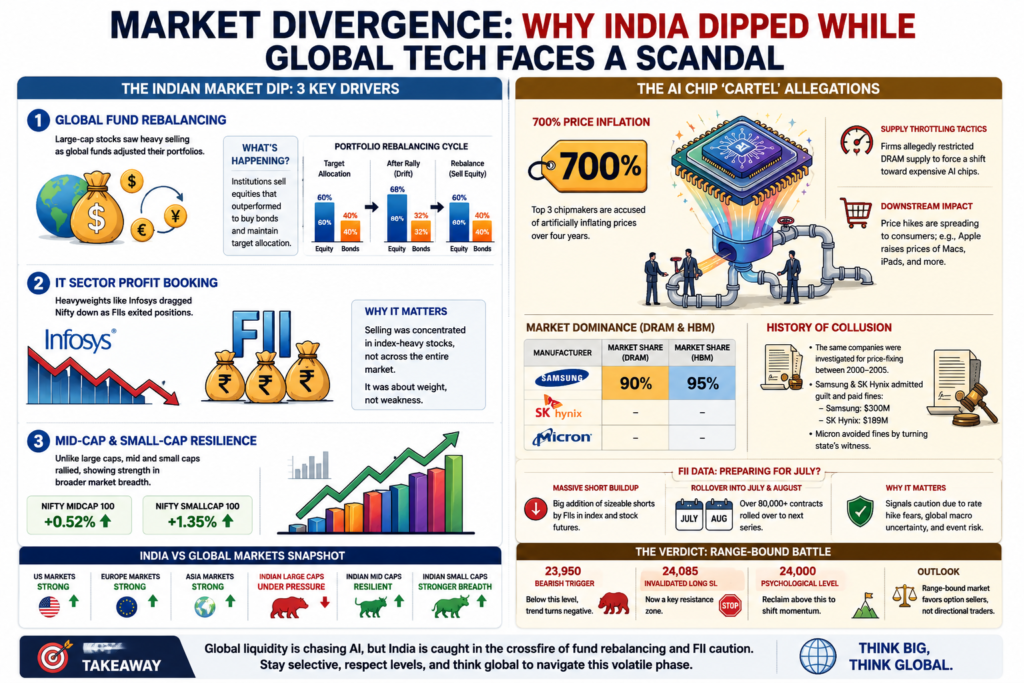
The Great Decoupling: Why Nifty Is Falling While Global Markets Keep Rising
Global markets are hitting fresh highs.
Artificial Intelligence stocks continue attracting billions of dollars.
The Nasdaq remains dominated by AI optimism.
Yet India’s benchmark indices have struggled to keep pace.
Is something fundamentally wrong with India?
Probably not.
The current divergence appears to reflect a combination of global portfolio rebalancing, foreign fund flows, sector rotation, and changing investor preferences, rather than a simple story of economic weakness.
Market Snapshot
| Indicator | Global Markets | India |
|---|---|---|
| AI Stocks | Strong | Mixed |
| Large Caps | Positive | Under Pressure |
| Mid Caps | Mixed | Relatively Resilient |
| Small Caps | Mixed | Stronger Breadth |
| FII Flow | Selective | Selling Pressure |
| DII Flow | Positive | Supportive |
What Is the Great Decoupling?
Normally…
When global markets rally…
India also participates.
This time, the picture looks different.
Global AI Rally

        │

US Markets ▲

Europe ▲

Japan ▲

        │

India ▼
The key question is:
Why?
1. Global Fund Rebalancing
Large institutional investors periodically rebalance portfolios.
When global equities outperform…
Funds reduce exposure in some regions to maintain target allocations.
India’s highly liquid large-cap stocks often feature in these adjustments.
Portfolio Rebalancing
Target Allocation

60% Equity

40% Bonds

       │

Equity Rally

       ▼

68% Equity

32% Bonds

       ▼

Sell Equities

Buy Bonds
2. Why Mid & Small Caps Look Stronger
Headline indices don’t always reflect the broader market.
Large-cap stocks carry the greatest weight in benchmark indices.
If a few heavyweight stocks decline…
The index can appear weak even when many stocks are advancing.
Market Breadth Illustration
| Segment | Performance Trend |
|---|---|
| Nifty Large Caps | Weak |
| Mid Caps | More Resilient |
| Small Caps | Mixed to Positive |
| Broader Market | Better Than Index |
Market Breadth Diagram
Large Caps ▼

Mid Caps ▲

Small Caps ▲

Nifty Index ▼
3. AI Is Driving Global Capital
Artificial Intelligence remains one of the biggest investment themes worldwide.
Major beneficiaries include:
- Semiconductor Manufacturers
- Cloud Providers
- Data Centers
- AI Infrastructure
- GPU Companies
- Networking Equipment
Global AI Investment Cycle
AI Demand

     │

Data Centers

     │

Semiconductors

     │

Memory Chips

     │

Cloud Infrastructure

     │

Corporate Spending
Semiconductor Market
| Segment | Importance |
|---|---|
| DRAM | High-Speed Memory |
| HBM | AI Memory |
| GPU | AI Computing |
| Foundries | Chip Manufacturing |
Demand for AI infrastructure has increased significantly, although supply constraints, pricing, and competitive practices remain subjects of industry debate and regulatory attention.
Semiconductor Pricing Debate
Recent legal complaints and regulatory reviews have raised questions about pricing practices within parts of the memory-chip industry.
These allegations have not been fully resolved, and investors should distinguish between ongoing legal claims and established findings.
Key areas under discussion include:
- Supply constraints
- Capacity allocation
- AI-driven demand
- Memory pricing
Global AI Spending
| Sector | Growth Driver |
|---|---|
| Cloud Computing | AI Models |
| Memory Chips | HBM Demand |
| GPUs | Training AI |
| Data Centers | Infrastructure Expansion |
| Networking | AI Clusters |
4. Why FIIs Matter
Foreign Institutional Investors influence market liquidity.
When FIIs reduce exposure…
Large-cap stocks generally experience greater pressure.
Domestic Institutional Investors (DIIs) can offset part of these flows, but not always completely.
Capital Flow
Global Funds

      │

FII Selling

      │

Large Caps

      │

Index Weakness

      │

DII Buying

      │

Partial Support
FII vs DII
| Investor | Current Trend |
|---|---|
| FIIs | Selective Selling |
| DIIs | Consistent Buying |
| Retail SIPs | Positive Flows |
5. Technical Outlook
Markets often move between support and resistance during periods of uncertainty.
Key indicators traders monitor include:
- Volatility Index (VIX)
- Market Breadth
- Open Interest
- Option Positioning
- Advance-Decline Ratio
Technical Flow
Higher VIX

      ▼

Higher Volatility

      ▼

Range-Bound Market

      ▼

Stock-Specific Opportunities
Market Risk Dashboard
| Indicator | Current View |
|---|---|
| FII Selling | 🔴 High |
| DII Support | 🟢 Positive |
| AI Valuations | 🟠 Elevated |
| Liquidity | 🟠 Moderate |
| Volatility | 🔴 High |
Sector Performance
Potential Beneficiaries
✔ AI Infrastructure
✔ Data Centers
✔ Power Utilities
✔ Select Industrials
✔ Export-Oriented Companies
Sectors Facing Headwinds
- Large-cap Technology (valuation-sensitive)
- Banking (foreign outflows)
- Consumer stocks (selective pressure)
Sector performance depends on company fundamentals and changing market conditions.
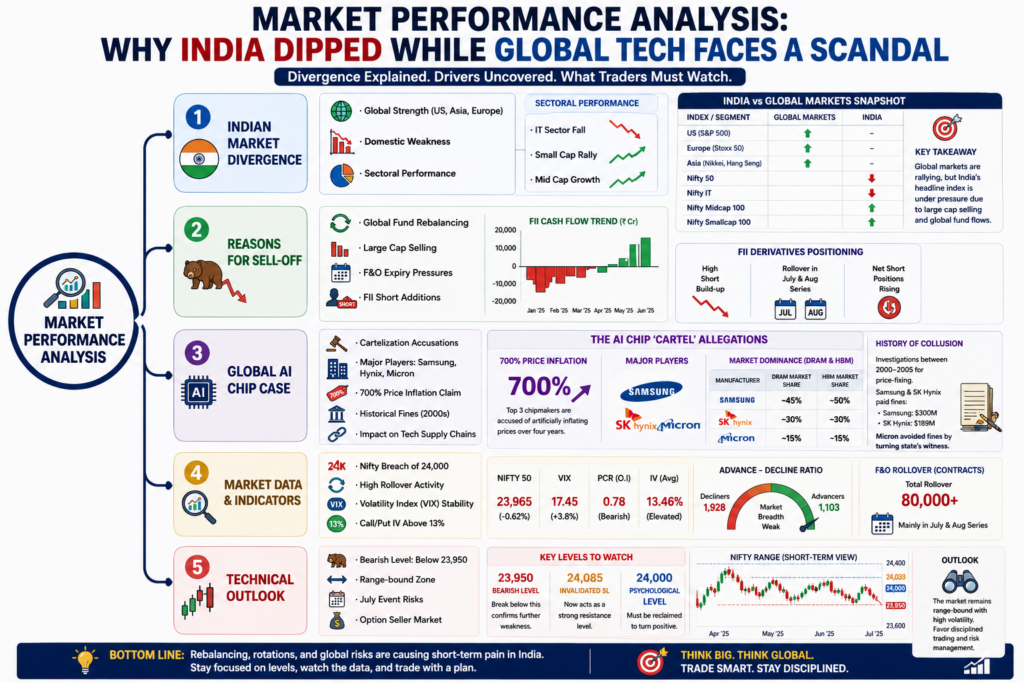
Risks Investors Should Monitor
Global Risks
- Interest Rates
- AI Valuation
- Semiconductor Supply
- Geopolitics
Domestic Risks
- FII Flows
- Corporate Earnings
- Rupee Movement
- Inflation
Investment Checklist
✅ Diversify Across Sectors
✅ Maintain Asset Allocation
✅ Review Valuations
✅ Avoid Chasing Momentum
✅ Monitor Global Liquidity
Frequently Asked Questions
Why is Nifty underperforming global markets?
Short-term underperformance can result from global fund rebalancing, foreign institutional investor flows, sector composition, and valuation differences.
Why do large-cap stocks fall first?
Large-cap stocks are more liquid, making them easier for institutional investors to buy and sell in significant volumes.
Is AI still a long-term growth theme?
Many analysts view AI as a significant long-term technology trend, though valuations and earnings expectations can create periods of volatility.
Should investors panic?
Short-term market divergence is common. Long-term investors generally benefit from focusing on diversification, asset allocation, and company fundamentals rather than reacting solely to short-term market movements.
Key Takeaways
✅ India’s recent underperformance does not necessarily reflect broad economic weakness.
✅ Portfolio rebalancing by global institutions can temporarily pressure benchmark indices.
✅ Large-cap weakness may coexist with resilience in broader market segments.
✅ AI remains a major global investment theme, but high valuations and industry developments warrant careful monitoring.
✅ Long-term investment decisions are often strongest when based on fundamentals, diversification, and disciplined risk management.
Final Thoughts
Markets rarely move for a single reason.
Today’s divergence between India and global markets reflects a complex mix of liquidity flows, institutional rebalancing, sector leadership, and evolving investor expectations.
Rather than focusing only on headline index movements, investors should monitor market breadth, earnings quality, global capital flows, and valuation discipline.
Periods of divergence often create both risks and opportunities—but patience and thoughtful portfolio construction remain the foundation of long-term investing.
Infographic Data
India vs Global Markets
Global Markets ▲

AI Boom ▲

Liquidity ▲

         │

India Large Caps ▼

Mid Caps ▲

Small Caps ▲
Investment Flow
AI Spending

      │

Chip Demand

      │

Global Capital

      │

FII Allocation

      │

Indian Large Caps

      │

Nifty Movement
Estimated Reading Time: 15–17 Minutes
🔥 Top 10 Titles
- The Great Decoupling: Why Nifty Is Falling While Global Markets Soar
- Why Nifty Is Bleeding While the World Celebrates an AI Boom
- The Great Decoupling: The Hidden Reason India Is Underperforming Global Markets
- Global Markets Are Rallying—So Why Is Nifty Falling?
- The AI Boom vs. Nifty Crash: The Truth Behind India’s Market Weakness
- Why Smart Money Is Leaving Nifty While AI Stocks Hit Record Highs
- The $Trillion AI Rally: Why India Isn’t Joining the Party
- The Hidden War Behind the AI Boom: Why Nifty Is Paying the Price
- Nifty vs. The World: The Great Market Divergence Explained
- The Great Decoupling: Why India’s Stock Market Is Breaking Away from the Global Rally