
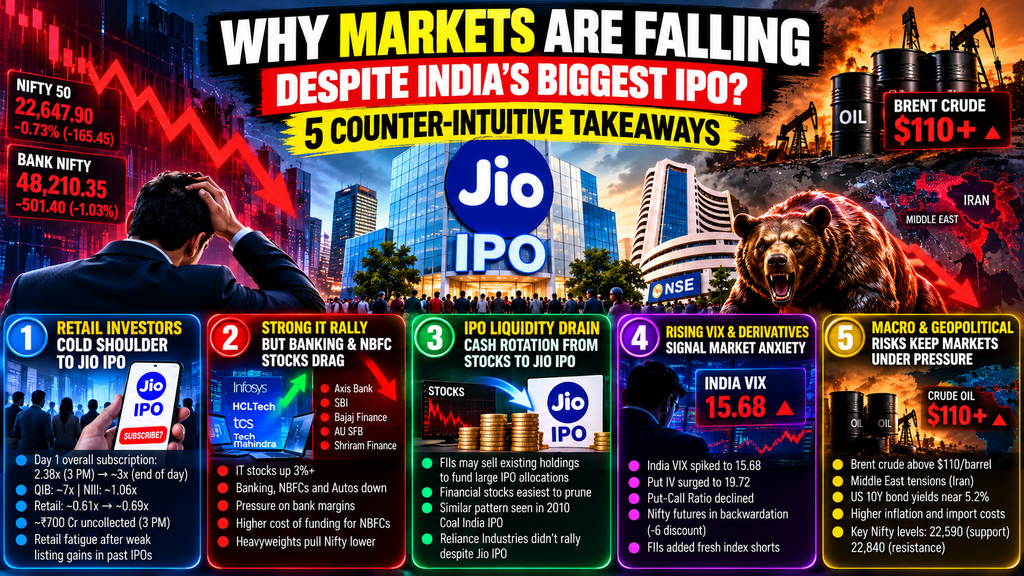
India’s stock market is facing a surprising contradiction. The much-anticipated Jio Platforms IPO has attracted substantial institutional demand, yet the launch has coincided with falling benchmark indices, rising volatility, and pressure across several major sectors.
Investors expected the country’s largest-ever IPO to generate excitement across Dalal Street. Instead, market participants have had to navigate a difficult combination of expensive crude oil, concerns about inflation, global geopolitical uncertainty and uneven sector performance.
On October 21, 2026, the Nifty IT index outperformed several other sectors, with Infosys, HCL Technologies and Tech Mahindra among the notable gainers. However, broader market breadth remained weak. The Nifty 50 closed around 22,811, and on October 22 it fell further amid renewed oil-price concerns and uncertainty surrounding the Middle East conflict.
The Jio Platforms IPO is an important development, but it does not automatically explain every market decline. The key is to distinguish the IPO’s confirmed subscription figures from the wider economic and market forces affecting investors.
Here are five important takeaways for investors and traders.
1. Jio IPO: Strong Institutional Demand, but Retail Participation Initially Lagged
The Jio Platforms IPO became one of India’s most closely watched primary-market events in October 2026. The issue opened on October 21 and is scheduled to close on October 23.
The IPO comprises a fresh issue of 27 crore shares, with a price band of ₹1,065–₹1,119 per share. At the upper end of the band, the issue size is approximately ₹30,213 crore.
Jio Platforms IPO: Key Details
| Particular | Details |
|---|---|
| Issue size | Approximately ₹30,213 crore |
| Price band | ₹1,065–₹1,119 per share |
| Fresh issue | 27 crore shares |
| Opening date | October 21, 2026 |
| Closing date | October 23, 2026 |
| Minimum retail lot | 12 shares |
| Minimum investment at upper price | ₹13,428 |
| Tentative listing date | October 28, 2026 |
Source: Jio IPO subscription reports and issue details published by HDFC Sky and NDTV Profit.
Day 1 subscription: Why the timing matters
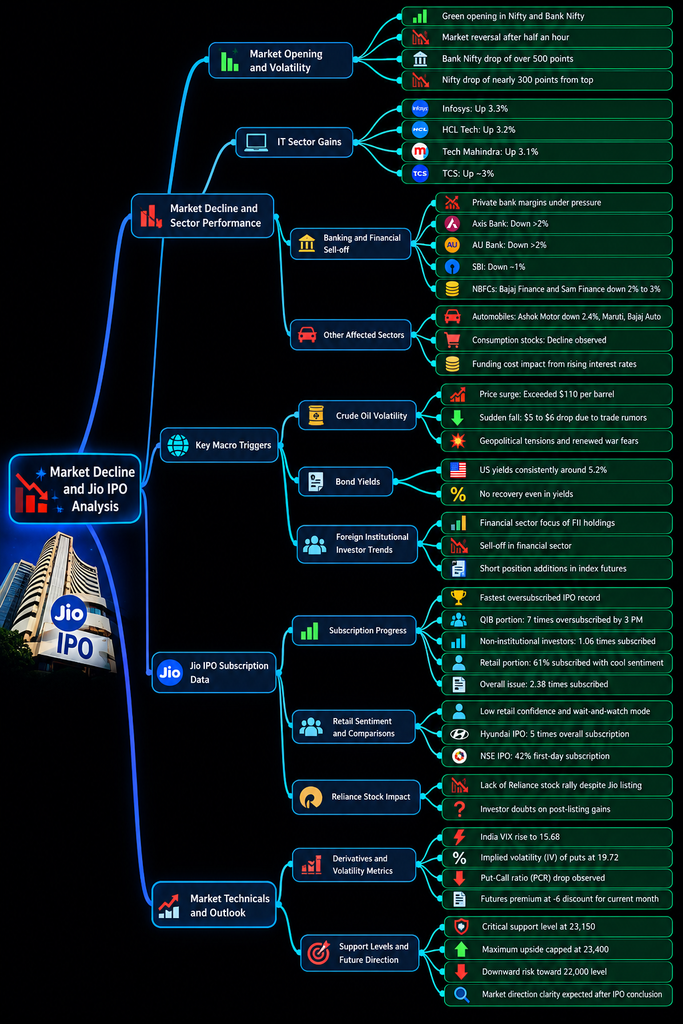
At 3 PM on October 21, HDFC Sky reported that the issue was subscribed 2.38 times, with qualified institutional buyers (QIBs) at approximately 7.09 times, non-institutional investors (NIIs) at 1.06 times, and retail investors at 0.61 times.
By the end of the day, later reports showed overall subscription of approximately 3 times, while the retail category remained below full subscription at roughly 0.69–0.73 times. These figures differ because they represent different reporting times.
The early subscription figures suggest that institutional demand was stronger than retail demand. However, this gap should not be interpreted as proof that retail investors had permanently lost confidence. Subscription figures can change throughout the issue period.
Subscription snapshot
| Investor category | Day 1 indication |
|---|---|
| QIBs, excluding anchor investors | Approximately 9.02x in later reports |
| NIIs | Approximately 1.59x |
| Retail investors | Approximately 0.69x |
| Overall issue | Approximately 3.02x |
Figures reflect later Day 1 reporting; exact multiples vary slightly by source and reporting time.
What does this mean for the stock market?
A large IPO can attract money that investors might otherwise allocate to existing shares. Some investors may also sell other holdings to arrange funds for an IPO application.
However, this is a possible liquidity channel—not proof that institutional investors sold banking stocks specifically to finance Jio applications. That conclusion would require supporting transaction or flow data.
Investor takeaway: Strong IPO subscription indicates demand for the new issue, but it does not guarantee a stock-market rally, listing gains or a particular direction for the Nifty.
2. A Strong IT Rally Could Not Offset Weakness Across Other Sectors
One of the most striking features of the October 21 trading session was the difference between the performance of technology stocks and the wider market.
Infosys, HCL Technologies and Tech Mahindra recorded gains of approximately 3% in the session, according to market reporting. Despite this strength, the benchmark indices struggled, and market breadth remained weak.
Sectoral divergence: What investors should understand
IT stocks: Technology shares received buying interest, helping the sector outperform the broader market.
Banking and financial stocks: Investors remained sensitive to earnings expectations, funding costs, margins and credit growth. Weakness in major financial stocks can have an outsized effect on benchmark indices because of their index weightings.
NBFCs: Non-banking financial companies can be particularly sensitive to funding costs, borrowing conditions and credit quality. However, the impact differs across companies depending on their liabilities, asset mix and ability to pass on higher costs.
Autos and consumer-facing stocks: These businesses may face pressure from slowing discretionary demand, input costs or company-specific earnings disappointments.
Why sector divergence matters
The Nifty 50 is not an equally weighted index. A strong rally in one sector cannot necessarily compensate for losses in other heavily weighted sectors.
For example, if IT shares rise but banking and other large index constituents fall, the benchmark may still close lower. The same pattern can occur when only a small number of stocks support the index while most shares decline.
This is why traders should monitor market breadth alongside index performance.
Useful indicators include:
- Advances versus declines on the NSE.
- Sectoral index performance.
- Heavyweight stock contributions to the Nifty.
- Trading volume during rallies and declines.
- Whether gains are broad-based or concentrated in a few stocks.
Investor takeaway: A green IT index does not automatically mean the broader market is healthy. Broad participation is a more useful sign of market strength than a rally led by a handful of stocks.
3. Is the Jio IPO Draining Liquidity From the Secondary Market?
A large IPO creates a primary-market event in which investors commit funds to a new share offering. This can influence the allocation decisions of investors who also trade in listed equities.
The mechanism is straightforward: an investor with a fixed amount of capital may need to choose between buying existing shares, maintaining cash,h or applying for a new issue.
When several large offerings arrive during a period of market weakness, the competition for available capital can become more noticeable.
How primary-market demand can affect listed stocks
- Portfolio reallocation: Some investors may reduce existing holdings to create cash for an IPO application.
- Temporary cash requirements: Investors may keep funds available while an application or allotment process is underway.
- Risk management: Institutional investors may adjust exposure across sectors while reassessing earnings, valuations, ns and market volatility.
- Sentiment effects: A major IPO can attract attention and trading activity even when the broader market is weak.
These are plausible channels, but the available subscription figures alone cannot establish that the Jio IPO caused the market decline.
Why Reliance Industries’ share price matters—but does not tell the whole story
Reliance Industries is closely associated with Jio Platforms, but the parent company’s stock price reflects multiple businesses, financial expectations, valuations and broader market conditions.
A lack of upward movement in Reliance shares does not independently prove that investors are rejecting Jio’s valuation or that institutions are selling existing stocks to fund the IPO.
To assess the liquidity hypothesis, investors should examine daily foreign portfolio investor (FPI) flows, domestic institutional investor (DII) flows, trading volumes and sector-level performance.
Investor takeaway: Treat the IPO liquidity-drain theory as one possible contributor to short-term market pressure, not as a confirmed explanation for the entire sell-off.
4. India VIX and Derivatives: What Rising Volatility Really Signals
Market volatility is another important factor to monitor during periods of falling indices and geopolitical uncertainty.
India VIX, often described as the market’s fear gauge, measures the market’s expectations of near-term Nifty volatility based on options prices. A rising VIX generally indicates that options markets are pricing in greater uncertainty.
On October 21, India VIX rose approximately 6.1% to 15.68, according to market data reported that day. On October 22, the index moved higher during early trading as crude oil prices and geopolitical risks weighed on sentiment.
Four derivative indicators worth watching
1. India VIX
A rising VIX indicates higher expected volatility, not necessarily a guaranteed market crash. It can rise during sharp declines, uncertain consolidations,ons or periods when investors are paying more for protection.
2. Put implied volatility
Higher put-option implied volatility can indicate stronger demand for downside protection. However, it should be compared across strikes and expiries before concluding.
3. Put-call ratio (PCR)
PCR can provide clues about options positioning, but its interpretation depends on whether it is calculated using open interest or traded volume, which contracts are included, and how market makers hedge their exposures. A falling PCR alone does not prove that a major decline is coming.
4. Futures premium and discount
Futures trading below the spot index can reflect bearish positioning, financing effects, dividend expectations, or expiry-related dynamics. A futures discount is not sufficient evidence that institutions are rolling over short positions.
Important note about the derivative figures
The original draft mentions put IV of 19.72, a current-month futures discount of six points, a next-month premium of 28 points and 2,700 additional index short contracts. These precise figures have not been independently verified here against a timestamped NSE derivatives report.
They should not be published as confirmed institutional signals without checking the relevant contract, expiry, timestamp,p and official open-interest data.
Investor takeaway: Use volatility and derivatives to understand risk and positioning, not to claim that the market has certain knowledge of an impending event.
5. Crude Oil Above $110: The Macro Risk That Could Keep Markets Under Pressure
Crude oil is a major macroeconomic variable for India because the country depends heavily on imported energy.
On October 22, Brent crude traded above $110 per barrel amid concerns about Middle East supply disruptions. Reuters reported that Indian equities declined for a third consecutive session as higher oil prices increased inflation concerns.
The same report said the Nifty 50 fell 0.73% to 22,647.90 and the Sensex declined 0.49% to 73,343.98 at the close. Fifteen of sixteen major sectoral indices ended lower, while small-cap and mid-cap indices also fell.
Why higher crude prices matter
Inflation: Higher energy prices can raise transportation, manufacturing and distribution costs.
Trade balance: An increased oil import bill can widen India’s merchandise trade deficit if other factors do not offset the increase.
Rupee pressure: Higher dollar demand for oil imports can add pressure to the currency, although exchange rates are affected by many other factors.
Corporate earnings: Airlines, tyre makers, paint manufacturers and logistics companies can face higher costs. The actual impact depends on pricing power, hedging and the ability to pass costs on to customers.
Interest-rate expectations: If oil prices cause persistent inflation, markets may reassess the likely path of monetary policy.
The Reserve Bank of India’s policy outlook is particularly important. Reuters reported that minutes from the latest monetary policy meeting showed discussion of the possibility of further rate increases to address inflation, although policymakers also acknowledged risks to economic growth.
What should investors track?
- Brent crude’s sustained direction.
- Developments affecting shipping through the Strait of Hormuz.
- The USD/INR exchange rate.
- Inflation and trade data.
- RBI communications and bond yields.
- Earnings guidance from oil-sensitive sectors.
Oil prices can change quickly as supply conditions and geopolitical risks evolve. A price above $110 is a meaningful risk indicator, but it does not guarantee a market crash.
Nifty 50 Technical Outlook: Updated Levels Matter
The original draft identifies 23,150 as critical support and 23,400 as resistance. Those levels should not be presented as the current trading framework without qualification.
By October 22, the Nifty had moved well below 23,150. Reuters reported a close of 22,647.90, while market commentary published earlier that day identified 22,590 as a near-term level to watch and 22,840 as a level that could help confirm a recovery.
Technical levels: A framework, not a forecast
| Level | Interpretation |
|---|---|
| 22,590 | Near-term support area cited in October 22 market commentary |
| 22,840 | Recovery confirmation area cited in the same commentary |
| 23,150 | Earlier level from the original draft; no longer near the current spot price |
| 23,400 | Earlier upside reference from the original draft; requires fresh chart validation.on |
These are reference levels from published commentary, not guaranteed turning points. Traders should recalculate support and resistance using the latest completed session’s high, low and close, along with relevant intraday price action.
A decisive move below support can increase downside risk, but the next target should not be assumed without examining the chart structure, volume and market conditions.
Conclusion: The Jio IPO Is Important, but It Is Not the Whole Market Story
The simultaneous launch of a major IPO and a market decline creates a compelling headline, but the two events should not automatically be treated as cause and effect.
The available evidence points to several overlapping factors: uneven sector performance, higher crude oil prices, rising volatility, inflation concerns and uncertainty surrounding global geopolitics.
The Jio IPO subscription data shows strong institutional demand alongside initially weaker retail participation. Subsequent subscription updates also show that investor interest evolved as the issue progressed. Neither development, by itself, predicts how the Nifty will perform.
For investors, the most useful approach is to monitor the evidence rather than follow a single narrative.
Watch market breadth, foreign and domestic institutional flows, oil prices, earnings announcements and updated technical levels. Avoid leveraged trades based solely on the IPO headline or a single derivatives indicator.
The key question is not simply whether the Jio IPO can attract investors. It is whether India’s broader market can regain support from earnings, valuations and improving macroeconomic conditions.
What is your view on the current market: is this a temporary correction or a sign of deeper weakness? Share your analysis and risk-management approach in the comments.
Frequently Asked Questions
1. Why did the Indian stock market fall during the Jio IPO?
The market decline coincided with the IPO, but available evidence does not prove that the IPO caused the fall. Higher crude oil prices, inflation concerns, geopolitical uncertainty, and sector-level selling were also important factors.
2. What was the Jio Platforms IPO subscription on Day 1?
At 3 PM on October 21, the issue was reported as subscribed 2.38 times. Later reports placed the final Day 1 subscription at approximately 3 times, with the retail category below full subscription.
3. Does strong QIB demand guarantee Jio IPO listing gains?
No. Subscription demand does not guarantee listing gains. Listing performance depends on valuation, market conditions, investor expectations, and demand when trading begins.
4. What does a rising India VIX indicate?
A rising India VIX generally indicates higher expected near-term volatility. It does not independently predict the direction or size of the next market move.
5. Why is crude oil above $110 a concern for India?
Higher oil prices can increase import costs and inflation, and pressure on the rupee, while affecting margins in oil-sensitive sectors. The final impact depends on how long prices remain elevated.
6. Is 23,150 still the current Nifty support level?
It was a level mentioned in the original draft, but the Nifty moved below it before the October 22 close. Investors should use updated charts and current price data rather than rely on an outdated support level.
Disclaimer
This article is for educational and informational purposes only. It is not investment advice or a recommendation to buy or sell any security or derivative. Market prices and technical levels can change rapidly. Verify all figures against official exchange data and consult a qualified financial adviser before making investment decisions. Securities-market investments are subject to market risks.
Top 10 SEO Titles
- Why Is the Stock Market Falling Despite the Jio IPO? 5 Key Reasons
- Jio IPO 2026: Why the Indian Stock Market Is Falling
- Nifty 50 Today: 5 Reasons Behind the Market Sell-Off During the Jio IPO
- Jio IPO Analysis 2026: Institutional Demand vs Stock Market Weakness
- Indian Stock Market Crash 2026? Jio IPO, Crude Oil and FII Selling Explained
- Jio IPO Subscription Status: Why Strong Demand Isn’t Lifting the Nifty
- India VIX Rises as Nifty Falls: 5 Market Signals Investors Should Watch
- Crude Oil Above $110: How Rising Oil Prices Are Hurting Indian Stocks
- Jio IPO vs Nifty 50: 5 Surprising Truths About India’s Stock Market
- Nifty 50 Outlook 2026: Jio IPO, Banking Stocks and Global Market Risks