
Nifty 50, Fed Rate Hike Risk, Crude Oil and HDFC Bank: Why September Could Be a Volatile Month
The Indian stock market entered the final days of August with a very different setup from what investors had expected just a few sessions earlier.
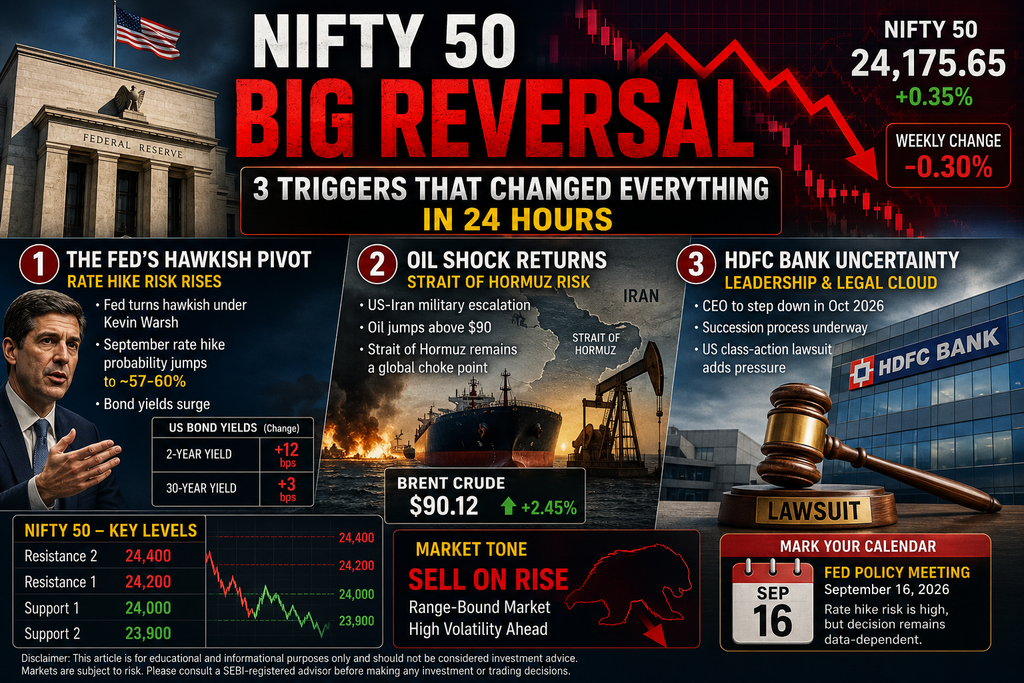
The Nifty 50 closed at 24,175.65 on August 28, gaining 0.35% on the day but still recording its third consecutive weekly decline, down around 0.3% for the week. More importantly, the index remained trapped below the important 24,200–24,400 resistance zone, while 24,000 continued to act as a critical psychological and technical level.
Then came three fresh catalysts:
- A sharply more hawkish Federal Reserve tone
- A renewed US-Iran escalation around the Strait of Hormuz
- A major leadership transition at HDFC Bank
Together, these developments have changed the risk-reward equation for Indian equities going into September.
1. The Fed Has Turned Hawkish — But a September Hike Is Not Yet a Done Deal
The biggest global trigger came from Federal Reserve Chair Kevin Warsh’s Jackson Hole speech.
Warsh emphasized that inflation has not yet made sufficient progress toward the Fed’s 2% objective. He also argued that financial conditions are not sufficiently restrictive and stressed that short-term interest rates remain the primary policy tool.
The important message was not an explicit promise to hike rates.
It was the warning that another rate increase is possible if inflation fails to improve.
Market expectations changed rapidly after the speech.
Before the Jackson Hole remarks, market pricing put the probability of a September hike at roughly 35%. After the speech, it moved to around 57%, with some subsequent pricing putting the probability above 60%.
That is a major repricing.
Why does this matter for India?
Higher US interest rates can create pressure through several channels:
- Stronger dollar
- Higher US Treasury yields
- Pressure on emerging-market currencies
- Potential FII outflows
- Higher global funding costs
- Reduced appetite for expensive equities
For India, the biggest concern is the combination of higher crude + higher US rates.
That combination can pressure both the rupee and corporate margins.
The important September date
The next major Fed decision is scheduled for September 16, 2026.
But investors should not assume that a hike is guaranteed.
The upcoming US inflation and employment data could still change expectations. Several economists have argued that the September decision remains data-dependent.
Therefore, the correct market message is not “September hike is confirmed.”
It is:
The probability of a September hike has risen sharply, and that risk is now being priced into global markets.
2. The Oil Shock Is Back: Strait of Hormuz Becomes the Biggest Wildcard
The second major trigger is crude oil.
The market had started to become comfortable with lower oil prices. But the situation changed rapidly after renewed military action between the US and Iran.
On August 31, US forces struck Iranian launchers on Larak Island in the Strait of Hormuz, while Iran reportedly retaliated against US bases in Jordan.
Oil immediately reacted.
Brent crude moved back above $90 per barrel, while WTI moved above $86 during Monday’s trading.
This is important because the Strait of Hormuz is one of the world’s most critical energy corridors.
Reuters reported that before the war, roughly one-fifth of global oil flows passed through the strait. Shipping traffic has subsequently become much more cautious, with visible commodity-vessel movements falling sharply.
The Oil Mirage
The recent decline in crude should therefore not automatically be interpreted as a permanent return to lower oil prices.
The market is balancing two opposing forces:
Bearish for oil:
- Weakening Chinese demand
- Higher global supply expectations
- Additional Venezuelan production
- Demand destruction from expensive energy
Bullish for oil:
- Strait of Hormuz risk
- US-Iran military escalation
- Reduced tanker traffic
- Potential supply disruption
- Geopolitical risk premium
Reuters’ latest analyst survey still sees Brent averaging around $85.08 per barrel in 2026, but also highlights persistent supply disruption risks and a market deficit.
That means oil does not necessarily need to remain above $90 to hurt Indian equities.
Even a sustained move toward $90–95 could become uncomfortable for India.
3. HDFC Bank: The Corporate Governance Story Gets Bigger
The third trigger is domestic—and potentially more important for the Indian banking sector.
HDFC Bank CEO Sashidhar Jagdishan has decided not to seek another term and will step down in October 2026. The bank is now accelerating its succession process and considering both internal and external candidates.
This comes after months of governance and leadership uncertainty.
Reuters reported that HDFC Bank shares had fallen around 27% from the beginning of the year by August 30, with the bank facing investor concerns over governance, leadership and post-merger performance.
The bank is now considering candidates including Deputy Managing Director Kaizad Bharucha as well as an external candidate, with the eventual appointment subject to RBI approval.
Why HDFC Bank matters to Nifty
HDFC Bank is not just another stock.
It is one of India’s largest private-sector banks and a major heavyweight in the benchmark indices.
Therefore, any prolonged uncertainty around:
- CEO succession
- Governance
- Regulatory scrutiny
- Legal issues
- Asset quality
- Post-merger performance
can influence broader market sentiment.
There is also a US class-action lawsuit related to alleged illegal payments that HDFC Bank has said is without merit and that it intends to defend.
The combination of legal headlines and leadership transition explains why HDFC Bank has become a major market focus.
Interestingly, the stock showed resilience on August 31, with reports indicating shares rose around 2.7% to ₹739.50, suggesting that some investors may view the leadership uncertainty as becoming more manageable now that the succession process is clearly underway.
So this is not necessarily a one-way bearish story.
It is a high-volatility governance story.
4. Nifty Technical Setup: 24,000 Is the Battlefield
Now comes the most important question for traders:
What does all of this mean for Nifty?
The technical structure remains range-bound.
Recent market analysis has repeatedly highlighted 24,000 as critical support, while the broader resistance zone remains around 24,200–24,400.
The latest weekly close was:
Nifty 50
24,175.65
Immediate support
24,000
Major downside trigger
23,900
Immediate resistance
24,200
Stronger resistance
24,400
The market therefore remains stuck in a compression zone.
5. What Happens If Nifty Breaks 24,000?
This is the level traders should watch closely.
If Nifty decisively breaks below 24,000, the market could enter another downside phase.
A move below 23,900 would be technically more significant because it would indicate that the recent consolidation is breaking on the downside. Analysts have also highlighted 23,900 as an important downside threshold.
The potential sequence could then become:
24,000 → 23,900 → 23,700 → 23,500
These are scenario levels, not guaranteed targets.
The speed of the decline would depend heavily on:
- FII flows
- Crude oil
- USD/INR
- US Treasury yields
- Fed expectations
- India VIX
- Option-chain positioning
6. What Happens If Nifty Reclaims 24,200?
The bearish thesis becomes weaker if Nifty can reclaim and sustain above 24,200.
A sustained move above 24,200–24,400 would suggest that the index is attempting to break out of the current consolidation range. Analysts have identified this zone as the key area that needs to be cleared for renewed strength.
Therefore, the market has a very simple technical battle:
Below 24,000
Bearish pressure increases
24,000–24,200
Choppy / range-bound zone
Above 24,200
Recovery attempt
Above 24,400
Bullish breakout confirmation becomes stronger
7. The Hidden Fourth Trigger: MSCI Rebalancing
There is another event that traders should not ignore.
The MSCI index rebalancing became effective after the August 31 market close, creating the possibility of concentrated passive-fund flows and unusual closing-session volatility.
This matters because large institutional orders can temporarily distort prices.
Therefore, a sharp move around the closing auction should not automatically be interpreted as a genuine trend reversal.
The market needs to distinguish between:
Index-flow volatility
and
fundamental selling pressure.
That distinction becomes particularly important around major rebalance dates.
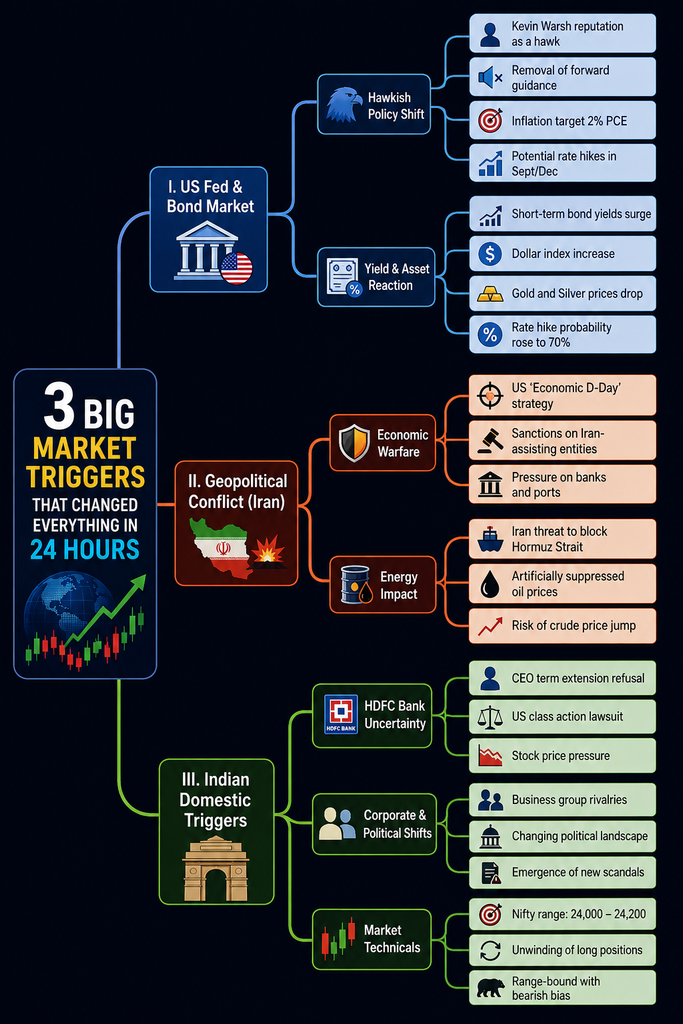
8. The Bigger Picture: Three Risks Are Now Moving Together
The real danger is not any single headline.
It is the interaction between the three.
Risk 1 — Fed
Higher probability of a rate hike
↓
Higher US yields
↓
Stronger dollar
↓
Pressure on emerging markets
Risk 2 — Oil
Hormuz escalation
↓
Higher crude
↓
Higher Indian import bill
↓
Margin and inflation pressure
Risk 3 — HDFC Bank
Leadership transition + legal/governance headlines
↓
Pressure on a major index heavyweight
↓
Potential impact on financial-sector sentiment
When these three risks appear together, market volatility can increase disproportionately.
9. September Could Become a “Data vs Geopolitics” Market
The biggest mistake traders can make now is to trade only one narrative.
September could be driven by two competing forces:
Bullish scenario
- US inflation cools
- Fed remains on hold
- Crude retreats below $85
- Hormuz tensions ease
- FII selling slows
- Nifty reclaims 24,400
In that case, the current weakness could turn into a powerful relief rally.
Bearish scenario
- US inflation remains sticky
- Fed hike probability rises further
- Treasury yields move higher
- Crude stays above $90
- Hormuz tensions escalate
- Rupee weakens
- Nifty loses 24,000
In that scenario, the market could see another leg lower.
10. Final Verdict: Sell on Rise or Buy on Dip?
At the current level, blindly calling the market either “bullish” or “bearish” is risky.
The better framework is level-based trading.
Bearish below 24,000
If Nifty breaks 24,000 and sustains below it, traders should be prepared for increased downside volatility.
Neutral between 24,000–24,200
This is the highest-risk zone for false breakouts and stop-loss hunting.
Bullish above 24,400
A sustained breakout above 24,400 would weaken the immediate bearish structure and could trigger short covering.
Therefore, the current market is better described as:
Range-bound with a bearish risk bias until Nifty decisively reclaims the 24,200–24,400 zone.
The phrase “Sell on Rise” can still work as a tactical strategy while Nifty remains below major resistance, but it should not be treated as an unconditional rule.
Conclusion: The September Countdown Has Started
The market has not necessarily entered a permanent bearish trend.
But the comfortable bullish narrative that dominated earlier has clearly become harder to defend.
The Federal Reserve is signaling that inflation remains a problem. The probability of a September rate hike has risen sharply, although the decision remains data-dependent.
At the same time, renewed US-Iran fighting has pushed Brent crude back above $90 and revived fears surrounding the Strait of Hormuz.
And domestically, HDFC Bank is entering a major leadership transition just as investors are already questioning governance and post-merger performance.
For Nifty traders, the map is therefore simple:
24,400 = Bulls’ confirmation zone
24,200 = Immediate resistance
24,000 = Critical battlefield
23,900 = Breakdown warning
September could ultimately become a battle between Fed policy, crude oil, institutional flows and technical levels.
And that means one thing:
Volatility is likely to remain the dominant theme.
Disclaimer
Disclaimer: This article is for educational and informational purposes only and should not be considered investment advice, financial advice, or a recommendation to buy or sell any stock, index, futures, options, cryptocurrency, or other financial instrument. Market data, projections, technical levels, probabilities, and scenarios mentioned in this article are subject to change and may become outdated without notice.
Financial markets are inherently risky, and past performance does not guarantee future results. Readers should conduct their own research and consider their financial objectives, risk tolerance, and investment horizon before making any trading or investment decision.
The views and analysis expressed in this article represent the author’s interpretation of available information and are not a guarantee of future market performance. Trading derivatives, including futures and options, involves substantial risk and can result in significant losses.
The author and publisher shall not be held responsible for any direct or indirect loss arising from decisions made based on the information presented in this article. Readers are strongly advised to consult a SEBI-registered investment adviser or qualified financial professional before making investment decisions.
10 title options:
- Nifty Market Reversal: 3 Big Triggers That Could Change Everything in September
- Nifty 50 Big Reversal: Fed, Oil & HDFC Bank Trigger Fresh Market Risk
- Nifty September Outlook: 3 Major Risks Every Investor Must Watch
- Nifty 50 Under Pressure: Fed Rate Hike, Oil Shock & HDFC Bank Crisis Explained
- Why Nifty Is Turning Bearish: 3 Triggers Shaking the Indian Stock Market
- Nifty 50 Prediction September 2026: Key Levels, Fed Risk & Crude Oil Outlook
- Stock Market Big Twist: Fed, Iran War & HDFC Bank Could Trigger Nifty Volatility
- Nifty at 24,000: Breakout or Breakdown? 3 Signals Traders Must Watch
- Nifty Bearish Setup? Fed Rate Hike Risk, Crude Oil & HDFC Bank in Focus
- The Great Nifty Reversal: 3 Global & Domestic Triggers Behind the Market Volatility