
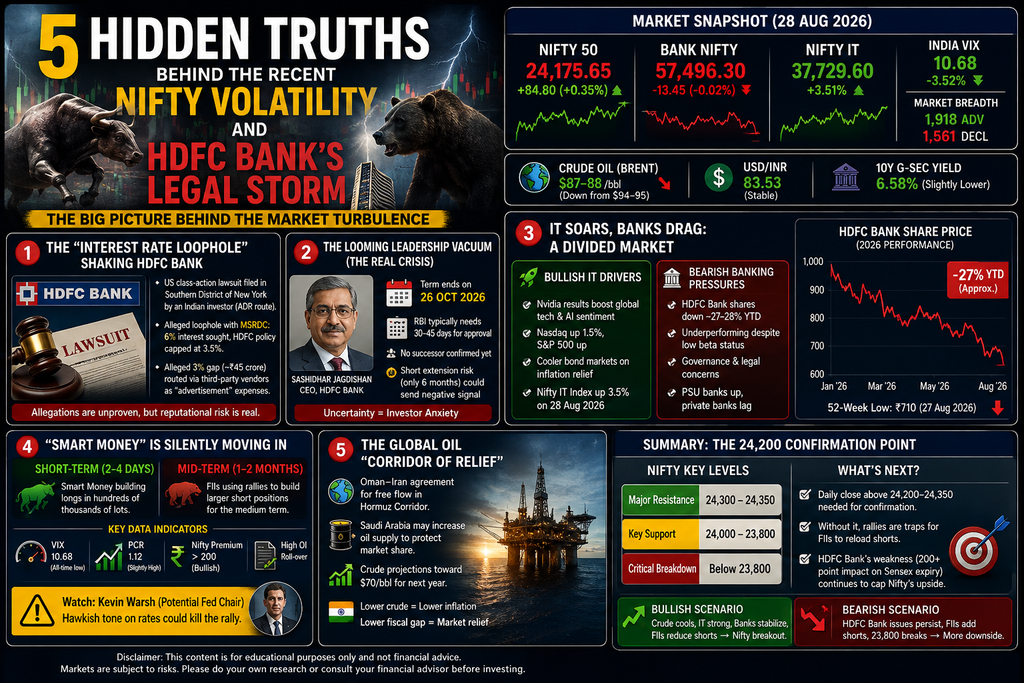
The Indian stock market is entering a phase where sector rotation, corporate governance and global macro risks are becoming more important than headline earnings.
Nifty has been struggling around the 24,000–24,200 region, while one of its biggest heavyweight stocks, HDFC Bank, has faced an unusually sharp deterioration in investor sentiment.
But there is a crucial distinction between a weak stock and a weak bank.
HDFC Bank’s latest operating numbers remain relatively resilient. In Q1 FY27, the bank reported a 5% year-on-year increase in net profit to ₹19,060 crore, loan advances grew 15.4%, deposits increased 13.3%, and gross NPA stood at 1.17%. Net interest margin was 3.26%.
So why is the stock under so much pressure?
The answer lies in governance, valuation, leadership transition, and investor confidence.
1. The HDFC Bank Legal Case: What Investors Actually Need to Know
The first major risk is the US securities class-action lawsuit involving HDFC Bank and certain senior executives.
The allegations relate to approximately ₹45 crore of payments connected with Maharashtra State Road Development Corporation (MSRDC).
According to the allegations described in the lawsuit, HDFC Bank is accused of using marketing/sponsorship payments to effectively compensate for an above-market deposit rate offered to MSRDC. The complaint alleges that the arrangement involved a roughly 6.01% interest rate, compared with the bank’s standard rate, with the difference allegedly routed through marketing-related payments.
But there is an important caveat.
These are allegations contained in litigation—not proven findings of wrongdoing.
That distinction matters enormously for investors.
The financial amount itself is relatively small compared with HDFC Bank’s balance sheet.
The bigger issue is:
Governance credibility.
A bank can easily absorb a ₹45-crore financial impact.
What markets struggle to absorb is uncertainty around:
- Internal controls
- Compliance
- Management accountability
- Disclosure standards
- Regulatory oversight
- Leadership credibility
That’s why a relatively small alleged transaction can create a disproportionately large impact on the stock.
2. The Real Shock: HDFC Bank’s CEO Is Actually Leaving
This is where the original thesis needs an important update.
Earlier, the market was speculating about whether CEO Sashidhar Jagdishan would receive another term.
That uncertainty has now been resolved.
HDFC Bank announced on August 29 that Jagdishan will not seek reappointment and will retire when his current term ends on October 26, 2026.
This is significant because Jagdishan has led the bank since 2020, including the transformational merger with HDFC Ltd.
The bank’s board has said it will fast-track the search for his successor.
Reuters reports that the bank is considering Deputy Managing Director Kaizad Bharucha as well as an external candidate.
Why does this matter?
Because HDFC Bank isn’t merely replacing a CEO.
It is replacing the person who has been associated with the post-merger integration period.
Investors therefore want answers to three questions:
1. Who will replace him?
2. Will the new CEO maintain the same strategy?
3. Will the new leadership change the bank’s approach to growth, deposits and margins?
Until those questions become clearer, the stock can continue to trade with a governance discount.
3. The Stock Has Already Paid a Massive Price
The market has not ignored these risks.
HDFC Bank has dramatically underperformed the broader market in 2026.
According to Business Standard, the stock was down around 25.85% YTD as of August 5, while later reports showed the decline approaching 27–28%.
On August 27, HDFC Bank touched approximately ₹710, its lowest level in more than two years, before closing around ₹712. The stock was down roughly 28.14% YTD at that point.
Another report estimated that more than ₹4 lakh crore of market capitalisation had been erased from the bank during the decline.
This creates an interesting investment dilemma.
Is the stock cheap?
Or:
Is the market correctly pricing a structural problem?
That is the central question.
4. The Biggest Contradiction: Weak Stock, Strong Balance Sheet
This is perhaps the most important hidden truth.
HDFC Bank’s stock performance looks extremely weak.
But its operating data does not resemble a distressed bank.
Q1 FY27 snapshot
| Parameter | HDFC Bank |
|---|---|
| Net Profit YoY | +5% |
| Loan Growth | +15.4% |
| Deposit Growth | +13.3% |
| NIM | 3.26% |
| Gross NPA | 1.17% |
| Provisions YoY | -78% |
| Treasury & Fee Income QoQ | -41% |
This tells us something important.
The current problem is not simply “HDFC Bank is financially collapsing.”
Instead, the market is assigning a much higher weight to:
Governance + leadership + valuation + post-merger expectations.
5. The Post-Merger Problem Has Become a Valuation Problem
The 2023 HDFC Ltd–HDFC Bank merger created one of India’s largest financial institutions.
But investors have increasingly questioned whether the merger has produced the expected acceleration in growth and profitability.
The bank’s Q1 FY27 numbers showed loan growth of 15.4% and deposit growth of 13.3%, but its NIM at 3.26% remained below historical pre-merger levels.
This is important because the market had historically valued HDFC Bank as a premium-quality compounder.
When a premium stock starts delivering merely average growth, the valuation premium can compress.
That creates a dangerous combination:
Lower growth + lower valuation multiple = significant share-price correction.
This may explain why the stock has fallen much more than the broader market.
6. HDFC Bank Is Too Large for Nifty to Ignore
There is another reason the stock matters so much.
HDFC Bank carries one of the highest weights in India’s major benchmark indices. A recent report placed its Nifty 50 weight at approximately 10.27%.
That means HDFC Bank isn’t just another banking stock.
It is effectively an index-level variable.
When HDFC Bank falls sharply:
HDFC Bank ↓
→ Bank Nifty pressure
→ Financial-sector sentiment ↓
→ Nifty heavyweight pressure
→ Sensex/Nifty performance deteriorates
This is why the HDFC Bank story can become a broader market story.
7. IT vs Banking: India’s Market Is Splitting Into Two Stories
At the same time, the IT sector has been showing very different behaviour.
On August 28, Nifty IT surged approximately 3.5%, helped by strong global technology sentiment after Nvidia’s earnings. Meanwhile, HDFC Bank declined around 0.9%.
This creates an unusual market structure.
IT
AI + Nasdaq + global tech optimism
↓
Technology stocks outperform.
Banks
Governance + leadership + credit-cycle concerns
↓
Financial stocks struggle.
This sectoral divergence explains why Nifty can appear relatively weak even when individual sectors are performing extremely well.
8. The “Smart Money” Story Needs More Evidence
The original thesis argues that smart money is building short-term longs while FIIs are building larger medium-term shorts.
This is a useful hypothesis, but it should not be presented as a confirmed fact without current F&O positioning data.
A stronger analytical framework is:
Watch four things together:
FII index futures positioning
Put/Call open interest.t
India VIX
Nifty price structure
If price rises while:
- VIX remains subdued
- Put writing increases
- FII shorts reduce
- Futures premium improves
then the rally has stronger confirmation.
But if Nifty rises while FII shorts continue increasing and call OI builds aggressively near resistance, the move could be vulnerable to reversal.
9. Oil Could Become the Market’s External Relief Valve
The second major macro variable is crude oil.
Any reduction in geopolitical risk around the Strait of Hormuz could lower the risk premium embedded in crude prices.
For India, that matters because India is heavily dependent on imported crude.
Lower crude can potentially mean:
Lower import bill
→ lower inflation pressure
→ better rupee stability
→ lower bond-yield pressure
→ improved corporate margins
→ better market sentiment.
Recent reports have highlighted continued uncertainty around Hormuz and Middle East supply routes, keeping crude an important variable for Indian markets.
So there is an interesting counterbalance:
HDFC Bank = domestic risk
Crude oil = global relief possibility
The Nifty is effectively caught between these two forces.
10. Nifty’s 24,000 Zone Remains Critical
The broader Nifty structure is still one of consolidation rather than a confirmed trend.
For the week ending August 30, Nifty traded between approximately 24,076.85 and 24,378.60, while the broader range remained around 23,900–24,750. India VIX fell 4.64% to 10.68, indicating relatively subdued near-term volatility expectations.
Another market assessment identified 24,000–23,800 as an important support area and roughly 24,190–24,350 as the immediate upside zone.
Trading framework
Above 24,300–24,350
→ bullish momentum can strengthen.
24,000–24,300
→ consolidation/range trading.
Below 23,800
→ bearish pressure can accelerate.
The important point is that one intraday move isn’t enough.
A daily closing confirmation is more useful.
11. The 24,200 “Confirmation Point” Is Not a Magic Number
The original article treats 24,200 as the decisive confirmation point.
A better interpretation is to use it as a decision zone, not a guaranteed prediction.
If Nifty repeatedly fails near 24,200–24,350 while HDFC Bank remains weak, the market can remain trapped.
But if:
- HDFC Bank stabilises
- Bank Nifty breaks higher
- IT maintains strength
- crude remains controlled
- VIX remains subdued
then Nifty could attempt a broader recovery.
12. What Could Turn HDFC Bank Bullish Again?
The recovery doesn’t necessarily require the legal issue to disappear immediately.
The market needs uncertainty to decrease.
Five developments could help:
1. Clear CEO succession
A credible successor with a smooth transition.
2. Strong deposit growth
Deposit mobilisation needs to remain healthy relative to loan growth.
3. Stable NIM
A stabilising or improving NIM would reassure investors about earnings quality.
4. Governance clarity
Further disclosures or regulatory developments that reduce uncertainty.
5. Relative strength
HDFC Bank must begin outperforming Bank Nifty and Nifty on a sustained basis.
13. What Could Make the Situation Worse?
The bearish scenario would involve several problems arriving simultaneously:
Uncertain CEO transition
Additional governance concerns
Weak deposit growth
NIM compression
Continued stock underperformance
Rising bond yields
That combination could create a much deeper valuation reset.
And because HDFC Bank is such a large index constituent, the impact wouldn’t necessarily stay inside the stock.
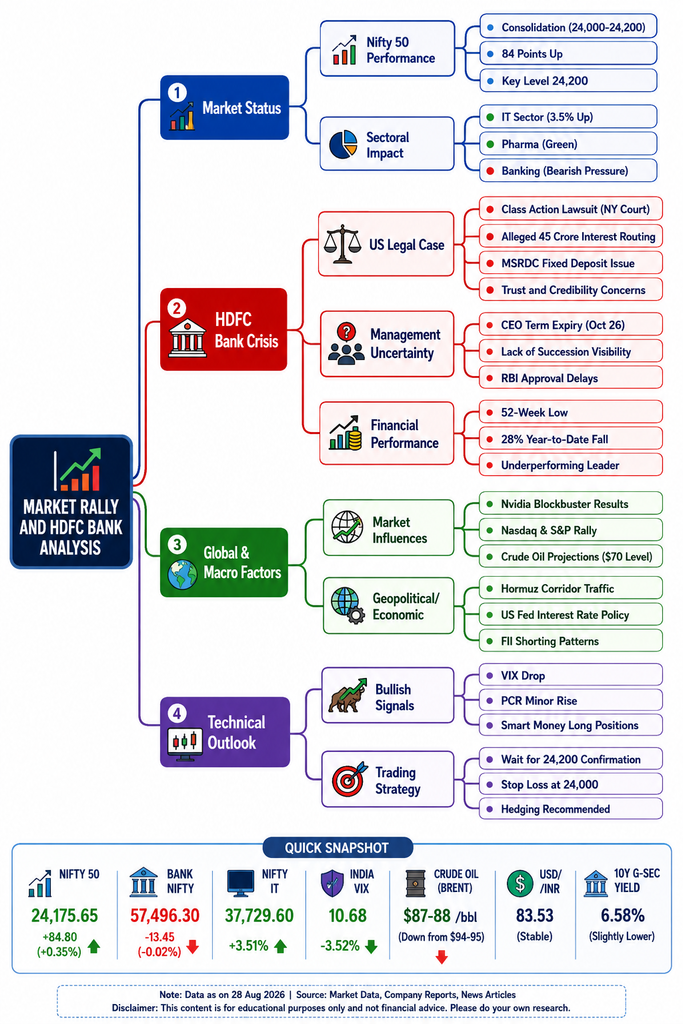
14. Five Hidden Truths Investors Should Remember
Truth #1 — The lawsuit is primarily a governance risk
The ₹45-crore allegation is not large enough by itself to threaten the bank’s balance sheet.
The bigger issue is trust.
Truth #2 — The CEO uncertainty has now become a transition
Jagdishan’s departure on October 26 is confirmed. The question is now about who replaces him and what changes under the new leadership.
Truth #3 — The bank is weak in the market, not necessarily broken financially
Q1 data showed 5% profit growth, 15.4% loan growth and a 1.17% gross NPA ratio.
Truth #4 — HDFC Bank weakness can distort the Nifty
With a double-digit index weight, a major move in HDFC Bank can materially influence the benchmark.
Truth #5 — Crude remains the wildcard
A sustained fall in crude could provide macro relief even while domestic banking sentiment remains under pressure.
Nifty 50 & HDFC Bank: The Data Dashboard
| Indicator | Current Signal | Market Interpretation |
|---|---|---|
| Nifty | ~24,176 | Consolidation |
| Major Support | 24,000–23,800 | Critical |
| Near Resistance | 24,300–24,350 | Breakout zone |
| India VIX | 10.68 | Low volatility |
| HDFC Bank YTD | ~-27% to -28% | Severe underperformance |
| HDFC Q1 Profit | +5% YoY | Operationally resilient |
| Loan Growth | +15.4% | Strong |
| Deposit Growth | +13.3% | Healthy but below loan growth |
| Gross NPA | 1.17% | Relatively contained |
| NIM | 3.26% | Key metric to monitor |
| CEO | Exit Oct. 26, 2026 | Succession risk |
Conclusion: Is HDFC Bank a “Dying Stock” or a Turnaround Opportunity?
Calling HDFC Bank a “dying stock” at this stage would be too aggressive.
The financial data does not support that conclusion.
The bank continues to generate substantial profits, grow loans, and maintain a relatively contained gross NPA ratio.
But the market is telling investors something else:
The premium trust once attached to HDFC Bank has been damaged.
The US class-action allegations have created a governance overhang.
The CEO’s confirmed October exit creates a major leadership transition.
The post-merger growth story has not yet produced the kind of shareholder returns many investors expected.
And the stock’s roughly 27–28% decline in 2026 shows how aggressively the market has repriced those concerns.
For Nifty, the equation is even simpler:
HDFC Bank stabilises + Bank Nifty strengthens → Nifty gets breathing room.
HDFC Bank continues falling + 24,000 breaks → broader downside risk increases.
The next few weeks therefore aren’t simply about whether HDFC Bank’s share price goes up or down.
They are about whether India’s largest private lender can restore confidence, governance credibility and leadership clarity.
The real trade isn’t HDFC Bank versus Nifty.
It is confidence versus uncertainty.
And right now, the market is demanding proof before it gives HDFC Bank its old premium valuation back.
Disclaimer
This article is for educational and informational purposes only and is not investment advice. The legal proceedings and allegations discussed above remain subject to due process and should not be interpreted as established wrongdoing. Stock prices, derivatives data, crude oil prices, and technical levels can change rapidly. Investors should conduct independent research and consult a SEBI-registered investment professional before making investment decisions.
Top 10 SEO Titles
- Nifty Volatility Explained: 5 Hidden Truths Behind HDFC Bank’s Legal Storm
- HDFC Bank Crisis: 5 Hidden Risks Every Nifty Investor Must Watch
- Nifty 24,200 at Risk? HDFC Bank, FII Shorts and 5 Market Warning Signs
- HDFC Bank Legal Case Explained: What It Means for Nifty and Bank Stocks
- Nifty Market Outlook: HDFC Bank Crisis, FII Selling and Global Oil Relief
- HDFC Bank Under Pressure: Leadership Uncertainty, Legal Risks and Nifty Volatility
- Why Nifty Is Struggling: HDFC Bank, Smart Money and 5 Hidden Market Risks
- HDFC Bank Stock in Trouble? 5 Reasons Behind the Recent Nifty Volatility
- Nifty 24,200 Breakout or Breakdown? HDFC Bank and FII Positioning Explained
- Indian Stock Market Warning: HDFC Bank Crisis, FII Shorts and the Road Ahead for Nifty