
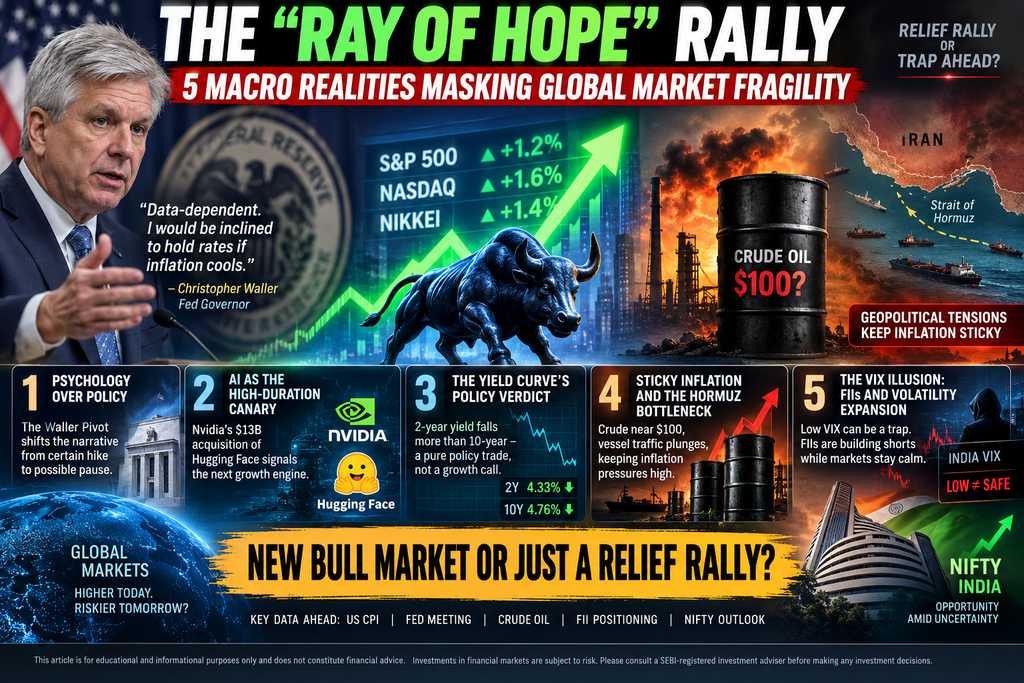
Global markets have staged a powerful rebound, with technology stocks leading the recovery as investors reassessed the Federal Reserve’s September policy outlook.
The immediate catalyst was Federal Reserve Governor Christopher Waller, whose latest comments opened the door to a potential pause in September if inflation continues to cool. His remarks triggered a sharp repricing across equities, bonds, currencies and precious metals.
But there is an important distinction between a policy relief rally and a genuine new bull market.
The latest US employment data has already complicated the picture. August nonfarm payrolls increased by 162,000, while unemployment remained at 4.1%. Following the report, markets increased the probability of a September Fed hike to around 59%.
That means the market is once again caught between two competing forces:
Cooling inflation = Fed pause
versus
Resilient employment + sticky inflation + expensive energy = Fed hike risk
Here are five macro realities investors should watch closely.
1. The Waller Pivot: Hope, Not Yet a Policy Victory
The biggest catalyst behind the latest rally was Waller’s change in tone.
Waller said that if incoming August inflation data confirms continued progress toward the Fed’s 2% inflation target, he would be inclined to support keeping interest rates at their current level.
However, he also made the opposite scenario clear: if inflation unexpectedly accelerates, he would consider another rate increase at the September 15–16 FOMC meeting.
This distinction is critical.
The market did not receive a promise of lower rates. It received something much more subtle:
The possibility that another rate hike may not be necessary.
That was enough to trigger a significant risk-on move.
Before Waller’s comments, markets had been pricing a relatively high probability of a September hike. His remarks pushed expectations closer to a 50-50 debate, temporarily reducing pressure on growth stocks and bonds.
Why this matters
The Fed is still data-dependent.
The next major test is the August CPI report due September 11, just days before the September FOMC meeting.
Therefore, investors should not interpret the Waller comments as the beginning of a new easing cycle.
It is better described as a conditional policy pause.
2. Strong Payrolls Have Changed the Equation Again
The latest employment report has made the Fed’s decision more complicated.
US August nonfarm payrolls increased by approximately 162,000, while unemployment remained at 4.1%. Previous months were also revised higher.
This is important because Waller himself indicated that employment data would matter less to his decision than inflation.
The market, however, cannot completely ignore a resilient labour market.
A strong employment backdrop gives the Fed more flexibility to maintain restrictive policy if inflation remains elevated.
The key macro equation
Strong jobs + sticky inflation = higher-for-longer
Weak jobs + cooling inflation = Fed pause
Weak jobs + falling inflation + rising unemployment = potential future easing.
That is why the September CPI report may now be even more important than the payroll headline itself.
3. AI Is Still the High-Duration Canary
The technology sector has once again demonstrated how sensitive high-growth assets are to changes in interest-rate expectations.
When Treasury yields fall, the present value of distant future earnings increases. This makes technology and AI stocks particularly sensitive to changes in the discount rate.
The latest Nvidia-Hugging Face transaction adds another layer to the AI story.
Nvidia agreed to acquire Hugging Face for approximately $12.93 billion, including around $11.9 billion for shareholders and up to $1 billion in employee retention incentives. The transaction is expected to close in the first half of 2027, subject to regulatory approvals.
Hugging Face has more than 18 million developers, researchers,s and creators, over 3 million models, approximately 500,000 datasets, and more than 200,000 companies using its platform, according to Nvidia.
This is strategically significant because Nvidia is attempting to expand beyond chips into the broader AI software and developer ecosystem.
But investors should also recognize the risk.
When valuations become heavily dependent on future AI growth, they become extremely sensitive to:
- Treasury yields
- Fed policy
- earnings expectations
- capital expenditure
- AI monetisation
- liquidity conditions
Therefore, the AI rally can be viewed as a barometer of financial conditions.
If yields fall, AI can explode higher.
If yields rise sharply, the same high-duration stocks can reverse very quickly.
4. Oil and the Middle East Remain the Inflation Wild Card
The biggest threat to the Fed-pause narrative may not come from Wall Street.
It may come from energy markets.
Crude oil has remained elevated amid continuing Middle East tensions. Recent trading has seen crude in the low-$90s, rather than a sustained move above $100, but the $100 level remains an important psychological threshold for markets.
The reason oil matters so much is simple:
Oil → transportation → logistics → input costs → consumer prices → inflation → Fed policy
A sustained oil shock could therefore undermine the entire Waller-pause narrative.
The $100 crude scenario
If crude moves decisively above $100 and stays there, the market could begin pricing:
Higher inflation → fewer Fed cuts/greater hike risk → higher Treasury yields → pressure on technology stocks → stronger dollar → emerging-market stress
That chain reaction would be particularly important for India because India remains highly sensitive to imported energy costs.
Therefore, $100 crude should be treated as a macro warning zone rather than an automatic sell signal.
5. The VIX Illusion and the FII Positioning Question
Low volatility can create a dangerous sense of security.
When implied volatility falls, options become relatively cheaper, er and investors often become more comfortable taking directional positions.
But low VIX does not necessarily mean low risk.
It can sometimes mean that the market has become too comfortable.
The Indian market provides an interesting example.
On September 3, FIIs sold approximately ₹2,345 crore in Indian equities, while DIIs bought around ₹4,977 crore.
This creates an important divergence:
Domestic liquidity is supporting the market while foreign investors remain cautious.
That does not automatically mean a crash is coming.
But it does mean the market’s apparent strength should be examined beneath the surface.
If FIIs continue reducing cash exposure while maintaining bearish derivatives positioning, a sudden volatility expansion could produce an outsized move.
For traders, this is why price + FII positioning + VIX + crude + USD/INR should be monitored together rather than independently.
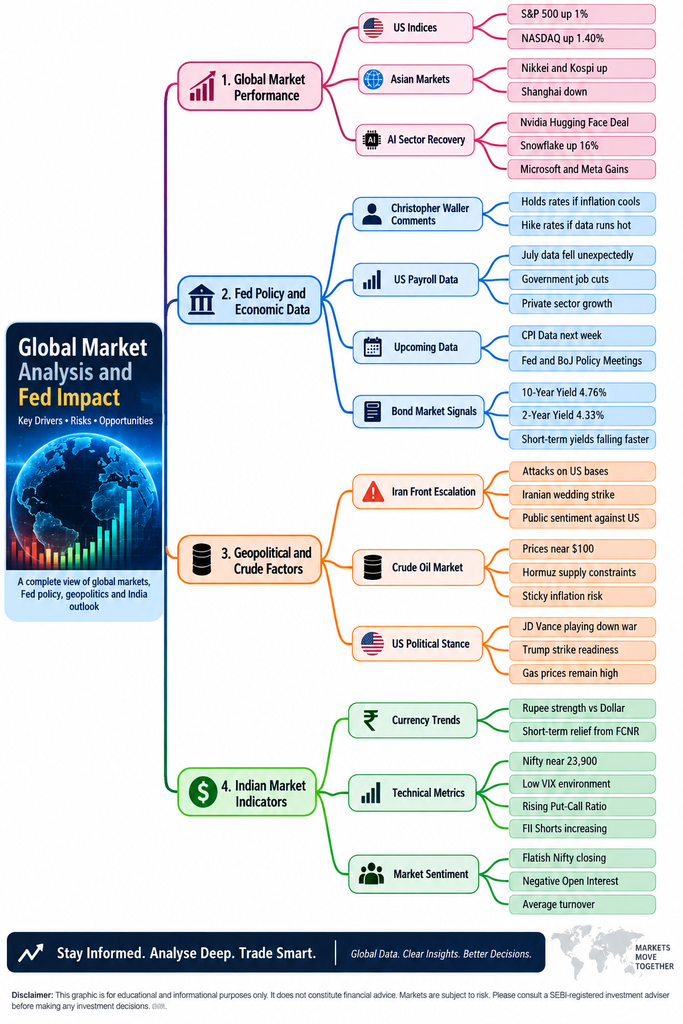
The Yield Curve Is Sending a Mixed Message
The bond market initially reacted positively to Waller’s comments.
The 2-year Treasury yield, which is particularly sensitive to Fed expectations, moved lower as traders priced out some immediate rate-hike risk.
However, after the stronger August jobs report, the 2-year yield moved back toward 4.38%, while the 10-year yield remained around 4.76%.
This is an important reminder:
The bond market is not making a simple “Fed is done” call.
Instead, it is constantly recalculating the probability of:
Inflation vs employment vs energy shock vs fiscal pressure.
Waller has also warned that structural factors, including large US fiscal deficits and changes in the Treasury market’s traditional safety premium, could keep the longer-run neutral rate higher.
That means even if the Fed pauses, investors should not automatically assume that long-term yields will collapse.
What Happens Next? The September Macro Timeline
The next two weeks could be among the most important periods for global markets.
September 11 — US CPI
This is arguably the most important immediate data point.
September 15–16 — Federal Reserve Meeting
The Fed will decide whether to hold or raise rates.
Oil — Continuous Risk Variable
Any sustained move toward or above $100 could change the inflation narrative rapidly.
Treasury Yields — Market Confirmation
A falling 2-year yield would support the Fed-pause thesis.
A sharp reversal higher would indicate renewed rate-hike pressure.
FII Positioning — India Risk Indicator
If FIIs continue selling cash equities and maintaining defensive derivatives positioning, India’s relief rally could remain vulnerable.
Three Scenarios Investors Should Watch
Scenario 1: Bullish Relief Rally
CPI cools + oil stays below $100 + Fed holds
This would strengthen the soft-landing narrative.
Potential consequences:
- Treasury yields decline
- Nasdaq remains strong
- AI stocks outperform
- Dollar weakens
- Emerging markets receive inflows
- Nifty gets another relief rally
This would be the strongest setup for a continuation of the current risk-on move.
Scenario 2: Inflation Shock
CPI comes in hot + crude moves toward $100+
This is the most dangerous scenario for the current rally.
Potential chain reaction:
Higher CPI → Fed hike probability rises → 2Y yield rises → Nasdaq sells off → Dollar strengthens → EM currencies weaken → FII selling increases
In this environment, the current rally could prove to be nothing more than a temporary policy-driven bounce.
Scenario 3: Stagflation Risk
This is the most complicated scenario.
Employment weakens + oil remains elevated + inflation stays sticky.
The Fed would face a difficult choice.
Cutting rates could reignite inflation.
Keeping rates high could weaken economic activity further.
This is the scenario where traditional equity-market relationships can break down.
India: Why Nifty Traders Should Care
For Indian investors, the global macro picture can be reduced to five variables:
1. US 2-Year Yield
Rising yields = negative for high-beta/risk assets.
2. Crude Oil
Above $100 for a sustained period = major inflation risk for India.
3. USD/INR
A stronger dollar can increase imported inflation and pressure foreign flows.
4. FII Futures Positioning
Heavy short positioning can amplify downside when volatility expands.
5. India VIX
Low VIX does not guarantee safety. A sudden volatility expansion can accelerate both directions.
The important point is that Nifty does not trade in isolation.
A global risk-off move caused by US yields or crude can overwhelm domestic bullish signals surprisingly quickly.
Final Verdict: Bull Market or Relief Rally?
The evidence currently points toward a policy-relief rally rather than a confirmed new bull leg.
That does not mean the market must fall.
It means the rally still needs confirmation.
The strongest confirmation would be:
Cooling CPI + stable oil + falling 2Y yields + Fed hold + improving FII flows.
The warning combination would be:
Hot CPI + $100+ crude + rising 2Y yield + stronger dollar + continued FII selling.
That combination could transform today’s optimism into another global risk-off episode.
The most important lesson for investors is therefore simple:
Do not trade the headline. Trade the reaction of yields, oil, the dollar and institutional positioning to the headline.
The “ray of hope” is real—but it is still conditional.
Until inflation confirms Waller’s thesis, the September Fed meeting remains a major volatility catalyst.
And for the next few weeks, crude oil, the US 2-year yield, and the September CPI report may matter more than the green screen on Wall Street.
Disclaimer
Disclaimer: This article is for educational and informational purposes only and should not be considered financial, investment, trading, legal, or tax advice. The information, market data, opinions, scenarios, and analysis presented here are based on publicly available information and are subject to change without notice.
Financial markets, including stocks, futures, options, commodities, currencies, and cryptocurrencies, involve substantial risk. Past performance does not guarantee future results. Any market levels, scenarios, probabilities, targets, or expectations mentioned in this article are illustrative and should not be interpreted as guaranteed outcomes.
Investors and traders should conduct their own research and consider their risk tolerance, investment objectives, and financial situation before making any investment or trading decision. Options and leveraged products can result in rapid and substantial losses, including loss of the entire invested capital.
The author/publisher does not guarantee the accuracy, completeness, or timeliness of the information provided and shall not be responsible for any financial loss arising from reliance on this content.
Always consult a SEBI-registered investment adviser or qualified financial professional before making investment decisions.
10 SEO-friendly titles:
- Global Markets Rally: 5 Hidden Risks Behind the Fed-Waller Relief Rally
- Fed Waller Pivot: Is This a New Bull Market or Just a Relief Rally?
- Stock Market Rally 2026: 5 Macro Risks Investors Cannot Ignore
- Fed Rate Hike vs Market Rally: The 5 Risks Hiding Behind Global Gains
- Global Stock Market Rally: Why Crude Oil, CPI and Fed Policy Matter Now
- Nifty & Global Markets Outlook: 5 Warning Signals Behind the Latest Rally
- Fed September Rate Decision: Why This Market Rally Could Be Fragile
- Crude Oil at $100: The Biggest Threat to the Global Market Rally?
- US CPI, Fed Waller & FII Positioning: What Could Trigger the Next Market Move?
- The “Ray of Hope” Rally: 5 Macro Signals That Could Change Everything